


On 8 June 2026, City AM’s Simon Hunt and Felix Armstrong reported that Squarepoint’s London profit had soared.
The 38% they quoted belongs to Squarepoint UK Holdco 2 Ltd (Holdco 2), a holding company with no staff that books its subsidiaries’ dividends. About half the rise is the London staff company paying up earlier profits, while the regulated partnership that manages money in London earned its least in eleven years.
Squarepoint’s London profit didn’t soar in 2025; its holding company booked the dividends. A model of London built on that profit starts in the wrong place, because the year’s result is made in the companies underneath.
The paid half settles whether London made more money in 2025. It names what London’s two operating companies earned and which of them carried the year, and gives our odds, as a number, that the two are at or above zero in 2026. The deciding number is their combined result, the partnership’s profit plus the staff company’s profit before tax.
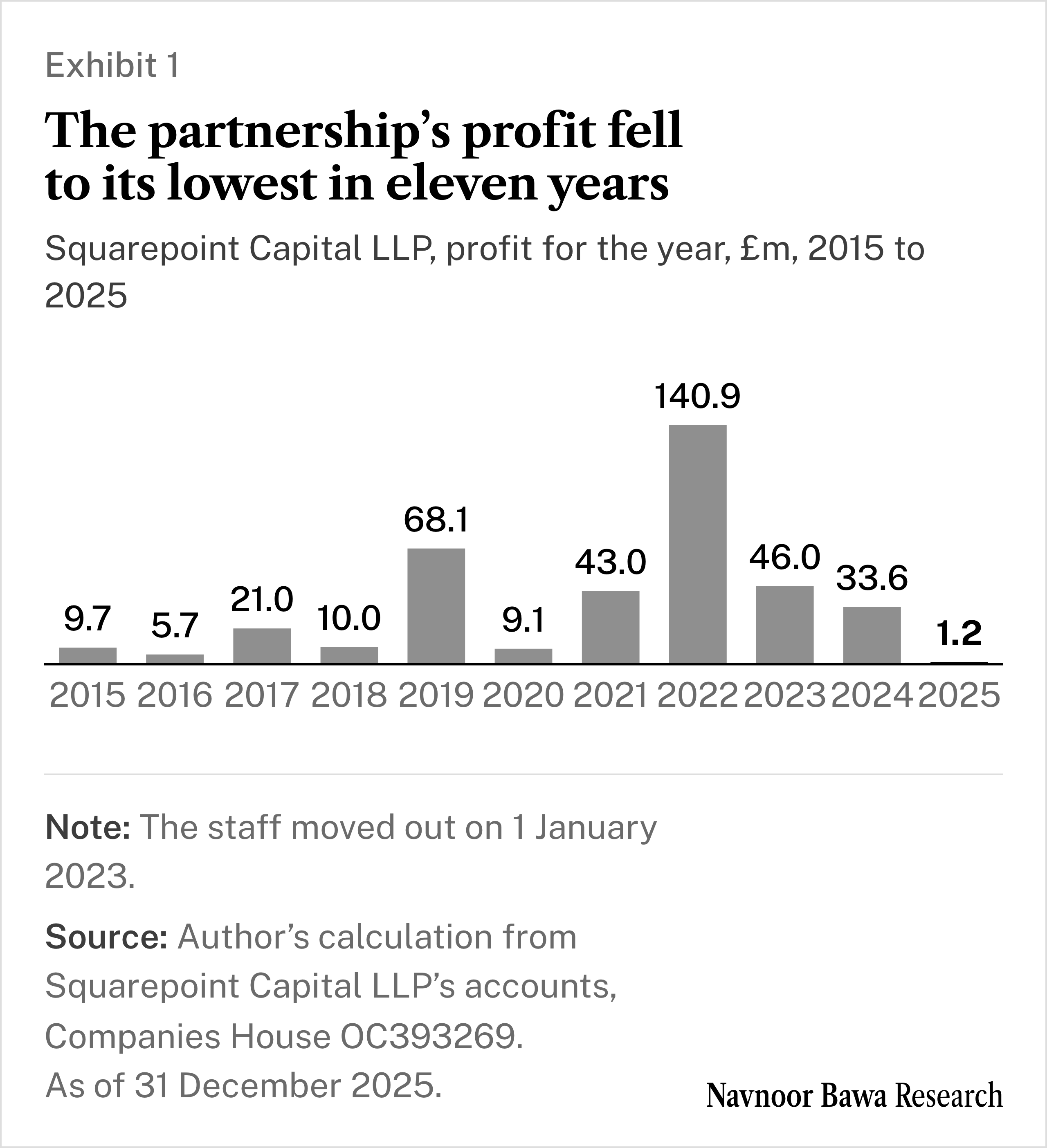
The partnership moved its staff to another company in 2023; 2025 is still its lowest year.
Holdco 2 books its subsidiaries’ dividends
I read the 2025 accounts of all six of Squarepoint’s UK companies, not only the holding company City AM quoted, and added up the two that do the work. The first check matches the press: Holdco 2 made £120.7m before tax, 37.8% more than the year before.
Holdco 2 filed its accounts the day before the story. Its revenue was £120.8m. Of that, £108.1m, 89.5%, was dividends from its subsidiaries. The rest is a profit sharing fee of £12.6m, paid under a revenue sharing arrangement by what the accounts call “a third party”, and a small service fee. Costs are close to nil, so revenue and profit are nearly the same number. This is the dividend chain: profit earned in the companies below, counted again as revenue by the one above.
Revenue rose by £33.1m from £87.7m, in three parts. The biggest, £17.0m, came from the staff company, Squarepoint Services UK Ltd, which employs the London staff and whose sole investor is Holdco 2, and its dividend went from £33.0m to £50.0m. Another £7.4m is a bigger profit sharing fee, up from £5.2m, and £8.7m is more dividends from other subsidiaries, most of them outside the UK. So about half the jump is one London company paying up more, after a 2024 in which it made £68.1m before tax.
Holdco 2 made £123.6m in 2023, then £87.6m a year later. The 2025 rise reverses that dip and still leaves profit below 2023’s.
Of the £108.1m, £58.1m came from subsidiaries other than the staff company; Holdco 2’s other holdings include research companies in Spain, France and Switzerland. The partnership, Squarepoint Capital LLP, is not among them; a sister holding company, Squarepoint UK Holdco 1 Ltd (Holdco 1), owns nearly all of it.
None of the 2025 dividends moved cash. Note 7 reads: “All related party dividends and distributions were non-cash transactions.” They were settled by entries between the companies’ books, not payments. City AM’s body calls the company “The UK holding entity for the firm”, and its figures match. What the accounts do not support is “profit soars” beside an office move, with “whipsawing markets” as the cause, because Holdco 2 “has no employees or customers”.
The London group of Qube Research & Technologies (QRT), another quant manager, shows the difference: it made £1,052.1m before tax, up 15.1%, a profit earned by its 1,336 group staff. Holdco 2’s profit was earned by companies beneath it, and the fees start with Squarepoint Ops, the US adviser that runs most of the funds and itself sits under Holdco 2.
The fees stop at Squarepoint Ops
Squarepoint Ops “is the Alternative Investment Fund Manager (AIFM) for the majority of the Squarepoint funds”, says the partnership’s capital disclosure. An AIFM is the manager legally answerable for a fund.
The partnership’s own accounts say it provides “sub-investment management services to the Squarepoint Funds as delegated by Squarepoint Ops LLC”. Squarepoint Ops hands it part of the investment work and pays it a sub manager fee, its main income. That fee fell to £25.4m in 2025, from £72.4m the year before. Its total revenue fell from £106.8m to £50.6m. London is paid for a service, and most fund fees stay with the adviser.
Russell Morgan, named in the capital disclosure as the partnership’s chief operating officer, spans the London companies: he signs the partnership’s accounts as a director of Holdco 1 and sits on the staff company’s board.
The money comes back through ownership. Holdco 2 owns almost all of Squarepoint Group Intermediate LP, a holding partnership whose indirect subsidiaries include Squarepoint Ops. That gives profit made under the US adviser a route up the dividend chain to the UK. The £58.1m from Holdco 2’s other subsidiaries fits that route, though the accounts do not name each payer.
QRT, whose London accounts we read as a money engine, built it the other way: its London group books £1,443.5m of performance fees at home, more than its whole profit even after what it passes on to affiliates. Squarepoint’s London companies earn fees for services instead, and the profit that reaches the press is ownership income coming back. A UK holding company’s profit is what its subsidiaries paid up; add the operating companies before reading it.
The partnership’s fall began when it gave up its people. Its 2023 accounts say: “The Partnership transferred all employees to an affiliated entity on January 1, 2023”. It also booked a revenue share expense of £112.7m “as part of a revenue share agreement with an affiliated party”, paying away much of what its fund mandate earned.
In 2024 the arrangement moved again. The 2024 accounts say: “The arrangement was amended from 30 September 2024 and the revenue share fees are now being received by a UK group affiliate of the Partnership.” The charge was £14.9m for nine months, about £5.0m a quarter. Net of £2.4m of income, it cost the partnership about £12.4m.
So from October 2024 the partnership stopped paying the share away, and a UK affiliate started receiving it. Holdco 2 “entered into a revenue sharing arrangement from 1 October 2024“, the next day; whether its third party pays the same share, the accounts do not say.
In 2025 the partnership “earned no manager income” and “incurred no expenses” from the revenue share. If the share moving out had taken 2025’s profit, the accounts would show a charge; they show none, though a lower sub manager fee would move income without one. Dropping a £12.4m net cost should have lifted the year, yet profit fell from £33.6m to £1.2m. The revenue share explains the earlier steps and leaves this one unexplained.
The members, the partnership’s owners, give a reason in the accounts Morgan signs. “The decrease in revenues is due to the decrease in operating expenses as well as the decrease of the overall Group’s income.” The filing bears out the first half; Squarepoint Ops’ smaller fee fits the second. Revenue falling with its own costs reads as a fee set partly on those costs, and the part tied to the funds, the sub manager fee, collapsed.
What surprised me was that its holding company booked £46.0m from the partnership in a year the partnership earned £1.2m. Holdco 1 booked it as a distribution without cash and made £45.9m before tax, against £43.9m in 2024. It’s earlier years’ profit, already allocated to the members for tax, moving up the chain; the partnership paid out more than it earned in 2024 too.
The partnership’s job is changing too. It gained AIFM authorisation from the FCA in the third quarter of 2025, and from 1 April 2026 it replaces Squarepoint Ops as investment manager of one affiliated entity. London’s people and their costs, though, sit in the staff company.
A bigger London, and “or losses”
The staff company’s latest accounts put average headcount up 31%, from 479 to 629. Staff costs rose 21%, from £185.6m to £225.1m. London hired hard in the year the partnership’s profit fell.
Holdco 2 also guaranteed, jointly with an affiliate, a group company’s 20 year office lease, with about £430m of rent over the 15 years it can’t be cancelled. The accounts don’t say where; City AM places it on Gresham Street, with JP Morgan Asset Management as landlord. That’s a bet against a shrinking London, guaranteed by Holdco 2.
Rising costs are one reading of the group’s weaker year, and they’re real, but the staff part is more people, not higher pay, because staff cost per head fell from about £387,000 to about £358,000. A bad year for the funds is the other reading, and it fits the members’ words. These accounts print no fund return, so what can be read is where a bad group year lands.
The staff company is paid under cost plus service agreements: its costs back plus a margin, and a share of the residual, what the group has left after those fees. The UK tax authority’s transfer pricing manual describes the same two layers, a basic return and then a split of “any profit (or loss) left after the allocation of basic returns“.
A sister company shows what a profits only share does. Squarepoint Services International Ltd, the technology company, earns its costs plus a mark up and a share of residual profits, with no mention of losses in either year. Its profit before tax rose to £9.2m in 2025, from £6.2m. As a share of its costs, that is 10.5% and then 10.3%.
The wording of the staff company’s own clause changed between the two years. The 2024 accounts gave it “a share of residual profits”. In 2025 its directors, Gregoire Schneider, Russell Morgan, Olivier Durantel and Nicolas Dreyfuss, report “a share of residual profits or losses”. On that wording, a bad group year can now land on the staff company. Which way the two companies’ year went decides whether Holdco 2’s profit says anything about London.
What did the two companies that run London earn in 2025?
Below the paid line:
The staff company’s latest result under the wording that names losses, and the two companies’ combined result.
One reconciled table of all six UK companies over three years, with QRT beside them.
Our odds for next year, a two outcome model with its sensitivities, and four dated checks.