


On 23 April 2026, the board of Arini Capital Management Limited approved accounts carrying its first dividend, $25.0m. It is the London company that advises Arini’s flagship fund, and by 7 November, as Hedgeweek reported, founder Hamza Lemssouguer’s flagship was down 32% this year.
The owner was paid before the loss. Without performance fees, the share of gains paid only when a fund makes money, the London company’s other fees do not cover even its pay bill. So the fund’s loss lands on the pay of its staff, or on the owner. To avoid a first operating loss, 2026 needs a deep pay cut or money from its group, and the 2026 accounts will show which.
The press reads the year as a manager under pressure. Hedgeweek’s 4 November report, relaying the Financial Times, said the flagship had faced margin calls from the banks that lend to it.
The owner was paid first
Hedgeweek’s two reports, of 4 and 7 November, also carried the mirror, new money still arriving. The fund’s letter, as Hedgeweek relayed it, held its line: “As for our core positions, let us be clear: Our conviction remains firm.” Both readings are right about the fund. Neither says who inside the firm pays for the lost fees, and the London company’s own accounts can.
I did not expect a first dividend to exceed the year’s profit, yet the London company paid that $25.0m to its parent in 2025, more than its $21.5m profit after tax. I read its four sets of audited accounts, a 2022 opening period and three full years, with its UBS security deed and its SEC filings. My estimate of the fees that did not depend on performance, checked against 2024, the one year the accounts split fees fund by fund, came within 2.2% of the itemised figure.
The board gave one sentence of reasoning for the dividend: it “was taken following engagement with various stakeholders and considering the future growth of the Company”. The 2024 accounts used the same words for the opposite decision: “During the year the Board decided that no dividend would be declared.” The sentence names a process and no figure.
The parent now owes the London company $31.4m, with no interest or terms stated, against $1.4m a year earlier, when a different Jersey company was its parent. It is an asset, a claim the London company holds, and the accounts do not say how it arose. Other group companies’ debts to it rose by almost as much, while the funds’ receivable fell.
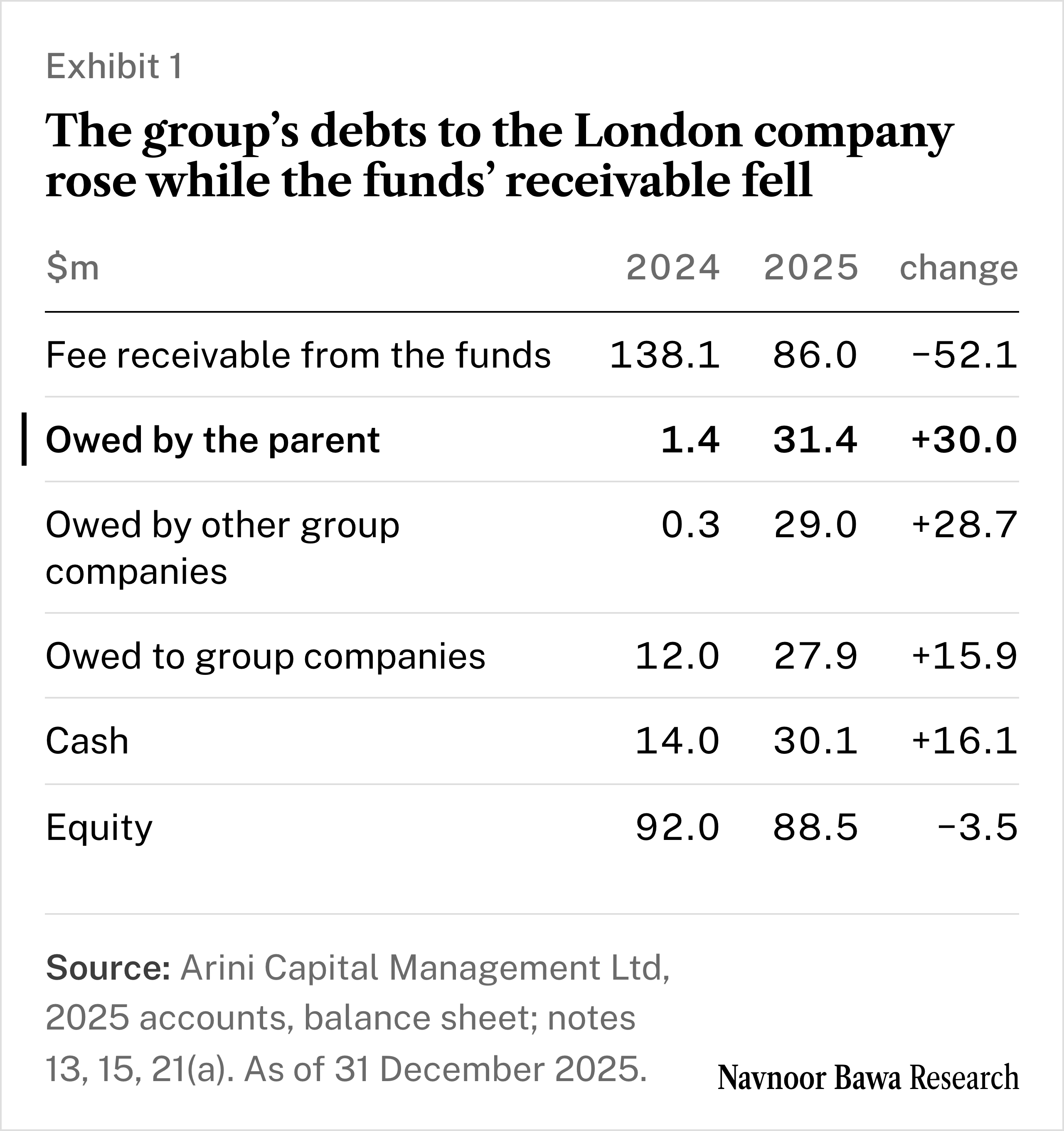
Source: Arini Capital Management Ltd’s 2025 accounts (balance sheet; notes 13, 15 and 21(a)), with the 2024 comparatives printed there; the 2024 accounts put the 2024 parent balance at $1.7m, owed by the previous parent before the shares moved to Arini Capital Management Asset Holdco (Jersey) Limited on 3 November 2025, per the confirmation statement · as of 31 December 2025.
Lemssouguer controls the London company through Jersey holding companies, per note 22 of the 2025 accounts, and stepped down as its director on 28 February 2023, per the officers list. Arini’s brochure, Part 2A of its Form ADV, the SEC registration form, says: “Arini is principally owned by Hamza Lemssouguer.” The dividend is gone for good; the parent’s and the group’s balances come back as cash only when they are paid.
The balance sheet rests on claims
None of this drained the balance sheet. Equity fell only $3.5m, because the year’s profit nearly covered the dividend. The cash came from that profit and from a $59.3m rise in creditors in the cash flow note; debtors absorbed $8.9m.
That leaves the balance sheet resting on what others owe. Note 21(a) puts what related parties owe at $148.7m, and the funds’ $86.0m alone equals 97% of equity. The funds’ $86.0m is fees already earned, which the brochure says fund administrators generally deduct from the funds’ accounts.
The $60.4m the parent and other group companies owe carries no stated terms. A separate loan to ACM Investment I Ltd, a group company, does: 6% interest, repaid five years from its first drawing, with $2.2m owed including interest. Add that loan, take off the $27.9m the London company owes group companies, and its net claim on the group is $34.7m.
On 13 February 2026 the London company charged two of its Barclays bank accounts to UBS Switzerland AG, as security trustee, holding it for the lenders, under a security deed “relating to Project Amazon”, for a revolving facility. Neither the deed nor the charge register gives its size or its borrower. Nothing in it points to distress, and note 20 of the accounts says of events after the year end that “no material events were noted”.
The directors wrote in April: “Supported by revenue, profit and other business forecasts, which are subject to stress testing, the directors have a reasonable expectation that the Company has adequate financial resources to continue in operational existence” for the 12 months after the accounts were approved.
EY, signing on 24 April 2026, wrote that “we have not identified any material uncertainties relating to events or conditions that … may cast significant doubt on the Company’s ability to continue as a going concern”.
Operating cash inflow was $53.7m, and cash more than doubled. The strategic report adds that “the majority of the Company’s liabilities are variable compensation accruals linked to performance as well as deferrals relating to investments held by the Company”: most of what it owes is pay that moves with performance. That is the strongest case against a 2026 loss, and it is right about the design.
Not all of the pay falls at once. The 2024 accounts’ tax note names deferred remuneration, pay awarded in one year and paid in a later one, so some of 2026’s bill may already be set; the accounts do not say how much. Nothing in these documents doubts the London company’s solvency. What they leave open is how far pay must fall.
The receivable also shows how much of the year depended on performance. Its accounts state: “Performance fees are recognised when crystallised”, that is, fixed and owed. A fee that crystallises at the year end sits in the receivable until the fund pays it, and 2024 confirms the reading: the receivable of $138.1m sat within $1.2m of the year’s itemised performance fees.
So turnover less the receivable estimates the fee floor, the fees that did not depend on performance, even for 2025, whose accounts no longer split fees by fund.
Two funds paid most 2024 performance fees
Performance fees were most of 2024’s income. Note 19 of the 2024 accounts split them fund by fund: $136.9m, or 72.1% of turnover, against nil in 2023, when the company was paid under a contract with a global asset manager. The flagship, Arini Credit Master Fund Limited, the master fund through which its feeder funds invest, paid $68.2m of them, 8.4 times its management fee.
Arini Blue Peak Fund LP, Blue Peak, paid $55.6m, so the two funds together paid 90.4% of the year’s itemised performance fees. Part of Blue Peak’s fees, and a small part of the flagship’s, came under a fee line that shares its label with an Arini feeder fund investing in the flagship and two other Arini master funds. That suggests, though no filing says so, that Blue Peak is tied to the same book; none of these documents gives its 2026 return.
That dependence runs higher than at a London peer. Sona Asset Management (UK) LLP, Sona, took 60.4% of its turnover from performance fees in the year to 31 March 2025, against the London company’s 72.1% in calendar 2024; the two periods sit three months apart.
Some of the group’s performance fees never reach the London company. Item 5 of the brochure reads: “With respect to certain Advisory Clients, the performance-based compensation is paid to Arini’s affiliate (instead of Arini)”. So every figure here is the London company’s, not Arini’s as a whole. It still advises the money. Its Form ADV reports $35.5bn of regulatory assets, the SEC’s gross measure of assets managed, against its $192.2m of 2025 turnover, so a squeeze on its pay is a squeeze on the team behind that money.
A hedge fund’s performance fee usually returns only when the fund regains its previous peak, its high-water mark. On 2 November I put 75% on the flagship still being below its value at the end of 2025 when 2027 closes. Down 32% this year, the flagship pays no performance fee for 2026, the premise from here.
The London company has never had a losing year in which to cut pay. Its one fall in the pay bill, London staff costs plus the service charges group companies bill it, was 8.9% in 2024, a gaining year, from a 2023 run under the outside contract. Wages fell 22% that year as average headcount nearly doubled, from 25 to 49 (2024 accounts, note 6). The charge from its US affiliate rose from $4.1m to $16.0m. In 2025 the pay bill rose 28%.
New money will not close the fee gap quickly. As Hedgeweek reported, the fund “reported $389m in inflows over the past week, forming part of a broader $1.5bn fundraising effort”. Arini Direct Lending Fund I, which the London company itself advises, shows gross assets of $1.24bn on its Form ADV, but with no fee rate in the brochure it cannot yet be sized in fees.
Two other readings would make 2026 routine. If pay flexes by formula, as the strategic report says most liabilities are built to, a modest fall in the bonus pool keeps the London company in profit. If the group decides where its fees land, turnover holds with no pay cut: all of 2025’s turnover was charged to related parties, and Item 5 shows the group already routes some performance pay to an affiliate.
That second route moves the cost to the owner without removing it. Only the 2026 accounts can separate the readings, because no full filed year was a losing one for the flagship. A deep cut would land on the team running a fund down 32%, in the year it is trying to win those losses back.
The 2025 dollars show the gap. Turnover was $192.2m. Take away the $86.0m the funds still owed at the year end, my estimate of the year’s performance fees, and what is left falls short of the $119.8m pay bill, before any other cost.
The first dated check comes this year: the flagship’s November return, by 15 December if reported. A further loss of 5% or more points to a smaller fee floor in 2026.
The paid half finds a first operating loss less likely than not, but only because it expects a pay cut deeper than any the company has made. The filings hold no odds; it builds them from fees, pay and the costs the accounts leave unexplained, across three routes: its own fees after a pay cut, more money from its group, or a loss. The deciding number is the share of 2025 net costs, administrative expenses less other operating income, that the fees outside performance covered.
→ The precedent for Arini’s year: Bear Stearns’ 2007 leveraged CDO funds, whose collapse reached the parent bank, rebuilt from SEC and Bear filings, a separate note on Patreon.
With no flagship performance fee in 2026, does the London company cover its costs from its own fees after a pay cut, from its group, or not at all?
Below the paid line:
What the fees cover alone: the fee floor against 2025 net costs, checked on 2024; the equity’s years of cover.
The 2026 bill, with odds: the pay bill’s record, the costs outside pay, three routes, one sensitivity table.
Where I would be wrong and by when; the test for any UK manager’s accounts; four dated checks.