


On 22 July 2026, Aston Martin announced new loans led by HPS, the BlackRock-owned private lender. “This new £550m debt financing,” said Doug Lafferty, its finance chief, “significantly strengthens our liquidity.” The loans effectively bypassed existing bondholders, including a creditor group led by Arini Capital Management, Bloomberg reported, and Arini’s flagship fund lost about 8% that month.
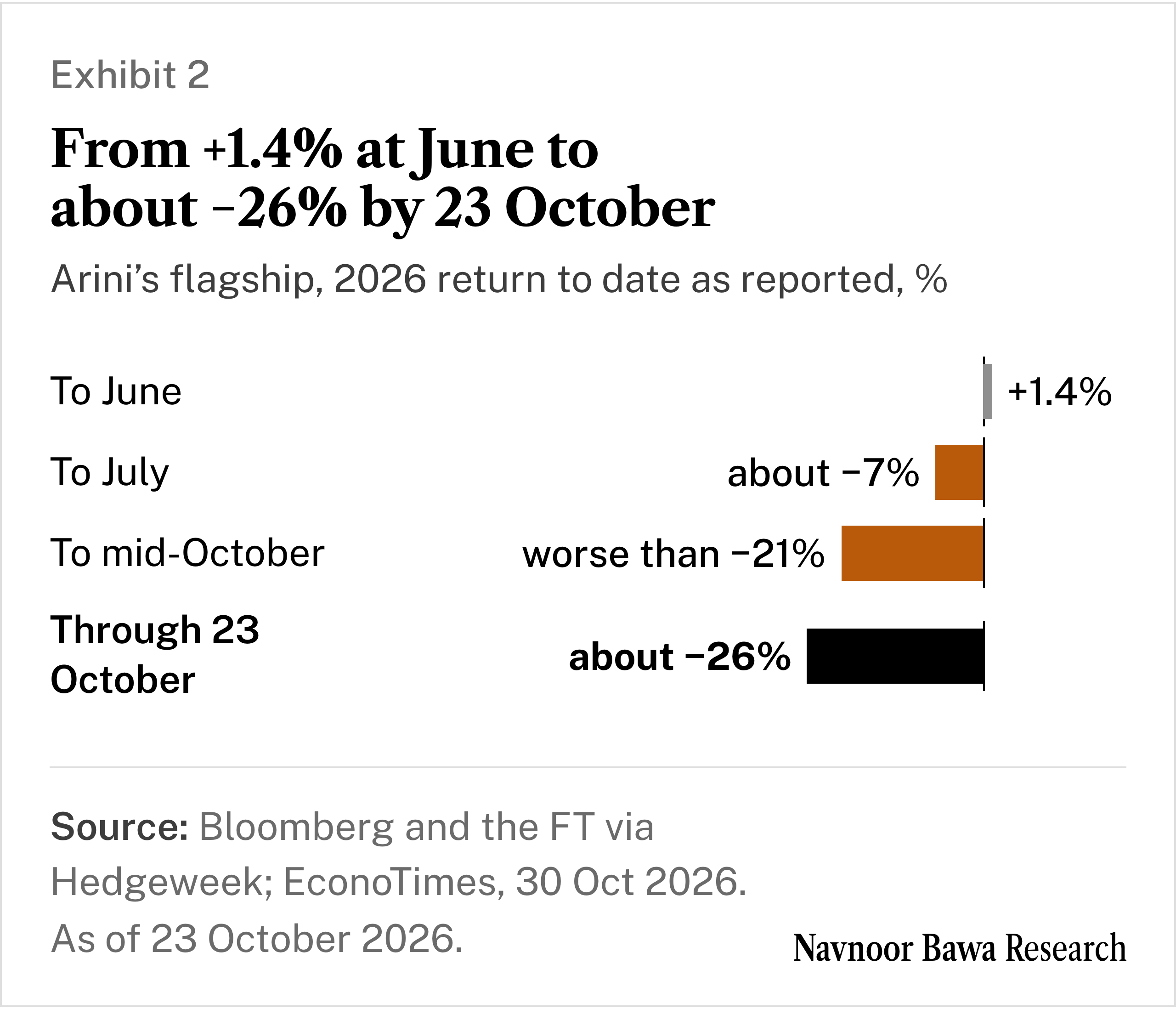
Through 23 October the flagship was down about 26% for the year, Bloomberg reported. Bloomberg and FT headlines framed a rout: a “Star Trader’s Woes,” a “bloodbath” for credit investors.
The next suspect is leverage. Yet Sona Asset Management, a credit peer with a larger flagship, shares four of Arini’s five prime brokers, the banks that finance its trades. Sona files about the same gross assets, everything held before debts, per dollar of reported capital, and it was about flat in mid-October. What separated the two sat under that ratio: in what each fund held, and, the evidence suggests, in derivatives the filing does not count. That matters to everyone who holds the same bonds.
Aston Martin’s July loans put new secured debt ahead of Arini’s bondholder group on some assets; Aston Martin’s notes kept falling, and Arini is preparing a claim.
Arini and Sona sat on the same lender committee at Altice International, the telecom group, and in the US junk index, Janus Henderson found, cable and telecom drove much of the selloff in CCC, junk’s lowest rating band.
Margin calls, banks’ demands for more collateral, made Arini sell its more liquid holdings, the WSJ reported, and some investors now hesitate to buy debt it holds in size, Bloomberg reported.
The firm is sturdier than its flagship: money in its CLOs, loan pools funded by bonds, stays for each deal’s life, and investors added to the flagship.
Below the paid line, both flagships’ filed ratios and a month by month split of the loss against the market.
Then a model of when the flagship’s investors are made whole, with my odds.
Aston Martin went around them
I set Arini’s flagship beside Sona’s on their SEC filings, read Arini’s three years of audited UK accounts and Aston Martin’s own bond announcements, and split the loss month by month against index data anyone can download.
A falling US junk market explains much of Arini’s loss at the ratio on file. The rest came in two quiet months that only its names explain, and Aston Martin is the name with the clearest paper trail.
On 13 July, DCM Insider reported that BlackRock, Sculptor and Arini had formed a creditor group holding more than half of the carmaker’s 2029 notes, to guard against a liability management exercise. The notes then traded near 70 cents on the dollar.
Such an exercise moves value away from existing creditors: new debt ranked ahead of them, or assets moved into a unit they cannot claim.
Aston Martin is one of several losing names: its 2029 notes come to about $1.8bn after two more placings in 2024, against a flagship of roughly $8bn in January. They date from 13 March 2024, when Aston Martin priced $960m at 10.000% and £400m at 10.375%, both senior secured, backed by pledged assets.
On 22 July it announced a £450m term loan, borrowed for a fixed term, and a second, £100m loan, both led by HPS. They are secured on “certain of the Group’s assets situated in a newly incorporated subsidiary, together with certain other assets.” Of the money, £190m repaid two existing loans that already ranked ahead of the notes.
In early August, creditors owed £1.3bn, the 2029 noteholders among them, threatened to unwind the HPS deal and block a sale of 50.1% of the non-automotive branding rights to Authentic Brands, the FT reported. Arini is gathering evidence in New York for a UK claim, Just Auto reported, and Aston Martin’s lawyers argue the deal is lawful.
Bloomberg put the notes at about 55 cents at the start of October and 47 cents on 28 October, the day Aston Martin reported a narrower third quarter loss. At 47, the dollar notes’ 10% coupon, their annual interest, alone yields about 21%: the price assumes heavy losses for holders who now stand behind HPS’s secured loan.
The seat Sona shared
Sona sat on the same Altice committee as Arini and was down about 0.5% for the year in mid-October; Arini was down more than 21%. Neither fund had ever had a losing calendar year, the FT and Bloomberg reported.
Altice International is Arini’s other large fight. The telecom group’s drop-down in late November 2025 moved assets away from its secured lenders, and in December 2025 Octus, a credit research firm, listed Arini and Sona among the eleven funds leading them. The FT reported that Altice was the flagship’s largest loss in July.
Sona’s October losses included Virgin Media O2 and new Paramount Skydance debt, the FT and Bloomberg reported. Arini lost in July on equity tranches of credit default swaps providing protection against losses on Virgin Media debt, Bloomberg reported. A credit default swap insures against a borrower’s default; an equity tranche of a pool of such swaps takes the pool’s first losses. The WSJ’s account of Arini’s losses named Brightspeed and Optimum, two US telecom and cable borrowers.
Distressed debt like this trades in or near CCC and below, and that band fell. The ICE BofA US CCC and lower index lost 6.9% in total return from 31 December to 23 October, almost all of it from September; the broad euro high yield index lost 1.6%. Bloomberg reported European CCC spreads, the extra yield those bonds pay, at their highest since March 2020.
Janus Henderson wrote on 15 October that, in the US high yield index’s CCC bucket, the cable and satellite sector “is dominated by CSC Holdings, a subsidiary of Optimum,” and the wirelines sector by Altice. The two sectors were “responsible for much of the spread widening within CCC,” it wrote.
Diameter, another credit hedge fund, also slipped into loss in October.
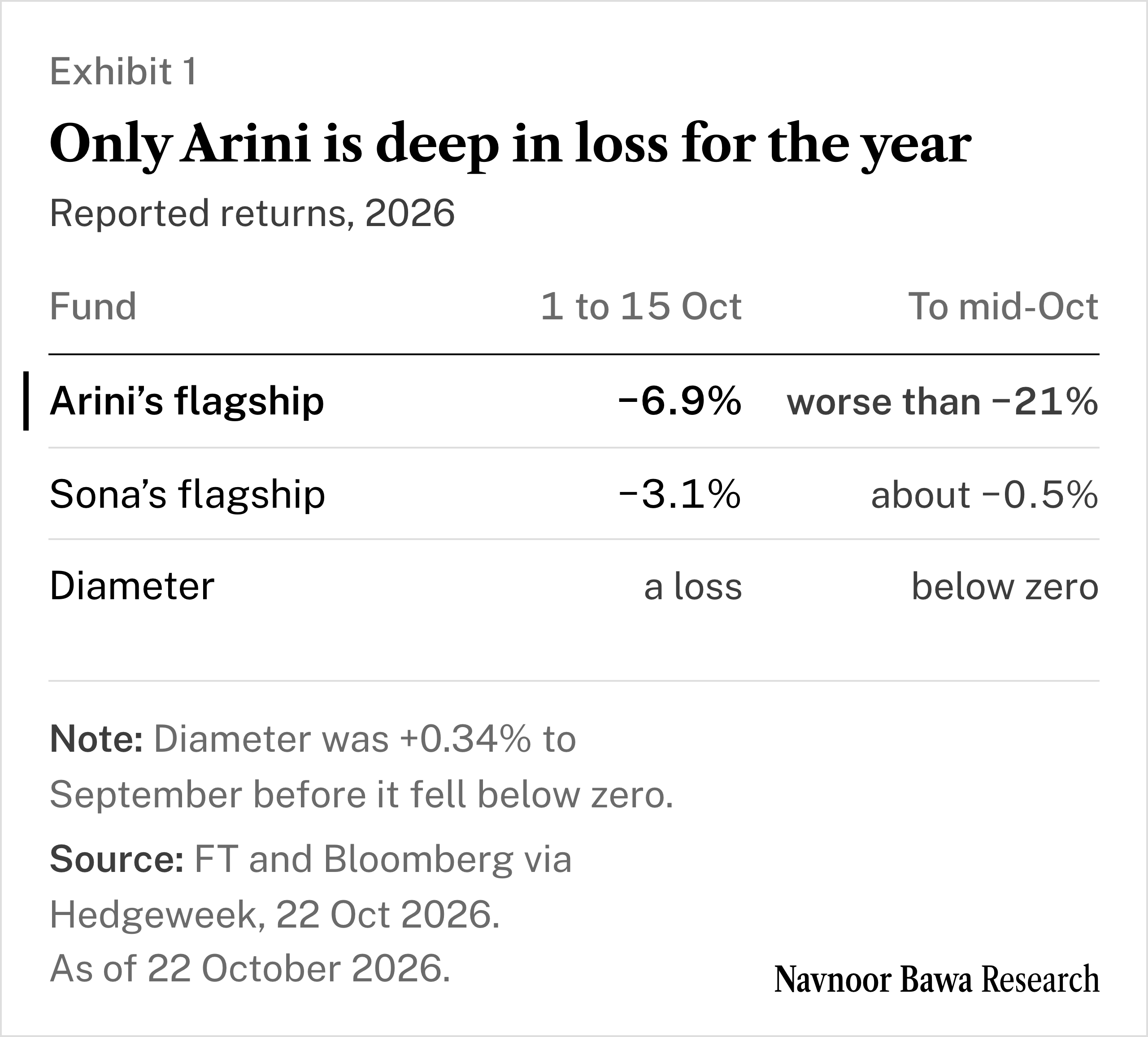
The selloff explains October’s timing, when all three lost. In the first half of October the US CCC index fell 1.84%: Sona lost about 1.7 times that, Arini about 3.8 times. What the selloff cannot explain is a twenty-point gap for the year between two funds on the same committee.
Too big to sell
Hamza Lemssouguer, a former Credit Suisse high yield trader, founded Arini in 2021 and is its chief investment officer. His method is the large stake and the lead seat. A Bloomberg headline of 10 September 2025 read “Ex-Credit Suisse Prodigy Is Dominating Europe’s Distressed Scene.” In one such fight, lending to keep a company alive at Kem One, Arini was a rescue lender.
A lead seat buys control of a restructuring, and its price is a large share of the debt, which a fund cannot sell in a hurry. Some investors have become reluctant to buy debt in which Arini holds large stakes, Bloomberg reported. A seller the whole market can see gets a lower bid, and that bid then sets the value of the rest of the position.
Concentration has cost the fund in calm markets before. In March 2024 it lost 6.6%, Bloomberg reported from its letter, which blamed “significant moves in three very large capital structures”; the US CCC index rose 1.3% that month. It also lost in each of the last four months of 2025, Bloomberg reported, while the index moved -0.1%.
Leverage turns the problem into cash. The WSJ reported on 30 October that Arini had sold about $800m of debt in recent weeks after margin calls from its banks. The calls were tied to credit default swap indexes, traded baskets of those swaps, and to other leveraged positions. Arini met them by selling its more liquid holdings.
The liquid bonds go first, so what stays is the paper buyers avoid, in the names that caused the loss. Arini had earlier sold its Intrum and Ritz-Carlton Yacht Collection investments and had recently left Pathway Vet Alliance, the WSJ reported. In late October Bloomberg put the yacht debt below 75 cents; it had been above 92 at the end of September. Lemssouguer has reportedly cut new purchases to manage the positions he has. A Bloomberg headline on 30 October said Pimco and Oaktree had bid for Arini’s junk debt.
Arini’s own account is that the losses are marks, not a broken thesis, and its investor letter, as the FT and Bloomberg reported it, says why. “We do not believe it is an indicator of soured investments, but rather part of the process – being contrarian is a necessary condition for this opportunity set.” That view does not change what the fund must do while its banks want collateral.
Each forced sale sets a price for everyone else in those seats, from BlackRock and Sculptor in Aston Martin’s group to PGIM, Invesco, King Street, BlueBay and Fidelity on Altice’s committee.
The firm outlives the fund
From June on, each report found the flagship deeper in loss:
The firm is sturdier than that table. Arini managed $22bn at 31 August, its release of 21 October says, and much of that is money that cannot leave in a hurry.
Arini’s Form ADV, the adviser filing the SEC requires, lists 19 CLOs with $9.2bn of gross assets. Each CLO’s loans are financed by bonds sold to investors, so its money stays for the life of the deal.
On 21 October Arini held the final close of its first direct lending fund, with the money it has lent approaching $2bn.
Against the firm, the flagship’s loss is survivable. Bloomberg put the flagship at $7.5bn at the end of July, down about 7% for the year, by my count. The FT put it at around $7.3bn after a 15.7% loss to September. Together they imply about $8.0bn to $8.7bn at the start of the year, depending on whether the FT’s figure includes October’s new money. A 26% loss on that is about $2.1bn to $2.3bn, about a tenth of the firm.
Investors still added money. By early October Arini had raised $1.5bn of new commitments, promises to invest, for the strategy, Bloomberg reported. More than $400m arrived at the start of the month, about $425m by the FT’s count, and the rest comes by February. That money buys in at the flagship’s lower October value. The fund has climbed back before: after a drawdown, a fall from a peak, in early 2024 it gained roughly 29% over the next twelve months, the FT reported. Gavin Yates, Arini’s former US head, left in August and is expected to build a distressed team at Citadel, the WSJ reported.
Below the line I date when the flagship regains its high-water mark, the level a fund must recover before it can charge performance fees again, and put my odds on it. The split rests on the ratio on file, which about matches the flagship’s loss as a multiple of the CCC index’s fall in the weeks it fell; the date rests on where the flagship stands.
→ Credit default swap tranches, as in Arini’s July loss: Paulson & Co.’s 2007 ABACUS protection, rebuilt from the SEC’s complaint, Trade File No. 5 on Patreon.
How long does a fund down a quarter, and still holding the names that sank it, take to climb back?
Below the paid line:
A month by month table of the loss against the lowest-rated bond index, rebuilt from public data.
The two flagships side by side: gross assets and banks from their SEC filings, set against capital as reported.
A three-outcome model of the recovery, with the odds I would bet at.
Arini’s London company’s audited accounts, read for what they show, and four dated checks.