

Sona, Polus, and Diameter captured ~68 cents of downside shorting the bonds. Arini and Monarch lent €230M+ in super-senior rescue financing. Now an uptier bondholder war — anchored by Gibson Dunn and the 50.01% consent threshold — threatens to subordinate minority creditors in Europe’s most contested distressed restructuring of 2025–26. This is how five hedge funds deployed three contradictory alpha strategies on a single French chlorochemicals producer whose bonds now trade at 2 cents.

FEBRUARY 20, 2026 · DISTRESSED CREDIT ANALYSIS
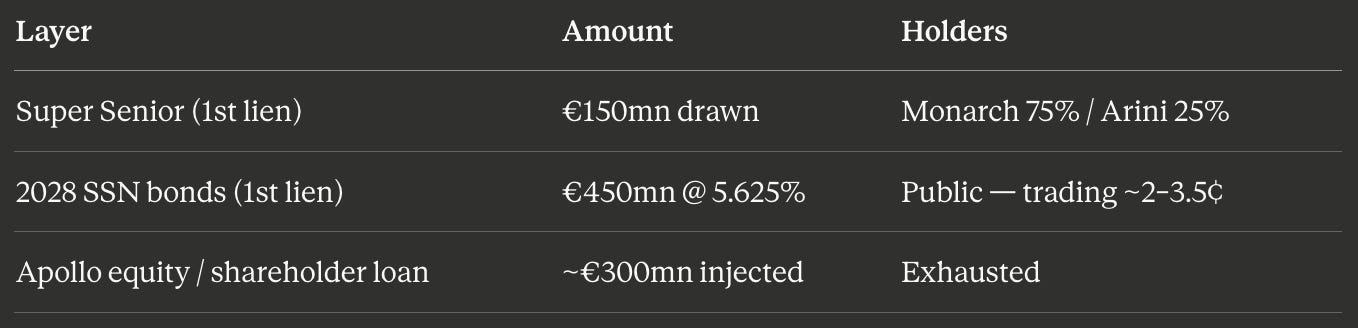
Kem One is not a story about one bad bet. It is a story about three distinct and mutually contradictory alpha strategies — structural short, super-senior rescue lending, and uptier restructuring — all running simultaneously on a single French chlorochemicals producer that Apollo Global Management acquired for a total consideration of roughly €704 million — implying an enterprise value of approximately €600 million, with the remaining ~€104 million representing net cash and closing adjustments per Octus Intelligence — in December 2021 and has watched deteriorate into near-total impairment since. As of today, Lune Holdings’ €450 million of 5.625% senior secured notes due November 2028 (ISIN XS2406727151) trade at approximately 2–3.5 cents on the euro — down from roughly 70 cents in early 2025. That 68-point collapse in under twelve months, confirmed by both Hedgeweek and Bloomberg, is the return that made three short funds look prescient and two long funds look dangerously exposed.
📋 This article covers the public narrative. If you want the full trade reference — every position broken down into CONFIRMED vs. INFERRED claims, all five strategies with exact mechanics, 13 reusable strategy lessons extracted from this trade, and the unresolved questions to watch in 2026 — I published an exclusive companion document on Patreon: → Kem One: Full Trade Reference
To understand why this trade happened — and why it split the European credit community into opposing camps — you need to start not in 2021, but in 2012.
A Company That Has Failed Before
Most coverage starts with Apollo’s 2021 acquisition. But Kem One’s structural fragility traces to an earlier failure that every serious analyst had in their model. The company began life as Arkema’s PVC division — a unit so persistently loss-making that in 2011 Arkema decided to divest it. In July 2012, Arkema ceded the division to Gary Klesch’s Klesch Group at zero cost, erasing debt and contributing €100 million in cash and guarantees. Within nine months, the company was losing €10–15 million per month. By March 2013, the Lyon commercial court placed Kem One in insolvency proceedings. French Minister for Industrial Renewal Arnaud Montebourg intervened to prevent the loss of 1,800 jobs. In December 2013, OpenGate Capital and Alain de Krassny acquired Kem One out of insolvency with government support and Arkema concessions. De Krassny rebuilt the company over eight years and sold it to Apollo.
That prior insolvency cycle is not a footnote — it is the thesis. A company that failed once under one set of macro conditions and was rebuilt is structurally more vulnerable when those conditions return. When Apollo completed the acquisition in December 2021, European chemical margins were near their post-COVID peak. By 2022–2023, those tailwinds had reversed violently. What happened next was telegraphed not just in the macro data, but in Kem One’s own boardroom.
CEO Musical Chairs as Signal
Governance instability at portfolio companies is a short-seller’s leading indicator — it signals that the business plan is not working before the financial statements confirm it. At Kem One, the pattern was unmistakable. Original CEO Frédéric Chalmin departed approximately six months after the Apollo acquisition — around June 2022. Board Chairman Laurent Lenoir served as interim before Apollo appointed Paolo Barbieri on April 3, 2023 — a former DuPont and Corteva executive brought in to stabilise the operation. Then, on September 1, 2025, at the peak of the company’s financial crisis, Barbieri himself stepped down, with Lenoir returning as interim CEO. Three leadership changes in under four years — each transition a data point confirming that the underlying industrial deterioration was not a management execution problem that a new hire could fix. It was structural. And the structure was being dismantled by forces far larger than any single executive.
The Macro Thesis: China Eats European Chemicals
The short case against Kem One rests on a structural, not cyclical, claim. China’s effective PVC production capacity reached 28 million tons by December 2024, with an additional 2.5 million tons planned. In 2024, China’s PVC exports surged approximately 42% year-on-year to 4.6 million tons, making it the world’s largest exporter. By the first half of 2025, EU imports of PVC from China had increased roughly 700% year-on-year at record-low prices, according to ChemOrbis. This is not demand destruction — it is supply displacement. European producers are not losing customers; they are losing the ability to compete on cost against a structurally cheaper input base.
The damage is sector-wide, not company-specific. Between 2022 and 2025, the EU lost approximately 37 million tonnes of chemical manufacturing capacity — roughly 9% of the total, with 20,000 direct jobs eliminated. BASF shuttered 11 factories in Germany. Ineos, which saw combined debt exceed £18 billion (~€21 billion) by end-2025, cancelled its annual dividend and filed anti-dumping cases against Chinese imports. Fitch changed its 2025 global chemicals outlook to “deteriorating” from “neutral.” Chemicals, packaging, and environmental services accounted for the highest defaulted debt volume globally in January 2026 at $2.6 billion.
Kem One’s specific vulnerability compounds the macro: it uses expensive ethylene-based feedstock to produce PVC. Chinese producers use coal-based feedstock at structurally lower costs. Even after investing €100 million in electrolysis modernisation at Fos-sur-Mer (the ELYSE project, which reduced electricity consumption by 16% and gas consumption by 36%), and €80 million in a cryogenic ethylene storage terminal, Kem One cannot reach the cost floor that Chinese producers operate at. Capital expenditure made the company more efficient — just not efficient enough to overcome a feedstock cost differential baked into the geology of two different continents.
One additional cost shock sealed the case: France’s regulated nuclear electricity pricing (ARENH at €42/MWh) expired at end-2025. Kem One signed a new 10-year EDF nuclear contract at approximately €70/MWh starting January 2026 — a 67% unit cost increase at a moment of zero pricing power.
The EBITDA Freefall
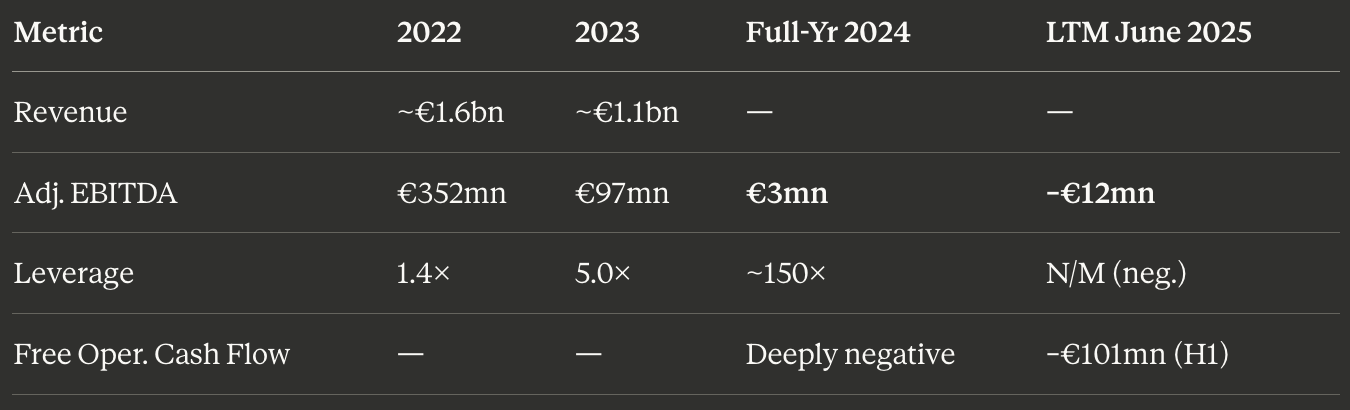
The governance deterioration and macro headwinds combined to produce financial results that track, almost precisely, the short thesis timeline:
Sources: S&P Global Ratings, Octus Intelligence, Lune Holdings investor filings
📋 Want the Full Trade Breakdown Behind These Numbers?
This table is the public summary. The Patreon companion document goes deeper: every trade isolated into its own block (structural short, super-senior rescue lending, uptier play, Apollo equity, minority bonds), with each claim marked [CONFIRMED] or [INFERRED] against primary sources. Plus 13 reusable strategy lessons extracted from this specific trade — on structural shorts, consent threshold mechanics, dual lender/bondholder positioning, and the Apollo-Diameter conflict-of-interest structure.
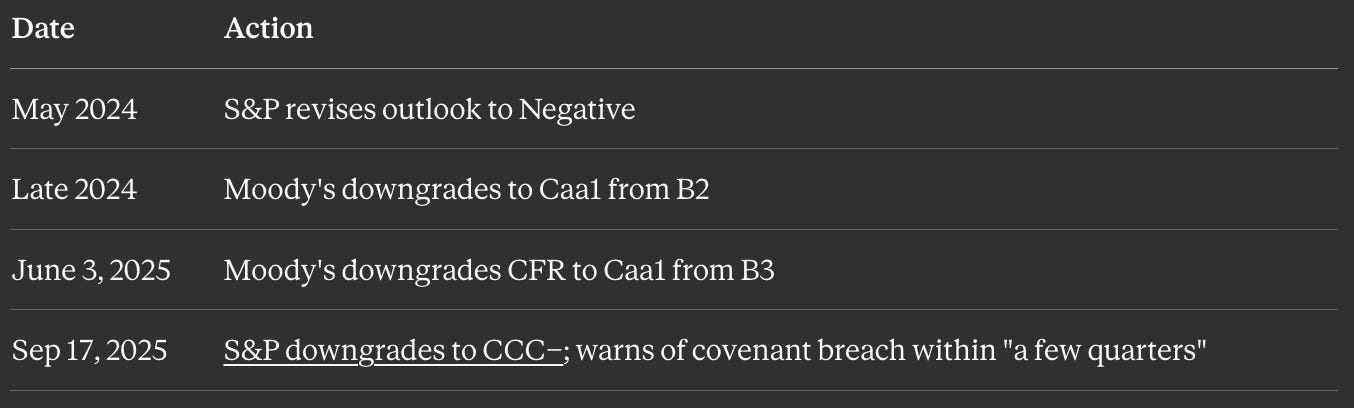
S&P Global’s CCC− downgrade on September 17, 2025 revealed that full-year 2024 adjusted EBITDA reached just €3 million, with projected 2025 EBITDA of approximately €2 million and negative adjusted free operating cash flow of approximately €177 million. S&P warned of covenant breach or liquidity shortfall “within the next few quarters.” Per Octus Intelligence, EBITDA for the twelve months to June 2025 was negative €12 million — meaning S&P’s €2 million full-year projection had already been breached within the first six months of the forecast period. With net debt of €583 million and €136.7 million in remaining liquidity, Octus estimated the company would reach a liquidity cliff by the second quarter of 2026.
Apollo’s European team took direct control in January 2024 and injected a €300 million shareholder loan to bridge the gap. By October 2025, that loan had been entirely consumed by negative free cash flow — burned through at a rate that no operational improvement could offset. What had been a €352 million EBITDA business in 2022 was now an entity that could not cover its interest costs, let alone service €450 million in bonds.
Capital Structure — Pre-Restructuring (as of June 30, 2025)
Source: Octus covenant analysis, Bloomberg
With that context established — governance failure, structural macro headwinds, and financial freefall — the investment community split into two opposing camps, running three distinct strategies simultaneously on the same credit.
The Short Side: Sona, Polus, and Diameter
Mechanics of a Bond Short
Hedge funds short credit primarily through credit default swaps (CDS), where the fund pays a periodic premium to a counterparty and profits when the reference entity’s spreads widen, or through total return swaps where a bank shorts the cash bond on the fund’s behalf. These instruments allowed Sona, Polus, and Diameter to build short exposure to Kem One’s bonds without owning them — and to close positions at substantial profit as the bonds fell from 70 cents to roughly 2 cents.
Sona Asset Management
Sona Asset Management, founded in 2016 by John Aylward — previously head of European high-yield trading at Deutsche Bank, European corporate credit at Claren Road Asset Management, and European credit at Highbridge Capital Management — runs a European all-weather long/short credit strategy. The flagship Credit Master Fund managed approximately $7.5 billion at the start of 2025, growing to around $11 billion by year-end; firm-wide AUM across all strategies reached approximately $16.6 billion by early 2026 per Hedgeweek. Sona was among the funds that shorted Kem One’s debt, booking profits as bonds cratered. The flagship returned 18.76% in 2024 — its fifth consecutive year of double-digit returns — winning Hedgeweek’s European Award for “Performance of the Year: Credit – Long/Short.” Sona has publicly estimated that approximately $100 billion of European leveraged loans face refinancing difficulties by 2028 — a forward pipeline that defines the structural short opportunity set the firm is built to exploit.
Polus Capital Management
Polus Capital Management emerged from the 2021 merger of Cairn Capital and Bybrook Capital, rebranding in November 2022. The firm manages approximately $11 billion in assets as of September 2024 following an ADIA capital commitment, with CIO of Opportunistic Credit Robert Dafforn — founder of Bybrook Capital — running the short book. Polus shorted Kem One’s bonds and benefited as prices collapsed. What makes Polus’s involvement analytically significant is Dafforn’s public commentary: he told Bloomberg the firm holds a “more substantial book of single-name, high-yield credit shorts” targeting chemicals, building materials, packaging, and consumer goods — precisely the sectors now being crushed by Chinese export competition. Portfolio Manager Jamie McFarlane has noted that European special-situations opportunities have nearly doubled versus pre-COVID levels, with 2026 expected to produce a similar or greater volume of stressed and distressed situations.
Diameter Capital Partners and the “Credit Microcycles” Framework
Diameter Capital Partners, founded in 2017 by Scott Goodwin (formerly head of high-yield trading at Citi, then Anchorage Capital) and Jonathan Lewinsohn (formerly Head of Research at Anchorage and Senior Managing Director at Centerbridge; JD from Yale Law School), oversees approximately $25 billion in assets across its flagship hedge fund, dislocation funds, CLO vehicles, and direct lending. Apollo holds an approximately 5% minority equity stake in Diameter, acquired in October 2022 — a fact whose significance becomes clear below. Diameter built a short position against Kem One as part of a broader bet against the global chemicals sector, articulated precisely in its Q4 2025 letter:
“We had success in the fourth quarter in shorts of global chemicals companies bedeviled not so much by sudden drops in demand (RECESSION!) than by the evolution of supply. The problem is China, which seems determined to add capacity up and down the chemicals chain.”
— Diameter Capital Partners Q4 2025 Investor Letter, January 8, 2026 (public PDF)
The letter included a forecast that even if all ethylene and propylene capacity in Europe and Japan were shut down, global excess capacity by 2030 would still exceed today’s levels — the mathematical case for why this is a structural, multi-year short, not a trade to be covered at the first hint of stabilisation. Diameter’s Master Fund returned 8.0% for full-year 2025, with only a 30-basis-point gain in Q4 — despite a significant loss on First Brands Group, which filed Chapter 11 in September 2025. The chemicals shorts were a critical offset to that First Brands impairment. Goodwin and Lewinsohn have publicly articulated their “credit microcycles” framework — industry-specific downturns that create dislocations even in stable macro environments — on the Goldman Sachs Exchanges podcast (December 18, 2025) and Capital Allocators Episode 484 (February 2, 2026).
The Apollo-Diameter Conflict of Interest
Apollo owns Kem One. Apollo simultaneously holds a ~5% minority equity stake in Diameter Capital Partners — one of the funds that shorted Kem One’s debt into near-worthlessness. The positions sit in separate legal entities with distinct mandates and fiduciary duties, and there is no suggestion of impropriety. But the structural fact — that a PE firm’s investee fund profited from the collapse of the PE firm’s own portfolio company — illustrates precisely how interconnected modern alternative asset management has become. Conflict-of-interest mapping is now a standard, non-optional component of distressed credit due diligence.
The Long Side: Arini and Monarch
While Sona, Polus, and Diameter were building short positions, two other funds made the opposite bet — that being first in line in the capital structure would be worth more than the market was pricing.
Arini Capital Management
Arini Capital Management was founded in 2021 by Hamza Lemssouguer, previously head of high-yield credit trading in Europe at Credit Suisse. Lemssouguer’s trajectory is relevant context: after joining Credit Suisse in 2015 upon graduating from École Polytechnique and interning at Goldman Sachs in 2013, his desk generated approximately $220 million in trading revenue in 2020 — roughly 5.5% of Credit Suisse’s total fixed income trading revenues — with gross annualized returns of 38%. He planned to launch Arini as an internal Credit Suisse fund, but the bank’s post-Greensill/Archegos risk aversion killed the plan. He left to build it independently.
The firm’s flagship Arini Credit Master Fund returned 21.2% in 2024 — more than double the 8.5% average for credit hedge funds — and was up 17% through August 2025, with AUM of approximately $12 billion at that date. Roughly 30% of assets are allocated to stressed and special situations. In a Bloomberg “Credit Crunch” podcast (January 2025), Lemssouguer described Arini’s edge as combining fundamental analysis, legal expertise, and game theory — specifically, modelling how different creditor classes will behave in restructuring scenarios. Kem One is a live demonstration of that framework in action.
Monarch Alternative Capital
Monarch Alternative Capital, co-founded in 2002 by Michael Weinstock, Andrew Herenstein, and Chris Santana — all veterans of Lazard’s distressed debt platform; Weinstock and Herenstein as Managing Directors (Weinstock’s team ranked #1 in distressed by Institutional Investor in 1998), and Santana as Vice President and Head Trader of the Lazard Debt Recovery Funds — manages approximately $16 billion in assets. Per a June 2025 press release, Weinstock transitioned from CEO to Executive Chairman effective December 31, 2025, with Santana becoming Co-CEO and Co-CIO alongside Adam Sklar, and Herenstein assuming the role of Vice Chairman. Monarch’s flagship Monarch Capital Partners VI closed with over $4.7 billion, surpassing its $3.5 billion target, dedicated to complex, dislocated credit.
The €200M+ Facility: Structure and Key Mechanics
In March 2025, Arini and Monarch jointly provided Kem One with a €200 million five-year delayed-draw term loan, structured as a senior secured facility with an initial draw of €120 million and an additional €80 million available over 18 months. Critically — per Octus covenant analysis — Monarch leads the deal at 75%, Arini at 25%. The facility holds the same security and priority as the existing revolving credit facility, augmented by additional collateral, and ranks senior to the €450 million of publicly traded 2028 bonds. This priming structure is the core of the long-side thesis: by sitting at the top of the waterfall, Arini and Monarch position themselves to recover value even in a wind-down scenario where bondholders are wiped out entirely.
By late June 2025, €150 million of the facility had been drawn, leaving €50 million available. In January 2026, the same lenders provided an additional €30 million emergency financing — ranking alongside the original €200 million loan — as the company approached what analysts estimated could be a liquidity cliff by mid-2026. Total super-senior exposure now stands at approximately €230 million. The question the market is now pricing is simple: does Kem One’s asset base, post-ELYSE modernisation, support full recovery of that super-senior stack in a French insolvency process where competing European chemical assets are simultaneously closing and depressing salvage values?
The Bondholder War: Uptier Restructuring
The rescue lending created the conditions for the third strategy — and the most legally complex one. An ad hoc group of bondholders representing approximately two-thirds of the 2028 senior secured notes — led by Arini and BlackRock — has retained Gibson Dunn & Crutcher to explore restructuring options. The proposed transaction, per Octus Intelligence, would see the ad hoc group inject new super-senior money (up to €47.5 million of remaining capacity under the bond indenture’s super-senior basket) and uptier its existing bond holdings into new 1.5 lien notes — ranking above the minority bondholders left outside the group, but below the Arini/Monarch super-senior facility.
The legal mechanics are the entire game. The intercreditor agreement requires 90% bondholder consent to “expressly subordinate the notes” — a threshold the ~66% ad hoc group cannot clear. However, 50.01% simple majority consent suffices for amendments to “application of collateral enforcement proceeds.” The uptier would therefore be structured as a collateral enforcement amendment rather than direct subordination — a pathway that has been used in US distressed markets but remains more contentious under European documentation norms, where creditor-on-creditor manoeuvres of this kind have less established precedent.
Arini’s position across this entire structure is worth pausing on: it is simultaneously a super-senior lender (through the Monarch-led facility at 25%), a lead member of the bondholder ad hoc group seeking to uptier its bond holdings, and operating in a market where the short-side counterparts (Sona, Polus, Diameter) are profiting from the bonds trading at 2 cents. This dual positioning gives Arini optionality across every restructuring scenario — recovery through the super-senior waterfall if assets liquidate, or an improved bond position if the uptier succeeds, or a negotiated outcome between the two.
Rating Agency Timeline
The rating agency timeline tracks the fundamental deterioration and maps precisely to the bond price collapse — each downgrade functioning as a public confirmation of what the short thesis had already priced in, and each action triggering forced selling by mandated holders unable to hold CCC-rated paper:
Three Alpha Strategies, One Credit
Taken together, the Kem One trade represents three distinct investment frameworks deployed simultaneously on one name — each internally coherent, each incompatible with the others:
01 — Structural Short (Sona, Polus, Diameter) Identify irreversible structural headwinds — Chinese PVC flooding Europe at cost-of-coal prices. Short the most leveraged, most exposed names via CDS. Captured approximately 68 cents of downside over ~12 months. Diameter framed this as a “credit microcycle” — a sector-specific dislocation that persists and deepens even when the macro economy is stable, because the driver is supply competition, not demand collapse.
02 — Super-Senior Rescue Lending (Monarch 75%, Arini 25%) Provide emergency financing at the very top of the capital structure, priming the existing €450 million of bonds. The thesis: France’s industrial protection norms, the company’s modernised electrolysis assets, and the strategic value of Kem One’s eight industrial sites create sufficient asset value for super-senior recovery even in a liquidation scenario where equityholders and bondholders are wiped out.
03 — Uptier Play (Arini, BlackRock and ad hoc bondholder group) Own ~66% of the existing bonds, retain Gibson Dunn, and execute a liability management exercise using the 50.01% collateral amendment route — promoting your debt above the minority holders who fall outside the group. Arini’s presence across both Strategies 02 and 03 simultaneously is the structurally elegant — and structurally conflicted — feature of this entire trade.
What the Trade Teaches
Kem One’s collapse is a case study in the divergence of credit intelligence operating on the same underlying asset. The short funds were right on the macro: Chinese chemical overcapacity is a structural, not cyclical, phenomenon. Diameter’s projection — that even eliminating all ethylene and propylene capacity in Europe and Japan would not absorb Chinese excess capacity by 2030 — is a framework, not a single trade. It defines an investment regime lasting years, not quarters. Sona and Polus’s willingness to hold short positions through headline volatility and interim bond rallies — and to exit at maximum dislocation — reflects the discipline that separates a structural short from a directional gamble.
The long funds were not wrong on the credit analysis; they were wrong on the timing and magnitude of industrial deterioration. Arini and Monarch lent into a company with modernised assets, super-senior collateral protections, and French government strategic-industry designation — a defensible position in a normalised scenario. The flaw is the residual asset value question: if Kem One enters a French insolvency process, what do chlorochemical plants in Fos-sur-Mer and Lavera clear for in a buyer’s market where competing European chemical assets are simultaneously closing and depressing the salvage floor? The ELYSE modernisation reduces cost; it does not bridge the feedstock cost differential with Chinese producers using coal at a fraction of European ethylene prices.
The Apollo-Diameter dynamic — a PE firm’s investee fund profiting from the collapse of the PE firm’s own portfolio company — is the structural conclusion that the alternative asset management industry should sit with. Separate mandates, separate fiduciary duties, genuinely separate decision-making. But the same web of capital relationships, increasingly, underneath every large distressed trade.
As Diameter’s Q4 2025 letter concluded: “We have shorts in the most impacted names and believe that 2026 will be a watershed inflection for chemicals.” For Kem One’s creditors across all three strategies, that inflection has already arrived.
📊 Want the Full Trade Reference Document?
This article covers the public-facing narrative. The Patreon companion document goes considerably deeper — and is structured differently: it is a reference file, not an article.
Every trade is isolated into its own block. Every factual claim is tagged [CONFIRMED] or [INFERRED] against a named primary source. It documents both the correct trades and the incorrect trades with equal rigour, because both are equally instructive. It also includes 13 reusable strategy lessons extracted from this specific trade — on structural short discipline, consent threshold mechanics, super-senior recovery analysis, dual lender/bondholder positioning, and how to map the ownership web in modern alternative asset management.
If you want the kind of analytical framework you can return to when the next distressed situation arrives, that document is the one.
→ Kem One: Full Trade Reference — Patreon Exclusive
By joining, you support independent financial research and motivate more analysis at this level of depth.
Primary Sources
Bloomberg — Apollo-backed Kem One secures €200mn financing (March 2025)
Bloomberg — Bondholders seek to band together (October 2025)
Diameter Capital Partners — Q4 2025 Investor Letter (public PDF)
Capital Allocators Ep. 484 — Credit Microcycles at Diameter (Lewinsohn)
Goldman Sachs Exchanges — Scott Goodwin on credit microcycles (December 2025)
PRNewswire — Polus Capital / ADIA commitment, September 2024 (~$11bn AUM)
Monarch Alternative Capital — Chris Santana biography (Lazard VP)
BusinessWire — Diameter raises $4.5bn for DDF III (November 2025)
Business Insider Markets — Lune Holdings bond pricing (ISIN XS2406727151)
OpenGate Capital — Kem One acquisition out of insolvency (2013)
European Business Magazine — Hedge funds in face-off over Kem One
This article is for informational purposes only. Nothing herein constitutes investment advice or a recommendation to buy or sell any security.
About the Author
Navnoor Bawa researches distressed credit, European high yield, and quantitative trading strategies with a focus on institutional-grade analysis accessible to independent investors.
📺 YouTube — In-depth video breakdowns of trades, strategies, and market structure: The Mathematical Trader
💼 LinkedIn — Follow for research updates and professional commentary: Navnoor Bawa
📊 Patreon — Exclusive quantitative research, trading strategies, and deep-dives not published anywhere else: Join here
Cover photograph: King of Hearts, CC BY-SA 3.0, via Wikimedia Commons.