


Chris Rokos’s fund made 50.8% in 2022, its best year. In January 2024 Bloomberg’s headline read “Rokos’ Hedge Fund Paid Members £445 Million After 2022 Gains”. Yet that record year booked his London partnership 62% of the revenue his pandemic year did.
The headline is right that the firm’s revenue swings with the fund, but the return alone did not set it. A macro firm like this one is paid mostly by its fund’s climb above the high-water mark, the highest value already charged a fee. In London’s accounts the cut fell on his own holding company, not on the other members: the owner eats the mark.
Money in the hole, the gap below its mark, pays no performance fee. His July 2025 fee rise, the step-up, has two rungs, and the fixed one, a higher management fee, keeps paying through the hole: 75 cents more per $100 every year.
I read the ten sets of accounts the partnership has filed at Companies House since 2016 and checked each year’s figures through March 2024 against the next year’s comparative. They tell the story in five chapters:
A Jersey manager he owns earns the fees; London bills it for a share.
The pandemic year booked about £1bn; the record year first refilled 2021’s hole, which explains most of its fall in revenue.
In London’s accounts the fall came out of his holding company’s allocation.
The fixed fee pays the firm below the mark; the step-up adds about $150m a year.
What the new terms would have taken since January 2020, and which fee takes it.
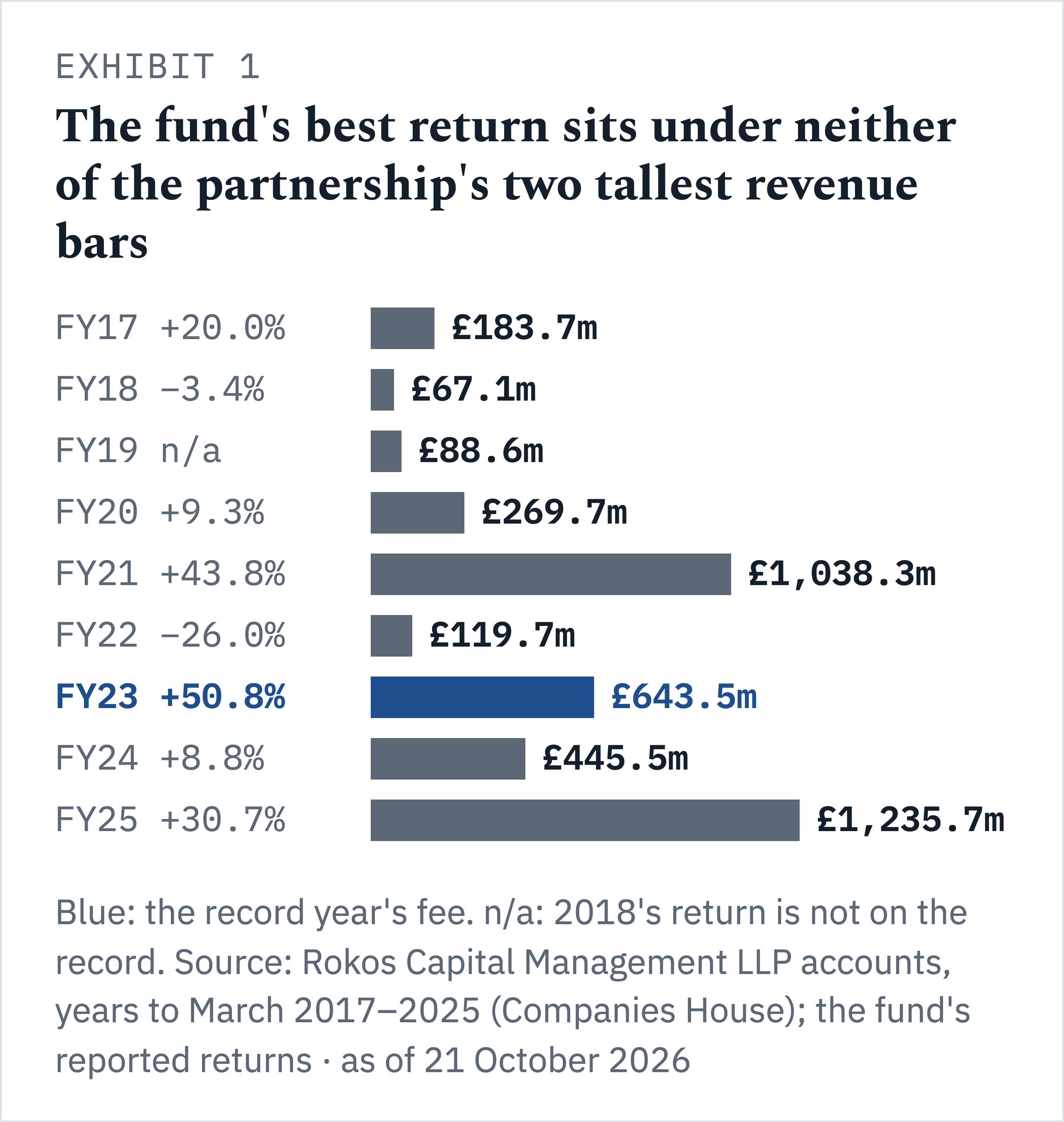
Source: Author’s calculation from Rokos Capital Management LLP accounts, years to March 2017–2025 (Companies House) and the fund’s reported returns · as of 21 October 2026
Each bar is a year’s revenue to 31 March, labelled with the return of the calendar year whose fee it holds. The firm’s assets grew from about $3.5bn in 2016 to about $22bn in 2025.
A Jersey manager pays London partners
The fees are earned by Rokos Capital Management (Jersey) LP, the Jersey manager. The London partnership, Rokos Capital Management LLP, bills only that manager; its accounts to March 2025 say “All revenue arose in Jersey, as sub-advisory fees”. It earns whatever share of the fees the Jersey manager passes down, a share the SEC brochure does not size.
Chris Rokos holds at least three-quarters of the Jersey manager, which in turn holds at least three-quarters of his holding company, Rokos Intermediate (Jersey) Ltd. That company takes an allocation of the partnership’s profit (Form ADV Part 1A, Schedules A and B).
Before the step-up, on terms the press reported, investors paid 2% a year of their money and 20% of the gain above the high-water mark. The fees fit a charge at 31 December, so the fund’s 2020 sits in the partnership’s accounts to March 2021.
In 2019 Chris Rokos, also the fund’s main trader, merged “portfolios previously run by individual traders into a single pool of money, allowing him to place bigger bets”. Such a book, like his bets against the Fed, wins big and loses big, and one bad year leaves the whole fund far below its mark.
Christos Nifadopoulos, a designated member, signed the accounts to March 2025 and their plainest sentence: “As a result of its revenue being linked to the performance of the fund it manages, the LLP’s principal risk is market risk.” The record narrows that link to the fund’s distance above its mark: for 2024, a year begun at the mark, revenue was £1.24bn.
The record year refilled a hole
In 2020, the year to beat, the fund made 43.8% and went into 2021 at about $14.5bn. For money that began the year at its mark, the whole gain carried the 20% fee, so fee and return rose together. The accounts to March 2021 show it: revenue was £1,038.3m, against £269.7m for 2019’s 9.3% gain. His holding company was allocated more than half the profit.
December 2020 reset the mark at the fund’s new high, and money invested in January 2020 then spent most of two years below it.
I matched the accounts to the fund’s year using the quarterly valuations UBS files on the SEC’s Form N-PORT. UBS’s A&Q Multi-Strategy Fund holds Rokos, and its four quarters of 2022, with no money in or out, chain to +50.8%, within a fraction of a point of the return Reuters reported. The fund publishes no returns; every other year’s figure is the press’s.
In 2021 the fund lost 26%, its worst year; in 2022 it made 50.8%. Run $100 invested on 1 January 2020, on 2% and 20%, through both years:
In 2020 it gains about 57% before fees and ends at $143.80, its new mark, after $12.95 of fees.
In 2021 it ends at $106.41, after $2.88 of management fee and no performance fee, because it is below the mark.
In 2022 it makes the same gain before fees, about 57%, and ends at $160.49. The 20% falls only on the climb above $143.80, so its fees are $6.30. UBS’s quarterly valuations show it crossing the line in the third quarter, at $145.73 by 30 September.
The same gain before fees paid less than half the fee. That $100 is among the most mark-bound money in the fund, though some money was not: the $1bn taken in January 2022 entered at its own mark, so it paid the full fee on 2022.
Set each year’s revenue against the calendar year whose fee it holds, and the record year booked £643.5m, 62.0% of 2020’s. The pitfall is the year: matched to the accounts to March 2022, 2022 seems to have booked £119.7m, the lean year’s figure.
Three ordinary explanations for the 62% fail on the record. A smaller fund would have shrunk the revenue, but it went into 2020 as a “$9 Billion Hedge Fund” and the firm went into 2022 at $12bn. The pound did not flatter 2020: in dollars, at the European Central Bank’s year-end rates, the record year is 54.6% of 2020’s, a deeper fall. And the US arm, Rokos Capital Management (US) LP, is paid out of revenue, so it can lower the profit, never the revenue.
That leaves the mark, and on every estimate we could build from the fund’s reported size it explains most of the fall. The rest is a change in how much of the Jersey manager’s fees reached London, which the accounts do not show and the press figures cannot size. At the year-end rate London booked about $1.42bn for 2020. The $100 case’s rates give only $1.17bn on the $9bn the fund started that year with, so the reported sizes cannot split the fall more finely than that.
The mark fell on the owner
Exhibit 2 · The record year’s fall landed on one member · as of 21 October 2026
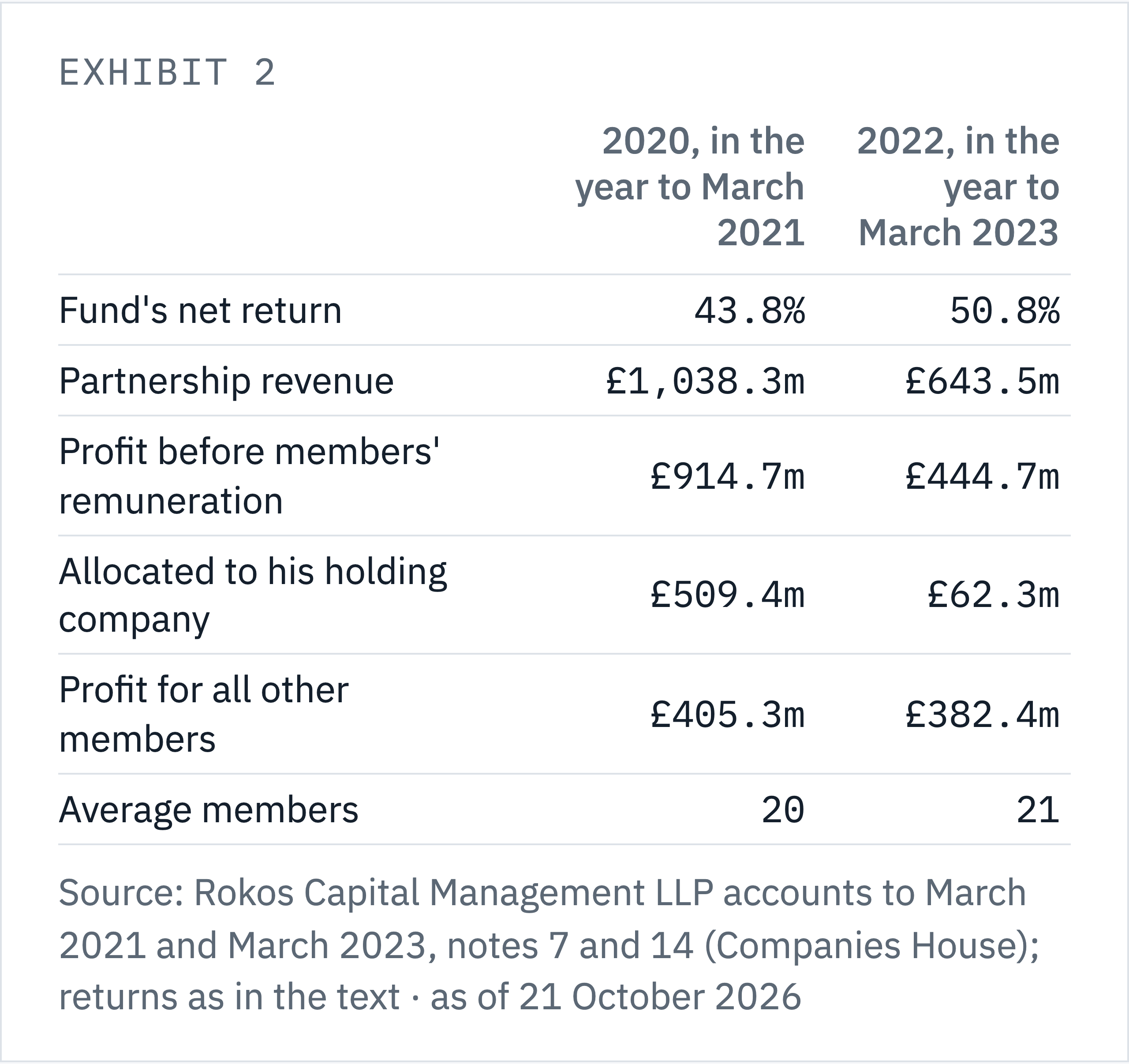
Source: Rokos Capital Management LLP accounts to March 2021 and March 2023, notes 7 and 14 (Companies House); 2020 return as Bloomberg reported it, 2022 from UBS’s A&Q fund’s N-PORT filings; all other members include Chris Rokos in his own name and two corporate members, Erunger Limited (Jersey, a member since 3 January 2019) and Rokos Services (UK) Ltd, which bills the partnership and is at least three-quarters owned by his holding company (members list; Form ADV Part 1A) · as of 21 October 2026
The last money rows show who absorbed the fall: his holding company’s allocation fell 88%, while all other members’ profit fell 6%. The £26.7m the press reported as that year’s top payout is note 7’s profit paid to the member with the largest entitlement; the allocations are note 14’s. Of the £62.3m allocated to his holding company, £32.4m was still owed to it at 31 March 2023, and still at March 2025.
On that record the partners appear to have been paid on the year, and the owner’s holding company took the hole: the owner eats the mark. The mark sets the size of the pool, and profits “are allocated to members after finalisation of the financial statements”, by a partnership Chris Rokos controls.
What London did not receive did not leave him: the Jersey manager that keeps the rest is at least three-quarters his, and nothing public shows what it kept.
After 2017’s 3.4% loss, the accounts to March 2019, which hold the fee for 2018, allocated his holding company £15.0m, against £112.8m two years earlier. The other members’ profit fell from £40.3m to £21.3m. Measured from the year before each loss to the year after it, his holding company took the deeper cut both times; only in 2022 did the rest barely move.
Nor is the split a formula: in the year to March 2024, a year above the mark, his holding company was allocated nothing while the member with the largest entitlement was paid £110.2m. Chris Rokos is also a member in his own name, so that nil says nothing about his own take, which the accounts never attribute to him by name.
The fixed fee pays lean years
The lean year is the accounts to March 2022, which hold the fee for 2021, when the fund lost 26% and earned no performance fee. Revenue was £119.7m against costs of £106.8m.
That year shows how much of the fixed fee reached London. The fund went into 2021 at about $14.5bn and the firm into 2022 at about $12bn. Across the year that is about $13–14.5bn. A 2% fee on it comes to roughly $260–290m by our estimate. If the insiders’ money paid none, it is $221–247m. London’s £119.7m, about $161m, was between about half and three-quarters of it, roughly enough to cover its own costs.
In July 2025 the firm told investors it would raise the management fee to 2.75% and the performance fee to 25% over three years. Hedgeweek, citing Bloomberg, put the move down to heavy investment in talent, research and trading infrastructure. Investors unwilling to accept could redeem; a firm representative said no redemptions had occurred.
The accounts bear out the talent part: costs nearly tripled, from £106.8m in the lean year to £311m in the year to March 2025. The London partnership reported 310 staff to the SEC in October 2026 and the US arm 51, their salaries paid whatever the fund does. The higher fixed fee looks built to pay them through another 2021.
In August 2025, with the fund above $22bn, the firm moved to cap it at $20bn and return the excess. Investors who stayed were paid: by November 2025 the fund was reported up more than 20%, against 4.8% to October for the self-reported macro average of HFR, a data firm, and 0.9% for Brevan Howard’s Master Fund.
The October 2026 brochure names three fees: management, infrastructure and performance. At the full rung, 0.75 points more on a fund held at its $20bn cap is $150m a year. On the $22bn the firm was reported to manage in October 2026, it is $165m. If the 15% that Rokos and related persons own (Form ADV Part 1A) pays no fee, the cap’s figure is $127.5m, more than half of the lean year’s management fee on the same fee-paying share.
A high-water-mark fund that pays its people from performance fees usually has its thinnest fee year when it loses money, and a fixed charge, as a fee or a pass-through, is what pays the firm through it. Tudor’s brochure says its pass-through staff pay “will be payable whether or not the applicable Tudor Hedge Fund experiences positive trading results”, and Marshall Wace has charged a “compensation surcharge” of up to 0.75% of fund assets.
Peers’ brochures put their management fees lower, each beside other charges:
Caxton: up to 2.4%, with pass-throughs and performance rates of up to 30%.
Tudor’s flagship: 1.75–2.25%, with its pass-through on some funds.
Element: 2%, with performance rates of up to 40%.
So 2.75% would be the highest management fee of the four, though not the highest total charge.
In August 2026 Rokos was reported to be adding a three-year share class, with 8.33% of capital redeemable each quarter against 25% in the one-year class. Our August piece read the fee rise and the cap as price and size instead of a longer lock-up, and we were wrong about the lock-up.
Should an investor stay in Rokos for three more years at 2.75% and 25%, or redeem now?
Below the paid line:
The new terms run over the fund’s own path since 2020, in one table.
How the extra cost splits between the two rungs, and which one charges in a losing year.
Whether staying paid: the share of the gain kept, and the one kind of year that changes it.
Our bet on the December accounts’ revenue line, with its odds and its kill line, then four dated checks.