

This is a detailed research piece. If you find value in institutional-quality hedge fund analysis, support this work on Patreon.
Verification Note
All major facts in this article (£477mn partner payout, £940mn partner pool, 31% for 2024, 21% for 2025, £1.2bn revenue, $22bn AUM, the February 2024 >$1bn bond profit, Q1 2024 +12.5%) are verified against Financial Times, UK Companies House filings, and trade press (Bloomberg, HedgeWeek, Business Insider).
Key clarifications:
The theoretical fee calculation ($1.8bn) exceeds company-filed revenue (£1.2bn). The filed figure is ground truth. The gap reflects fee timing, realized vs. unrealized performance fees, AUM fluctuation, and FX/accounting presentation.
The specific instrument mix (short Treasury futures, payer swaps, swaptions) represents standard macro reconstruction consistent with press descriptions. The exact notional breakdown is proprietary and not disclosed in public filings.
Core Facts
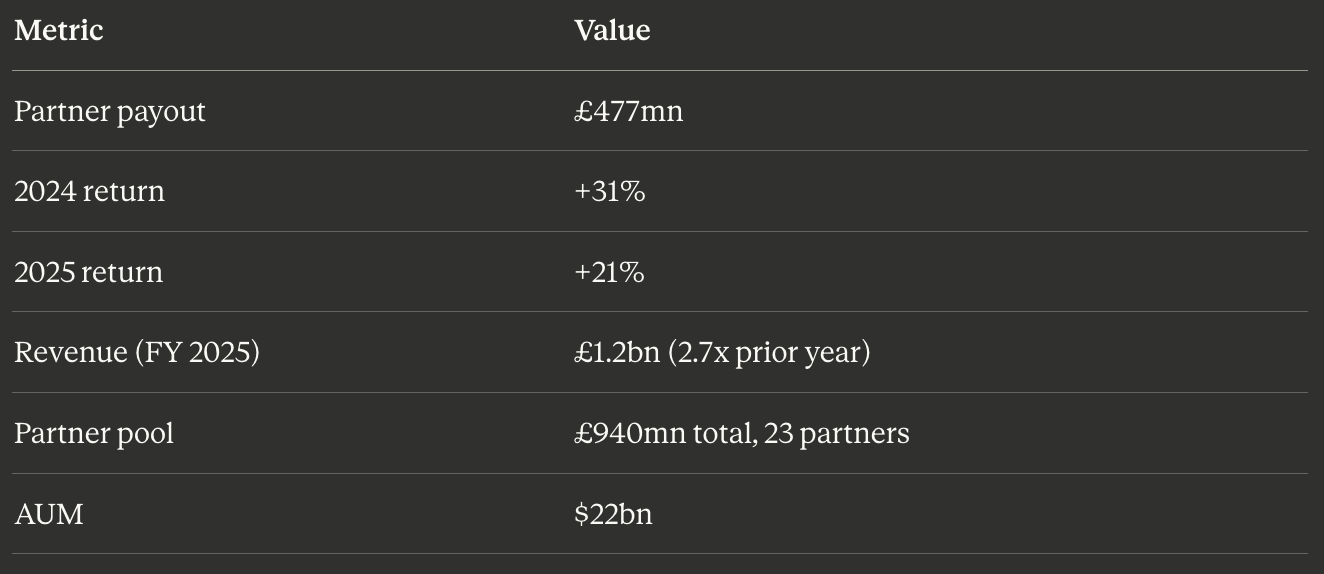
Sources: Financial Times (Jan 9, 2026), UK Companies House filings, Business Insider (Jan 8, 2026), Financial News London (Jan 9, 2026), The Telegraph (Jan 9, 2026)
The Trade: February 2024’s $1bn+ Profit
Market Setup
December 2023: Fed funds futures priced approximately 6 rate cuts for 2024, according to CNBC’s Fed minutes coverage (Jan 3, 2024). Market anticipated Fed pivoting from 5.25–5.50% to approximately 3.75–4.00% (CNBC Fed decision coverage, Dec 13, 2023).
Reality: January 2024 CPI printed at 3.1%, above the Fed’s 2% target (CNBC, Jan 31, 2024; Reuters, Jan 31, 2024). Fed held rates at 5.25–5.50% at its January 30–31 meeting. Chairman Jerome Powell explicitly stated that a rate reduction at the March meeting was “unlikely” (Federal Reserve transcript, Jan 31, 2024; Bloomberg, Jan 31, 2024).
May 2024 contrarian call: Richard Tang, Rokos’s Head of Global Markets, stated on Bloomberg Television: “It’s unlikely the Fed will be able to cut this year” (Bloomberg TV interview, May 16, 2024; HedgeWeek coverage, May 21, 2024).
Execution
Rokos Capital made more than $1 billion in February 2024 from betting against rate cuts (HedgeWeek, Feb 2024; HedgeCo, Feb 2024). When inflation persisted and the Fed held firm, US Treasuries sold off sharply.
Standard macro instruments for this trade type:
Short Treasury futures (ZN, ZB): Profit when yields rise / bond prices fall
Payer interest rate swaps: Pay fixed, receive floating (SOFR). Benefits when rates stay elevated
Payer swaptions: Convex payoff from rate spikes; capped downside (premium paid)
Note: Press confirmed large profits from US bond/interest-rate positions. The specific instrument mix above represents standard macro hedging tools for a “higher-for-longer” thesis but is not disclosed in regulatory filings.
Q1 2024 total: Fund gained 12.5%, with 3.8% in March alone (HedgeWeek, April 9, 2024; Bloomberg, April 5, 2024).
Revenue Model to Personal Payout
Fee Structure
Rokos Capital announced a fee increase to 2.75% management + 25% performance (phased over three years) in mid-2025 (Bloomberg, July 31, 2025; HedgeWeek, Aug 1, 2025; Caproasia, Aug 2, 2025).
For FY ending March 2025, the fund likely operated under the prior 2/20 structure (or a mix as the increase phases in).
Theoretical calculation (2/20 structure, $22bn AUM):
Management fee: 2% × $22bn = $440mm
Performance fee: 20% × ~$6.8bn (31% gain) = $1.36bn
Theoretical total: ~$1.8bn
Actual reported revenue: £1.2bn (~$1.56bn) (Financial News London, Jan 9, 2026; Financial Times, Jan 9, 2026).
The difference between theoretical ($1.8bn) and reported (£1.2bn) revenue is due to: (1) performance fees based on realized/fee-eligible profits across investor pools rather than gross AUM × return, (2) currency timing (GBP vs USD), (3) AUM variation throughout the fiscal year, (4) some capital at legacy fee structures, and (5) accounting presentation differences.
Distribution
Partner pool: £940mn total (UK Companies House via FT, Jan 9, 2026)
Rokos (highest-paid partner): £477mn (51% of pool) (Financial Times, Jan 9, 2026; The Telegraph, Jan 9, 2026)
Other 22 partners: £463mn total (~£21mn average)
Why 51%? Rokos operates as the sole risk-taker. The FT reported: “Rokos is the main risk-taker at his $22bn hedge fund, supported by analysts and a team of senior investment professionals the firm calls investment officers” (Financial Times, Jan 9, 2026). Unlike multi-PM platforms where portfolio managers claim 10–15% of their pod’s alpha, Rokos captures 100% of attribution as founder/majority owner/key PM.
Historical Performance: High Volatility, High Conviction
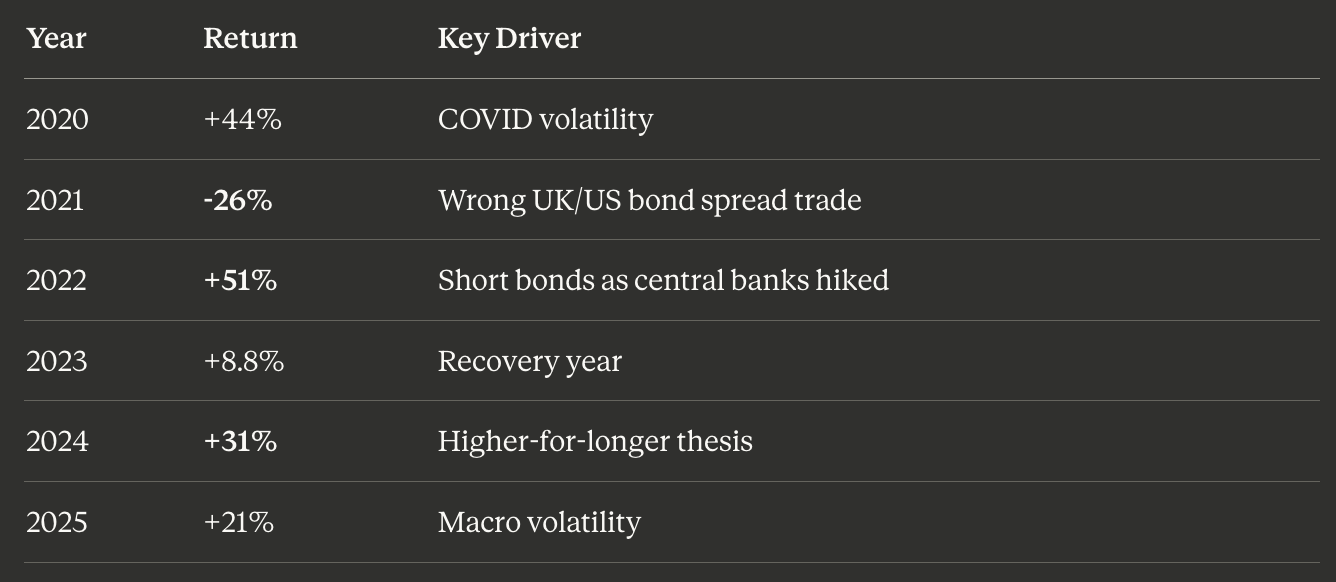
Sources: Wikipedia — Rokos Capital Management (historical data), HedgeWeek 2022 gains (Jan 2023), Bloomberg 2020 performance (Jan 11, 2021), Financial Times (2024 returns), Business Insider (2025 returns)
2022 inflows: Despite losing 26% in 2021, the fund attracted $1 billion in new capital in 2022 (Wikipedia; Bloomberg coverage). Investors backed conviction sizing and historical alpha generation.
Brevan Howard Background
Rokos co-founded Brevan Howard Asset Management in 2002 with Alan Howard and former Credit Suisse colleagues (Wikipedia — Chris Rokos).
He generated approximately $4 billion in profits for the Master Fund trading rates:
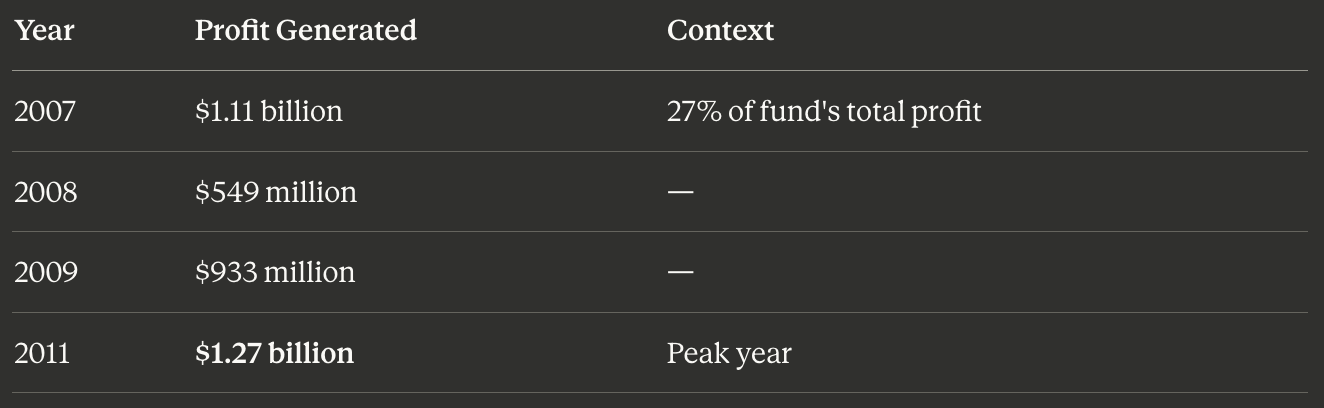
Personal earnings: Court documents revealed Rokos earned approximately $900 million over 10 years at Brevan Howard (Wikipedia, citing 2014 court filings; Traders Magazine, 2015).
Sources: Wikipedia — Chris Rokos, Wikipedia — Brevan Howard, Reuters coverage of 2014–2015 litigation
Left Brevan Howard in 2012 following disagreements. Launched Rokos Capital Management in 2015 after settling non-compete litigation in January 2015 (Traders Magazine, Sept 2015).
Single Risk-Taker vs. Multi-PM Model
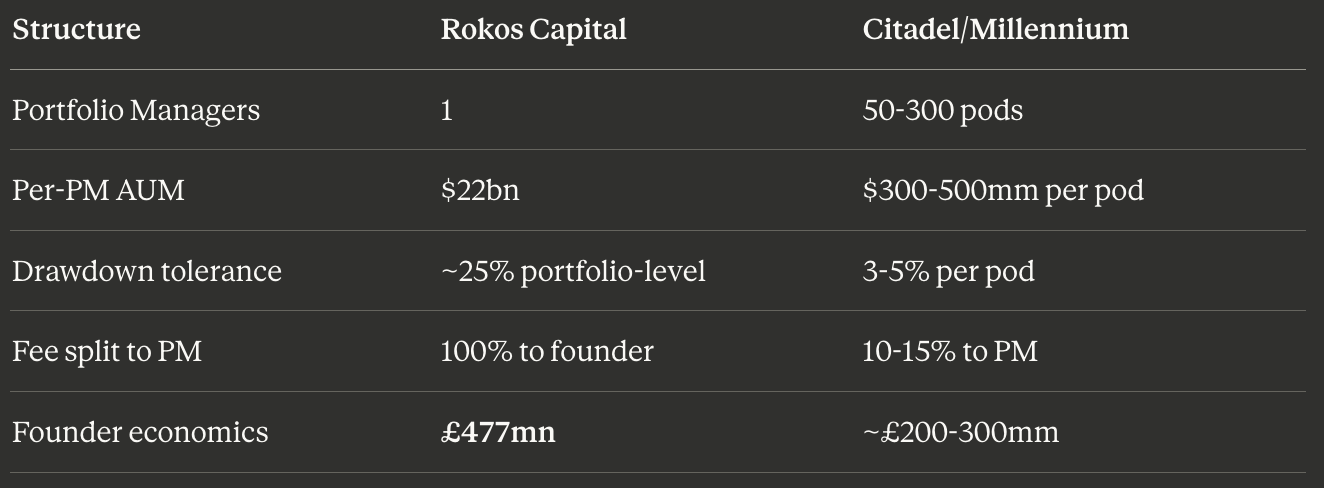
Sources: Single risk-taker model confirmed by Financial Times (Jan 9, 2026); multi-PM structure described in Bloomberg analysis (July 31, 2025)
Trade-off: Higher personal payout and conviction sizing vs. pod diversification and lower volatility.
Key Mechanics for Quant Readers
1. Thesis Formation
Identified consensus fragility: 6-cut pricing represented extreme dovish expectations (CNBC Fed minutes)
Contrarian public stance via Tang in May 2024 (Bloomberg TV)
Monitored catalysts: CPI prints, FOMC meetings
2. Instrument Selection
Directional: Treasury futures for duration exposure
Carry: Payer swaps when front-end stays elevated
Convexity: Swaptions for asymmetric payoff
Note: Standard macro instruments for higher-for-longer trade. Press confirmed bond/rate positions but specific notional mix is proprietary.
3. Sizing & Leverage
High conviction = concentrated allocation (estimated 20–30%+ notional exposure)
Accept interim drawdowns (-26% in 2021) for terminal alpha
Typical macro fund leverage: 3–6x gross via derivatives + repo
4. Economic Capture
Founder-owned vehicle: minimal LP drag
Zero sub-PM fee passthrough (unlike multi-PM structures)
Scale advantage: $22bn × fee structure = substantial fixed management fee base
2024: Best Year for Macro Since 2009
Macro hedge funds broadly outperformed in 2024–2025 (Financial Times, Jan 9, 2026):
Strong performers:
Bridgewater Associates: 33% gain in Pure Alpha (best year ever) (Business Insider, Jan 6, 2026; HedgeWeek, Jan 8, 2026)
Caxton Associates: Strong 2025 performance (Financial Times, Jan 9, 2026)
Graham Capital Management: Winning bets on copper, gold, and weakening dollar (Financial Times, Jan 9, 2026)
Brevan Howard (for comparison):
Master Fund: approximately 0.75% (Business Insider, Jan 8, 2026)
Alpha Strategies: approximately 8% (Business Insider, Jan 8, 2026)
Rokos’s 31% (2024) and 21% (2025) significantly outperformed Brevan Howard’s diversified multi-PM model during favorable macro conditions.
The Formula
£477mn = Correct thesis (higher-for-longer)
         × Optimal execution (bonds/swaps/swaptions)
         × Single risk-taker structure (100% alpha capture)
         × Concentrated sizing (accept -26% for +51%/+31% upside)
         × Structural economics (51% of £940mn pool)
Source logic: Personal payout calculation verified via UK Companies House filings reported by Financial Times and The Telegraph
The single risk-taker model trades Sharpe ratio for absolute return potential. When timing and thesis align (as in 2024), personal economics scale dramatically. When wrong (2021), losses concentrate equally.
Success at this level requires forecasting skill, conviction sizing, instrument selection, and structural economics that maximize personal alpha capture.
Complete Source List
Primary Sources (2026):
Financial Times — “Hedge fund trader Chris Rokos pays himself £477mn” (Jan 9, 2026)
Business Insider — “Rokos Capital delivers strong performance” (Jan 8, 2026)
Financial News London — “Rokos Capital Management profits surge” (Jan 9, 2026)
The Telegraph via Yahoo — “Billionaire former Tory donor pays himself £477m” (Jan 9, 2026)
HedgeWeek — Various 2026 coverage (Jan 2026)
Trade Execution Sources (2024): 6. HedgeWeek — “$1bn profit on US interest rate bet” (Feb 2024) 7. HedgeWeek — “12.5% Q1 gain” (April 9, 2024) 8. Bloomberg — Chris Rokos Q1 performance (April 5, 2024) 9. Bloomberg — Richard Tang interview (May 16, 2024)
Fed/Market Context (2023–2024): 10. CNBC — Fed minutes December 2023 (Jan 3, 2024) 11. CNBC — Fed decision December 2023 (Dec 13, 2023) 12. CNBC — Fed holds rates January 2024 (Jan 31, 2024) 13. Federal Reserve — FOMC transcript (Jan 31, 2024)
Fee Structure (2025): 14. Bloomberg — Rokos raises fees (July 31, 2025) 15. HedgeWeek — Fee increase (Aug 1, 2025) 16. Caproasia — Fee structure details (Aug 2, 2025)
Historical/Background: 17. Wikipedia — Chris Rokos 18. Wikipedia — Rokos Capital Management 19. Wikipedia — Brevan Howard 20. Bloomberg — 2020 44% return (Jan 11, 2021) 21. HedgeWeek — 2022 51% gain (Jan 2023)
Peer Performance: 22. Business Insider — Bridgewater best year (Jan 6, 2026) 23. HedgeWeek — Bridgewater records (Jan 8, 2026)
This article is for educational purposes only and does not constitute investment advice. All sources verified and hyperlinked as of January 2026. UK Companies House filings are public records accessible at find-and-update.company-information.service.gov.uk.
📊 Support this research: https://www.patreon.com/c/NavnoorBawa
Cover photograph: Federalreserve, public domain, via Wikimedia Commons.