



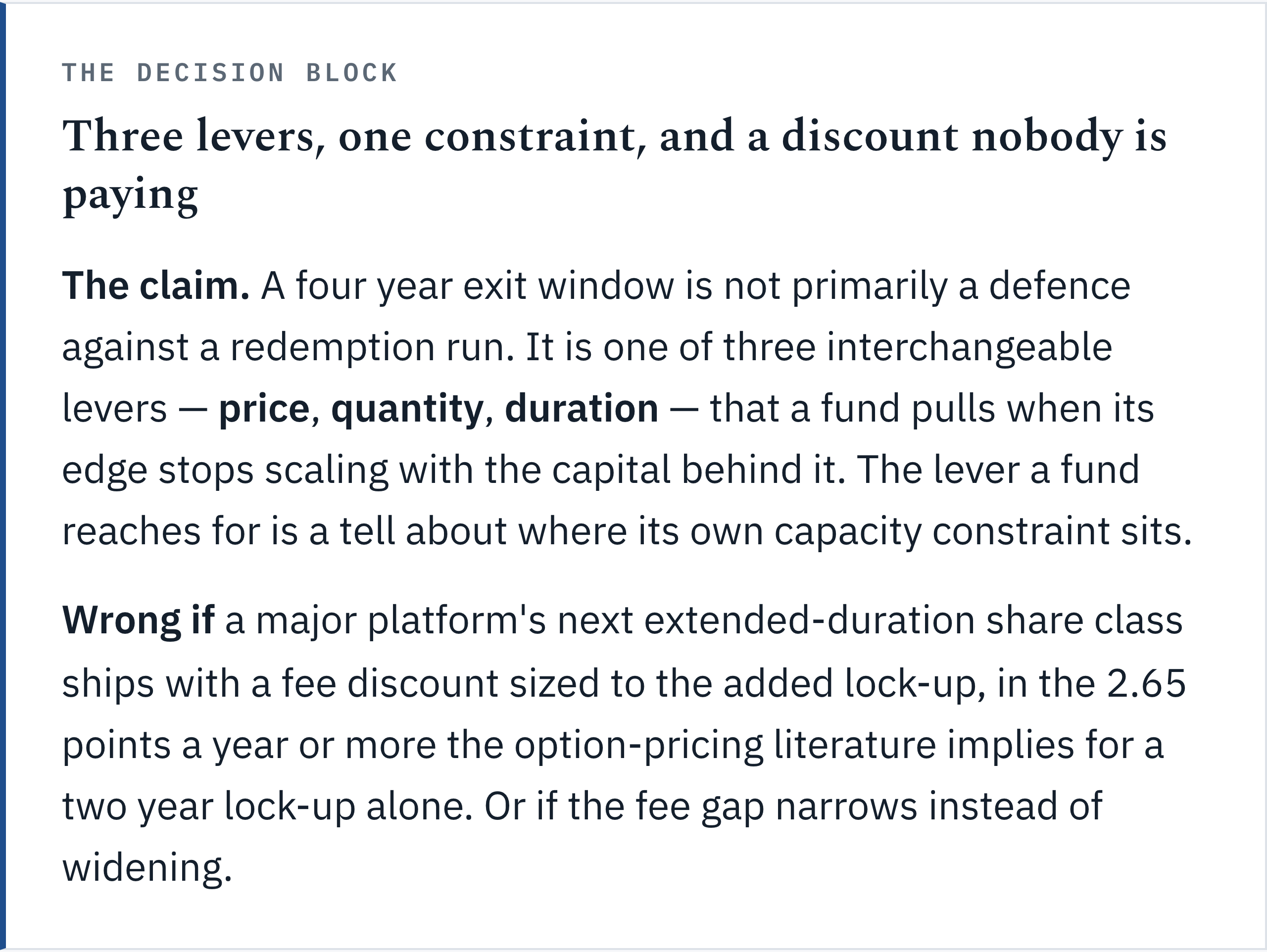
The claim: D.E. Shaw’s new four year exit window isn’t primarily a defense against a redemption run. It’s one of three interchangeable levers, price, quantity and duration, that a fund pulls when its edge stops scaling with the capital behind it. The fee data shows platforms are pricing the duration lever without paying investors the discount the option-pricing literature says it’s worth.
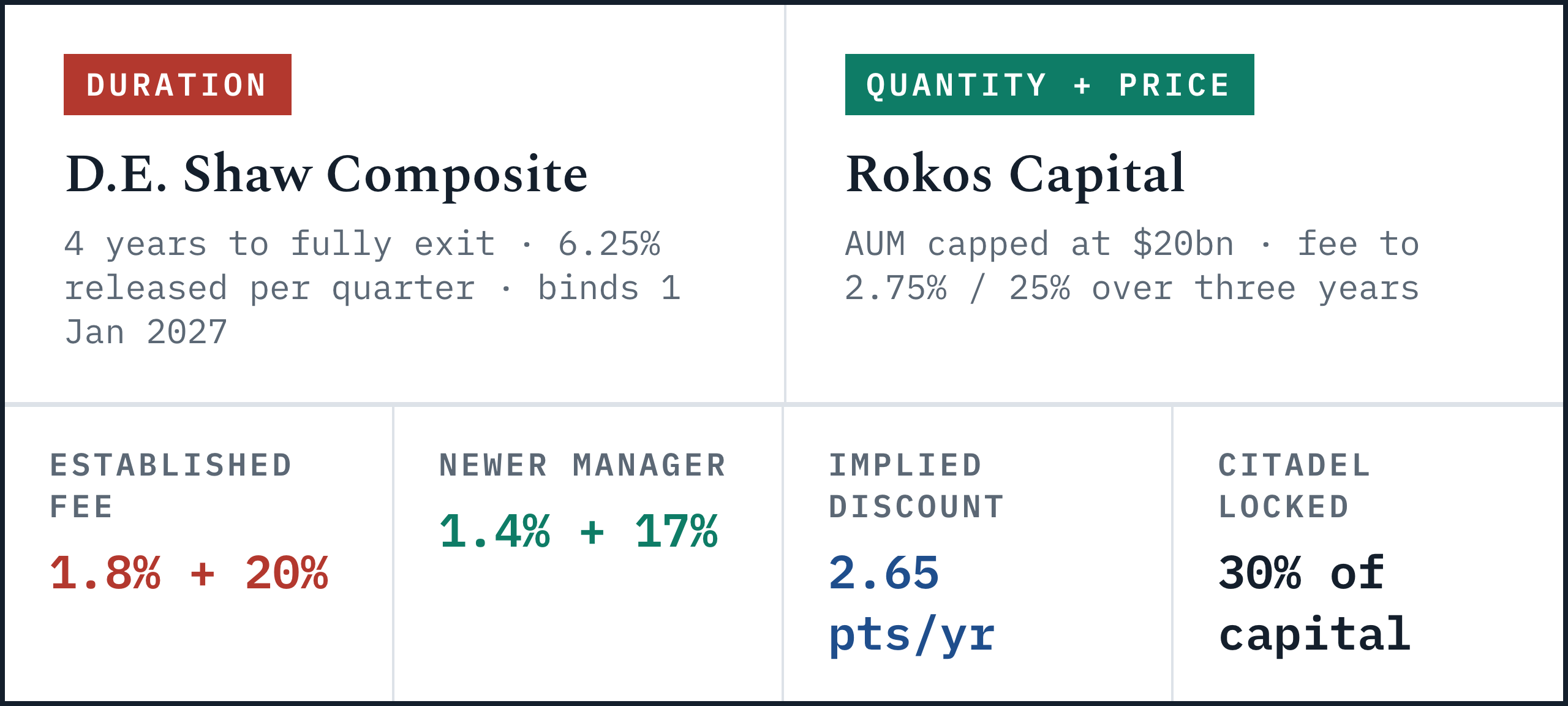
The numbers: D.E. Shaw’s Composite fund now takes 4 years to fully exit (6.25% released each quarter, starting 1 Jan 2027), and Oculus 3 years (Bloomberg via Investing.com, 3 Jun 2026) · established platforms charge 1.8% + 20% in their standard share class against 1.4% + 17% at newer managers offering real quarterly liquidity (Seward & Kissel, 2025) · Citadel already runs 30% of investor capital on a rolling two year lock-up against a 1/16th-per-quarter class for the rest (KBRA, 21 Apr 2026).
The catalyst: D.E. Shaw’s new terms bind on 1 January 2027. Seward & Kissel’s next Established Manager study, usually published mid-year, will show whether the fee gap against newer managers widened or closed.
Wrong if: a major platform’s next extended-duration share class ships with a fee discount sized to the added lock-up, in the 2.65 points a year or more the option-pricing literature’s own table implies for a two year lock-up alone. I’d also be wrong if the fee gap above narrows instead of widening.
D.E. Shaw’s own explanation, and why it holds up
Start with the strongest version of what D.E. Shaw actually said, because it’s not spin.
In June, D.E. Shaw told clients it was stretching the time it takes to fully exit its Composite fund to four years. Its second largest fund, Oculus, moves to three. Neither Bloomberg’s report nor D.E. Shaw’s own statement says what the prior exit timeline was, so I won’t guess at it. Composite investors can now withdraw 6.25% of their assets per quarter starting 1 January 2027. Oculus investors are capped at 8.3% a quarter. The firm said the changes respond to “a broader industry trend of tighter liquidity terms that help protect portfolios and funds,” and that it had studied competitors’ terms and concluded its own funds “were not in the best position for success in future crises.” Bloomberg named the comparison directly: the move “joins similar actions by peers including Millennium Management and Citadel in seeking to keep client cash for longer periods.” Bloomberg via Investing.com
That comparison checks out, and it predates D.E. Shaw by years. Millennium put in place a plan to stretch its full redemption period from one year to five, a program it has kept expanding since. Citadel takes up to four years to fully withdraw cash for a large share of its capital. Hedgeweek Balyasny told clients in 2023 it would lock new money up for two years, then in 2024 capped quarterly withdrawals on new capital at 8.3%, roughly a three year exit, down from a prior 25% a quarter pace that let investors leave in about a year. Brevan Howard’s shift is the starkest of the group. Around 70% of its $11.4bn Alpha Strategies platform now sits in share classes that need at least two years for full redemption, against a three month notice period on the same capital three years earlier. Hedgeweek
There’s real science behind calling this protective, and it is not just a talking point. A 2021 Federal Reserve staff paper on the March 2020 Treasury crisis found that funds with stricter share restrictions pulled back less from Treasury market making, because their capital couldn’t run. Its own number for the median fund at the time: “at least 30 days notice before the first 1% of investor capital (net asset value) is redeemed.” Federal Reserve Intuition: a lock-up is a contractual promise, agreed up front, that capital cannot leave before a set date. A gate is different. It’s the manager’s own emergency power to block withdrawals mid-crisis, used after the fact. Locked-up capital can’t demand its money back into a falling market, so the fund never has to sell a position it likes at a price it hates just to make an investor whole. That is a genuine stabilizer, and I think it is the honest half of D.E. Shaw’s explanation.
The same constraint, three different levers
Here is where I depart from the official story. I think the explanation is incomplete, and I want to be clear that I don’t think it’s wrong.
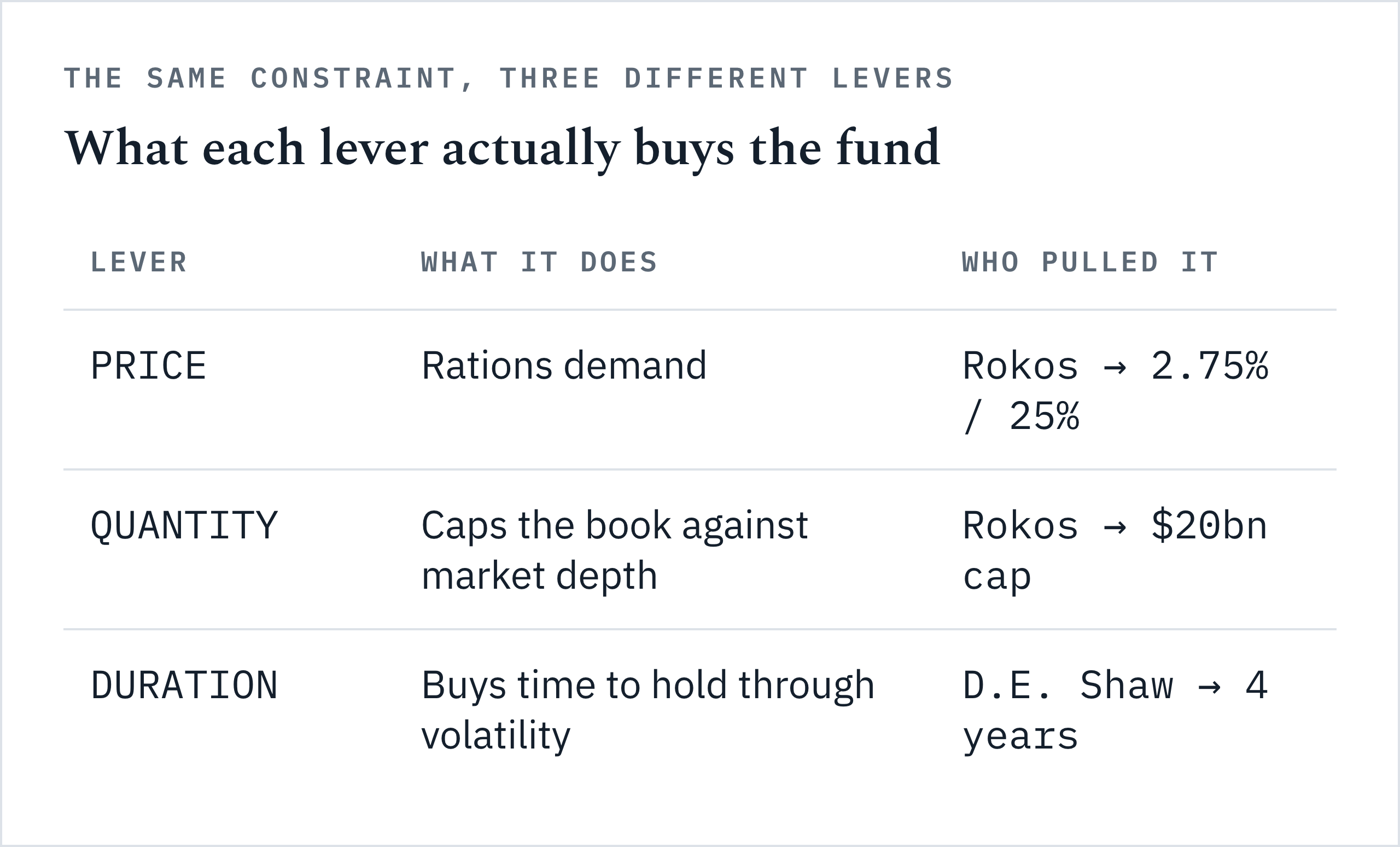
A fund’s edge doesn’t scale with its capital forever, and I’d start there because I think everything else follows from it. Add another dollar and eventually it either dilutes the return on every existing dollar or forces the manager into trades with a worse edge. Every manager I can think of who ran money long enough hit that wall. What varies is which lever a firm pulls in response, and I count three that keep showing up in the public record: raise the price of running the money, cap the quantity you run, or extend the duration you get to hold it for. Duration, as I’d define it here, buys time to hold a position through volatility without being forced out. Quantity caps the size of the book against the depth of the market it trades. Price, as I’d put it, simply rations demand.
Chris Rokos pulled the first two levers in the same twelve months D.E. Shaw pulled the third. His $22bn discretionary macro fund had gained around 21% for full year 2025. Hedgeweek In July 2025 Rokos Capital told investors it would raise its management fee by 75 basis points over three years, to 2.75%, and its performance fee from 20% to 25% over the same stretch. Investors who disagreed were offered a chance to redeem instead. A firm representative said nobody took it. Hedgeweek A few days later, the firm capped assets at $20bn and said it would start handing money back on a pro rata basis, citing “talent constraints and limited capacity in certain macro strategies.” Hedgeweek On the reported “more than $22bn” against a $20bn cap, that is at least $2bn walking back out the door. I did that arithmetic myself from the two disclosed figures. Neither article states the return figure outright.
I don’t think that is a coincidence of timing, though I’ll admit Rokos’s own quote hedges between two reasons at once, “talent constraints and limited capacity,” and I cannot cleanly separate a retention story from a market-depth story in one sentence from one press release. Still, Rokos runs discretionary rates and macro through a single risk-taker, and his capacity is bounded by how much of a specific instrument he can move without moving the price against himself. A longer lock-up does not make the government bond futures market any deeper, so duration doesn’t fix that constraint. Size and price do. D.E. Shaw, Millennium, Citadel and Balyasny run internally levered, pod-based multi-manager books, where the binding constraint is closer to the one the Fed paper measured: can the fund hold its book through a shock without an investor forcing a sale at the wrong moment. Duration fixes that constraint directly. My read is that the lever a fund reaches for is a tell about where its own capacity constraint actually sits, and a London discretionary macro shop and a New York multi-strategy quant platform chose opposite tools for what looks, from the outside, like the same problem.
I hold this loosely. It’s a tendency I think I can see, and I would not call it a law. D.E. Shaw itself has pulled the quantity lever before, for capacity reasons: it returned client profits most years since 2018 to keep its funds from outgrowing their opportunity set. Investing.com/Bloomberg In January 2026, five months before extending Composite and Oculus to their new terms, it broke that habit and kept the cash instead. One fund reaching for two different levers inside a single year doesn’t wreck the pattern I’m describing, but it does mean I am reading a tendency from a handful of cases, not a law.
