


Squarepoint’s US adviser has told the SEC since at least March 2025 that it reserves shorter-term signals for some funds. Its July 2026 brochure repeats the tests for them: higher fees, far more staff money.
Hedgeweek says most of Squarepoint’s capital comes “from partners and employees”, which suggests staff and outsiders ride together. The filing shows one master fund they do not share, 100% owned by the firm and its people. On my reading, outsiders get the slower of two Squarepoints: their funds lack the brochure’s “shorter-term signals”, which work only at limited size. So holders of Focus and Atlas, and perhaps Core, the funds outsiders buy, would trade second, at prices the brochure expects to be less favourable.
I read four of Squarepoint’s Form ADVs, from December 2022 to August 2026, and five rivals’, fund by fund; they make the case in five steps:
Four partners own most of the firm, whose regulatory assets, a gross measure, are three times those in its December 2022 filing.
One master fund, with 390 investors, is owned entirely by the firm and its people.
The brochure reserves the shorter-term signals for funds with higher fees and far more staff money in dollars; Focus and Atlas carry the least, and Core is the open question.
A number of its principals own most of STG, an options market maker that shares Squarepoint’s offices and research.
Whether any of five rivals runs a fund its own people own on this scale, and which way staff ownership has moved since the December 2022 filing.
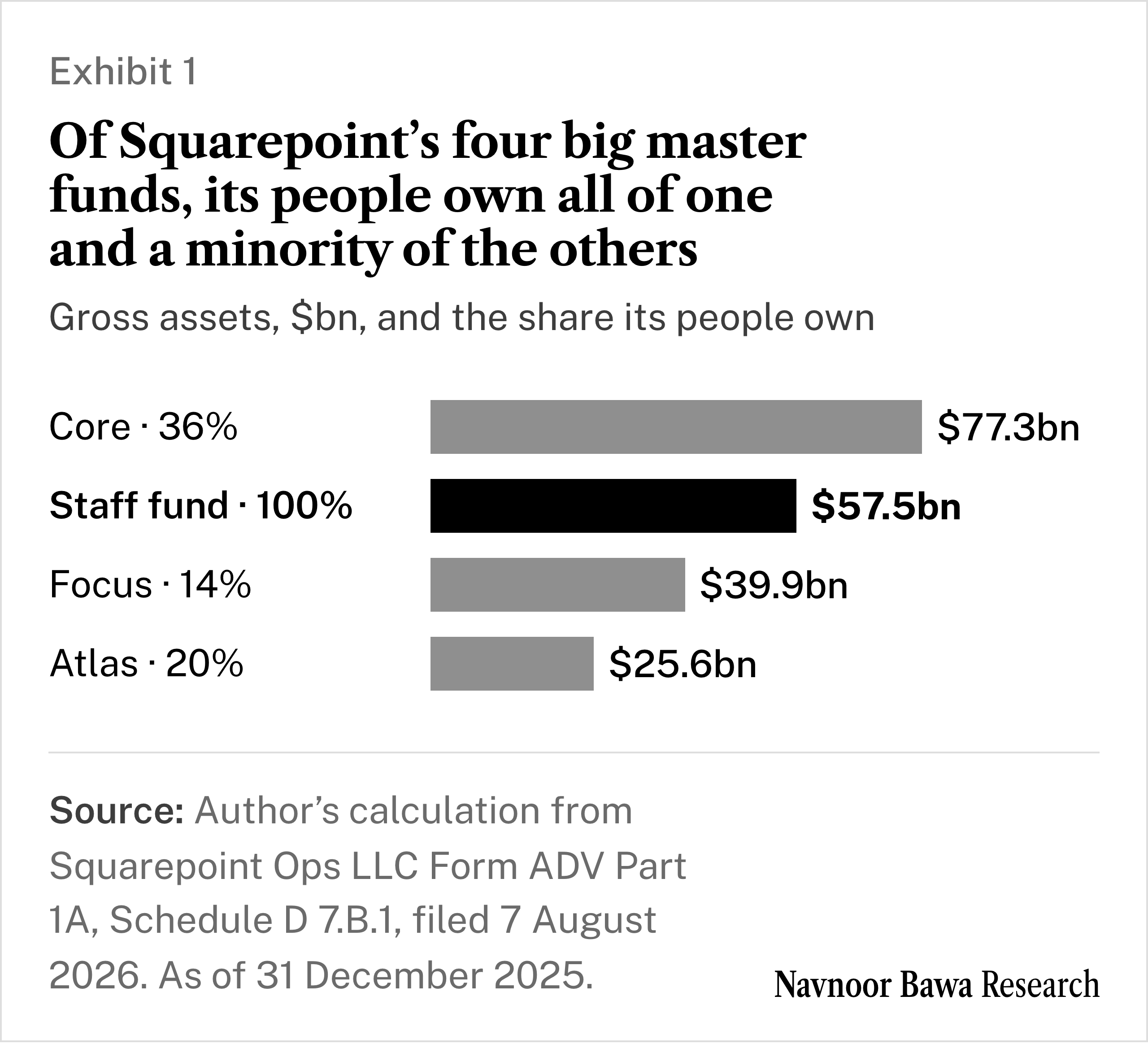
Bars are gross assets, which count borrowing and the funds’ holdings of one another; labels give the share its people own.
Four partners own most of it
Squarepoint began as nQuant, a team that moved from Lehman Brothers to Barclays in 2008, by the firm’s own account; it now calls itself “a privately held firm led by its four founding partners”. Its brochure names its majority owners: “Olivier Durantel, Antoine Fillet, Maxime Fortin and Grégoire Schneider”. None of the four has given an on-record interview that I could find.
On 16 December 2014 entities owned by its managers bought the business from Barclays, the brochure says. That same day, Squarepoint International Feeder Ltd, an offshore feeder of the master fund its staff now own outright, made its first sale. The US feeder of Squarepoint Core Master Fund Ltd first sold on 1 October 2015.
Its adviser, Squarepoint Ops LLC, which with its affiliates forms what its brochure calls the Squarepoint Group, runs all 28 of its accounts with discretion, so one firm decides which fund gets what it trades. Its regulatory assets under management, a gross figure that nets no borrowing, were $227bn on 31 December 2025, three times the figure in its December 2022 filing.
Growth puts more money in line for signals of limited capacity, and the brochure’s rule decides which funds get them: their capacity, it says, “has been reserved for the Higher Fee Funds”, the funds that pass those tests.
Staff own one fund outright
Form ADV gives each private fund its own row, in Schedule D, section 7.B.1, and Squarepoint’s, read fund by fund, sort into two kinds. Question 14 asks what share of a fund the adviser and its related persons own. The SEC’s instructions count among them “all of your current employees (other than employees performing only clerical, administrative, support or similar functions)”, so I call that share the insider share.
If staff and outsiders shared funds, the staff’s biggest stake would sit in a fund outsiders also own. In the August 2026 filing it sits in one they do not: Squarepoint Master Fund Ltd (the staff fund) reports $57.5bn of gross assets, 390 owners and an insider share of 100%. It is itself a fund of funds that invests in other funds Squarepoint manages, which the rows do not name, and no fund of funds owns any of it.
Squarepoint Core Master Fund Ltd (Core) is larger, at $77.3bn of gross assets, with 226 owners and an insider share of 36%.
Squarepoint Focus Master Fund Ltd (Focus) has $39.9bn of gross assets and an insider share of 14%. Squarepoint Atlas Master Fund Ltd (Atlas) has $25.6bn and 20%. On Question 14, outsiders own most of all three, so I call them the outside funds.
The rows show insider money in a fund of its own, and staff a minority, on Question 14, in every outside fund. The one quantity they leave open is staff money through the staff fund: funds of funds own between 13% and 37% of each outside fund, and the filing does not say whose those stakes are.
Citadel’s people sit with outsiders instead: on Citadel Advisors’ filing of 11 June 2026, Citadel Wellington LLC, with $30.9bn of gross assets, is 53% owned by Citadel and its people, a majority by share inside a fund outsiders also hold.
So an outside investor’s own number is the insider share of the fund he holds, and the brochure sets out what each fund gets for its money.
Higher Fee Funds get shorter-term signals
Item 6 of the brochure gives the adviser’s rule for which fund gets which signal. It defines the Higher Fee Funds by two tests. They charge “higher performance-based fees or performance allocations than other Funds, in percentage terms or in absolute dollar amounts”, and “Squarepoint staff have significantly more capital invested in those Funds” than in others. Then it says what they get:
“The Higher Fee Funds have access to shorter-term signals that are not made available to other Funds because the signals are believed to be capacity constrained, and their capacity has been reserved for the Higher Fee Funds.”
In plain terms, the short horizon signals have room for only so much money, and the firm keeps that room for the funds where its staff have the most at stake. The mechanism runs in four steps:
A short horizon signal predicts a price move over a short window; trade it with too much money and the fund’s own orders move the price it is chasing, which is what capacity constrained means.
Squarepoint gives that scarce capacity to the Higher Fee Funds, which also “have priority with respect to new strategies, methods, signals, and other opportunities”.
On execution, the brochure adds that “the Higher Fee Funds generally reach the market ahead of the other Funds. This is likely to result in the other Funds having their orders filled at less favorable prices.”
The brochure says the Higher Fee Funds “have generally experienced, and are expected to continue to experience, higher Sharpe ratios and higher gross returns than the other Funds”.
The signal rule splits the funds two ways, the Higher Fee Funds against “other Funds”. The fund rows show no fees, and the staff test is in dollars. On gross assets, the staff fund carries about $57.5bn of staff money on Question 14, and Core about $28bn. Focus and Atlas carry $5bn to $6bn each. I read the staff fund as a Higher Fee Fund, though the brochure also lists “proprietary funds” beside the tier, so it could sit outside it.
If Core is one too, which its staff money allows, its outside owners sit in the faster tier, while Focus and Atlas carry the least staff money of the four. The brochure names none, so which fund is which stays my reading. Item 6 gives the gap no number, only that one fund’s impact on another “may be material”; any cost of trading second falls on about $66bn of gross assets in Focus and Atlas, and up to $143bn with Core.
The faster tier is not free on paper. The Higher Fee Funds carry higher performance fees, in rate or in dollars, and Item 5 says certain shares restricted to staff bear other products’ expenses “on a greater than pro rata basis”. The brochure prices neither as the cost of the signals.
A further clause lets the firm copy one fund’s human traders into another, including from “other Funds in which Squarepoint Group personnel have substantial proprietary capital invested”, and the copying can run “In either direction”.
The brochure says the copy “is expected to underperform”, at times “materially”, and that the adviser “will continue to charge performance-based fees and management fees” on it. The receiving fund pays full fees for a copy the firm expects to trail.
The rule is not new: the July 2026 brochure lists no material change to Item 6 since the March 2025 one. Item 10 names another business, one that some of the principals own themselves.
Some principals own a market maker
Item 10 puts it in one sentence: “A number of the Squarepoint Group’s principals and their related persons own, directly or indirectly, a substantial majority of a separate commercial trading business, STG group”.
Its broker-dealer, STG Securities LLC, “principally operates as a market maker and liquidity provider with respect to options”. It “does not perform any services, including execution and brokerage services, for clients or the Funds”. It “may, on occasion, act as a counterparty to the Funds” on orders with a US options leg, which “will be handled by a third-party broker”.
STG Group was founded in 2022, and on 30 September 2025 its holding company bought Hull Partners LLC, now STG Securities.
FINRA’s BrokerCheck shows Kirill Gelman running it as chief executive since September 2025, with Eric Levine as head of trading, and STG Securities’ audited accounts show $7.15m of member’s equity on 31 December 2025: a startup’s balance sheet.
STG’s press statement of March 2026 presented the launch as a clean break: “STG Group was established by principals at Squarepoint and is separate from its investment management business”. Hedgeweek, citing that statement on 5 March, reported that “the new broker-dealer will operate independently from Squarepoint’s hedge fund operations and trade securities using its own capital”.
The brochure filed in July 2026 lists the ties:
the two groups “share office space, technology, infrastructure, research, data and other resources”;
“certain senior management of Squarepoint Group are involved in strategic, governance, operational and/or other management decisions or activities related to the Squarepoint Group and the STG Group”;
the Squarepoint Group “expects from time to time to enter into lending arrangements … between Higher-Fee Funds and other funds managed by the Squarepoint Group and entities affiliated with the Squarepoint Group, including the STG Group”.
BrokerCheck adds that a Squarepoint services company has kept part of STG Securities’ books and records since 18 November 2025. STG’s statement and the brochure, which says the two “generally operate as separate businesses”, agree on “separate” and part at “independently”.
The brochure answers the obvious worry in one line: “The Squarepoint Group and the STG Group do not coordinate their trading activities.” Uncoordinated is not harmless. It adds that STG’s trading “may inadvertently have adverse impacts” on the funds, that “any such adverse impacts could be material”, and that “Increases in overlap and competition in business activities will exacerbate the impacts described above”.
On paper STG sits outside the adviser: its Form BD says it is not “under common control with” any securities or advisory firm, and the tie runs through “a number of” principals rather than through the adviser.
eFinancialCareers made the comparison on 5 March: STG “will have a similar relationship to the fund that Citadel Securities has to Citadel”. The lending clause, which that comparison leaves out, brings STG closer to that shape.
So STG touches an outside holder in three ways. It shares Squarepoint’s research, its own trading can move the prices and liquidity his fund meets, and on occasion it may take the other side of his fund’s options orders through that broker. The lending clause touches the funds where staff money sits, not his. STG is separate in law and close in practice.
Where will Squarepoint’s next brochure, due by the end of March 2027, leave a holder of Core: behind the staff fund, or beside it?
Below the paid line:
The screen: the largest fund each of six firms’ people own, side by side, and where Renaissance’s Medallion sits.
The series: each fund’s insider share across three filings, and the funds of funds’ stakes in dollars.
The verdict, my odds on which fund gets the signals, and the line that would prove me wrong.
What to watch: three dated checks on STG and Squarepoint’s next annual ADV.