

Citadel, D. E. Shaw, Elliott, and Farallon each answer the SEC’s independent valuation question zero percent on every private fund they report, three years after SEC staff said the correct answer for their exact fact pattern is 100 percent.
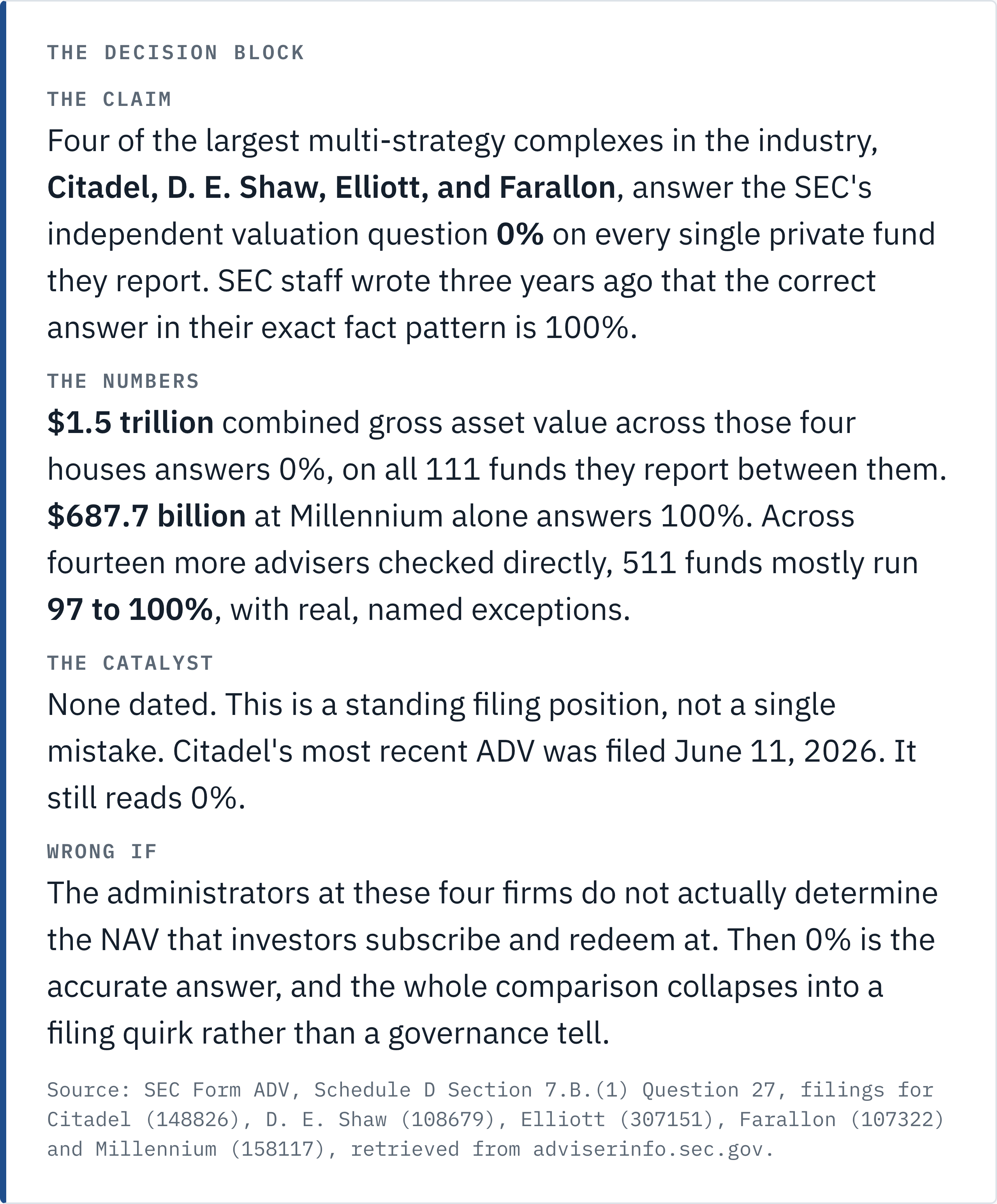
Every SEC-registered adviser to a private fund answers the same question every year: what share of the fund’s assets, by value, was priced by somebody who isn’t you. I pulled the current Form ADV for eighteen of the largest multi-strategy and quantitative managers in the business and read every answer myself, fund by fund. As far as I can tell, nobody has ever tabulated them. What I found is a split so clean it worried me at first. Fourteen houses run overwhelmingly at 97 to 100 percent, real exceptions included. Four cluster at exactly 0, on every fund they report, with no exceptions at all. And the SEC’s own staff has already told the industry, in writing, which of those two answers this fact pattern is supposed to produce.
The question everyone answers, and almost nobody reads
Schedule D, Section 7.B.(1), Question 27 of Form ADV asks each private fund a version of the same thing: during the last fiscal year, what percentage of the fund’s assets, by value, was valued by a person who is not your related party, such as an administrator. The instruction attached to the question is specific about what counts. It only counts if that outside person carried out the valuation procedure the fund actually uses. And it only counts if the resulting number is the one applied to investor subscriptions, redemptions, and fee calculations. A shadow number nobody trades on doesn’t qualify. I read the underlying instruction directly off the SEC’s own Form ADV general instructions, which tell advisers to “treat all of the assets of a private fund as a securities portfolio” and never deduct liabilities. Question 27 is written with the same precision.
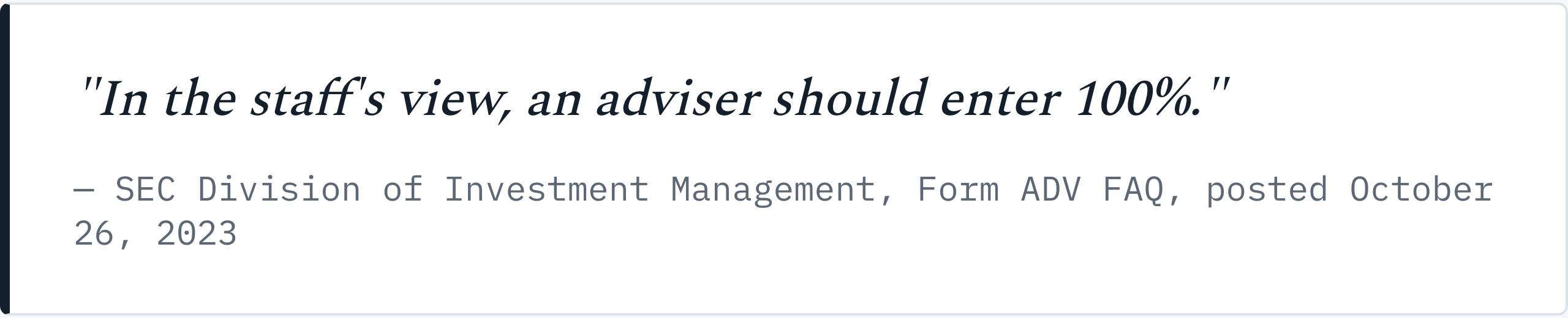
That specificity matters, because the SEC has already ruled on the exact ambiguity a 0% answer could be hiding behind. In an FAQ the agency posted on October 26, 2023, staff addressed an adviser who reasoned this way: my administrator prices 100% of the fund, but I’m ultimately responsible for the number, so shouldn’t I enter 0? The staff’s answer, verbatim: “In the staff’s view, an adviser should enter 100%.” I confirmed this myself, on the live SEC site. sec.gov blocks automated fetches outright. A plain HTTP request and a scripted fetch both come back with a flat 403. I had to load the page in a real browser session and pull the text off the rendered page. The guidance has been public for almost three years.
One caveat on the guidance itself, stated plainly: it is a staff FAQ, not a Commission rule. Nobody is bound to follow it, and I found no enforcement action or deficiency letter citing any adviser for answering Question 27 the way the FAQ says not to. Three years of an unchanged 0% is three years of not adopting non-binding guidance, not defiance of a rule. I have tried to keep that distinction in view throughout.
A 0% answer, filed by a firm that names a real, unaffiliated administrator, is not a neutral disclosure. It’s an assertion. It says the administrator’s valuation work is not the number the fund’s own investors trade on.
What “a good administrator” is assumed to mean
Ask most allocators what an independent administrator buys them and you’ll get the standard operational due diligence answer. A big, recognizable name like Northern Trust or Citco or State Street on the fund’s paperwork means an outside party is checking the manager’s marks. Full stop. Writing on ODD practice, like this overview of the discipline, asks who the administrator is and whether it’s independent. It rarely asks whether that number is the one that actually prices a subscription or redemption, and the industry has generally assumed those are the same question. Two law firm alerts, from Mayer Brown and Simpson Thacher, told compliance departments the 2023 guidance existed. Neither asked which large advisers had actually changed their answer. That’s the strongest form of the consensus: a large, unaffiliated administrator is the disclosure that matters, and a single percentage field on page 40 of a 300-page form is a compliance detail nobody outside the back office reads.
I don’t buy it once you look at what the four 0% firms are actually reporting, fund by fund, alongside that one answer.
The variant view, and what forces it
Citadel Advisors LLC’s most recent Form ADV, filed June 11, 2026 (the same filing where Citadel’s own AUM runs eight times the headline number), reports thirty-seven private funds. I extracted every one of them from the filing’s Schedule D myself, matching each fund’s gross asset value and Question 27 answer to its own top level entry. Master-feeder structures nest sub blocks inside a master fund’s own record, and a naive text search will happily attach the master’s dollar figure to the wrong feeder’s name. I built my extraction around the form’s own item numbering to avoid exactly that trap, and I paid for the caution once already: my first pass misassigned Millennium’s $687.7 billion flagship to a feeder fund called Millennium USA LP. I had to trace the item hierarchy back to find its real owner, Millennium Partners, LP, the entity that actually carries item 27’s 100% answer alongside 1,697 beneficial owners. The full six-step version of that method, and a nineteenth adviser I checked against it after this piece first went out, are in a companion note on Patreon.
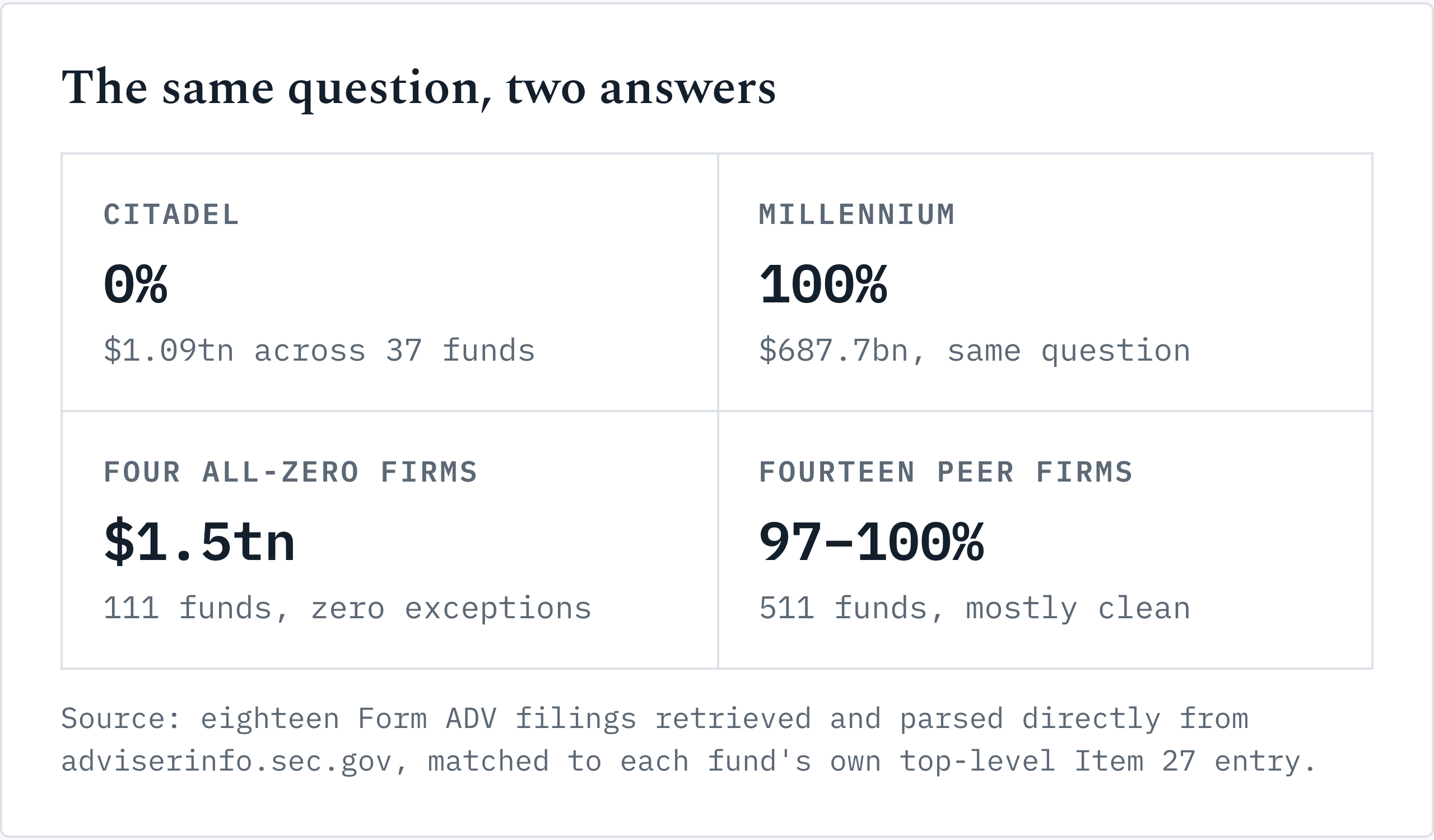
Every one of Citadel’s thirty-seven funds answers 0%. That’s $1,094,345,899,742 in combined gross asset value. Every dollar of it. Including the $331.3 billion Global Fixed Income Master Fund, Citadel’s single largest reported fund. Including the $30.9 billion Wellington fund, which reports 309 beneficial owners and a named administrator, Northern Trust Hedge Fund Services LLC, that the filing says sends account statements to every one of them. I pulled up that specific page as a rendered image instead of trusting the extracted text, because Question 26’s sub answers are radio buttons, not typed fields, and extraction can silently drop which button is actually marked. The image confirms it. “Is the administrator a related person of your firm?” is marked No. “Does the administrator prepare and send investor account statements?” is marked Yes, provided to all investors. Question 27, right below both, still reads 0%.
The other three all-zero houses
D. E. Shaw’s current filing shows the identical shape: thirteen funds with a reported gross asset value, all thirteen answering 0%, $213.4 billion combined, Citco Fund Services (Cayman Islands) Ltd named as administrator on every one. Elliott Investment Management reports thirteen funds, all 0%, $128.6 billion, administered by Harmonic Fund Services, with Bank of New York Mellon also named on its two largest. Farallon Capital Management reports forty-eight funds with a gross asset value on file. Every single one is 0%. $64.2 billion combined. Twenty of the forty-eight name State Street (Cayman) Trust Limited or International Fund Services as administrator; the other twenty-eight report none at all, which makes a 0% answer on those twenty-eight unremarkable, since there is nobody to override. It is the twenty with a real, named, unaffiliated administrator that carry the same weight as Citadel’s and Elliott’s. Four firms. Four different unaffiliated administrators, at least where one is named. One identical answer, repeated across a hundred and eleven separate fund filings, with zero exceptions among them.
I checked the other side of the comparison with the same discipline, because a finding this clean is exactly the kind that turns out to be a parsing artifact. I downloaded and parsed fourteen more advisers, matching item hierarchy the same way: Millennium, Point72, Two Sigma, Bridgewater, AQR, Schonfeld, Balyasny, ExodusPoint, Squarepoint, Verition, Tudor, Voleon, Third Point, and Capstone. Across those fourteen, 511 funds report a Question 27 answer, for 622 across the full eighteen-adviser sample combined. Two Sigma answers 100% on all sixty-two of its funds, from its $38.3 billion Absolute Return Portfolio down to its smallest vehicle. Bridgewater, all thirty-eight, including its $48.4 billion Pure Alpha Trading Company II. Schonfeld, thirty-nine of thirty-nine, topped by a $171 billion master fund. Balyasny, forty-three of forty-three. ExodusPoint, Squarepoint, Voleon, and Capstone answer 100% on every fund each of them reports. AQR reports 100% on 199 of its 203 funds; the four exceptions sit at 91 to 99 percent, never zero. Verition answers 99% flat across all five of its funds. Tudor is the real outlier on this side of the comparison: ten funds ranging from 100% down to a single fund at 3%, a genuine spread inside one firm’s own book. That’s the clearest illustration in my whole sample of what an honest, asset-driven answer looks like when it varies. Real operational variation shows up as a spread. It doesn’t show up as a wall.
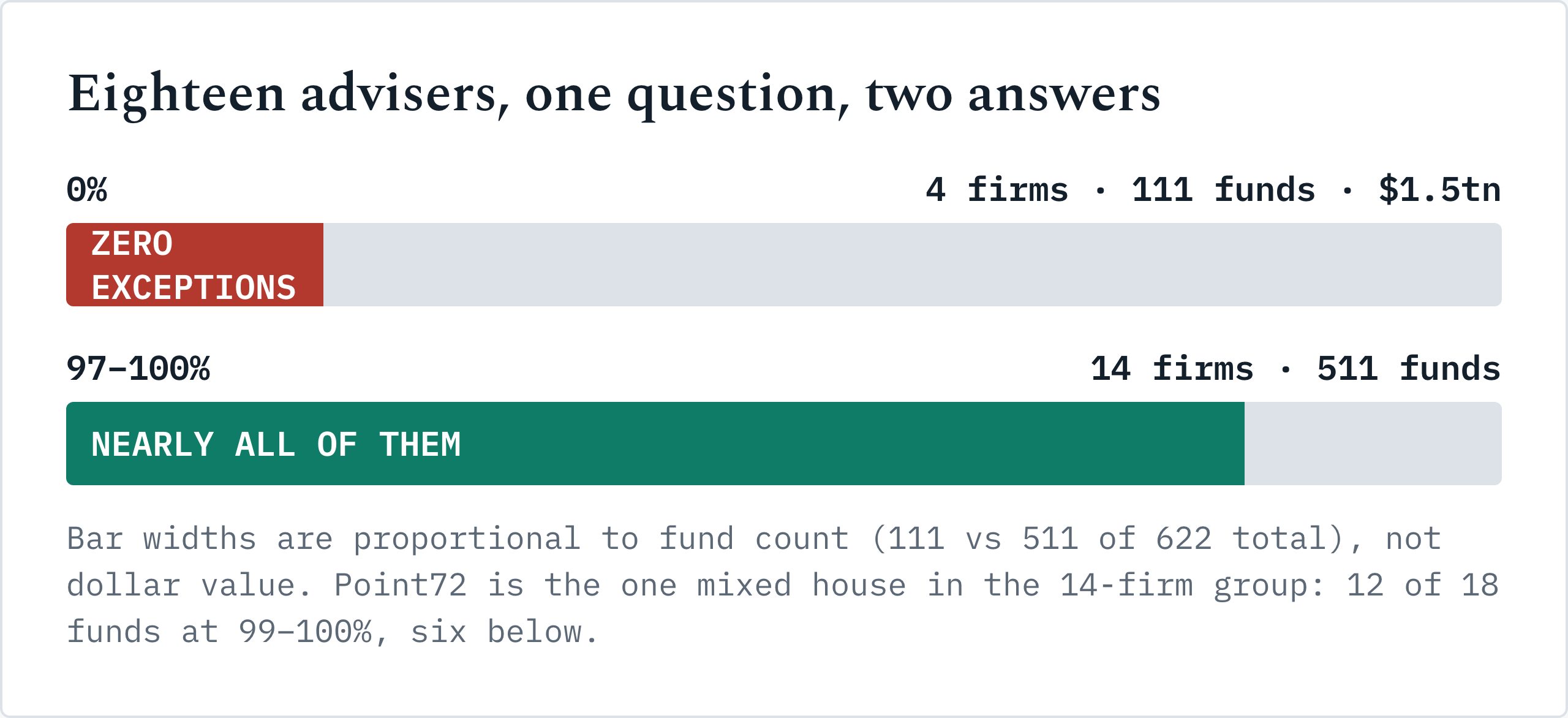
Point72 is the one mixed house in my whole sample, and it’s instructive precisely because it isn’t clean. Point72 Associates, LLC, its $266.3 billion flagship, answers 99%. Twelve of its eighteen funds run 99 to 100%. But six smaller Point72 vehicles answer differently: Point72 Credit at 46%, three Point72 Hyperscale entities at 0% (running $75 million, $283 million, and $67 million), and two more, CPV Real Estate Holdings at 0% ($22 million) and CPV Holdings II at 0% ($1.52 billion), all presumably because those specific funds hold assets the administrator can’t price. That’s what an honest, asset-driven answer looks like. It varies with what the fund actually holds. It moves fund by fund, the way a real operational difference should, and Tudor’s 3-to-100 spread makes the same point from a different firm. Citadel, D. E. Shaw, Elliott, and Farallon never vary. Not once, across 111 funds combined, spanning fixed income, equities, credit, and multi-strategy books alike.
I went a step further and checked whether Point72’s spread might explain the broader pattern on its own, since it’s the clearest case in my sample of a firm reporting both answers honestly. It doesn’t. Point72’s zero-percent funds are mostly small relative to its $266 billion flagship, with one real exception, the $1.52 billion CPV Holdings II. Citadel’s zero-percent funds are not small either. They include the largest fund among the four all-zero houses, at $331 billion, larger than Point72’s own flagship and every one of its exceptions. Scale doesn’t explain a firm answering 0% either way; if anything, the biggest fund among the four zero-percent complexes is the one where an outside valuation would matter most to the investors who hold it.
