


Qube Research & Technologies’ 2025 accounts, filed in September, split £2.92bn of revenue into two lines. For QRT, the London quant firm, the larger is its own costs coming back from its funds; the smaller is its performance fee.
So QRT earns one thing, a share of its funds’ gains, while the funds pay its bills through a monthly charge it calls the pass-through. Its profit is the fee it keeps, and the cost of its growth comes out of the returns its investors are shown.
No press report has printed that bill; the 2026 accounts test whether it tops the fee again.
The closing chapters settle whether 2025 was a single year or a pattern.
They give the odds, as a number, that the funds again pay more toward QRT’s costs than in fees, and name the deciding number in QRT Limited’s 2026 accounts.
Half the revenue is its own costs
The filer is QRT Limited, the UK group. I rebuilt QRT’s money from its own nine sets of accounts at Companies House, 2017 to 2025, and checked every year against its own profit line. Each one ties out, so the numbers below are the firm’s own.
What surprised me was note 4 of the 2025 accounts: the line for QRT’s own costs coming back from its funds, £1.48bn, is bigger than the performance fee, £1.44bn. Together they make the £2.92bn. Note 4 calls the larger line “other revenue” and says it “represents pass through revenue and the recharge of expenses”. I call it cost recovery.
The accounting policy, note 2.5, says how it works. “Pass through revenue is based on expenses incurred by QRT and recoverable from the Funds. Pass through revenue is recoverable on a monthly basis, when the costs are incurred by QRT”. The policy’s conditions are that QRT has incurred the cost and may recover it from the funds; none is about how the funds performed.
QRT pays its staff and its bills, and the costs are recoverable from its funds1 monthly, as they are incurred. In 2025 QRT recovered £1,476.1m of the UK group’s £1,518.4m of costs. That share, which I call coverage, was 97.2%. The funds pay nearly all of QRT’s running costs as they go.
Divide cost recovery by the fee and the funds paid £1.02 toward QRT’s costs for every £1 of performance fee they were charged.2 I call that the ratio, and it last stood above £1 in 2019, when QRT employed 125 people. Above a pound, the funds pay more toward the firm’s costs than in performance fees. The margin is thin, £32.6m on £1.44bn of fees, but it points one way.
Half of what QRT calls revenue is its own costs coming back from its funds, and in 2025 that half was the bigger one. Those costs are charged to the funds as they arise, so they come out of the returns QRT’s investors are shown. QRT’s payroll reaches its investors’ returns as surely as its models do.
BDO, QRT’s auditor, named pass-through revenue as one of two areas it tested for fraud risk, beside management override. It checked “the existence and accuracy of pass-through revenue recognition” against the signed investment management agreement between QRT and its funds. Of QRT’s two revenue lines, the auditor chose the pass-through to test.
The press reads QRT through its returns. In January, Hedgeweek, citing Bloomberg, reported that QRT’s “flagship hedge fund delivered gains of around 30% in 2025”. The 2024 accounts got the same reading from eFinancialCareers, which wrote that “Revenue in the entity more than doubled to £2bn” and put pre-tax profit at £914m. About half of that revenue, £1.07bn, was cost recovery. The returns decide what QRT earns; they do not decide what its funds pay.
The funds pay for the growth
QRT’s board, led by chief executive Pierre-Yves Morlat, names one driver for both lines. Director Marcus Knight signed the 2025 strategic report on 23 April 2026. It reads, “As the investment manager of the Funds, the primary KPI for the Group is linked to the performance of the Funds, which drive the total revenues and expenses of the Group”.
The record bears out the revenue half of that sentence better than the expenses half. Take the net fee, what QRT keeps after its sister firms abroad, entities under common control that the 2023 accounts place in Hong Kong, Singapore and Dubai, take their share. In 2023 the net fee grew 4.3% while costs grew 59.6%. Since 2022, the returns drive the fee and the firm’s size drives the costs.
Two readings would shrink that finding, and the record rules out both. If cost recovery outgrew the fee because returns fell, the net fee would have shrunk; it grew in every year from 2021 to 2025. The 2024 accounts began showing fees before the sister firms’ share, and that change lowered the ratio, so the new presentation did not make the finding. Coverage holds no fee line, and it had already jumped under the old presentation.
The firm’s size is people. The UK group employed 1,336 people on average in 2025, against 343 in 2022, and its costs went from £357m to £1.52bn. QRT’s centralized allocation grew the firm; the accounts show who paid for the growth.
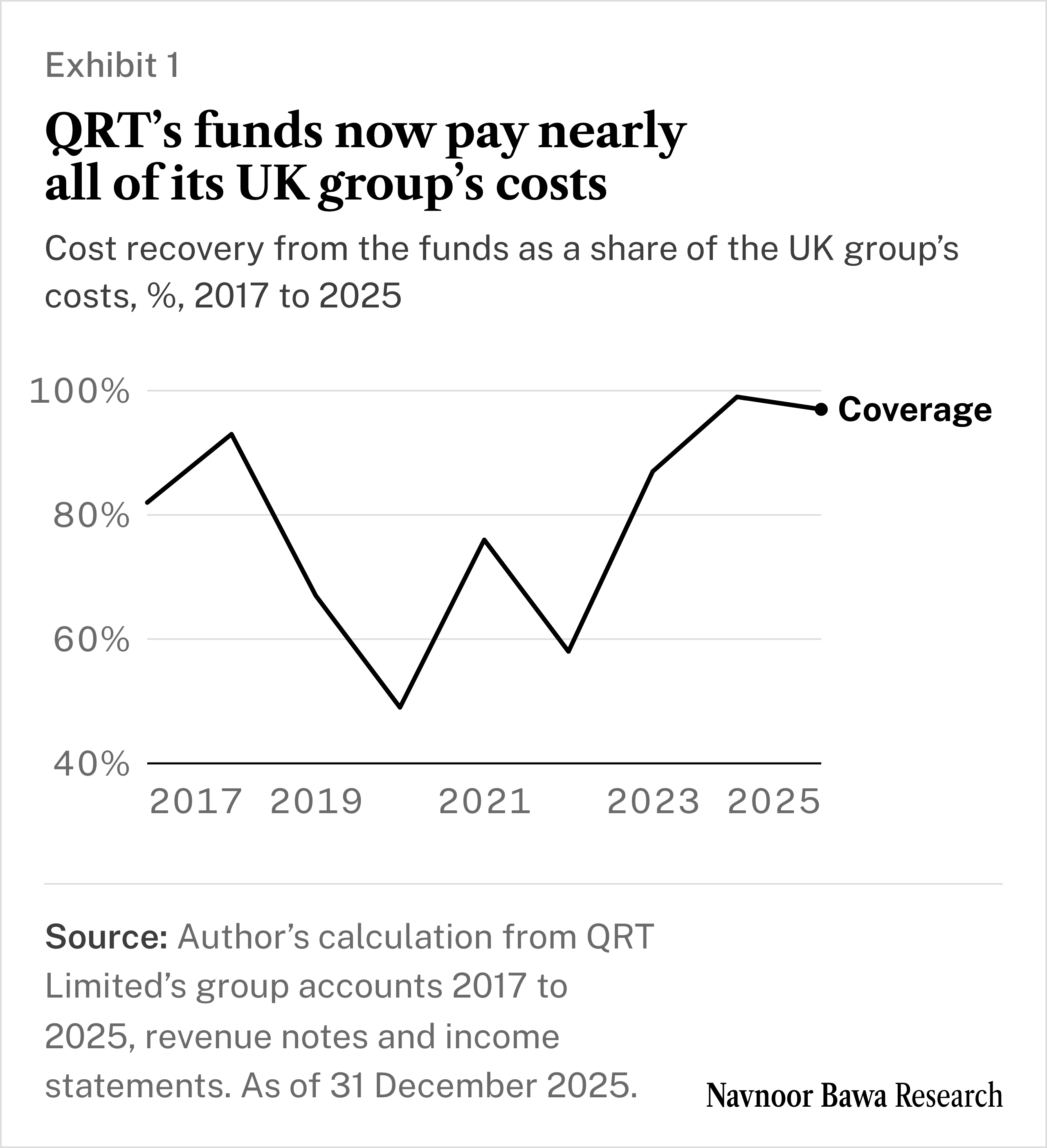
The charge itself is old.3 What changed is the share the funds carry. Coverage went from 58% in 2022 to 87% in 2023, and held between 97% and 99% in 2024 and 2025, as Exhibit 1 shows. The filings do not say why 2023 jumped. In 2025, with coverage near its peak, costs rose 40.9% against a net fee up 19.5%.
A peer says outright what a pass-through means for the investor. The brochure of Tudor Investment Corporation says the staff pay it passes through “accrues regularly and will be payable whether or not the applicable Tudor Hedge Fund experiences positive trading results”. QRT’s accounting policy is less blunt and names no condition on returns; the agreement that sets the terms is not public.
A prime broker has measured what such structures cost investors. BNP Paribas data, as Hedgeweek reported, found that investors in multistrategy funds “kept just 41 cents of every dollar earned” in 2023, down from 54 cents in 2021. QRT’s growth arrived as a bill on its funds, and in three of the last four years the bill grew faster than the fee.
The profit is the fee it keeps
Walk 2025 from revenue to profit, and the cost lines all but cancel against the cost recovery above them.
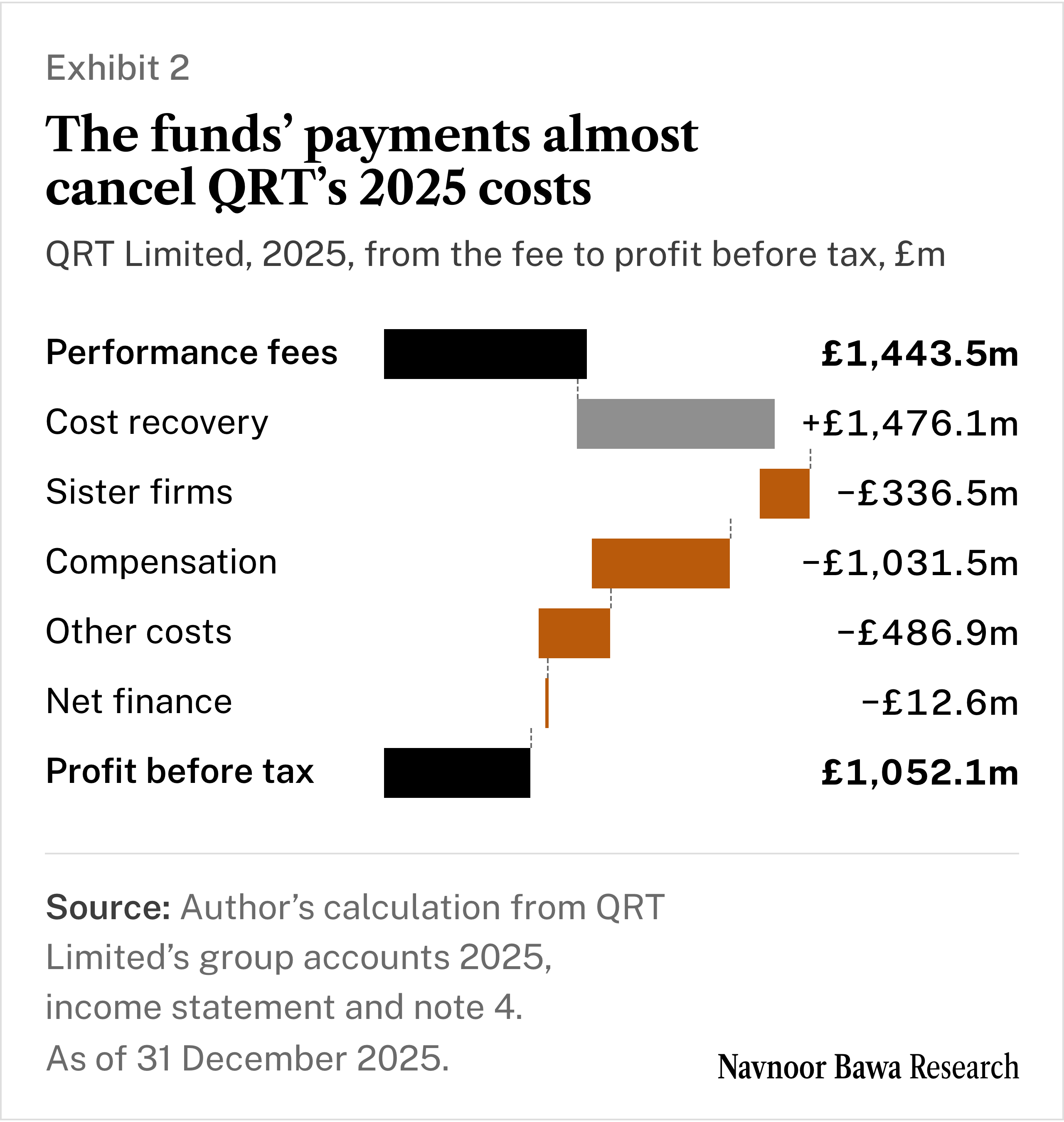
The sister firms took £336.5m. That left QRT a net fee of £1,107.0m, and profit before tax was £1,052.1m, 95% of it. Almost none of the cost bill reaches the profit line.
The directors lean on the same mechanism to call QRT a going concern. They expect adequate resources “based on the net current asset position as at the balance sheet date and the Company’s pass-through mechanism”. The funds’ payments are part of why the directors expect QRT to pay its way.
What reaches the owners is the fee. The UK group paid £499.0m in dividends in 2025, against £362.5m in 2024. A strong year for the funds is a strong year for QRT’s owners, and the funds carry most of a year of heavy hiring.
A performance fee is usually struck after costs. Where it is, and a fund sits above its high-water mark, the past peak it must regain before it earns a fee, investors bear 65–75p of each pound of pass-through cost at incentive fees of 25–35%. That is the range Hedgeweek reported in September 2025 for QRT’s staff share classes, “bringing them in line with external investors”. Most of each pound of cost is the investors’.
The claim stops at the UK group’s edge. QRT Limited is not all of QRT, because the sister firms keep their share outside it. The consolidated accounts of 1751 Capital Holding Ltd, the Guernsey parent, “can be obtained from their registered office”, and no public register holds them. So the claim is the UK group’s, and that group booked £2,895.7m from the funds in 2025, almost all of its revenue.
Marshall Wace, the London peer, shows the other model. It kept a management fee, and its LLP booked £658.8m of “management fees and other income” beside £755.5m of performance fees in its year to 28 February 2025. Its other income includes research costs its funds pay. Both firms collect money their funds pay in any year; Marshall Wace books most of it as a management fee, QRT as its own costs coming back.
→ QRT’s 2024 Darktrace short, rebuilt from the regulator’s filings, Trade File No. 6 on Patreon.
Will QRT’s 2026 accounts show its funds paying more toward its costs than in fees for a second year?
Below the paid line:
A five row replay of QRT’s own years, with our odds on a repeat as a number.
A nine year record table of QRT’s accounts, with the ratio counted two ways for the last three years.
A four line test for any manager’s UK accounts, run next on Marshall Wace.
Three dated checks, each with the line that settles it.