



In 2025, Jane Street Europe, the firm’s London trading company, nearly tripled its trading gains. Its return on capital went from 17.1% to 17.7%, by the measure its own accounts define, applied to the company alone, without its Indian and Korean subsidiaries.
In other words, since 2023 Jane Street Europe has earned a steady return on its capital, measured as operating profit over capital employed (total assets less current liabilities). Its 2026 accounts, due by 30 September 2027, should show it again.
That matters to anyone reading Jane Street’s London accounts: the trading company’s profit measures the capital it puts up, and London’s trading sits in a bill. Since 2023 its return has been no gauge of how London traded.
In July, Elias Ward of btw.media read the same accounts the other way. He set the 2025 falls of the London group, the company with its subsidiaries, a return on capital down from 34% to 19% among them, beside the company’s own figures. He wrote that “a lower return on capital employed shows that more capital does not automatically mean more value”. He read its independence as “a costed bet that internal control over technology and capital produces better trading outcomes than outsourced scale”.
The London group’s return did fall. The fall sits in its subsidiaries in India and Korea, whose trading gains, Korea’s included in 2025, dropped by about three quarters in a year that included an order by India’s market regulator. The company itself employed more capital in 2025 and earned a higher return on it. One question decides between the readings: does the trading company’s own return move with its trading? From 2023 to 2025 it did not.
I read the accounts Jane Street Europe and its London partnership have filed since 2022 and recomputed the company’s return from its own definition. I also matched the charge it books against the partnership’s revenue line “amounts charged to other affiliates”: they agree within 6% every year.
The case runs in six chapters:
Since 2022 the trading company has held London’s positions, and the partnership its people.
The trading company’s return has held near 17.5% while the charge moved with its gains.
London’s pay nearly doubled in 2025, part of it a promise paid later.
The largest partner, a Delaware Jane Street company, was entitled to $1.56bn of 2025’s profit.
India carries the London group’s fall, and a $539m escrow with no provision.
The 2026 accounts should put the return inside 13% to 22% again.
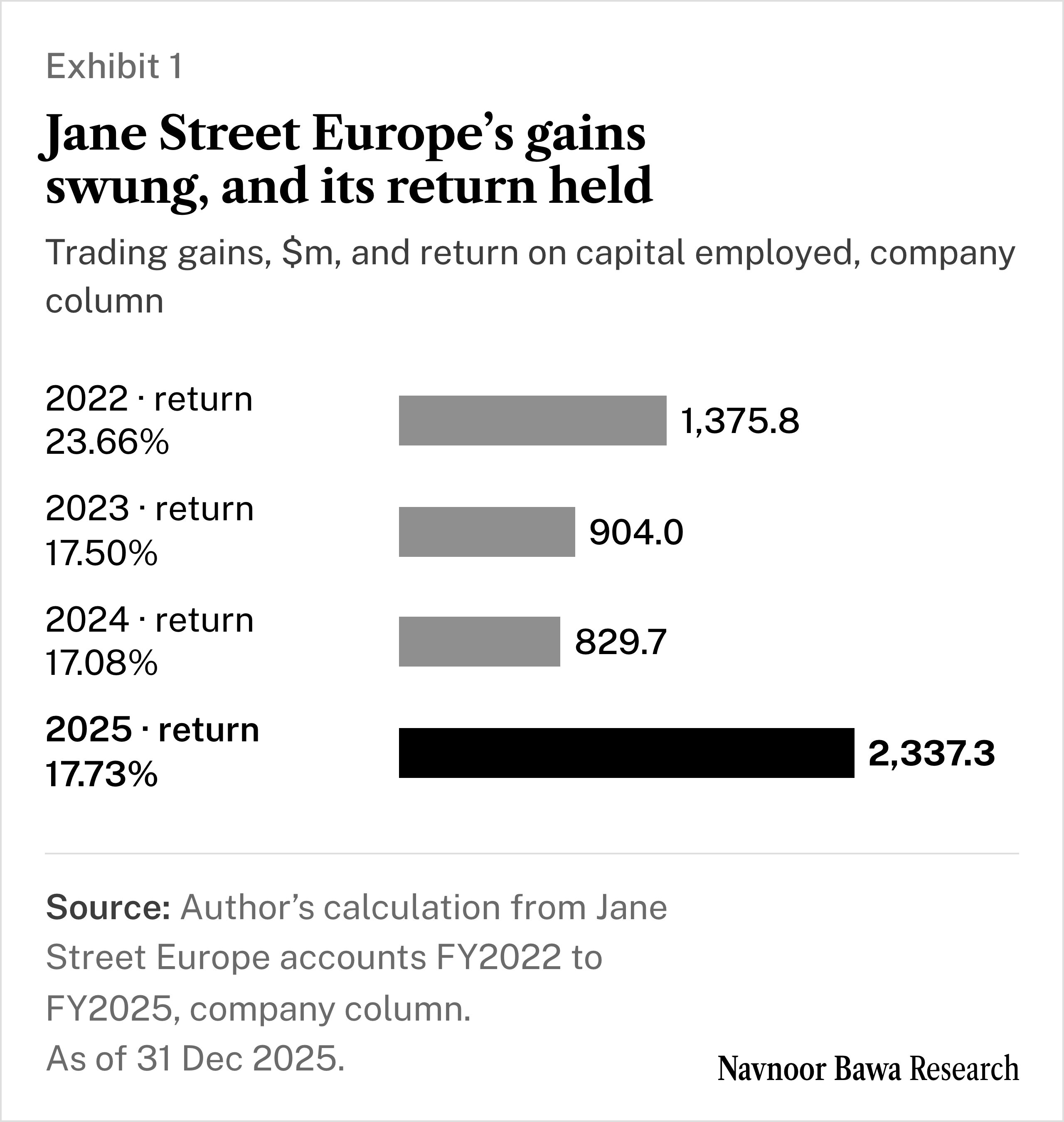
Source: Author’s calculation from Jane Street Europe Limited accounts FY2022 to FY2025, the revenue note (note 2 in FY2022 and FY2023, note 3 in FY2024, note 4 in FY2025) and the balance sheet, company column; return is operating profit over total assets less current liabilities · as of 31 Dec 2025.
Read it down: from 2023 the return stays within a point while the gains swing, and 2022, the year London’s people moved out, sits above. The swing went into the partnership’s charge, which rose from $202.7m in 2024 to $1.67bn.
London moved its people in 2022
The move began with a rewrite. Jane Street Europe’s 2022 accounts say: “During the year ended 31 December 2022, the Group’s Transfer Pricing Arrangements were revised and the Company entered into a UK Services Agreement.” Transfer pricing is what one company in a group charges another. From 1 January the company “no longer receives an allocation of employee costs”. On 1 August “all of the Company’s employee contracts were transferred to JSUP”, under the rules that carry employment contracts across unchanged when work moves to a new employer.
JSUP is Jane Street UK Partnership LLP, a limited liability partnership formed in October 2021. The accounts give no reason beyond the revision, and warn that 2022’s revenues are “not directly comparable” with earlier years.
What stayed in the trading company is the trading. Its revenues “are attributable to income from movements in the fair value of financial instruments, trading profits and losses”, plus charges to Jane Street’s US parent and from other affiliates. That is narrower than the usual answer, market making on enormous volume, and fees run the other way: commissions and fees, and interest and dividends, sit as costs inside its 2025 revenue line.
The partnership’s accounts describe its job in one line: “The principal activity of the LLP is the provision of certain operational services to its UK affiliates”. It employs London’s people, seconds them out and bears the trading company’s audit fee and future lease payments. It averaged 790 people in 2025 of Jane Street’s roughly 3,500, and its two designated members are Delaware companies: Jane Street Group, LLC and Jane Street Global Trading, LLC.
For the whole firm, Reuters reported Jane Street’s 2025 net trading revenue at $39.6bn, against roughly $12.3bn at Hudson River Trading and $12.2bn at Citadel Securities, none of it filed.
Since 2022 the trading company has held the positions and none of the people, and the partnership the people and none of the positions. The charge between them, labelled in 2022 “Amounts charged from JSUP”, is where London’s trading shows up.
London’s company earns a steady return
The trading company’s accounts name the link: it “receives/pays compensation for all trading activities performed on behalf of the Group in accordance with a trading services agreement … and the Group’s transfer pricing arrangements”. The machine runs in four steps:
London’s people, employed by the partnership, trade positions booked in the trading company or elsewhere in Jane Street.
The gains land in the company that holds the position.
The partnership charges that company under arrangements whose formula the accounts never state.
The trading company’s revenue line is left with the rest; the partnership spends the charge on its people and allocates what remains to its members.
The 2025 revenue note is the worked case, set out in Exhibit 2.
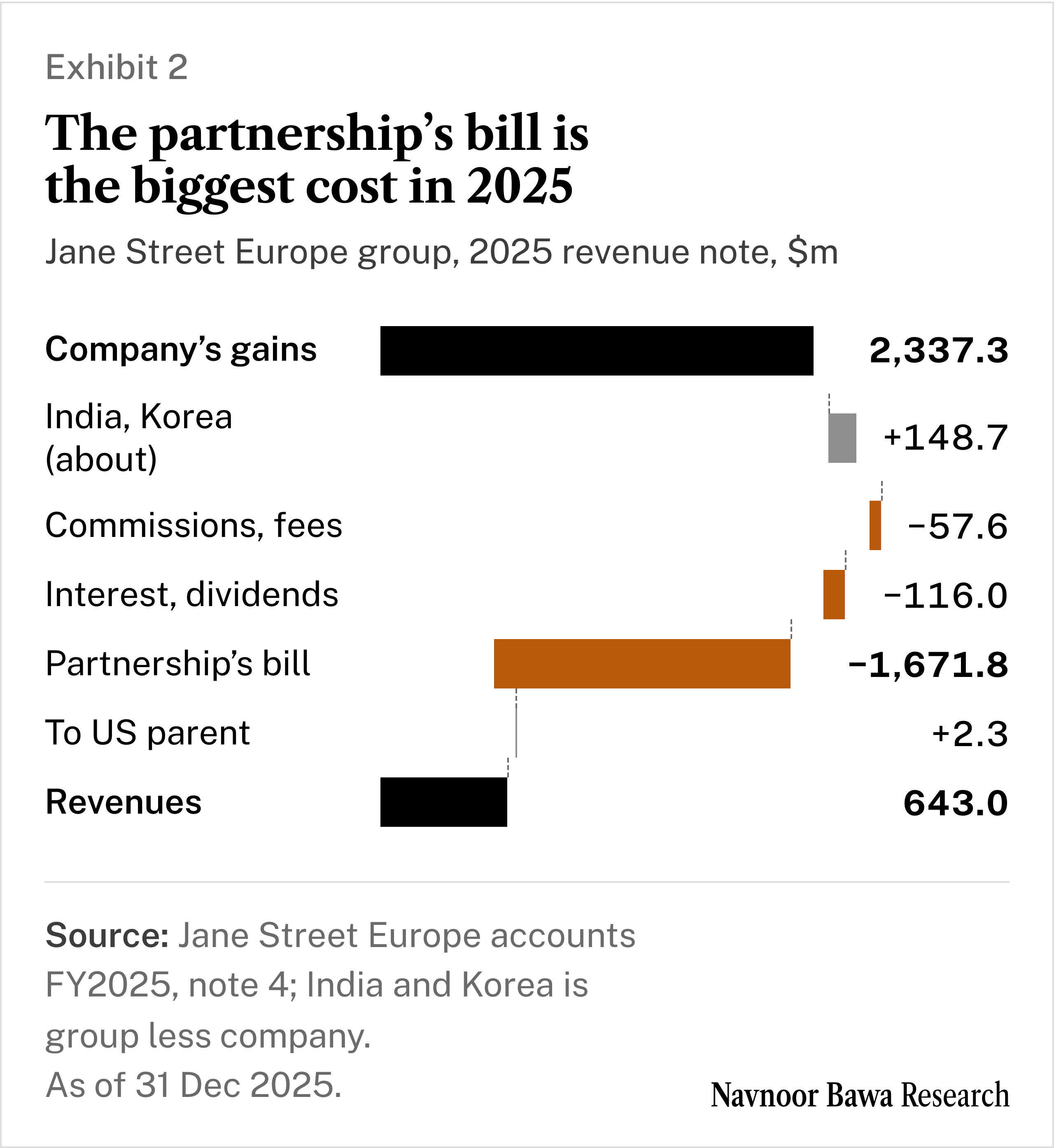
Source: Jane Street Europe Limited accounts FY2025, note 4 p29, group column except the first line, which is the company’s own; the India and Korea line is the author’s calculation, group less company · as of 31 Dec 2025.
The lines sum to the filed revenue within rounding; the second line is why the London group’s column misleads.
In the company’s own column the charge took 71.5% of its gains, and its revenue line was left with $498.1m. Its operating profit was $491.3m on capital employed of $2,770.7m, which is 17.73%. The accounts define the measure themselves: “Return on capital employed is calculated by dividing operating profit by total assets less current liabilities”.
To redo it, take Jane Street Europe’s accounts for 2022 to 2025, use the company column rather than the group’s, and apply that definition each year. Then set the charge beside the partnership’s revenue line “amounts charged to other affiliates”, as Exhibit 3 does. The trap is the London group’s column, which carries India and Korea: on it the 2025 charge looks like 67% of the gains instead of 71.5%, and the return falls with India’s gains.
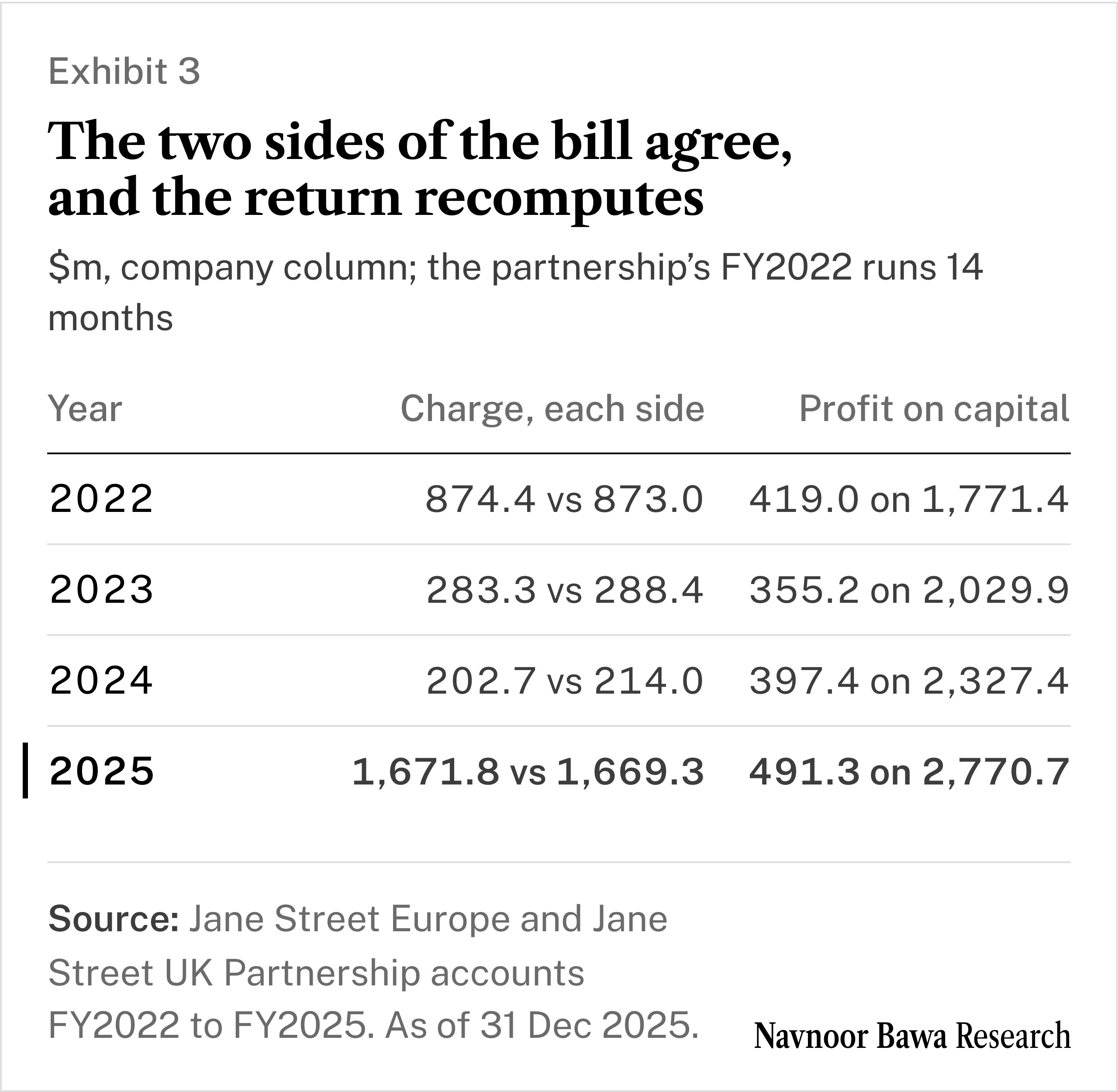
Source: Jane Street Europe Limited accounts FY2022 to FY2025, company column; Jane Street UK Partnership LLP accounts FY2022 to FY2025, the revenue note (note 2 in FY2022 and FY2023, note 3 in FY2024 and FY2025), its FY2022 a 14-month period · as of 31 Dec 2025.
Read across: one bill seen from both ends, then the two inputs of Exhibit 1’s return.
The obvious rival is a cost plus fee, which would give the partnership a small, steady markup on its costs and leave the trading company’s return to swing. The partnership’s profit has instead ranged from 84% to 118% of its costs; the steady number is the trading company’s, though from 2023 its gains slipped 8% and then nearly tripled.
What the four years show instead is a return that follows the capital. From 2023 to 2025 it stayed inside a band of about two thirds of a point. In each of those years the charge moved by 97% to 125% of the change in the gains.
It is the shape left by a method that pays the capital a return and leaves the rest to the people: a split that gave the company a real share of what remains would have lifted its 2025 return, which barely moved. That is my reading of the filings, which disclose no method.
KPMG has identified a fraud risk over the transfer pricing arrangements in every audit of the trading company since 2022, at first tied to the changes in them. The 2025 report, signed by James Voyle as senior statutory auditor, words it this way:
“On this audit we do not believe there is a fraud risk related to trading revenue because of the nature of the transfer pricing arrangements used by the Company, as well as the systemised nature of trading revenue streams. Given the complex and inherently judgmental nature of transfer pricing arrangements … we have identified a fraud risk over the transfer pricing arrangements.”
It is a risk the audit tested, and each year’s opinion says the accounts “give a true and fair view”. The trading is systemised; the judgement, and London’s year, sit in the bill.
London’s pay nearly doubled
The partnership’s biggest cost is its people. Its 2025 payroll was $1.66bn, up 93.5% on 2024. eFinancialCareers’ Alex McMurray, working from the same accounts, headlined “Jane Street’s UK pay: $1.9m per head, $55m if you’re a partner“ on 16 September, and my reading matches it: salaries alone, $1.48bn over 790 people, come to about $1.88m each.
From 2023 to 2025 headcount rose by about a quarter while payroll more than tripled.
The 2025 accounts carry a sentence the 2024 set does not: “In addition, the LLP provides other long-term benefits to participants in a compensation plan. The estimated value of future payments related to these benefits are recognised as an expense within staff costs.” A new line arrives with it, $287.0m of accruals falling due after more than a year, where the 2024 balance sheet showed none.
So part of 2025’s pay is a promise booked now and paid later. The accounts do not say how much of that balance was expensed in 2025; if all of it was, payroll still rose about 60%. The filing does not say what the plan is.
Nor did 2025’s jump come from people moving in: every contract moved in 2022, and in 2025 headcount rose only about 15%.
Per head, London’s payroll came to $2.11m in 2025, against a Jane Street average for 2025 of about $2.7m that Bloomberg reported, on a different base: a reported pay pool spread over about 3,500 people. Pay rose most in the year the charge did, and what it leaves goes to the partnership’s members.
The biggest partner is in Delaware
The charge lands in the partnership as revenue, and after pay the biggest share of that revenue is one member’s. The partnership “is controlled by and is a subsidiary of JSG, an entity that was formed under the laws of the State of Delaware”, and M R Berger signed its 2025 accounts on behalf of both Delaware members.
Its $3.88bn of 2025 revenue has two payers. “Amounts charged to other affiliates” came to $1.67bn, matching the trading company’s charge to about $2.5m. “Amounts charged to the Parent” came to $2.21bn, for London’s work for the rest of Jane Street, and no filing shows how it is set.
Of that revenue, 43% went on pay and 40% to a single member, which the accounts call “a corporate Member”, entitled to $1.56bn of the $1.86bn of members’ profit. The partnership averaged eight members in 2025, “a mix of corporate entities and natural persons”. Its register has only ever listed two corporate ones, the two Delaware designated members.
On 16 September 2026 McMurray put the top member at $1.54bn and wrote that, if that went “to one of the entities”, “the remaining partners received an average of $55.6m”. Note 5 of the partnership’s 2025 accounts files the largest entitlement at $1,563,388,000, to “a corporate Member”, which leaves $292m for the other seven members. One of those seven is the second Delaware company, so the six people on the register averaged at most $48.7m each.
At the end of 2025 the trading company still owed its affiliates nearly $1.5bn, most of the year’s charge.
The people on the two sides of the bill overlap too. John Steven Mackenzie, a director of the trading company and of Jane Street Financial, a London investment firm, has been a member of the partnership since 1 August 2022, and Maanit Desai, the trading company’s other director, since 1 January 2025. The payer’s directors sit in the payee, and the biggest partner is Jane Street itself.
India carries the London group’s fall
The London group’s fall sits in two Indian subsidiaries of the trading company. JSI Investments Private Limited and JSI2 Investments Private Limited are “registered in India and regulated by the Securities and Exchange Board of India”, and the trading company owns them. Read as the London group’s column less the company’s, an approximation, the subsidiaries’ trading gains went from about $32m in 2023 to $592m in 2024, roughly two fifths of the London group’s trading gains that year.
In 2025 they fell to about $149m, including Jane Street Korea, acquired on 1 October and counted from the year’s opening balances, while the trading company’s own revenue and operating profit rose.
On 3 July 2025 India’s market regulator, known as SEBI, issued an interim order signed by Ananth Narayan G., one of its whole time members. It said “the intraday reversal of positions in the cash market was conducted by JS Group in its India entities viz. JSI Investments Private Limited”. SEBI says the matter is still at the investigation stage.
SEBI ordered the four Jane Street entities in its case, two of them outside the London group, to deposit a sum jointly and severally. The two London-owned Indian entities “have credited a sum of 48.44 billion INR (equivalent to approximately $539 million) to an escrow account with a lien marked in favour of SEBI”. The London group carries it as “Other receivables” due after more than a year, and “no provision has been recorded”. The sum is about 18% of the London group’s equity.
The trading company’s directors, Desai and Mackenzie, answer in its accounts that Jane Street “is cooperating with SEBI’s investigation and plans to challenge the findings of the Interim Order through the appropriate process”. On 21 October 2026 India’s Securities Appellate Tribunal reserved its order on Jane Street’s plea for SEBI’s documents.
India’s gains and deposit sit in the London group’s column, so none of it reaches the trading company’s operating profit.
The 2026 accounts can break it
In 2026 Bloomberg reported a record first quarter for Jane Street, with $16.1bn of trading revenue, and Reuters a $15bn hit in July, in a report CNBC carried on 14 August.
If the steady return holds, none of that reaches the trading company’s return: a strong year or a weak one moves the partnership’s charge, and the return lands near 17.5% again. The band I set is 13% to 22% of capital employed, far wider than the three years’ own range.
The 2022 transition year, at 23.7%, sits above that band, in a year the company paid a $350m dividend and still borrowed from its parent at interest. Added back, that dividend alone moves 2022 to 19.75%.
The ratio rests on capital at the year end, which Jane Street can move. The steady years also begin with the loan between the company and its parent turning interest free on 1 January 2023, and by the end of 2025 the company had lent its parent $1.42bn on those terms, about half its capital employed.
I would put 80% on the 2026 return landing inside that band, against three years in three since the revision. I am lower than three in three because the arrangements have been rewritten once in four years.
Only 2025 tested much: in 2024 the gains moved 8%, and 2026 tests the reading only if its gains move a long way from 2025’s. The evidence is an audited filing for the return, and no filing at all for the formula behind it.
The lease rules that start on 1 January 2026, “increasing both total assets and total liabilities”, can lower the ratio a little without the argument being wrong.
Flip the assumption and suppose the company is paid for its own trades. Had the charge stayed at 2024’s 24.4% share of its gains, its 2025 return would have been about 57% on unchanged capital, and still over 40% with the extra profit kept as capital. Leaving the band would be ordinary.
The reading reaches past Jane Street, though not far: McMurray’s March survey of “20 top electronic trading firms and what they pay in London“ reported that two of the twenty run partnerships, Jane Street and XTX. The rule travels as a test, never a presumption: Jane Street Financial is billed through the same partnership, yet its return on capital went from 19% in 2022 to 16% in 2023, then climbed to 23% and 31%. Where a trading group’s London company earns a steady return on its capital, read its trading year in the bill it is charged.
The argument is wrong if Jane Street Europe Limited’s 2026 accounts, due at Companies House by 30 September 2027, show its operating profit outside 13% to 22% of its capital employed, total assets less current liabilities in the company column.
Three trip wires come with it:
An explicit statement that the transfer pricing arrangements, the trading services agreement or the UK Services Agreement were revised, amended or replaced voids the test rather than failing it.
So does a change in capital that moves the ratio by itself: a dividend or other return of capital above about $540m, a fifth of 2025’s capital employed, would lift 2025’s return to 22%, and an injection of about $1bn would pull it to 13%.
A charge further from the partnership’s 2026 revenue “charged to other affiliates” than 6% or $25m, whichever is larger, would mean the two sides no longer describe one bill.
If the 2026 accounts show the trading company’s return inside that band again, London’s trading year will have landed in the partnership’s bill for a fourth steady year, and the company will have been paid for its capital.
Further reading
How HRT and Jane Street Made $22.5B in One Quarter: The Models, the 50.1% Edge, and the SEBI Order: the firm-wide quarter and the SEBI order that this piece reads from London’s side
How Hudson River Trading Beat Goldman’s Desks, at What Risk: the rival Jane Street is ranked against here, read from its own quarter
How Market Makers Like Citadel Securities Actually Make Money on 0DTE Options: how a market maker earns on its own positions, the gains this piece follows into a bill
Next: Jane Street’s July loss, and which of its books took it, read from its own filings.
→ The five line screen for where a London trading group’s year shows up in its accounts on Patreon, open to everyone.
Navnoor Bawa · YouTube · LinkedIn · Corrections: reply or comment.
Logo: Jane Street