


Hudson River Trading made a record $11.4bn trading in the second quarter of 2026, Bloomberg reported on 19 August. In December Bloomberg said HRT was minting billions by “embracing more risk”; to see what that risk looks like, I netted the stock its US dealer owned against the stock and futures it sold, at all eight year-ends filed electronically.
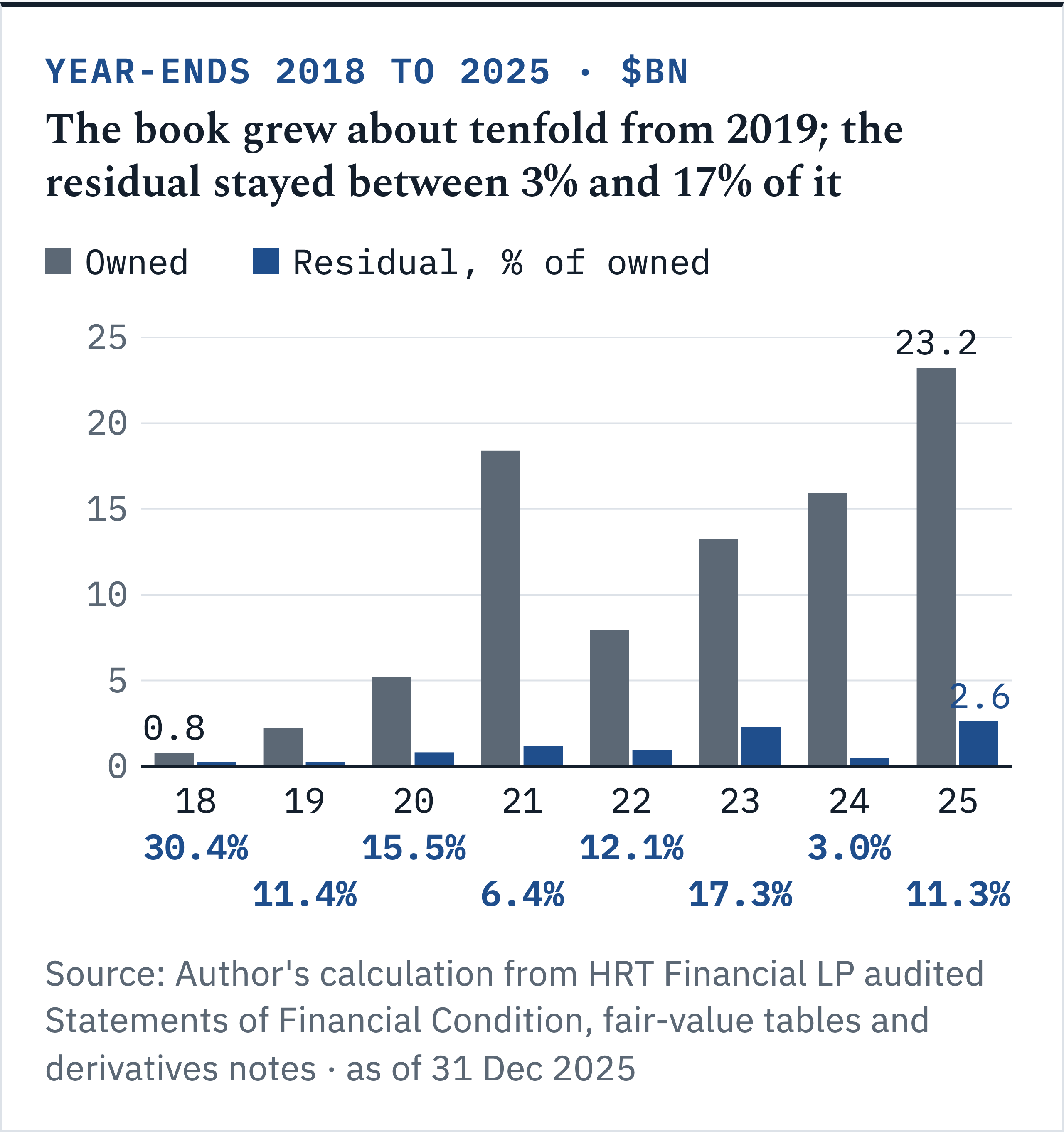
Hudson River Trading out-traded each Goldman Sachs desk in the second quarter, and its US dealer’s audits show how it carries the risk: a bigger book, hedged within the same band. From 2019 to 2025 the dealer’s book and its unhedged residual both grew about tenfold, and a loss would land first on its partners’ capital.
The piece runs in four steps: the quarter against Goldman’s desks, why volume does not pay for it, the risk Bloomberg described, and what eight audits show about it.
HRT out-traded each Goldman desk
Goldman Sachs had posted its quarter five weeks before Bloomberg’s report. Its 8-K of 14 July 2026 showed $7.4bn of equities revenue and $4.6bn from FICC, its fixed income, currencies and commodities desk. HRT’s $11.4bn is larger than either. It is also about 1.5 times the $7.5bn the two desks made from intermediation, which is buying and selling for clients, the part of a bank’s trading closest to what a market maker does.
Add the $4.5bn the desks earned from financing, lending to clients against their securities, and they made $12.0bn. HRT reached neither that nor JPMorgan’s $12.1bn of markets revenue. It did clear Morgan Stanley’s $8.8bn and the record $7.3bn at Citadel Securities, a non-bank market maker.
The figures are not the same kind of revenue. Goldman’s is client business, reported in a filing; HRT’s is a private firm’s own trading revenue, reported by Bloomberg and then by the FT from a person familiar with the results, and HRT declined to comment. Virtu Financial, a market maker that files its numbers, reported $0.86bn of trading income for the same three months.
Volume alone doesn’t pay for it
A sceptic has two explanations for the record that need no audit. The first is a volatility windfall, which predicts a jumpier market. The FT’s report, in Hedgeweek’s summary, credited “Market volatility linked to the war in Iran and dramatic swings in technology and artificial intelligence stocks”.
The market’s volatility index was calmer: the VIX averaged 18.31 in the quarter against 23.56 a year earlier, on our average of daily closes.1 An index average cannot see single stocks swinging against each other, so the windfall survives only in the FT’s narrower form, swings inside technology and AI stocks.
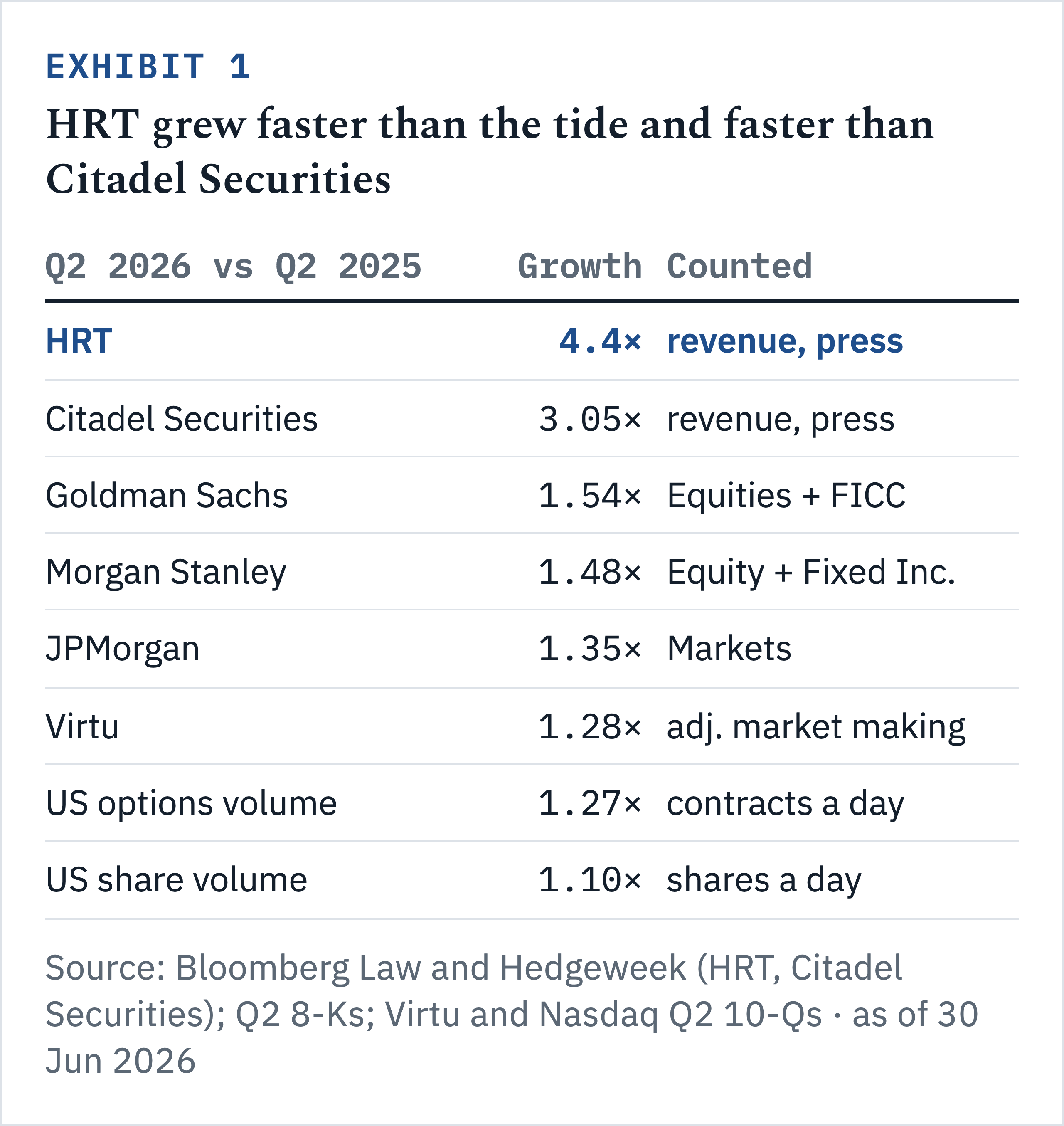
The second is a tide that lifted every intermediary. Jamie Dimon, JPMorgan’s chief executive, described it in his bank’s 8-K: “Markets revenue growing 35% due to elevated client activity, strong trading performance and continued demand for financing in Equities”. A tide predicts that every firm grows alike, and at about the pace of volume. Nasdaq’s 10-Q puts US share volume up 10% on a year earlier, and options volume up 27%.
Exhibit 1 · HRT grew faster than the tide and faster than Citadel Securities.
Source: Bloomberg Law and Hedgeweek for HRT; Bloomberg and Hedgeweek for Citadel Securities; the Goldman Sachs, Morgan Stanley and JPMorgan Q2 8-Ks; Virtu’s and Nasdaq’s Q2 10-Qs · as of 30 Jun 2026
Volume grew by about a tenth to a quarter, the banks by a third to just over a half, and the two non-bank market makers about three and four times. Virtu grew at the tide’s pace: its market-making measure rose 28%, against HRT’s fourfold.
Raman Kalra of Coalition Greenwich, a market research firm, put the non-bank liquidity providers’ revenue pools up 45% from 2024 to 2025, in a 3 June 2026 release. “Whether these outsized returns are the new normal or just a byproduct of a unique macroeconomic moment remains to be seen,” Kalra said. One quarter cannot settle that. It does show HRT taking more than the tide, and Bloomberg had printed an explanation the previous December.
The story says more risk
On 2 December 2025 Bloomberg ran “More Risk, Less Speed: Hudson River Mints Billions Slowing Down”. Its second paragraph begins: “The high-frequency firm is increasingly holding positions for days and even weeks, embracing more risk”. Business Insider had described the engine nine months earlier, from people familiar with the firm. HRT, it said, was “earning billions in profits from hedge-fund-style trading strategies that require greater risk and longer holding periods”.
The unit running them is Prism, which “generated more than $2 billion” in 2024, according to the same report, with “ETF arbitrage and index rebalance” its noteworthy strategies. Roughly half of profits still came from the high-frequency business HRT calls Classic.
Iain Dunning, who heads AI research at HRT, gave both halves on Bloomberg’s Odd Lots podcast on 31 October 2025. “We make money only because someone else wants to trade,” he said. “If no one was trading, we wouldn’t exist.” On the longer horizons he went further: “I think the market making service provision does break down.”
The filings back Bloomberg on holding. HRT Financial LP, the group’s US dealer, files a Form 3 each time it becomes a 10% owner of a listed company, and it filed one in 2023, two in 2024, four in 2025 and 66 in 2026 through 16 September, nearly all for micro-caps. Adam Nunes, the dealer’s president and chief executive since May 2010, signs them. One Form 4 shows Aditxt shares bought on 18 June 2026 and sold to zero on 22 June: held four days.
The dealer’s quarterly 13F, which Nunes has signed every quarter since at least 2017, grew too, to $54.8bn at 30 June 2026, 2.4 times its level a year earlier.2 The 13F shows HRT holds more; how long it holds is Bloomberg’s reporting, not the filing’s.
The second half, “more risk”, is a different claim. If risk means a net position that moves with the market, a bigger book sold short against itself carries little more of it, and a bigger book left open carries a lot. Which one HRT built is written down once a year, in the dealer’s audited balance sheet. I found no published netting of it; Bloomberg and Business Insider describe the holding, not the net.
So the two answers predict different balance sheets. If HRT’s extra risk is a growing directional bet, what is left after its hedges should grow faster than its book, and its share of the book should climb out of its old range. If the extra risk is a bigger book hedged the same way, the dollars should grow and the share should not.
The audits show the same band
Every US broker-dealer files an audited Statement of Financial Condition each year, on Form X-17A-5. The dealer’s statement for 31 December 2025 opens its notes: “HRTF provides liquidity to financial markets and trades financial instruments utilizing a proprietary electronic trading system.” It adds: “The Partnership is engaged in a single line of business of proprietary trading as a securities dealer.”
The test is one subtraction, repeated. From each year-end’s equities owned, take away the equities sold, not yet purchased, then the futures sold, and add back the futures bought, all as the statement prints them, futures at notional. Notional is the full value of the stock or index a contract stands for. Call what is left the residual: the dealer’s net stock position after its hedges.
The trap is to use the 13F instead, which lists no shorts and no futures, so its residual is always 100% of the book.
Exhibit 2 · The dealer’s 2025 residual was $2.63bn, 11.3% of the stock it owned.
Equities owned: $23.23bn, 100%
Less equities sold, not yet purchased: $9.86bn, 42%
Less futures sold, notional: $11.07bn, 48%
Plus futures bought, notional: $0.33bn, 1%
Residual: $2.63bn, 11.3%
Source: HRT Financial LP, audited Statement of Financial Condition, fair-value table and derivatives note; assumes the futures sold offset stock, since the note does not name their underlyings · as of 31 Dec 2025
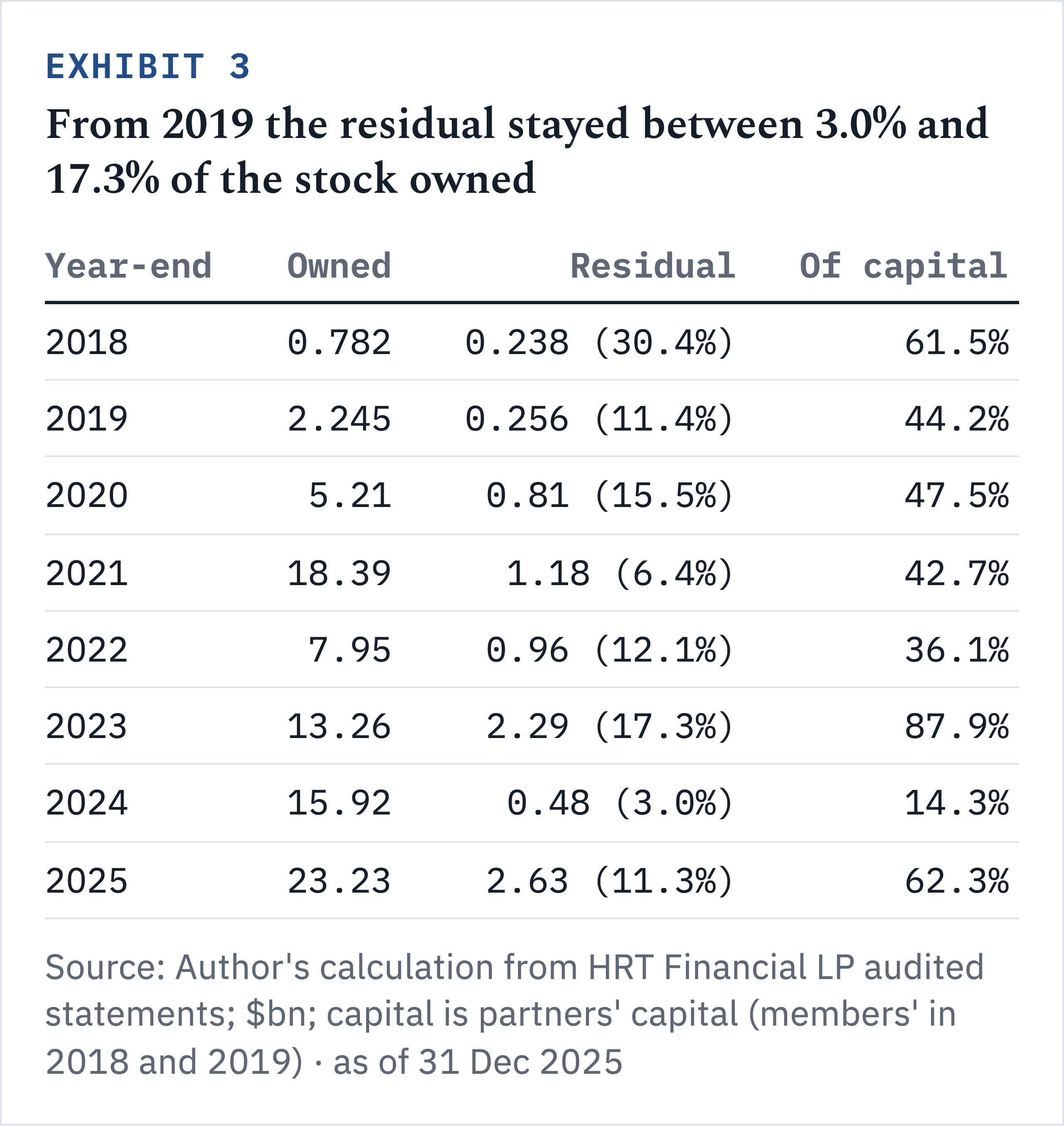
At end-2025, and at three of the four year-ends before it, short sales offset about two fifths of the stock the dealer owned, and futures sold offset most of the rest. Exhibit 3 repeats it at every year-end, and sets the residual against partners’ capital, the owners’ equity a loss reaches first.
Exhibit 3 · From 2019 the residual stayed between 3.0% and 17.3% of the stock owned, and between 14% and 88% of partners’ capital.
Source: Author’s calculation from HRT Financial LP audited Statements of Financial Condition, fair-value tables and derivatives notes; each year’s statement is in the dealer’s EDGAR filing list. Partners’ capital is from the same statements; in 2018 and 2019, before the dealer became a partnership, it is members’ capital · as of 31 Dec 2025
Two things hold across the table. The residual share topped 20% once, in 2018, on a book of less than $1bn; from 2019 the dealer sold short, or sold futures against, between 83% and 97% of what it owned. And the share moves without a trend. It fell to 6.4% in 2021, when the book first passed $18bn, and to 3.0% in 2024.
If the extra risk Bloomberg described were a growing bet, the 2025 statement would show the residual above its 2019 to 2024 range. On the stock owned, 2025’s 11.3% sits inside that range; on partners’ capital, its 62% sits inside it too, below 2023’s 88%. A band that wide cannot tell a slowly growing bet from a steady one.
The residual set a record
A hedged book still carries risk: the spread between what it owns and what it sold, and whatever the futures fail to match. That is the form of “more risk” the audits show: more of that spread risk, carried on a bigger book.
The number that cuts against our claim is the latest one. The residual rose from $0.48bn at the end of 2024 to $2.63bn a year later, 5.5 times, the largest in dollars of the eight year-ends, though only 15% above 2023’s $2.29bn. Its share of the stock owned went from 3.0% to 11.3%. In the year Bloomberg described, the bet grew in dollars, and its share went back to where it had been.
Against the partners’ capital, the record is large. The 2025 statement shows $4.22bn of it, so the residual equals 62%, second among the eight year-ends only to 2023’s 88%. Its subsequent-events note adds: “During this time, the Partners have withdrawn capital of $500.0 million.” That leaves $3.72bn before any 2026 profit, and puts the residual at 71%. A 10% fall in whatever the residual is long would cost about $0.26bn, 7% of that smaller base.
Who would bear that loss is on file. FINRA’s BrokerCheck lists the dealer, which Nunes runs, as a Delaware partnership owned through HRT companies. Jason Carroll, a co-founder Business Insider calls “a current managing partner”, holds between 50% and 75% of HRT Capital LLC, which indirectly owns 75% or more of the dealer.
No HRT document says why the dealer hedges what it carries. I infer it from the structure, with moderate confidence: when a loss lands first on the partners’ capital, a dealer has reason to keep its residual a small share of its book. Eight audits show the result that inference predicts. None of them states the motive.
What the audits cannot see
The futures’ underlyings and direction are not named. Netting only the stock leaves 57% to 58% of it in 2021, 2023, 2024 and 2025, so the futures carry the claim, and this is where the case against it is strongest. Two facts fit index hedging without proving it. At end-2025 the net futures sold, $10.74bn, hedged 80% of the stock-only net of $13.37bn; what they left is the residual. And the two largest lines on the June 2026 13F are the SPDR S&P 500 and Invesco QQQ index funds. The dealer also trades Treasuries, so some futures could be on rates. From 2021 the notes do not label futures bought or sold either: this piece reads the liability-side contracts as sold, as the 2018 to 2020 notes labelled them, and 2022’s fit that reading less cleanly.
Citadel Securities LLC’s audited statement for 31 December 2025 shows $34.16bn of equities and ETFs owned, 61% of it left after short sales, beside HRT’s 58%. Its derivative notionals appear only gross, $2.28tn of equity contracts with no bought or sold split, so the full netting cannot be run on it.
Option deltas are not disclosed. The 2025 note shows $31.6bn of options bought and $31.8bn sold, at notional,. Matched notional says the book sits on both sides. It gives no direction, and no delta is printed.
A year-end is a snapshot. The gap since the last audit is wide. The 13F’s shares and fund units rose from $24.26bn at 31 December 2025 to $39.92bn at 30 June 2026, 65% more, hedged by an amount no public filing shows. The next audit is the first look at that book.
The stock it owns has changed. The long book now reaches into micro-caps, where nearly all of 2026’s Form 3s were filed, while the hedges the evidence fits are index futures and index funds. A micro-cap hedged with an index carries size, liquidity and basis risk an index holding does not, so the residual can hold near 11% of the stock owned while the risk in each dollar rises. A constant ratio is not constant risk. For now each line is small: the largest of the stocks it crossed in the second quarter sat at $255,000 in the dealer’s 30 June 13F.
One entity is not the group. On 31 August 2022 Moody’s cut HRT to Ba2 from Ba1, outlook negative, and located the added risk in its “expansion into certain regions and markets outside of its core historical areas of focus”. The dealer’s statement cannot test that: it covers one US entity, and risk taken through prime brokers elsewhere need not touch it.
So the finding stops at the dealer, at its year-ends.
The next audit decides it
The argument is wrong if HRT Financial LP’s audited statement for 31 December 2026, due on the SEC’s EDGAR system by 1 March 2027, shows a residual above 20% of equities owned. That would make the dealer’s bet larger against its book than at any year-end since 2019.
I would bet, at about 75%, that the share stays under its line, because the dealer has hedged more than four fifths of its stock at seven straight year-ends while the book grew about tenfold.
The base rate alone would say 80% to 88%. The line was crossed at one of eight year-ends, on a book under $1bn, and the largest one-year rise in the eight statements, 8.3 points from 2024 to 2025, would carry the share from 2025’s 11.3% to 19.6%, 0.4 points short. My odds are lower because the futures’ underlyings are unnamed and the dealer is not the whole firm.
A market maker’s gross book shows its volume; only its net shows its bet.
HRT’s 2026 audit lands by 1 March: a net under a fifth of the stock it owns means the bigger book stayed hedged; above it, the extra risk Bloomberg found has become a bet.
Further reading
How HRT and Jane Street Made $22.5B in One Quarter: The Models, the 50.1% Edge, and the SEBI Order: the same two firms’ trading engines, a year earlier
How to Read a Market Maker’s 13F Options Line: Jane Street and Susquehanna’s SpaceX Book, Ranked Against Their Own: reading a dealer’s own filings without mistaking inventory for a bet
Next Monday: a named fund’s bet, read from its own filing, with the position.
→ A screen of every Form 3 HRT’s dealer has filed as a new 10% owner, each timed to its last reported trade on Patreon, open to everyone.
Navnoor Bawa · YouTube · LinkedIn · Patreon
Logo: Hudson River Trading LLC
The year-earlier quarter includes the April 2025 tariff shock, when the VIX averaged 31.97; May and June 2025 averaged 19.46, close to the second quarter of 2026.
HRT’s 13F cover totals are in thousands of dollars through the end of 2023 and in dollars from 2024; its information tables are still in thousands in 2026. Read the 30 June 2026 table as dollars and the SPDR S&P 500 line, 7,452,855 shares valued at 5,565,568, comes out at 75 cents a share instead of $746.77.