



Jane Street and Susquehanna both report net call heavy SPCX options lines in their Q2-2026 13F-HRs. Direction alone means nothing: about two-thirds of names in both firms’ books lean the same way, SPDR Gold Trust and Invesco QQQ included. Size is a different question. SPCX comes in 7th of 2,490 dual-leg names at Jane Street and 21st of 3,053 at Susquehanna, by dollar size of the net call tilt. Size beats direction here.
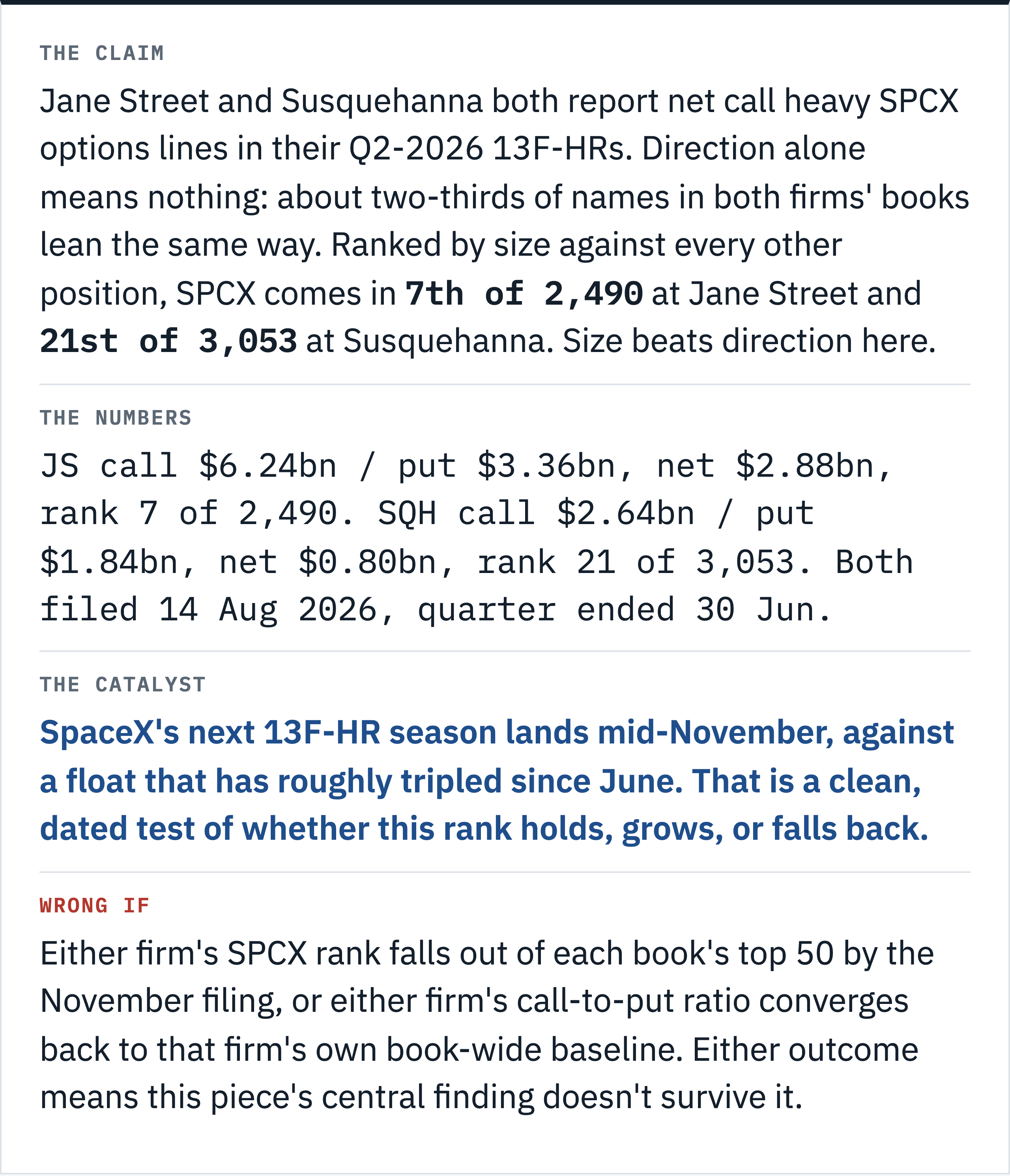

I write this because a day ago I had a different draft. That version read the same two filings and argued the tilt was dealer hedging conviction driven by SpaceX’s scarce post-IPO float. A second pass against both firms’ whole books broke the mechanism behind that argument. A third pass, ranking SPCX’s tilt against every other name each firm holds, showed the first correction had swung too far. Direction is noise. Size is not, and I hadn’t measured size until the third pass.
The reading everyone will reach for, and the reading that replaces it
The obvious read, if this data gets any attention at all, is that two of the biggest listed options market makers on earth are leaning bullish on the newest, most float constrained mega cap on the market, at the exact moment its float was thinnest. That’s a clean story and every fact in it checks out. SpaceX’s public float sat at roughly 638.9m shares, about 5% of shares outstanding, per S3 Partners’ own reporting, for the entire quarter these filings cover.
None of that tells you whether two dealers are betting on SpaceX, and neither does the direction of their SPCX lines on its own. Call heaviness turns out to be the ordinary shape of both books. I widened the check from the nine SPCX lines to every name carrying both a put and a call line in each filing:
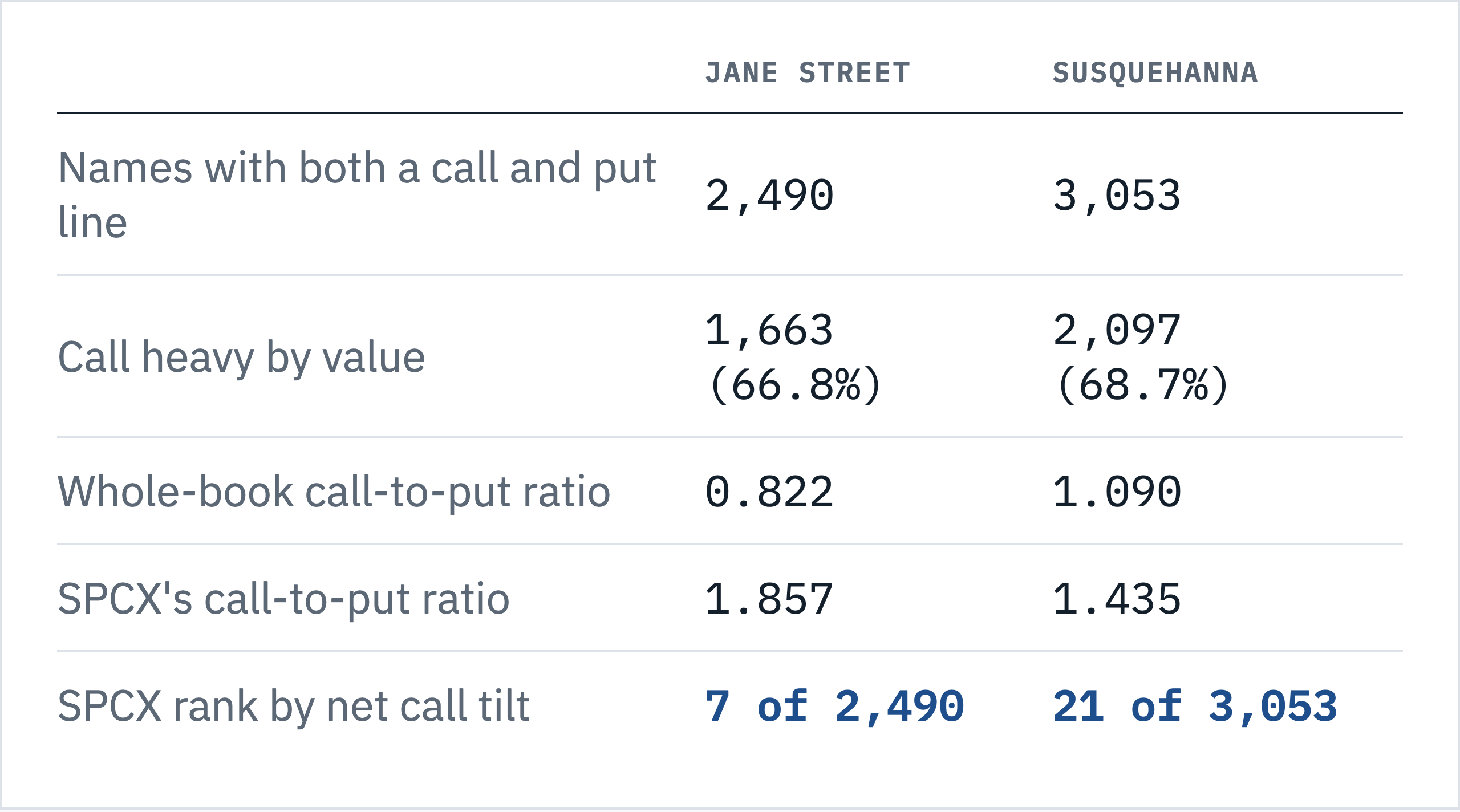
Two-thirds of both books lean call heavy, SPDR Gold Trust and Invesco QQQ among them, neither one float constrained in any sense. On direction alone, SpaceX is unremarkable. The base rate wins that round.
Size is where the two firms stop looking alike. Jane Street’s book runs net put heavy overall, a 0.822 ratio. Its SPCX line runs at 1.857. I make that 2.26 times its own baseline. Susquehanna’s book leans call heavy overall at 1.090. Its SPCX line sits at 1.435, so 1.435 divided by 1.090 gives 1.3 times its baseline. Both desks are more call heavy on SpaceX than they are on the typical name they carry. Jane Street’s gap is the larger one.
Ranked by dollar size of the net tilt, SPCX places 7th of 2,490 dual-leg names in Jane Street’s book, behind only Microsoft, Alphabet, Apple, Meta, Amazon and SPDR Gold Trust. At Susquehanna it places 21st of 3,053, behind NVIDIA, Microsoft, Meta, Tesla, Amazon, Invesco QQQ, Apple, Alphabet, Micron, SPDR Gold Trust and ten more names ahead of it. A stock that priced twelve trading days before the filing date sits inside the top three-tenths of one percent of Jane Street’s entire book by this measure, and inside the top one percent of Susquehanna’s. Both are outliers. That is the finding a quick read of the direction alone would miss entirely, and it’s also the finding my own first correction missed by stopping at direction.
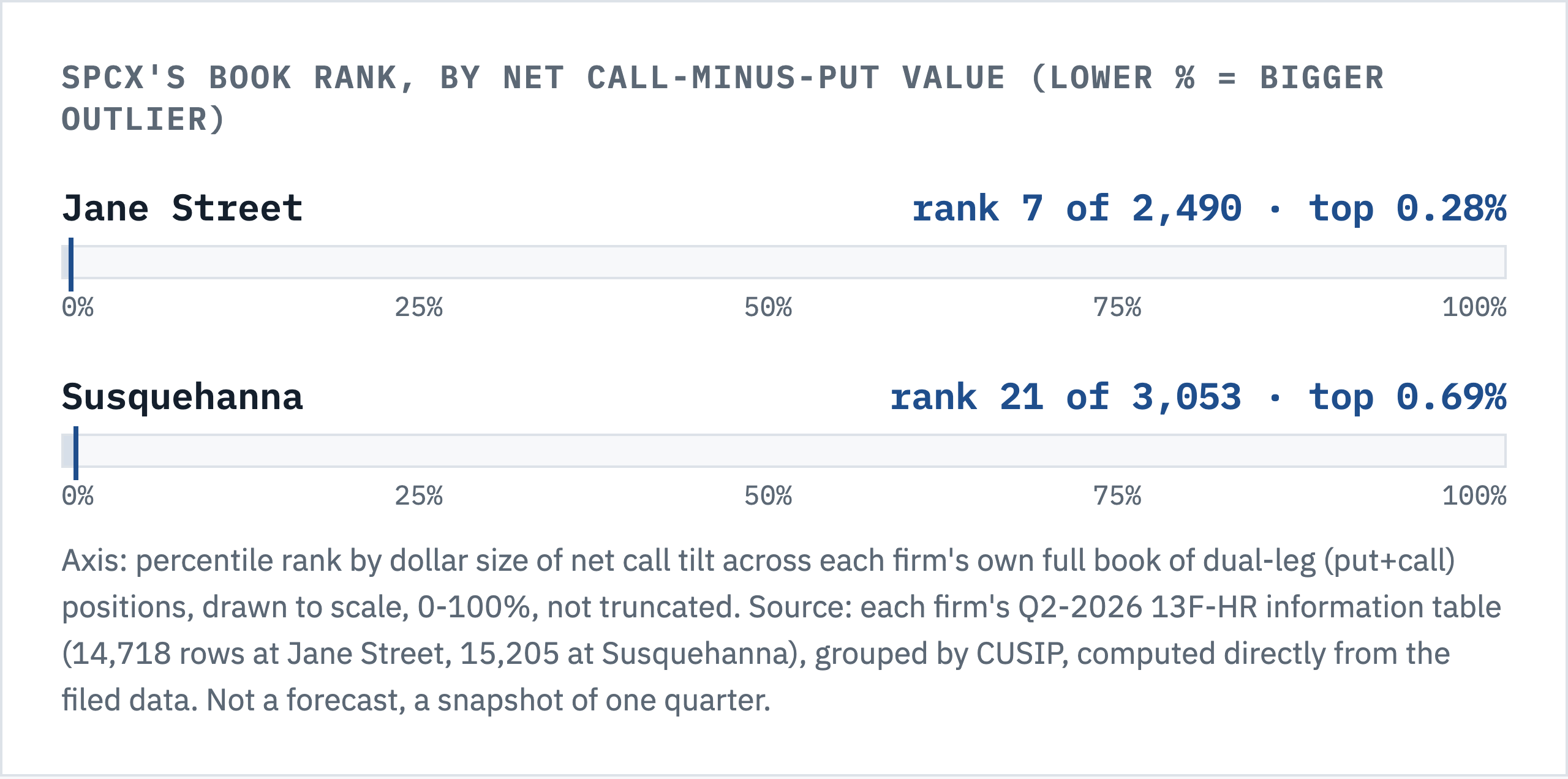
Scaled against the company rather than against the book, the tilt looks smaller. SpaceX’s implied market cap at the $170.86 quarter-end mark, on roughly 12.78bn shares outstanding, is about $2.18tn. Divide $6.24bn by that and Jane Street’s entire call line comes to 0.29% of the company. That is small. Both readings are correct at once: small relative to the company, unusually large relative to everything else either dealer carries. The second number is the one a whole-book check surfaces and a single-name read never will.
I’ll concede the point this cuts against me: a position that is 0.29% of a company is not what most readers mean by “a big bet,” and if you stopped reading at that one figure you would not be wrong to shrug. Rank inside the book is a different question from size against the company, and I am answering the first one, not the second.
Why the size still isn’t proof of conviction
Rank doesn’t rescue the bullish story either. Three things stand in its way.
Form 13F is long only, by explicit SEC instruction. The SEC’s own FAQ says so directly:
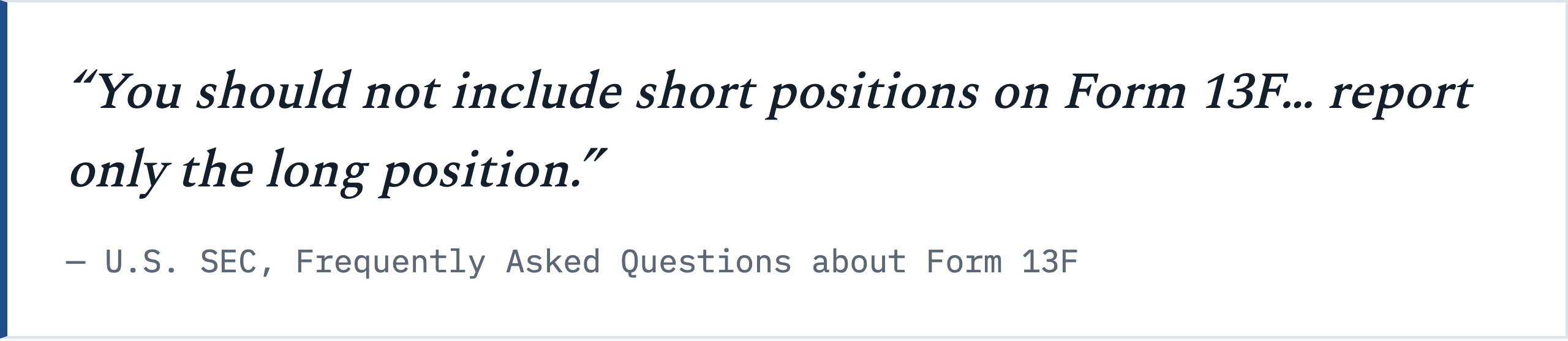
If a dealer absorbs client demand for SPCX calls, the dealer ends up short calls against that client, and that short leg can’t appear on this form regardless of how large the long side gets. The academic finding on this exact question is that options end users run net long and dealers sit net short as their counterparty. That’s the opposite of what a large long call line on a 13F would suggest, if you read it as the dealer’s own view.
A dealer’s reported long call position is more plausibly one leg of something else. A spread held against a short call at a different strike. The residual after netting many client trades at the position level. Calls held against a short stock position built elsewhere. The filing doesn’t disclose which, and I can’t determine it from public data. What I can say is that a large notional on this form isn’t, by itself, evidence the filer wanted the exposure. The form hides the half that would tell you. This publication’s earlier read of Jane Street’s own reported book ran into the same limit on a different name: what the filing shows and what the firm’s actual economics were doing are not always the same story.
The one distinguishing detail I thought I’d found doesn’t hold up. I originally read both filings as showing zero voting authority on every option line, against full voting authority on the small blocks of straight SPCX equity each firm reports, and treated that split as evidence these were dealer positions rather than conviction trades. Jane Street’s own SPCX put line reports 19,665,400 shares of sole voting authority, the same number as its share count, exactly like the equity lines. Only the call line reports zero.
Optiver’s Q2-2026 13F-HR, a third filer holding SPCX options the same quarter, shows a call line of $759,934,022 (4,447,700 share equivalents) against a put line of $390,500,530 (2,285,500 share equivalents), also net call heavy, also marked at the same $170.86 quarter-end price. It reports shared voting authority on both legs, not zero and not full. Three market makers, one instrument, one quarter, three different conventions on the same SEC field. It is a bookkeeping quirk, nothing more. A genuine conviction trade would report the identical zero this form shows for a hedge. The field can’t tell the two apart. It was never built to. Form 13F carries plenty of other quirks nobody enforces: the SEC doesn’t reconcile duplicate filings against each other either, which is its own lesson in reading these documents skeptically rather than literally.
Notional isn’t premium. Every SPCX line item across all three filings, calls, puts, and equity alike, divides out to the same $170.86 reference price, which I independently confirmed against SpaceX’s actual 30 June closing print. All three firms marked the book at the quarter-end price, not at cost. A $6.24bn call notional could be a small number of deep in the money contracts or a much larger number of cheap, far out of the money ones. Strike and expiry aren’t disclosed anywhere on this form. Rank tells you this tilt is unusually large in dollar terms. It can’t tell you what it cost, or what delta it actually carries.
A correction I owe the underwriter argument
There’s a second, more ordinary explanation for a fresh listing showing an outsized dealer tilt, and I want to be honest about how badly I first answered it.
SpaceX’s IPO priced 12 June 2026, a Friday. The 13F covers the quarter through 30 June, eighteen calendar days later, roughly twelve trading sessions later. Lead underwriters are documented net buyers of a freshly listed stock for roughly the first fifteen trading days, a laddering and stabilization pattern with nothing to do with float scarcity. Twelve trading days sits inside that window, not past it. My first draft claimed the 30 June snapshot was safely clear of this effect. It wasn’t.
Neither Jane Street nor Susquehanna led SpaceX’s IPO. Goldman Sachs and Morgan Stanley did. The narrowest version of the stabilization mechanism does not apply to either filer directly. A brand new listing with every dealer building inventory at once, twelve trading days after the print, is still a live, unresolved alternative explanation for an outsized tilt at two desks. I can’t rule it out. The date math does not do that work for me the way I first claimed it did.
What actually separates this from noise
The mechanical version of this check is three steps, and none of them requires anything beyond a 13F you can already download. Pull the filer’s full information table, not just the lines naming the stock you care about. Compute the filer’s own call-to-put ratio across every name carrying both legs, and compare the name in question against that baseline rather than against zero. Then rank the name in question against every other position the filer holds, not just the handful of names you’d guess would be larger. Any one of the three steps alone would have caught what my first draft missed, and the third step is the one that turned “nothing here” back into “something here, just not what it first looked like.”
This generalizes past SpaceX. Every quarter, newsletters and finance accounts pull a fund’s or dealer’s 13F, find one line that fits a story, and publish the story. Almost none of them pull the whole book and rank the position against it. Jane Street and Susquehanna happen to be the two names in this filing. The mistake in my own first draft, treating raw call-heaviness as a signal, isn’t specific to them.
The reusable version of that check, with the dollar tilt of the names sitting ahead of SPCX in both books and the dated re-run I have committed to, is the companion note on Patreon.
Three limits on what I can actually show you
I checked three filers in depth, not a market-wide sample. A rank of 7th and 21st across two books in one quarter tells you SpaceX is an outlier for these two firms this quarter. It doesn’t tell you whether a top-ten tilt on a six-week-old listing is itself unusual, since I haven’t ranked every other recent IPO against these same books to see how often a fresh name reaches this high.
I can’t separate proprietary conviction from hedging inventory with certainty. The long-only blind spot, the notional-versus-premium gap, and the three-way voting-authority mismatch all point toward caution about reading this as a discretionary bet. None of them prove it isn’t one.
The stabilization-window confound stays open. I’m naming it as unresolved rather than quietly dropping it, because that’s the honest state of the evidence right now.
What would prove this wrong, on a dated test
This reading is falsifiable on two dated tests. First: the November 2026 13F-HR season, due on or around 14 November, will show whether SPCX’s rank in either book holds near the top, or falls back toward the pack as the float, which has grown from 638.9m shares to about 1.91bn as of 18 September, stops being scarce. A rank that falls out of each book’s top 50, or a call-to-put ratio that converges back to each firm’s own baseline, would say whatever produced this quarter’s outsized tilt was a one-quarter artifact, not a standing feature.
Second: SEC fails-to-deliver data, updated twice monthly, is the more direct test of whether float scarcity is actually constraining these desks. The empirical literature on this exact mechanism finds that large options market makers facing genuinely hard-to-borrow stocks more often choose to fail delivery than compete for scarce shares, with the cost of failing priced into options rather than fought out in the borrow market. A persistent SPCX fails-to-deliver print would say dealers are routing around the float problem rather than being squeezed by it.
What this piece actually delivered
The interesting finding this week isn’t that Jane Street and Susquehanna are bullish on SpaceX. It’s that the two honest answers, “direction is meaningless” and “size is unusual,” both survive scrutiny at once, and neither one is the story a quick read would have told you. I nearly published the version that said size proved conviction. I then nearly published the version that said none of it meant anything. The number that mattered, SPCX’s rank against everything else each firm holds, sat unread in both drafts. I had to go and compute it myself. Nobody handed it to me.
The Decision-Grade Version
Everything above is free and always will be. The paid tier is where a filing this size turns into a named position instead of a framework: entry, level, sizing, and what takes it off, built from the same primary sources. Join here when the evidence supports one.
This piece is text and filings only. The same research process, walked through on camera, runs on the YouTube channel. Longer-form discussion and the professional network I actually use this research with is on LinkedIn.
If you’ve pulled a market maker’s 13F and stopped at direction without checking where the position ranks against the rest of the book, I’d like to know which name it was.
Cover photo: SpaceX Photos · CC0 1.0, adapted · via https://commons.wikimedia.org/wiki/File%3AFalcon%209%20first%20stage%20at%20LZ-1%28two%29.jpg