


On 18 May 2026, two Form 13F holdings reports arrived at EDGAR carrying the same number: 13676657577. Both covered the quarter ended 31 March. Both listed 42 positions. Both were signed by Christopher Zellner, Chief Compliance Officer, on 15 May. One came from Situational Awareness LP, Form 13F file number 028-24925. The other came from Situational Awareness Partners LP, file number 028-26981.
Neither report mentions the other. Both state, on the summary page, that the number of other included managers is zero.
I’ve spent the last several hours running the one check that would have caught this, and it isn’t a check anybody performs: comparing information tables across filers instead of reading any single filing. Read as filed, EDGAR contains two institutional investment managers who each exercised sole investment discretion over the same $13,676,657,577 of securities on 31 March 2026. Every database that keys 13F data to the filer, which is all of them, carries that book at $27.35 billion.
That’s the anecdote. What made me write it up is what the same check returns when you point it at the whole quarter.
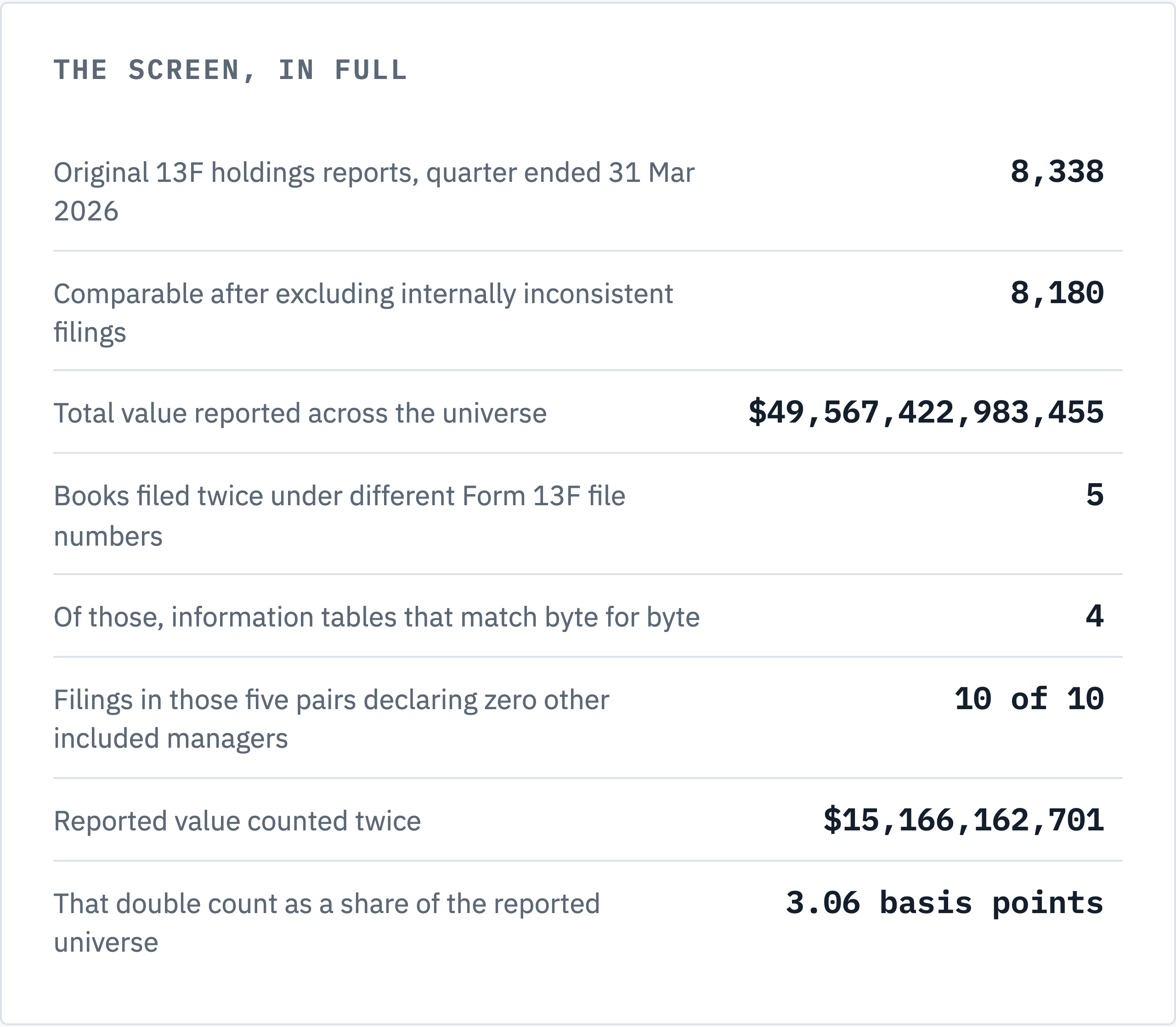
Three point zero six basis points. I want that number in front of you before the argument instead of buried after it, because the argument doesn’t depend on it being large, and a piece implying a crisis at 3bp would be refuted by its own table.
The consensus is right, and it is entirely about omission
Nobody sophisticated thinks 13F is clean. The defect list is stable, well understood, and priced in by anyone who uses the data seriously: a 45 day reporting lag, long positions only, no short book, no cash, no debt, no non-US listings, options carried at the notional value of the underlying instead of at premium, and holdings that can be withheld under a confidential treatment request. Every desk reading 13F applies some version of these adjustments, and the adjustments are correct.
Notice what they share. Every one is a defect of omission, something true about the manager that the filing does not contain, and every one gets applied inside a single filing. You take a 13F, you discount what it leaves out, you form a view.
Duplication is a defect of the opposite sign, and it is invisible to all of it. No amount of care applied to Situational Awareness LP’s filing reveals anything wrong. That filing is internally consistent, arithmetically correct, and signed. Its 42 line entries sum to exactly the total on its own summary page. Nothing in it is false. The problem lives entirely in the relationship between it and a different document, filed the same day by a different registrant, which it does not reference and you were never told to look for.
The standard 13F adjustments assume the filer set is sound, and nobody reconciles the filer set.
What the registry actually holds
The two Situational Awareness cover pages differ in the ways you would expect two registrants to differ. Different CIKs, 2045724 and 2038540. Different Form 13F file numbers. Slightly different street addresses at the same San Francisco building.
They agree in two fields that matter more than any of that.
Both report crdNumber 000333011. Both report secFileNumber 801-132039.
These are not two firms. They are one SEC registered investment adviser holding two live Form 13F file numbers, and it filed under both of them, itself, on the same day. There is no filing agent in the middle: the EDGAR accession prefixes are the registrants’ own CIKs, so both submissions went in directly.
I checked whether the two reports are the same document. They are not, and that turns out to be the more interesting answer. The information tables do not match byte for byte. Five of the 42 rows differ, and they differ in exactly one field, the voting authority “None” column, on the five call positions.
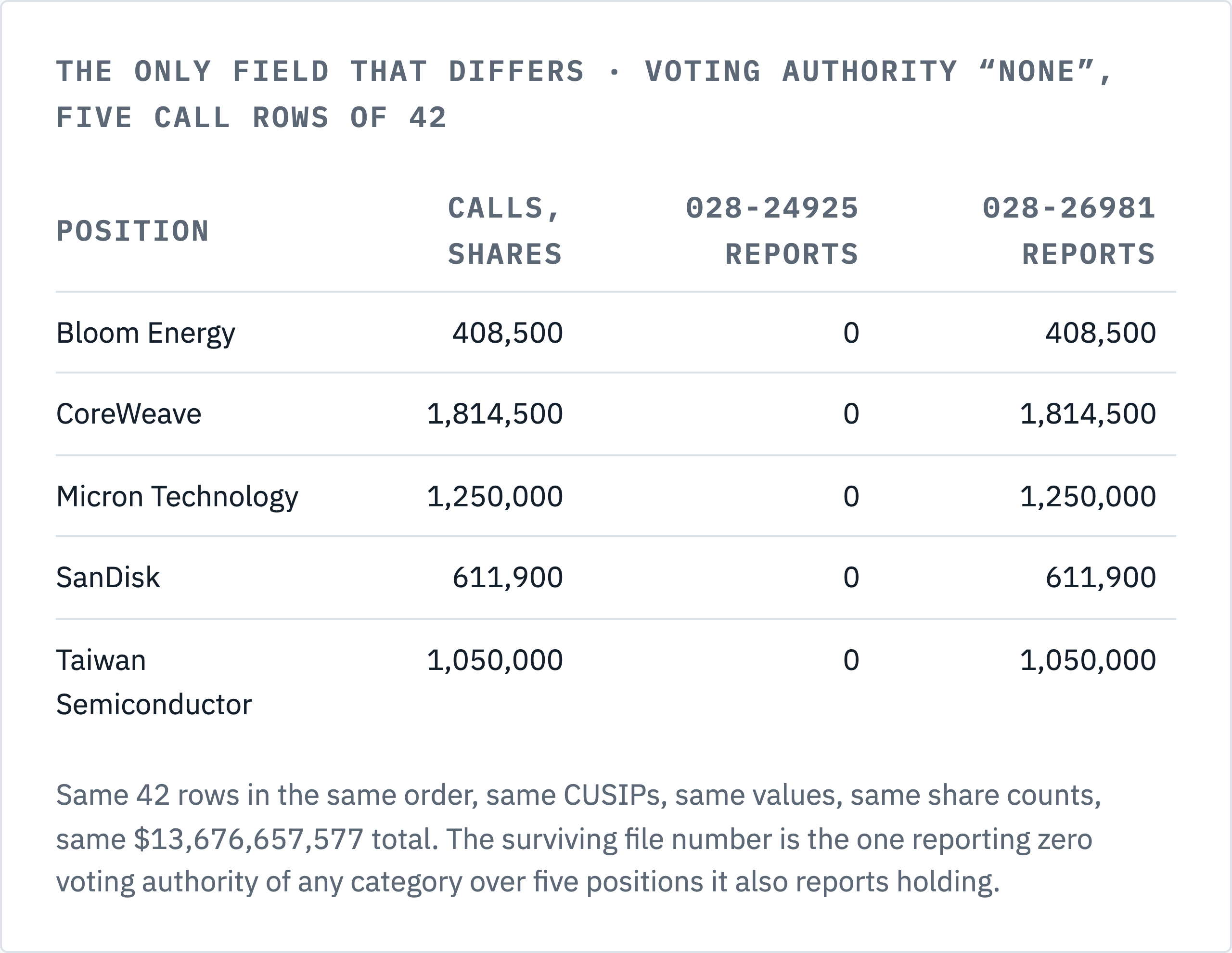
Same 42 rows in the same order, same CUSIPs, same values, same share counts, same $13,676,657,577 total. One field, five rows.
So it is the same book, filed twice, and not the same file uploaded twice. And the version that survives is the defective one. File number 028-24925 reports sole voting authority of zero, shared authority of zero, and no voting authority of zero, across five positions it simultaneously reports holding. Those three columns are supposed to account for the whole position. On five lines, in the filing that’s still active, they account for nothing at all.
Four more pairs, and these really are the same file
The Situational Awareness pair is the largest by value but it is not the only one, and the other four fail differently.
The universe here is the SEC’s own Form 13F structured data set for the period, which covers every filing received between 1 March and 31 May. I ran every comparable filing in the quarter through an order independent fingerprint of its information table, the multiset of CUSIP, class, value, shares, share type and put/call across every line. Twelve groups came back where two or more filings carry an identical book. Seven of those are $0 books and can be set aside. Five are real.
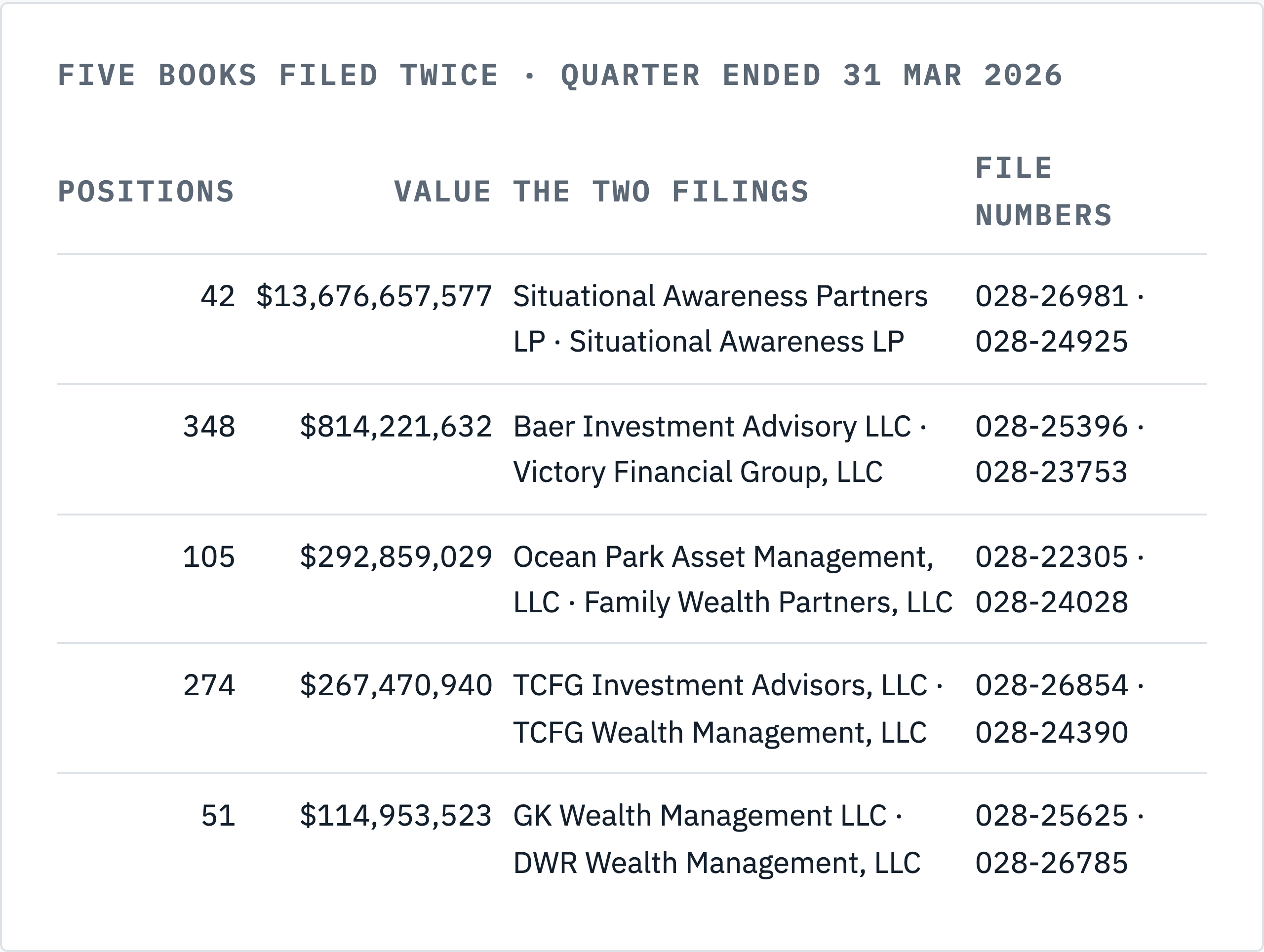
I had already been burned once by trusting a derived data set, which I will come to, so I went back to EDGAR and pulled the actual InformationTableOutput.xml for all eight filings. For each of the four pairs, the two files are identical byte for byte:
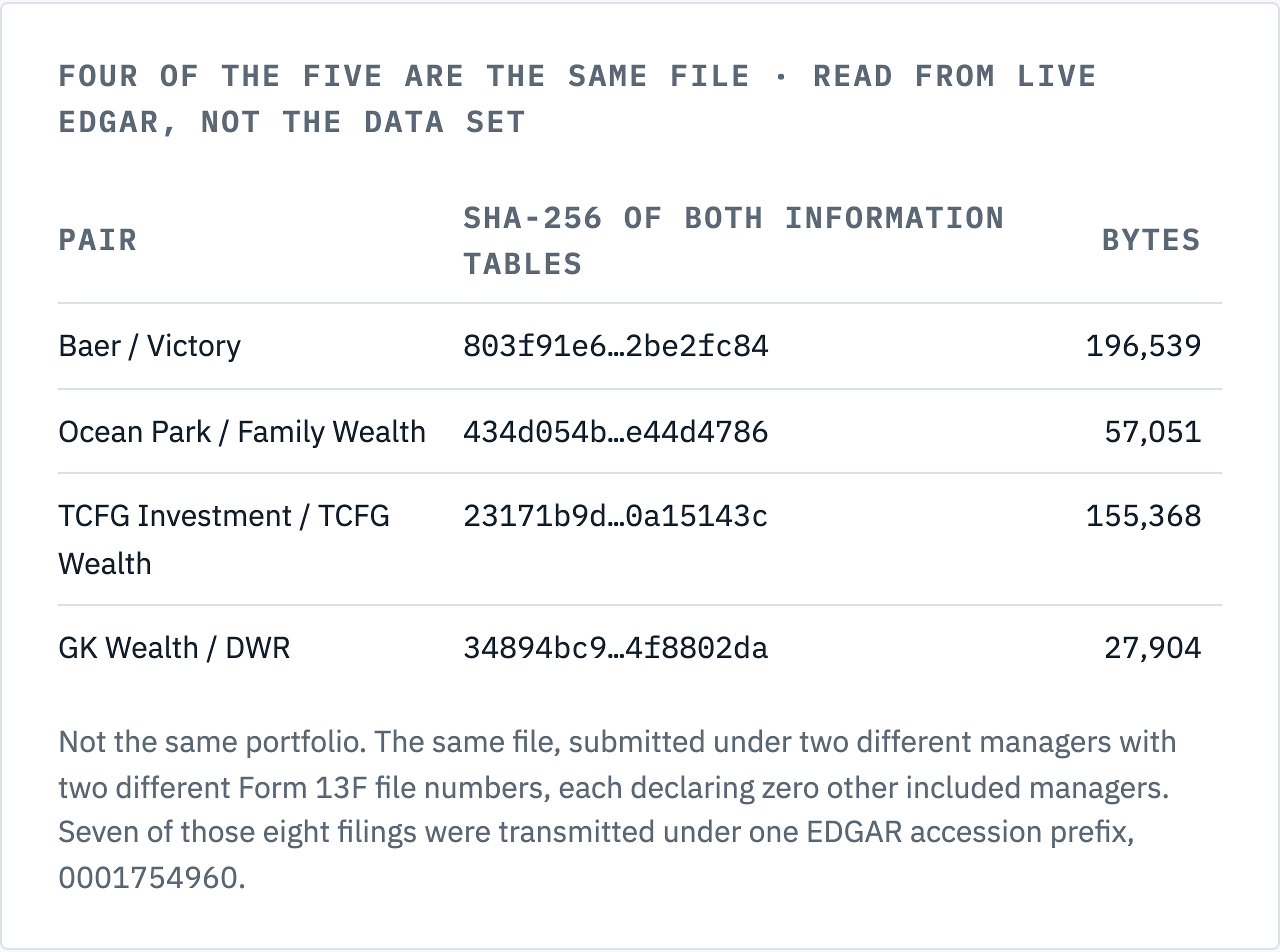
Not the same portfolio. The same file. One document, submitted under two different managers with two different Form 13F file numbers, each declaring zero other included managers.
Seven of those eight filings went in under a single EDGAR accession prefix, 0001754960, which is one third party filer agent. And the TCFG pair carries two different signature dates, 23 April and 5 May, on identical bytes. The same information table got reused across submissions twelve days apart, so this was not one slip in one session.
That’s a different disease from Situational Awareness. One is a registration nobody reconciled. The other is a filing pipeline that will carry the same payload for two clients without noticing.
