



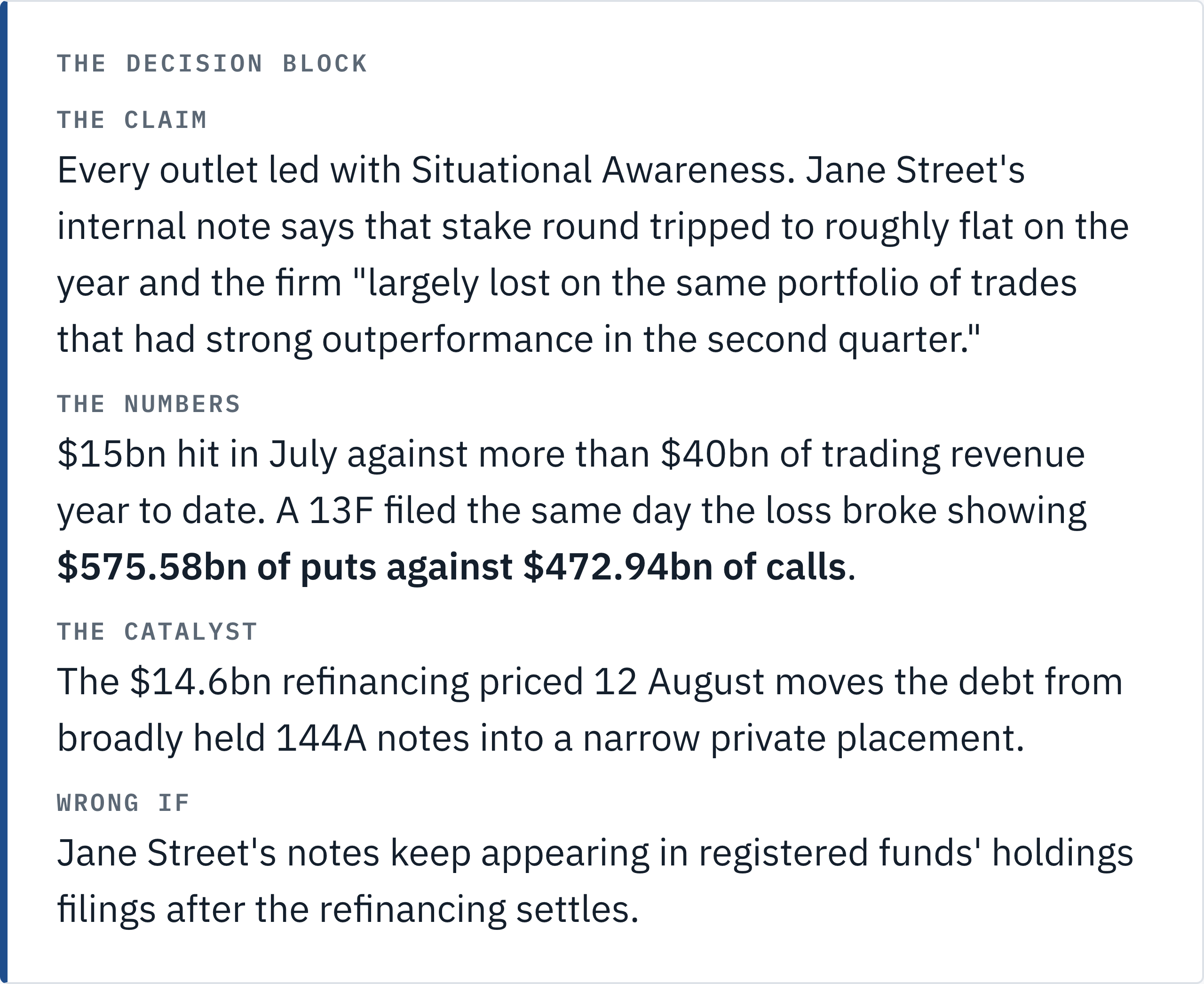
The claim: Every outlet led with Situational Awareness. Jane Street’s internal note says that stake round tripped to roughly flat on the year and the firm “largely lost on the same portfolio of trades that had strong outperformance in the second quarter.” The money went on its own book.
The numbers: $15bn hit in July against more than $40bn of trading revenue year to date. A 13F filed the same day the loss broke showing $575.58bn of puts against $472.94bn of calls. A credit spread that widened to about 330bp over a window in which the high yield market tightened.
The catalyst: The $14.6bn refinancing that priced on 12 August moves Jane Street’s debt from broadly held 144A notes into a narrow private placement, which collapses the audience for the only reporting that has ever shown this firm’s earnings.
Wrong if: Jane Street’s notes keep appearing in registered funds’ holdings filings after the refinancing settles, or the firm’s quarterly figures keep reaching the press at the same cadence.
What Reuters reported, and why it read as survivable
On 14 August, Reuters reported that Jane Street took a $15 billion hit in July, citing two people familiar with the matter and an internal note it had seen. Every version I read framed it the same way: the firm was an investor in Leopold Aschenbrenner’s Situational Awareness, that fund collapsed from $45bn to around $10bn on margin calls and a fire sale of its book to Citadel, and Jane Street wore the consequences. I wrote about the other side of that block when Citadel bought it.
I understand why it read as survivable. Trading revenue still runs above $40bn year to date, against $39.6bn for all of 2025. Fitch had upgraded the firm to BBB- from BB+ on 24 July, citing “strong through-the-cycle growth in net operating income.”
That account is coherent. It’s also widely repeated, and wrong about the thing that matters.
The note says the stake is flat on the year, and the loss came from the book
Read the internal note past the sentence everyone quoted. Here it is whole:
“We have an investment in Situational Awareness, an externally managed AI-focused hedge fund, that became large by performing well in the first half of the year. They had a large drawdown that left our stake about flat on the year, but still up over the entire period we have been invested.”
Flat on the year. Still up over the holding period. The position every headline blamed gave back its first half gains and finished roughly where it started. I’d call that a round trip. A hole is something else.
So where did I find the $15bn? The note answers directly, and this is the part nobody printed:
“The firm also took a hit from its long positions in non-AI stocks in Asia, many of which had outperformed the markets earlier during the year.”
“We largely lost on the same portfolio of trades that had strong outperformance in the second quarter. AI-exposed stocks were down a lot during July, several of the largest memory and semiconductor stocks were down around 50%.”
“Largely” is Jane Street’s own word, and I take it to point at Jane Street’s own book. The firm adds that it has “closed a significant portion of our risk in the specific areas we lost on in July, and have also reduced risk taking in other strategies.”
My read is that this reverses the story. The external allocation is the part that worked out. The firm’s own positions are what broke. A market maker’s edge is spread capture, roughly indifferent to direction and scaling with volume. July delivered plenty of both, in a month when chip stocks alone shed more than $1tn. What the note describes instead is a book that made money holding things in the second quarter and lost money holding the same things in July, which is a risk taking business wearing a market making name.
There is a second mechanism inside that first quote, and it is the one that generalises. The stake “became large by performing well.” Nobody chose to concentrate into it. An unrebalanced winner compounds into a concentration by arithmetic alone, and the moment it is largest is the moment immediately before it is marked down. That’s the oldest failure in allocation. It happened here to one of the most sophisticated risk operations in the world, and it happened to end flat.
$575bn of puts at 30 June, and what a 13F cannot see
Jane Street Group filed its Q2 13F on 14 August, the same day the loss became public, covering holdings as at 30 June. I haven’t seen anyone read the two documents against each other, and I think that’s the gap worth standing in.
The headline number is $1,205,633,745,715 across 14,718 line items. I parsed every row and the values sum to that total to the dollar. That’s my check. Nothing got dropped.
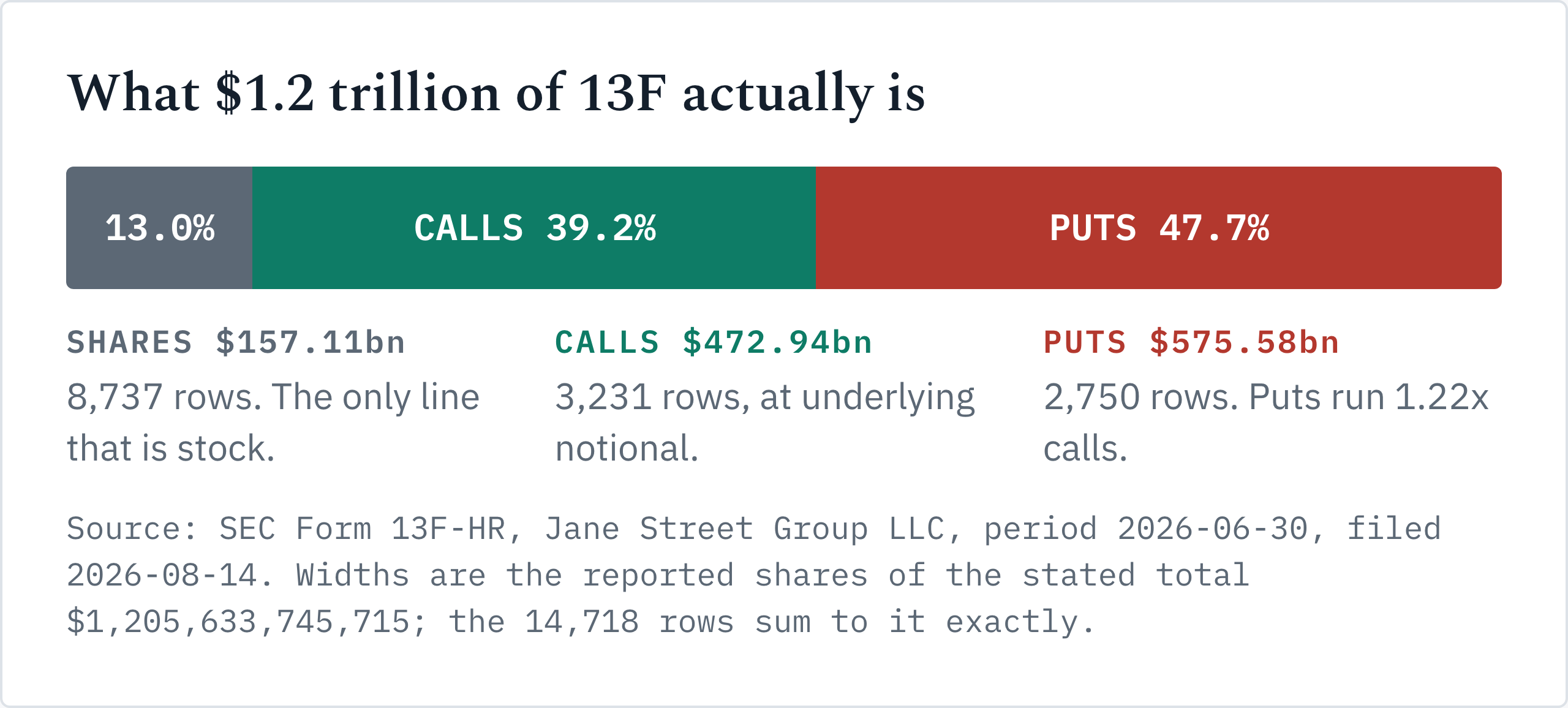
Only 13% of that trillion dollar headline is actual stock. Puts run about 1.22 times calls across the book.
One technical note, because it decides whether any of this means anything. The value column reports notional value of the underlying shares. Premium would paint a completely different picture, so I checked which one it was: for each issuer the implied dollars per share is identical across the share, call and put lines, which only happens if all three are struck against the same quarter end mark. Micron computes to $1,154.29, and Micron’s record close six days earlier was $1,213.37. The tape agrees.
Now to the memory and storage complex, which is the corner of the market the note names:
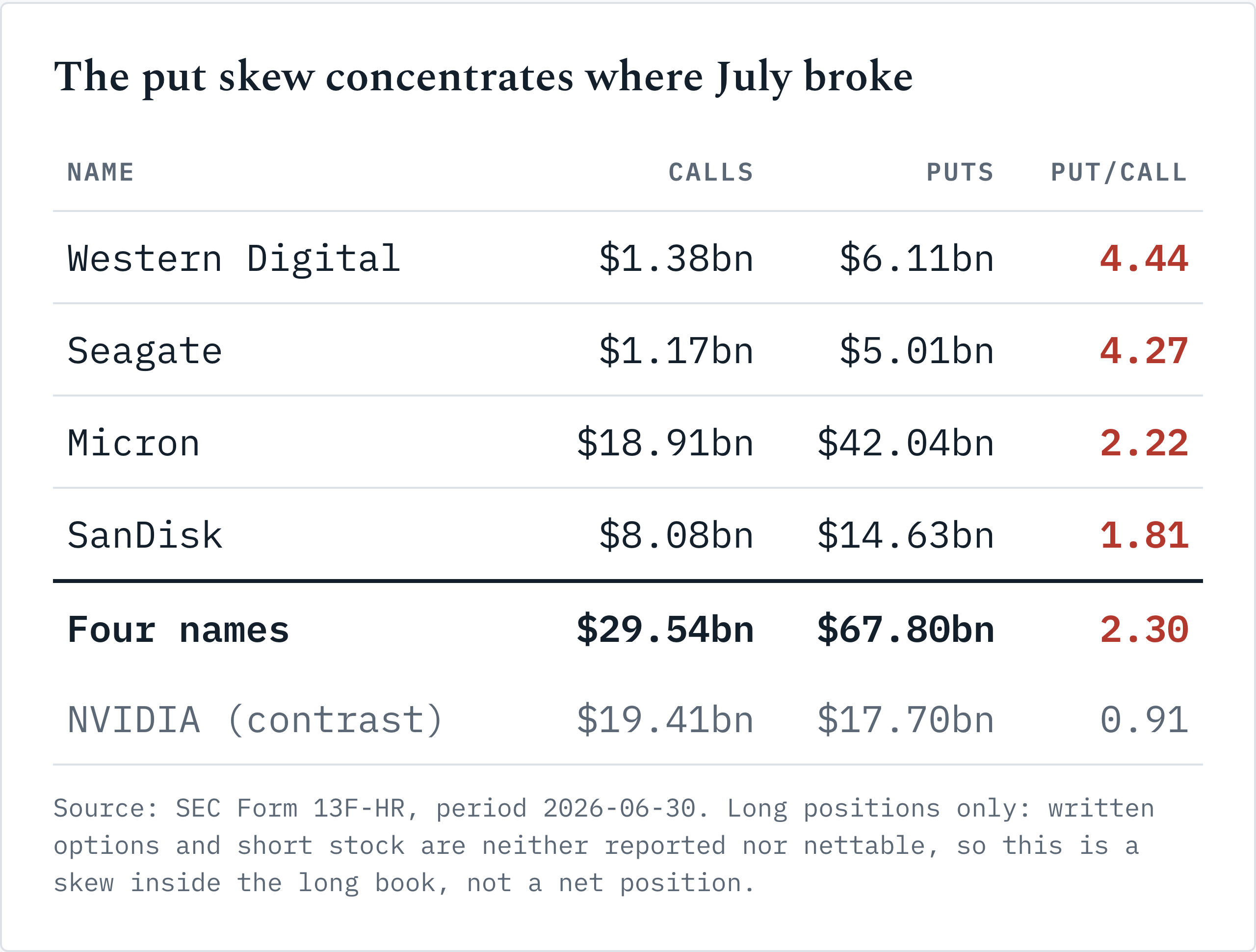
Across those four names Jane Street held $67.80bn of puts against $29.54bn of calls, a 2.30x skew on $102.87bn gross. NVIDIA sits at 0.91 in the same book on the same date.
Here is why that sits alongside the note. A 13F is a long only snapshot, filed on a 45 day lag and consolidated across eight Jane Street entities. Under the SEC’s instructions a manager reports neither short positions nor written options, and may not net either against a long holding in the same issuer. It also covers US listed securities only. The note points at Asia, which a 13F structurally cannot see. So the US listed book going into July leaned the other way in those names: real long exposure, with put notional running 2.30x the calls against it. And much of what the firm describes losing sits where this filing simply cannot look.
I get the same read from the audited numbers. In the statement of financial condition that Jane Street Capital LLC filed for 31 December 2025, that broker-dealer held $41.70bn of financial instruments owned against $45.01bn sold not yet purchased. Shorts exceed longs. That is a market making inventory at a point in time, seven months before the month in question.
