


Arini sold over $2bn of assets at face value last week, under its banks’ margin calls, the FT reported. Its founder, Hamza Lemssouguer, told investors in October that the losses were marks a contrarian fund holds through. Arini’s Form ADV, its SEC registration form, shows what that rests on: a book well over twice its flagship fund’s reported capital. Each 1% the book falls costs about $218m.
The banks decide how long a mark can be held: their calls follow the marks and any terms they tighten. Unless new money outruns them, Arini’s next loss, set against October’s, decides how much more it must sell.
The one dated risk is a default at Brightspeed, a US telecoms operator Arini lends to that faces a reported going-concern warning; it matters to anyone trading its paper beside Arini.
The evidence leans toward a default. The paid half settles what one by 31 March 2027 would cost Arini on each loan, with our odds beside S&P’s record; the deciding number is that cost as a share of capital, from filed loan marks.
A book bigger than its capital
The ADV lists each private fund’s gross assets and gives the flagship’s master fund, Arini Credit Master Fund, the pool its money is invested through, $21,796,891,222. That makes a point of the book, each 1% it falls, $217,968,912. It is a gross measure, since the ADV counts cash, posted collateral and hedges, so a point sizes the book, not the net loss.
I turned Arini’s own Form ADV into that unit and priced its 13F, the quarterly list of its US-listed stocks, at the 3 November close. I read Brightspeed’s loans at the prices mutual funds filed with the SEC.
Bloomberg’s 5 October report put the flagship at $7.6bn at the end of August, after a loss for the year we put at 8.4% by then. Assuming no flows, it held up to about $8.3bn at the end of 2025, when the book was at least 2.6 times capital.
In October to the 23rd the flagship lost 12.1%, which took its loss for the year to about 26%, Bloomberg and the FT reported; the full month is not yet out. Against the roughly $7bn the FT says it manages now, the book is nearer 3 times unless the selling shrank it, so each point is about 3% of capital.
Lemssouguer’s letter, as the news site Briefs quoted it on 5 October, defends the losses as strategy. “It is the same playbook we are running today and mark-to-market volatility is embedded in how this strategy generates returns.” The letter is right that the marks are part of the plan. The quoted passage leaves out the leverage they ride on. The ADV names five banking groups as the master fund’s prime brokers, the banks that lend to it against its positions, and they decide how much volatility the fund may sit through.
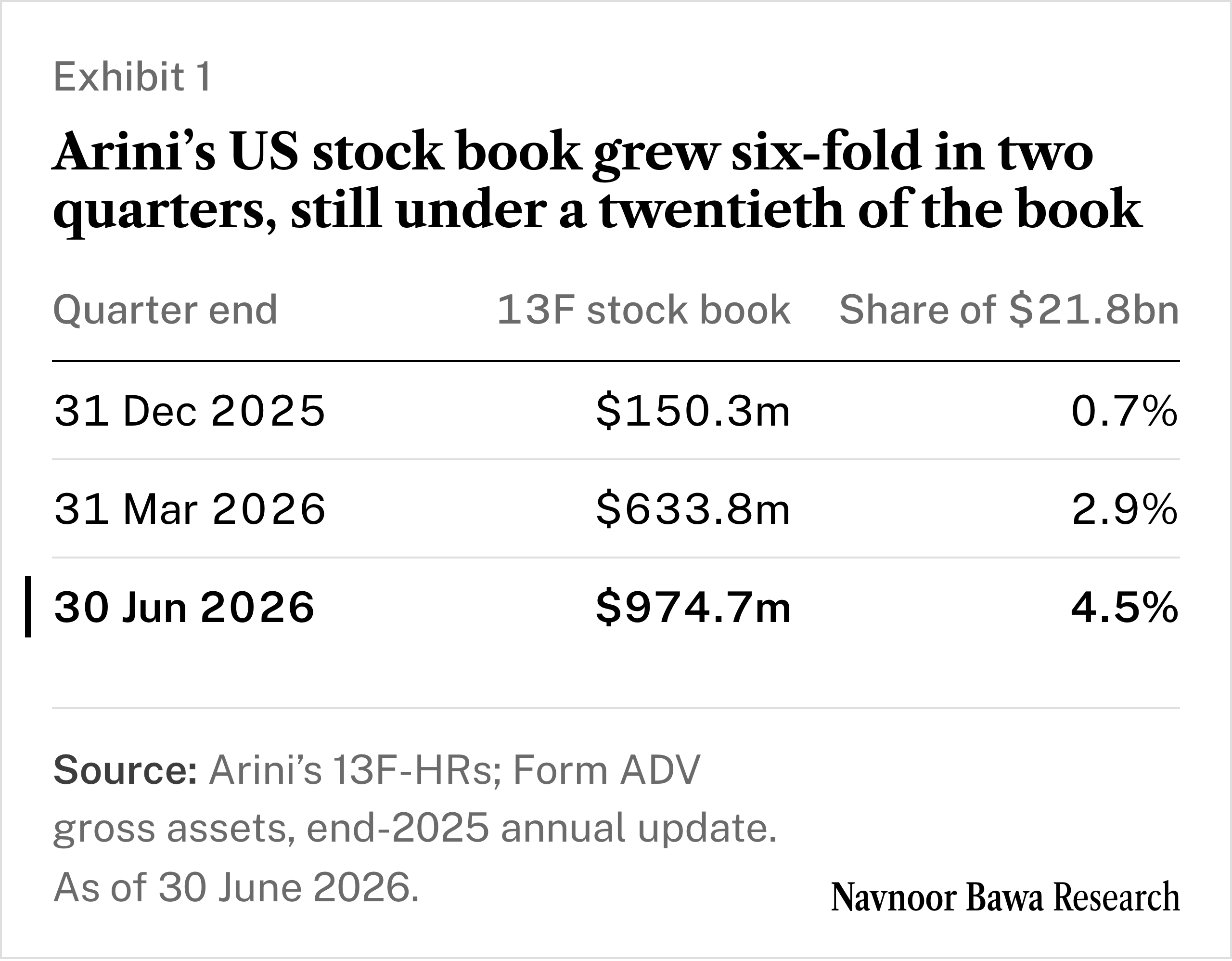
Arini’s 13F for 30 June, filed up to 45 days after the quarter and holding no bonds, loans, shorts or cash, showed $974.7m. That is more than six times its $150.3m at the end of 2025, yet 4.5% of the master fund’s book; it is about 14% of the flagship’s capital now, close to its October to the 23rd.
What surprised me was that half the stock book is one stock, EchoStar. Arini filed its June 13F on 12 August without it, and an amendment two days later added it and doubled the total.
Liquid credit went first
On 30 October Bloomberg reported that Arini drew bids from Pimco and Oaktree; Briefs wrote that the focus was on “liquid, better-performing assets”, including debt of the travel technology company Sabre. The same day the WSJ reported about $800m of debt sold, naming Pathway Vet Alliance, Intrum and the Ritz-Carlton Yacht Collection among positions exited. The FT then reported cuts in Merlin Entertainments, the healthcare data firm Claritev and Sabre and in credit default swaps.
The FT’s total counts face value, and distressed debt sold below par raises less cash than that. The reports give no size for the calls, but some sale proceeds met margin requirements tied to credit default swap indexes and other trades, the WSJ reported. The Fed’s survey of dealers, taken in August before the selloff, found their initial margin requirements on derivatives, the collateral posted up front, “basically unchanged”; the autumn survey is not yet out.
Planned de-risking and forced selling both fit the record. The WSJ and the FT tie the sales to margin, while Bloomberg’s “better-performing” describes a choice of which paper to sell. The banks set how much; Arini chose what.
The obvious reserve was the stocks, yet the sales named so far are mostly credit, by choice or because its blocks take days. Two of the four lines after EchoStar, Sabre and Claritev, are 9% blocks by its latest 13G filings, the filing a holder of more than 5% of a company’s shares makes; a third, Caesars, is a merger position. Its 13Gs show a block leaving around an event: last year Arini cut its WW International stake from 6.40% to 2.79% within six days of WW’s emergence from Chapter 11.
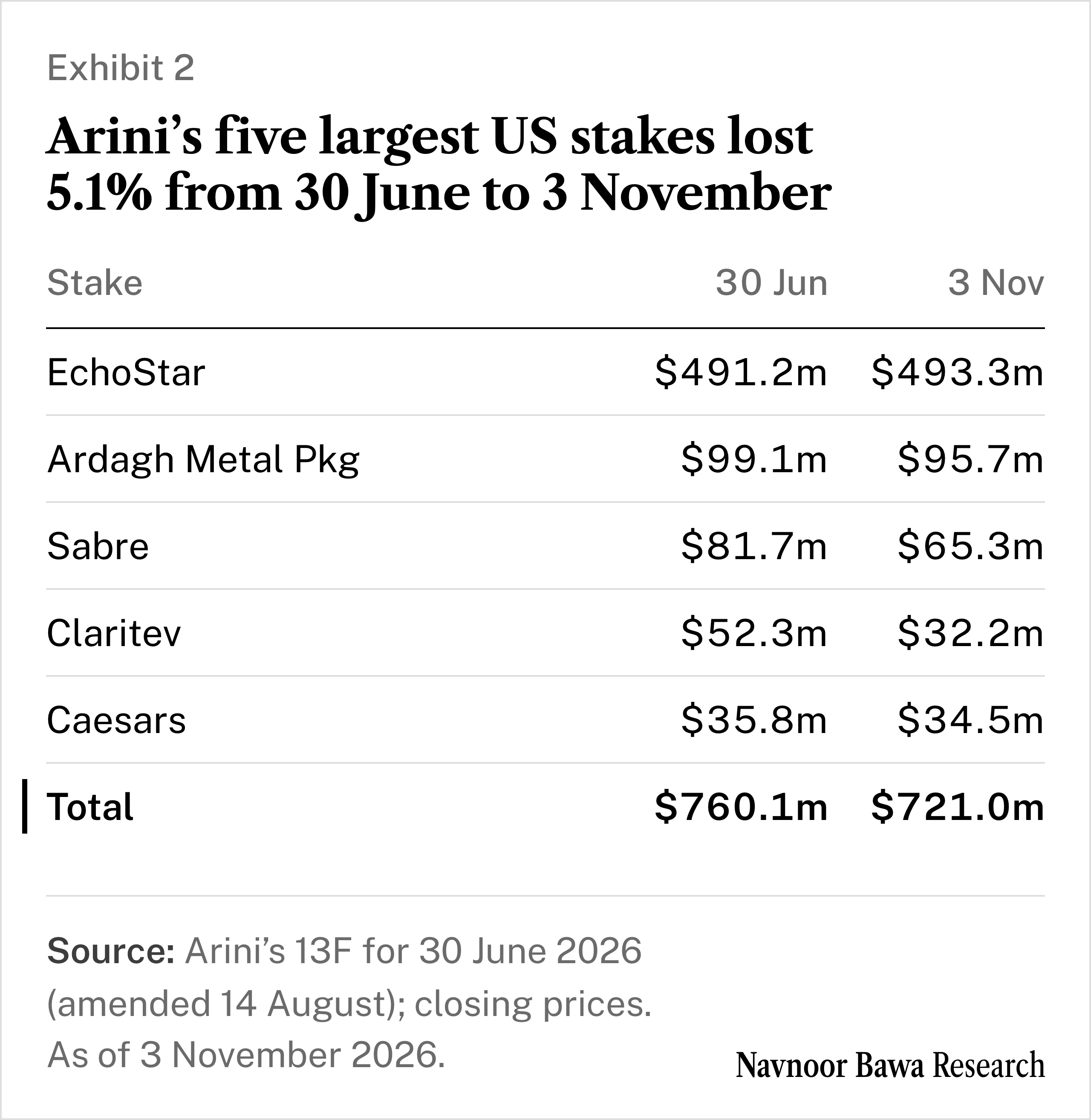
The June column is Arini’s filing; EchoStar’s shares at June’s $101.50 close make exactly the $491,174,537 Arini filed. The November column is ours, at June’s share counts, a 5.1% fall from $760.1m. On 20 October, the month’s lowest close, the five were worth $644.6m.
New money did not stop the selling either. The FT reported $1.5bn of new commitments in October, $425m of it deployed at the start of the month, and the calls and the week of sales came after it. The other $1.075bn is expected by February.
What slows the rest
Two things slow the sale of what is left.
The first is the seats. On 27 October Bloomberg listed Arini, the credit investor Diameter Capital Partners and others among the creditors of the telecoms group Altice International negotiating under a non-disclosure agreement. Until Altice publishes the figures they have seen, such creditors “will remain restricted from trading the relevant securities”, in Global Restructuring Review’s guide.
At Aston Martin, Arini and the asset manager Sculptor lead the bondholders’ cooperation group, the credit news service 9fin reported in July. The bonds behind Arini’s losing bet on the carmaker fell from about 55 cents on the dollar at the start of October to 47 by the 28th, Bloomberg reported.
The FT named both. In such holdings, Hedgeweek wrote, “restructuring negotiations and restrictions on trading could complicate efforts to reduce exposure.” Both debts still trade; what is hard is selling a large, visible block, and at Altice doing it while any restriction lasts. On this record, Lemssouguer’s method is the large stake and the lead seat. A lead seat buys influence over a restructuring and is paid for in liquidity.
The second is the other side. Some rival hedge funds have shorted Arini’s largest holdings, the FT reported. Buyers are wary too: “Some investors have reportedly become reluctant to purchase securities in which Arini holds sizeable positions,” Hedgeweek wrote of the same Bloomberg report. That is the 2005 pattern of Brunnermeier and Pedersen’s “Predatory Trading”: rivals sell ahead of a forced seller and buy back lower.
Bidders know they face a forced seller, as Citadel did when it bought the hedge fund Situational Awareness’s book at the bottom. This round left Arini holding paper that is harder to sell than what it sold, EchoStar apart, with rivals positioned against it.
What decides the next round
The dated risk is Brightspeed, backed by Apollo and borrowing as Connect Holding II LLC. Arini holds about $2bn of its debt, the FT reported, a sum apart from the week’s sales. That is about nine points of the book and 29% of the flagship’s capital, if all of it sits there.
S&P rates Brightspeed CCC+ and wrote on 17 August: “We continue to view Brightspeed’s capital structure as unsustainable.” A going-concern warning was reported on 1 September. On 30 October Fierce Network, citing the WSJ’s Pro service, reported that Brightspeed “is preparing for a potential bankruptcy filing as soon as December”, and that Apollo “apparently” would not put in more capital. On 2 November Brightspeed named Shawn O’Donnell, who had led FTI Consulting’s Americas telecom, media and technology practice, chief executive.
The credit research firm Octus gives it cash “runway through the first quarter of 2027”, which BEAD (Broadband Equity, Access and Deployment) grants or lower capex would extend; new debt ranked ahead of the loans would also buy time.
It has defaulted once already. In its 2024 exchange, creditors “took a roughly 23% discount”, 9fin reported, and S&P rated the company SD, for selective default, before raising it to CCC+. Its secured debt sits in four first-lien layers, first-out to fourth-out, repaid in that order, so one default costs each layer a different amount. The first-out layer holds notes as well as a loan.
Mutual funds report holdings to the SEC monthly in N-PORT filings, made public each quarter. In cents on the dollar, the first-out loan was last filed at 85.25 on 31 August and the second-out at 67.04 on 31 July. Both marks predate the going-concern report and the bankruptcy talk, and no fund files a price for the third- or fourth-out.
Other holders on file are far smaller. Oaktree Specialty Lending, Oaktree’s listed lending fund, marked its $14.6m of the first-out loan at 94.16 in June. Diameter Credit Co, Diameter Capital Partners’ listed lending fund, held $27.2m of it in March and none by June. The reports do not say which layer Arini’s $2bn sits in.
→ Arini’s 2025 WW International exit, rebuilt from its filings, Trade File No. 8 on Patreon.
If Brightspeed files this winter, will it cost Arini less than its October to the 23rd, or more?
Below the paid line:
What a Chapter 11 would cost Arini on each loan, then our odds on a default beside S&P’s record.
The model, and one table of what moves the cost.
A table of record: Brightspeed’s loan marks beside S&P’s recoveries, and what Arini’s five stocks would cover.
What the loans’ prices assume, the test for any levered credit fund, and the dated filings to watch.