


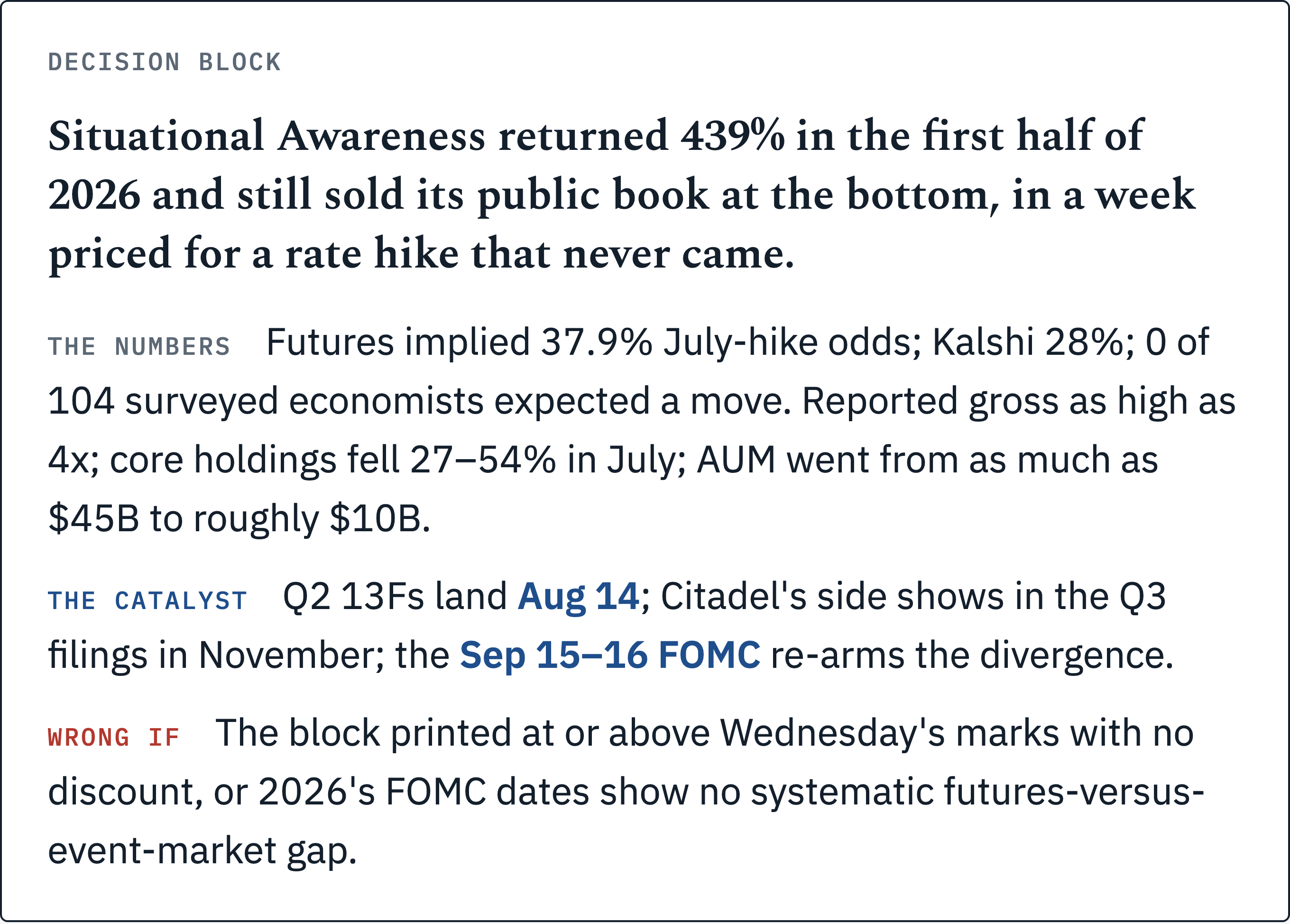
Situational Awareness returned 439% in the first half of 2026 and still sold its public book at the bottom, in a week priced for a rate hike that never came. The decision block, the numbers, and what would kill the view:
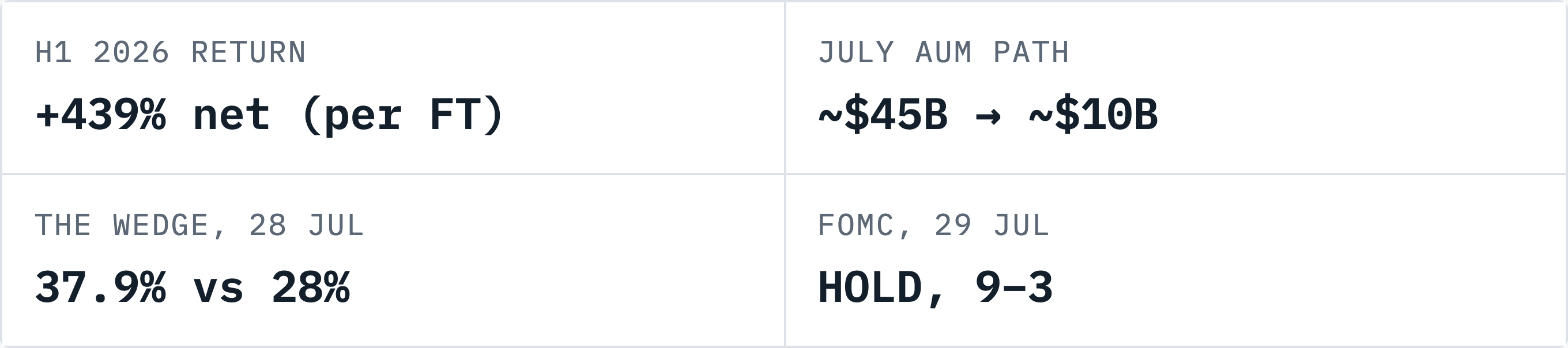
On Wednesday, July 29, the Federal Open Market Committee voted 9-3 to hold the federal funds rate at 3.50-3.75%. Before Thursday’s open, Situational Awareness LP, the AI-concentrated hedge fund run by former OpenAI researcher Leopold Aschenbrenner, sold its public equities book in a single block, longs and shorts together, to Ken Griffin’s Citadel. How much of it went is itself disputed: the whole book, per SpotGamma’s account of CNBC’s reporting and The Next Web’s of the FT’s; the majority of it, per TechCrunch. On Thursday, the names in that book ripped: SanDisk rose 23.9%, Micron 17.0%, Bloom Energy 26.4%, with the Nasdaq 100 up 3.1%.
The consensus reading of this episode is already settled: a brilliant, over-levered kid met a margin call, and leverage kills. That reading is true and worthless. Every professional already knows leverage kills. What the consensus misses is what the public record shows on two specific points. The fund’s hedges were structurally incapable of protecting it, and the numbers proving that sat in its own filings since May. And the panic that filled its final week was measurably part hedging flow rather than forecast, a distinction visible in real time on two free screens. Neither required inside information. That is the part worth a professional’s time.
Six days in July
The sequence matters. Backdrop first, then the tape.
2026’s inflation was an energy story. The CPI energy index rose 10.9% on the month in March, and headline inflation hit 4.2% in May before June’s print, released July 14, came in cool: down 0.4% on the month, 3.5% annually, with core at 2.6% and gasoline falling 9.7% on the month. The Fed’s own July statement still described inflation as “elevated relative to the Committee’s 2 percent goal, in part reflecting supply shocks that have driven price increases in certain sectors, including energy.”
Meanwhile the AI infrastructure complex was breaking for its own reasons. Over the month through late July, SanDisk fell 56% and Nebius dropped about 48% from its peak; SpotGamma’s post-mortem, counting a slightly different window, puts the fund’s core holdings, Nebius, SanDisk, Micron, and CoreWeave, each down between 27% and 54% on the month, with the Nasdaq 100 off more than 10%. The drawdown was doing its damage well before anyone repriced the Fed.
July 24: Aschenbrenner writes to clients that the fund, now at approximately $20 billion, has “not been immune” to the selloff, calls it one of the best buying windows since early 2025, and invites fresh capital starting August 1, with a possible Anthropic IPO highlighted as a catalyst. Whatever commitments came, they evidently did not come in time.
July 27-28: Citadel Securities publishes a client note by Frank Flight, its head of macro strategy, arguing for a surprise 25 basis point hike at the July meeting rather than September: “The market may once again be underestimating the extent of the hawkish shift at the Fed.” A hike now, the note argues, would “emphatically end the forward guidance era” and reduce the total tightening needed later.
July 28 (Tuesday): CME FedWatch puts hike odds at 37.9%, up from 25.7% a week earlier. Kalshi prices the same event at 28% on more than $45 million of volume; Polymarket at 27.5% on over $107 million. A Reuters poll of 104 forecasters taken July 17-21 finds none expecting a move.
The final days (reported only as “late July”): Goldman Sachs and JPMorgan issue margin calls to funds holding concentrated AI positions; Bank of America, Goldman, and JPMorgan are marketing Situational Awareness positions.
July 29 (Wednesday): The Fed holds, 9-3, with Hammack, Kashkari, and Logan preferring a quarter-point hike. The hike risk was real; a quarter of the committee voted for it. Equities stay heavy into the close. After the bell, Microsoft, which closed Wednesday at $390.54, reports results showing 43% cloud revenue growth.
July 30, pre-open: the book goes to one buyer in a single block, after Microsoft’s print is public. The buyer is Citadel.
July 30 (Thursday): Microsoft rises as much as 17%, its biggest one-day gain since 2008, adding roughly $480 billion of market value and dragging beaten-down semiconductors sharply higher, reversing Wednesday’s losses. SanDisk closes up 23.9%. Bloom Energy, up 26.4% on earnings. Nebius rises nearly 30% in morning trade. The Nasdaq 100 gains 3.1%.
A fund that returned 439% for the year through June and reached as much as $45 billion in assets at the start of July ended the week at roughly $10 billion, half of it a private Anthropic stake valued at $5 billion. It sold hours before the rebound, and after the rebound’s catalyst was already on the tape. That is not bad luck; that is what margin mechanics do, and it is worth being precise about which mechanics.
The panic had a basis, and the basis was the tell
Start with the instrument that carried the panic. CME’s FedWatch tool converts 30-day fed funds futures prices into implied probabilities of FOMC moves. The market treats those probabilities as forecasts. They are not. A futures price is a forecast plus a risk premium, and the premium is not small or stable: Piazzesi and Swanson’s canonical result is that excess returns on fed funds futures are positive on average, countercyclical, and predictable, and that “simply ignoring these risk premia has important consequences for the expected future path of monetary policy.”
One line of intuition for what that means in practice: when a levered investor fears a rate shock, he does not update a forecast, he buys protection, and protection demand moves the futures price exactly the way a genuine change in expectations would. FedWatch cannot tell the difference. Prediction markets mostly can, because their buyers are expressing the event probability itself, in capped-size, real-money contracts, not hedging a bond book. The forecasting literature backs the asymmetry: Snowberg, Wolfers, and Zitzewitz find prediction markets generally exhibit lower statistical errors than professional forecasters and polls and incorporate new information quickly. I have covered which funds actually trade these venues and the pricing math underneath the contracts before; July was the first time the two screens mattered this much in one week.
That is why July 28 was so informative. The same binary event was priced three ways at once, and surveyed a fourth (all four figures from the same Bloomberg-syndicated snapshot; the primary tapes are CME’s and the venues’ own):
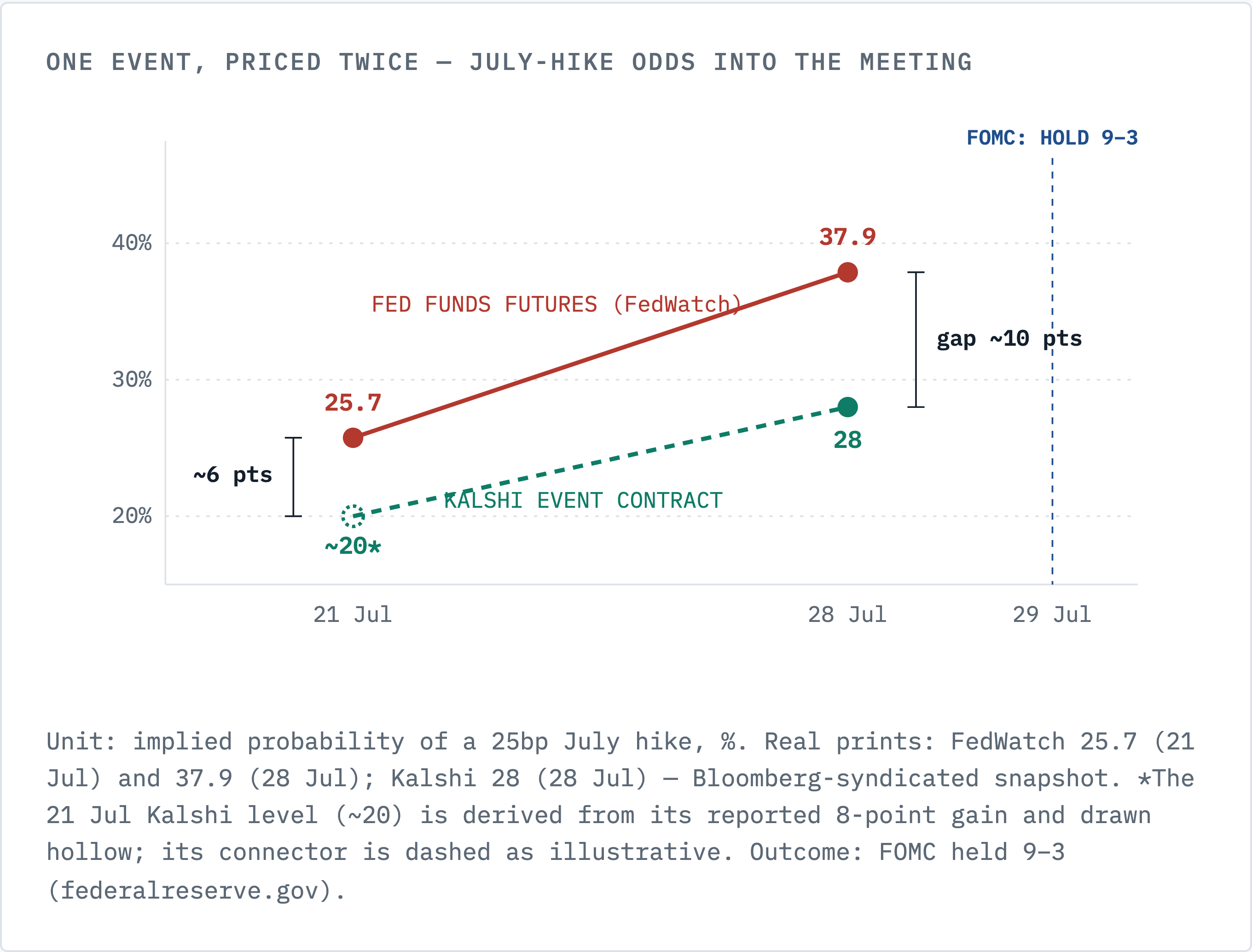
Be precise about what moved. Real information was repricing everyone that week: both venues repriced sharply, with Kalshi’s hike contract gaining 8 points into the meeting, which puts its week-earlier price near 20. The hike risk was not imaginary, and Wednesday proved it, with three of twelve voters dissenting in favor of a hike. But the futures-implied number rose 12.2 points into the same meeting, 25.7 to 37.9. So the gap between the two measures widened as the date approached: from roughly 6 points to roughly 10. Information moves both prices together; hedging pressure moves only the instrument people hedge with. The widening is the flow signature. Four points of widening on one meeting is a lean signal, and it is all the demonstration this episode offers; it was also visible in real time, timestamped, and free.
The Fed then held, 9-3. One hold validates nobody’s probability. The prediction-market number was not a clean forecast either: Kalshi’s own contracts show a documented favorite-longshot bias, which means a 28-cent hike contract likely overstated the true probability, making the futures premium larger, not smaller. This episode is one data point for the premium reading, no more. The systematic test, futures-implied minus event-market odds across every FOMC date since liquid Fed contracts existed, has apparently not been published. Someone will run it.
Now connect this to the dead fund, carefully, because the honest connection is narrower than the dramatic one. The month’s damage was done by the AI book itself: the fund had already fallen from $45 billion toward $20 billion before Citadel Securities wrote a word and before the futures spike. No fed funds flow moved SanDisk’s price. What the wedge tells you is what kind of week the fund’s margin clock ran out in: a week when priced fear exceeded measured probability by a third, when margin calls were going out across the levered AI complex, and when prime brokers were marking collateral against panicked prices rather than against the outcome three days away. Margin calls settle against price, not against the eventual outcome. This is the spiral Brunnermeier and Pedersen formalized, margins turning destabilizing as market liquidity and funding liquidity reinforce each other, and the single-block sale that ended the episode is what heading off that spiral looks like in practice. A levered fund dying in a flow-dominated week sells at flow-dominated prices. The Fed did not liquidate Situational Awareness. The Fed did nothing, which is the point.
