


This is a detailed research piece. If you find value in institutional-quality hedge fund analysis, support this work on Patreon.

Susquehanna Government Products, Jump Trading, and Founders Fund are actively deploying capital into Kalshi and Polymarket. With Intercontinental Exchange (NYSE parent) investing up to $2 billion and Kalshi reaching $11 billion valuation, prediction markets have transitioned from retail novelty to institutional infrastructure. Here’s how the smart money is positioning.
The Institutional Players: Who’s In
Susquehanna Government Products (SGP)
Role: First dedicated institutional market maker on Kalshi (April 3, 2024)
Susquehanna Government Products, LLLP — a market-making affiliate of the Susquehanna group — operates a dedicated trading desk exclusively focused on event contracts. The firm provides continuous two-sided liquidity across Kalshi’s political, economic, and sports markets.
Strategic Rationale: SGP’s market-making model extracts bid-ask spread while remaining delta-neutral to event outcomes. As part of one of Wall Street’s largest options market-making groups, the firm is replicating its equities playbook in a new asset class.
In late November 2025, Robinhood and Susquehanna announced a joint venture to acquire a CFTC-licensed derivatives exchange (reported variously as MIAXdx/LedgerX), with closing expected Q1 2026 — signaling deeper commitment to prediction market infrastructure.
Sources:
BusinessWire — Kalshi Onboards First Institutional Market Maker (April 2024)
Reuters — Robinhood, Susquehanna Take Over Exchange LedgerX (November 2025)
Jump Trading
Role: Active market maker on Kalshi (confirmed November 2025)
Bloomberg reported that Jump Trading has “quietly become one of the earliest proprietary trading firms to become active on prediction markets like Kalshi,” making markets on event contracts across elections, sports, and economic indicators.
Strategic Rationale: Jump’s crypto division (Jump Crypto) previously dominated DeFi liquidity provision before regulatory pressure in 2023. Kalshi’s CFTC-regulated structure provides a compliant venue for event-driven market making.
Source: Bloomberg — Jump Trading Joins Event-Betting Craze
Founders Fund (Peter Thiel)
Role: Lead investor in Polymarket’s $45M Series B (May 2024); in June 2025, multiple outlets reported Polymarket was nearing a $200M round led by Founders Fund at ~$1B valuation
Founders Fund has positioned Polymarket as a core portfolio company alongside Palantir, SpaceX, and OpenAI. The firm views prediction markets as a new data infrastructure layer.
Strategic Rationale: Thiel’s thesis centers on prediction markets as “truth engines” — mechanisms that aggregate dispersed information more efficiently than polls or expert forecasts.
Source: CoinDesk — Peter Thiel’s Founders Fund Backs $45M Investment in Polymarket
Citadel Securities (Peng Zhao)
Role: Personal investment by CEO Peng Zhao in Kalshi’s $185M Series C (June 2025)
While Citadel Securities hasn’t announced direct market-making on prediction platforms, CEO Peng Zhao participated in Kalshi’s funding round alongside Paradigm, Sequoia, and Multicoin.
Source: Yogonet — Kalshi Secures $185M Funding Round
Intercontinental Exchange (ICE)
Role: Up to $2 billion strategic investment in Polymarket (October 2025)
ICE announced a major strategic investment in a DeFi-adjacent platform, valuing Polymarket at approximately $8 billion pre-investment. ICE will distribute Polymarket’s event-driven data to institutional clients globally.
Strategic Rationale: ICE views prediction market data as a new sentiment indicator asset class. The partnership includes collaboration on tokenization initiatives.
Source: ICE Press Release — Strategic Investment in Polymarket
The Strategies: How They’re Making Money
1. Market Making (SGP, Jump Trading)
Mechanism: Quote continuous bid/ask prices on event contracts, capturing spread while hedging directional exposure.
P&L Drivers:
Spread capture (typically 1–5% on illiquid contracts)
Rebates from exchanges for liquidity provision
Inventory management across correlated contracts
Risk Profile: Market makers are exposed to adverse selection (informed traders picking them off) and inventory risk during volatile events.
Scale: Robinhood said its product attracted ~1 million customers and ~9 billion event contracts traded in the prior 12 months. SGP provides liquidity across multiple Kalshi markets; exact flow-through volumes are not publicly disclosed.
Source: Robinhood Newsroom — Prediction Markets Joint Venture
2. Directional Information Trades (Case Study: “Théo”)
The Trade: A French trader using the pseudonym “Théo” placed more than $30 million across multiple Polymarket accounts betting Trump would win the 2024 election, popular vote, and key swing states.
The Edge: Théo commissioned proprietary “neighbor polls” asking respondents who their neighbors would vote for — a methodology designed to capture “shy Trump voters” that traditional polls missed.
Execution:
Started August 2024 under account “Fredi9999”
Created additional accounts (Theo4, PrincessCaro, Michie) in September–October to avoid price impact
Over 450 bets placed during a 10-hour period from the Theo4 account alone
P&L (Disputed Across Sources): Estimates vary — mainstream outlets (WSJ/Bloomberg/Fortune) place profit nearer to ~$48–50M on ~$30–35M staked; Chainalysis (reported by The Block) estimated ~$78.7M; some outlets rounded higher to ~$85M.
Note: The disparity likely reflects different account attribution methodologies and timing of blockchain analysis.
Key Insight: The trade exploited information asymmetry between prediction market participants (sentiment-driven pricing) and rigorous polling methodology. Théo’s edge was better processing of publicly available polling artifacts, not proprietary data.
Sources:
Wall Street Journal — How the Trump Whale Correctly Called the Election
The Block — French Polymarket Whale ~$79M Profit Estimate (November 2024)
3. Tail-End Trading (Yield Extraction)
Mechanism: Buy contracts priced $0.95–$0.99 on near-certain outcomes, wait for settlement, capture the “certainty premium.”
Example:
Contract: “Will [resolved event] happen?” trading at $0.97 with 7 days to settlement
Return: 3.09% gross (~161% annualized, assuming 52 similar 7-day trades per year)
Risk: Resolution delays, edge-case outcomes, platform risk
Anecdotal Evidence: Experienced Polymarket traders interviewed by BlockBeats claim ~90% of large orders ($10K+) execute at prices above $0.95. This is participant-sourced data, not an audited on-chain statistic.
Quant Insight: Tail-end trading effectively prices the time value of money plus resolution uncertainty. The implied discount rate (10–50% annualized) reflects counterparty/platform risk rather than outcome uncertainty — making this a credit spread trade disguised as a prediction bet.
Source: BlockBeats — A Silent Arbiter Profiting on Polymarket
4. Macro Overlay Hedging
Use Case: Hedge portfolio exposures to discrete policy outcomes that traditional derivatives cannot efficiently price.
Examples:
Rate Hedging: Fund with duration exposure shorts “YES” contracts on Fed rate cuts when positioning for hikes
Political Risk: Long defense stocks + buy “NO” contracts on candidates proposing military budget cuts
Geopolitical: Energy-exposed portfolio hedging via event contracts on regional conflict escalation
Cost Structure: Event contracts typically cost 1–5% of notional exposure vs. options-based hedges with complex vol surface modeling. (Rule-of-thumb reported in analyst commentary; varies by market and maturity.)
Institutional Framework: Kalshi’s CFTC-regulated structure allows compliance teams to approve event contract hedging. Susquehanna’s market-making provides institutional-grade liquidity depth.
Platform Comparison: Where Institutions Trade
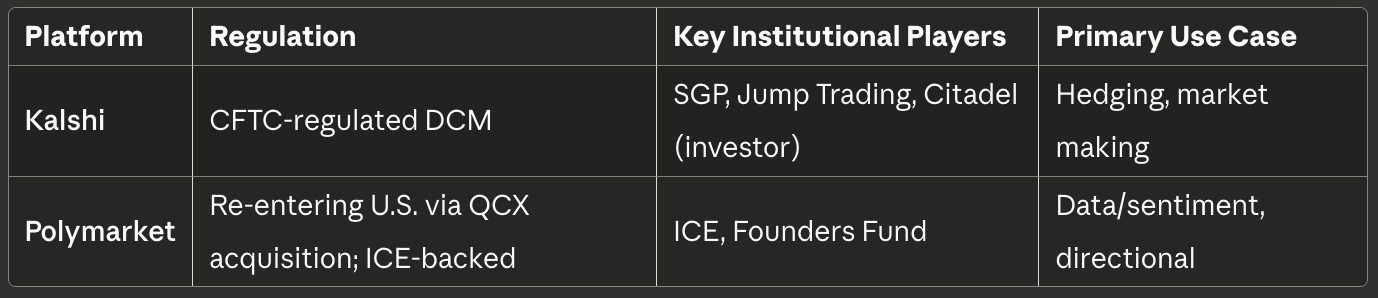
Volume Context:
Kalshi: ~$50 billion annualized trading volume (mid-October 2025, per NYT/TechCrunch)
Polymarket: ~$3.7 billion on 2024 presidential election market
Sources:
Key Takeaways
Market making is the dominant institutional strategy. SGP and Jump Trading are replicating their equities/options playbooks in event contracts — capturing spread while remaining directionally neutral.
Information edges compound at scale. Théo’s estimated $48–79M profit required superior polling methodology, not proprietary data. The edge was better processing of publicly available information.
Tail-end trading extracts credit-like returns. Near-certain contracts ($0.95+) offer annualized yields exceeding Treasury rates — reflecting settlement timing and platform risk rather than outcome uncertainty.
Event contracts complete the hedging market. Discrete policy outcomes (rate decisions, elections, geopolitical events) that defy continuous derivatives find natural expression in prediction markets.
Traditional finance is integrating fast. ICE’s up to $2B investment and Robinhood/Susquehanna’s exchange acquisition signal prediction markets are becoming core financial infrastructure.
Verified Sources
Institutional Activity:
BusinessWire — SGP Becomes Kalshi’s First Institutional Market Maker (April 2024)
Bloomberg — Jump Trading Joins Prediction Markets (November 2025)
ICE Press Release — Up to $2B Polymarket Investment (October 2025)
Reuters — Robinhood/Susquehanna Exchange Acquisition (November 2025)
Funding & Valuations:
Trade Case Studies:
Wall Street Journal — How the Trump Whale Correctly Called the Election
The Block — French Polymarket Whale ~$79M Profit Estimate (November 2024)
Prediction markets have crossed the institutional threshold. The question is no longer whether hedge funds will trade event contracts — it’s which strategies will generate durable alpha as liquidity deepens and spreads compress.
📊 Support this research: https://www.patreon.com/c/NavnoorBawa
Cover photograph: OtoPhuploader, CC0, via Wikimedia Commons.
Great article - prediction markets are a new frontier!