



Two Sigma’s Ownership Trusts were built so that no single life event at either founder could touch who controls the $75 billion firm, and John Overdeck’s own sworn testimony in his New Jersey divorce trial is now the evidence a court would need to treat that same trust interest as illiquid enough to discount, under a legal standard that otherwise forbids exactly that discount.
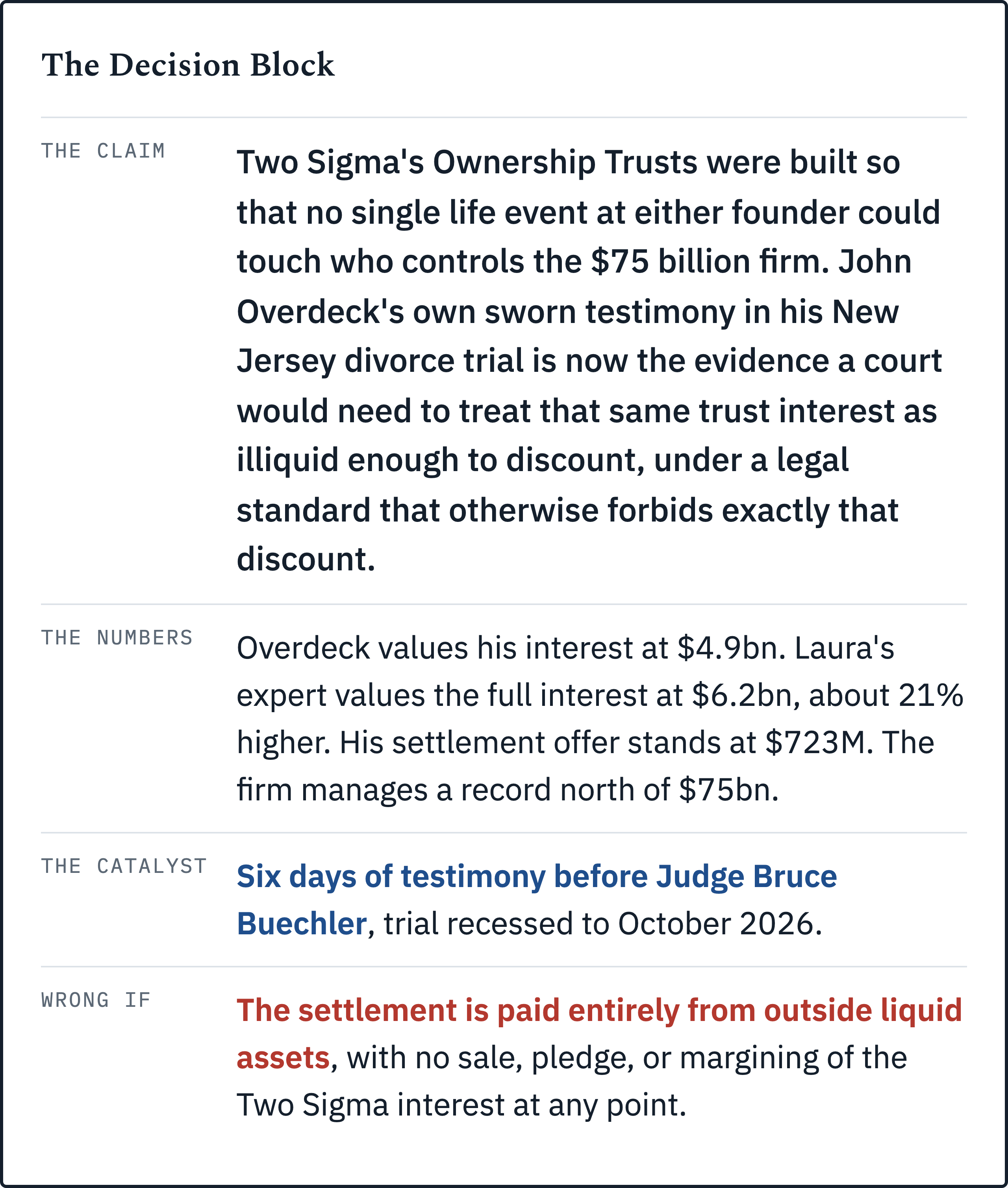
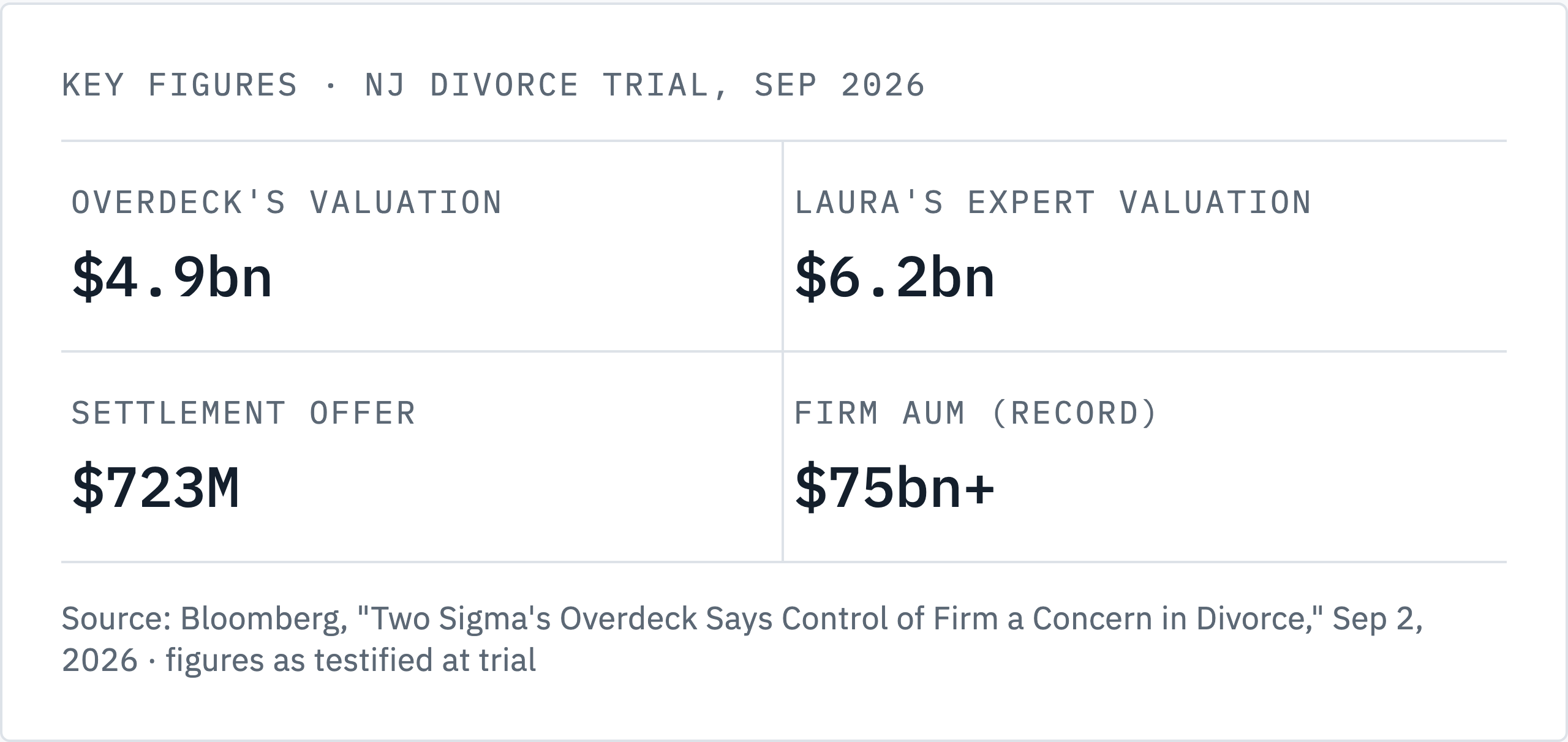
Photo: Don Ramey Logan · CC BY 4.0, resized · via Wikimedia Commons

A billionaire divorce, irrelevant to the fund
Read the coverage this week and the story is a celebrity divorce wearing a hedge fund’s clothes. Two billionaires. No prenup. A $6.2 billion number that makes headlines on its own.
That reading isn’t naive. Family offices see marital splits among the ultra wealthy constantly, and the standard playbook exists because it usually works. The business keeps running. The founder writes a check or a note. A few years later nobody outside the family remembers the number. That’s the base rate.
Two Sigma’s own numbers back that up. The firm is managing more money than it ever has, a record north of $75 billion, per Hedgeweek’s reporting on the 2023 investor departure, which the firm replaced and then grew past. A quant manager whose systems and headcount are intact doesn’t need Overdeck’s personal balance sheet to keep functioning.
On this view, the right professional reaction to “hedge fund cofounder’s divorce” is the same reaction a PM has to any billionaire’s marital news. Interesting. Irrelevant to the fund.
Overdeck’s testimony is doing legal work
I think that reading skips the one detail that actually matters to anyone who allocates to, competes with, or works inside a multi strategy manager. Overdeck is not describing a personal liquidity problem. He’s describing a control problem, under oath, in a jurisdiction whose leading precedent says his kind of interest should not get a discount for exactly the reason he’s describing.
That is a specific legal maneuver. Two Sigma’s own regulatory filings are what make the maneuver credible.
New Jersey values marital business interests at fair value, a specific legal standard distinct from fair market value. The state’s default rule, from Brown v. Brown (App. Div. 2002), holds that marketability and minority discounts do not apply absent “extraordinary circumstances”: “lack of liquidity does not affect the fair value of the minority interest,” full stop, unless the case clears that bar. Brown never defined what would.
Overdeck’s testimony reads like an attempt to clear it. Family law commentators have argued, following a 2022 state Supreme Court case about a closely held business buyout, that “extraordinary circumstances” should reach fact patterns like a buy sell agreement limiting what an owner can receive, or an owner who lacks real control over compensation and capital calls.
I went looking for the actual case behind that argument. It isn’t what it’s cited as. I want to be precise about what that 2022 case, Sipko v. Koger, actually is and is not: it is a shareholder oppression dispute between family members over two closely held companies, not a divorce case, and its own outcome ran the other way. The Court denied a discount because the controlling party had acted in bad faith to deplete the company’s value, the opposite fact pattern from Overdeck’s. The buy sell and compensation control framework is the commentary of one family law practitioner writing after that case, not a holding any court has applied to a fact pattern like this one. No court has yet found “extraordinary circumstances” in a case resembling Overdeck’s.
What his testimony has going for it is narrower than “new precedent, directly on point.” It reads like a serious attempt to build the record Brown itself said would matter, using the one argument NJ’s family bar has actually been making. I cannot prove that is his legal team’s deliberate strategy. I can show you it is a fit with the argument, not with a decided case.
The mechanism: a trust built to protect control becomes the exhibit that explains why it might not
Start with what Two Sigma actually built. Per Two Sigma Investor Solutions LP’s own Form ADV Part 2A brochure, an SEC-registered Two Sigma affiliate, public and current as of the March 2025 update, trusts established by Overdeck and Siegel, called the Ownership Trusts in the filing, are “the principal owners of the Adviser.” Those Ownership Trusts “indirectly effectively control” TSM, the general partner, and the advisory business itself.
That structure isn’t decoration. Routing founder control through a trust is a standard way large private managers wall off the firm from a single founder’s estate, incapacity, or a life event like a divorce. It’s the same logic that puts a founder’s operating company shares into a family trust or a voting trust well before anyone expects a fight: name the vehicle as the owner, and no single life event touching the individual is supposed to touch the vehicle. My read is that the design intent here was precisely what Overdeck is now testifying against: making sure nothing that happens to John Overdeck the person can, by itself, touch who runs the business.
Layered on top sits a two person Management Committee, one seat per Co-Chairman. Each Co-Chairman can unilaterally remove his own appointee. That’s 50/50 by construction, with no tiebreaker. I’d call that the single most fragile governance shape a manager this size can run: it works exactly as long as two people keep agreeing, and it has no built in answer for the day they stop. No committee. No board. No vote.
The firm’s leadership actually moved through this exact structure recently, and the dates matter. On September 30, 2024, Overdeck and Siegel both stepped back from the Management Committee itself, each naming a designee in his place. As of March 31, 2025, Overdeck reversed course and reclaimed his own seat, replacing his designee. A structure this sensitive to who occupies two chairs is a structure where the identity of the equity holder behind each chair isn’t a footnote.
Here’s the chain, in the order the risk actually moves. Four links. Money has to move through all four before the story is real, not hypothetical.
One. A New Jersey court values Overdeck’s trust interest for equitable distribution, somewhere between his $4.9bn and her $6.2bn.
Two. The court orders a payment Overdeck can’t fully cover from outside liquid assets alone. His own testimony is that this is a real possibility above his $723M offer.
Three. Meeting that order means monetizing part of an Ownership Trust interest that was never designed to be sold in pieces, through a pledge, a secondary sale, or a structured payout that still changes who holds an economic claim on the trust.
Four. Because the trusts are what “indirectly effectively control” the Adviser, any change to what sits inside Overdeck’s trust is a change to the mechanism that was supposed to keep 50/50 parity intact.
Each link is disclosed somewhere on the record. The ADV brochure supplies links one and four. His testimony supplies two and three. No single document states the whole chain, which is why it reads as a divorce story instead of a governance story to anyone reading only one source.
The tell that predates the trial by three years
The independent tell is the ADV brochure itself, and it predates the trial. Two Sigma’s Item 4 risk factors, filed under the heading “Certain Risks Associated with Management and Governance Challenges,” disclose that the Management Committee “has been unable to reach agreement on a number of topics,” specifically naming C-level role definitions, “organizational design and management structure,” “corporate governance and oversight matters,” and succession planning.
That sentence sits in a document the SEC can act against if it’s false or misleading. That’s a materially higher bar than anything said in a divorce deposition. I wouldn’t weight Overdeck’s trial testimony alone as proof the control risk is real. I weight it alongside a filing the firm had every incentive to soften and didn’t, filed year after year, long before a divorce trial gave anyone outside the firm a reason to read it closely. Nobody was reading it for this. It’s also not the first time Two Sigma’s own regulatory record has cut against its public reputation: I wrote up its $90 million SEC fine earlier this year, on a separate compliance failure the firm itself disclosed.
The same two week window in August produced two more data points, and both firm the mechanism up. On August 17, entities linked to Siegel’s family filed arbitration against Overdeck and co-CEO Carter Lyons, alleging undisclosed conflicts tied to a former employee’s severance and deferred compensation claim. Hedgeweek reported the dispute escalated all the way to formal arbitration, something the Management Committee itself was evidently unable to resolve internally.
The clearest account of the second dispute’s mechanics isn’t in any press report. It’s in Two Sigma’s own Form ADV, filed with the SEC on March 31, 2026. Siegel designated Seth Platt his Executive Manager and co-CEO on March 16, 2026, replacing Scott Hoffman, who Hedgeweek reported had resigned citing “continuing governance difficulties.” Platt then moved to terminate co-CEO Carter Lyons, arguing Lyons had undermined his authority. Overdeck called that move “imprudent and baseless” and placed the termination into dispute resolution, meaning it cannot take effect without Management Committee agreement or an arbitrator’s ruling. Whether an Executive Manager appointment even confers the co-CEO title at all, the filing states plainly, “is in dispute.”
That is Two Sigma telling the SEC, in its own words, that one Co-Chairman’s designated lieutenant tried to fire the other Co-Chairman’s designated lieutenant, and the firm’s own governance apparatus could not settle it without outside intervention. The same regulatory filing names the underlying ownership structure precisely: the “John A. Overdeck Revocable Trust” and the “David M. Siegel Revocable Trust,” both Delaware entities, both Limited Partners in the 25-to-50-percent band, each founder listed as trustee of his own trust. As of February 2026, a third party, Thomas Rafferty, was added as an additional trustee on Siegel’s trust. Overdeck’s trust carries no such addition on the same filing. I can’t tell you what that difference means. I can tell you it’s the kind of structural fact this system was supposedly designed to make irrelevant to any single person’s circumstances, and it isn’t. One trust got a second trustee. One didn’t.
Three separate legal proceedings. Two founders. Sixteen days. That’s what a firm running its command structure on ad hoc litigation looks like, and it’s happening at the exact moment a family court is being asked to decide how much one founder’s economic interest is worth. The Platt-Lyons succession fight itself already has a second life: I tracked how fast the public record moved versus how slowly an actual institutional allocator reacted once the story broke.
What “monetizing part of an illiquid trust interest” would actually look like is worth spelling out, because it isn’t a hypothetical this industry has never seen. Founder and GP-level stakes at private managers get sold every year to specialist buyers: Petershill, and Blue Owl’s GP Strategic Capital (the business Dyal Capital Partners became after its 2021 merger). A founder’s economic interest in a fund manager is illiquid by design, and a market exists to price that illiquidity anyway. A structured minority sale of a slice of Overdeck’s trust interest, or a margin loan collateralized by it, are the two realistic mechanisms for closing a multi billion dollar gap without selling the whole interest. Either one still changes who has a claim on the trust that “indirectly effectively controls” Two Sigma, even if Overdeck’s own voting seat never formally moves. The control risk doesn’t require a headline sale to be real. It only requires a lender or a minority buyer with a seat at the table that didn’t exist before.
The timeline: this was never a sudden story
Lay out the dates in order and the divorce trial stops looking like the origin of the problem. It starts looking like the latest entry in a ledger that has been running for three years.
March 31, 2023. Two Sigma first disclosed the Overdeck-Siegel rift to regulators as a business risk, in a Form ADV update Fortune reported on the same day it became public. The filing’s own language warned that “if such disagreement were to continue, the adviser’s ability to achieve client mandates could be impacted over time.” Around the same window, a major investor exited the platform citing that governance concern. The firm replaced the capital. The disclosure did not go away. It is still there, almost word for word, in the March 2025 update I read for this piece. Two years of an unresolved risk factor is not a disclosure. It is a standing admission that nobody inside the firm has found a structural fix.
September 30, 2024. Overdeck and Siegel both stepped back from the two person Management Committee itself, each naming a designee, and became Co-Chairmen of the general partner instead. The idea, I would guess, was to put daily governance in less personally entangled hands while the founders kept ultimate control through their trusts.
March 31, 2025. Overdeck reversed that, rejoining the Management Committee directly and replacing his own designee. Whatever the designee arrangement was supposed to fix, Overdeck judged it insufficient inside six months.
August 17 and 18, 2026. Two arbitrations, a day apart in filing terms and a world apart in subject: Siegel-linked entities accusing Overdeck and co-CEO Carter Lyons of undisclosed conflicts, and Seth Platt disputing whether his own committee seat carries the co-CEO title he believes it does.
September 2, 2026. Overdeck testifies that preserving voting parity with Siegel is a “principal concern” in his own divorce, the same figures and quote Bloomberg’s original report carries, independently confirmed here.
My read of that sequence: every governance fix Two Sigma has tried since 2023 has lasted less than two years before someone inside the firm needed a court or an arbitrator to settle it instead. Designee committee seats. A Co-Chairman layer. A title clarified by memo, never formalized in a document. None of it held. Every fix bought months, not years. A structure that keeps needing outside adjudicators is not stable. It has been quietly outsourcing its own governance function to litigation, and the divorce trial is simply the first instance visible to people who do not work there.
What any LP in a founder controlled fund should actually check
This is a design pattern common to nearly every founder led multi strategy manager, and Two Sigma’s public filings happen to be unusually legible about it right now. Three checks translate directly to any fund where control sits with one or two named individuals rather than an institutional board.
Read the ADV Part 2A’s risk factors section for governance language, not just performance and conflicts disclosures. Most LPs skim Item 4 for AUM and skip straight to fees. Two Sigma’s own “Certain Risks Associated with Management and Governance Challenges” heading has been sitting in plain text, publicly filed, for anyone who reads past the first page.
Ask directly whether founder economic interests sit in a trust, a direct partnership stake, or something else, and whether that vehicle has ever been tested by a life event. A trust that has never faced a forced valuation is an assumption. Nothing more. Two Sigma’s is being tested in real time, in public, right now.
Check whether governance depends on a fixed number of named seats with no tiebreaker, versus a board with independent members or a supermajority mechanism. A 50/50 committee with unilateral removal rights per seat, which is what Two Sigma discloses, has no structural way to break a genuine deadlock short of the two principals agreeing or an outside body forcing the question. That’s the exact condition under which one founder’s personal legal exposure becomes the whole firm’s problem.
None of those three checks require anything beyond documents every LP is already entitled to receive. Most never ask. That’s the gap, not the filing.
I ran this exact three clause check end to end on Two Sigma’s own filing, with the precise document retrieval path, the CRD lookup, and the dated trigger this specific case turns on: Two Sigma’s Own SEC Filing Shows Exactly How a $4.9bn Ownership Trust Works.
Strategic testimony, or a real balance sheet event?
The rival explanation deserves its full weight, because it is the one a skeptical family law practitioner would raise first. Spouses routinely overstate illiquidity and control risk specifically to argue the business interest down. It is close to the single most common maneuver in a high net worth divorce, and Overdeck’s counsel would be negligent not to make it.
Under that reading, “maintaining voting parity is a principal concern” is a line written for a judge. The ADV language is just risk factor boilerplate that every multi strategy manager with founder tension eventually files.
What separates the two readings is timing and audience. A risk factor written for a securities regulator, in a document that predates the trial by years and carries its own legal exposure for misstatement, is a different kind of evidence than testimony written for a family court judge weighing a settlement.
If the Management Committee gridlock were purely a talking point invented for this trial, it would not already be sitting in a 2025 client facing brochure describing succession and governance disagreements the firm had every reason to minimize. Two Sigma’s compliance and legal teams reviewed and filed that language before anyone knew a divorce trial would ever quote it back.
The ADV disclosure does not prove the control risk framing is honest. It proves the underlying gridlock is real and independently documented. That is the one fact a purely strategic reading of his testimony cannot explain away. The paper trail predates the motive.
Four things I can’t verify from public documents
I can’t verify the actual terms of the Ownership Trusts. The buy sell provisions, whether either founder holds a contractual right of first refusal on the other’s interest, whether the trust documents contain a specific divorce triggered transfer clause: none of that is public. The ADV brochure describes the control effect, not the trust mechanics that produce it.
I also can’t confirm the New Jersey court will accept a forced sale theory at all. Overdeck’s testimony argues for it, but no ruling on valuation methodology has been made public, and the trial doesn’t resume until October.
And the AUM record itself is a genuine confound. If the market believed governance risk at Two Sigma were acute, a multi strategy manager that depends on continuous capital raising would be the first place it showed up. It hasn’t shown up there yet. The market isn’t pricing this.
A fourth complication, and it cuts against my generous reading of the trust structure’s design intent. Laura Overdeck has a separate, still live lawsuit against the law firm Seward & Kissel, reported by The Wealth Advisor, alleging the firm moved several billion dollars of marital assets into new Wyoming trusts in 2018 without disclosing that the new terms would strip her beneficiary status the moment either spouse filed for divorce. Those are different vehicles from the Ownership Trust this piece is about, so the allegation doesn’t touch the ADV facts above. But it means I can’t take “the trust structure was designed as neutral governance protection” as a given about this particular person: his family has a separately litigated history around trust vehicles and divorce triggered terms, and a reader should weigh that when judging how much good faith to extend to the design intent reading. Good design and good faith are not the same claim.
I also can’t tell you how contested the $6.2bn figure currently is inside the actual courtroom: Laura Overdeck has been barred from testifying and from calling her own valuation expert at trial, a sanction Judge Buechler imposed for discovery misconduct: accessing Overdeck’s private computer and mailbox, and photographing emails before deleting the evidence. The $6.2bn number is on the record, but the witness who produced it may never take the stand. A number nobody can defend live is a number, not a fact yet.
That gap, between a record asset base and three simultaneous legal proceedings over control, is real. I’m not going to resolve it by assuming the quieter number is the one that’s wrong.
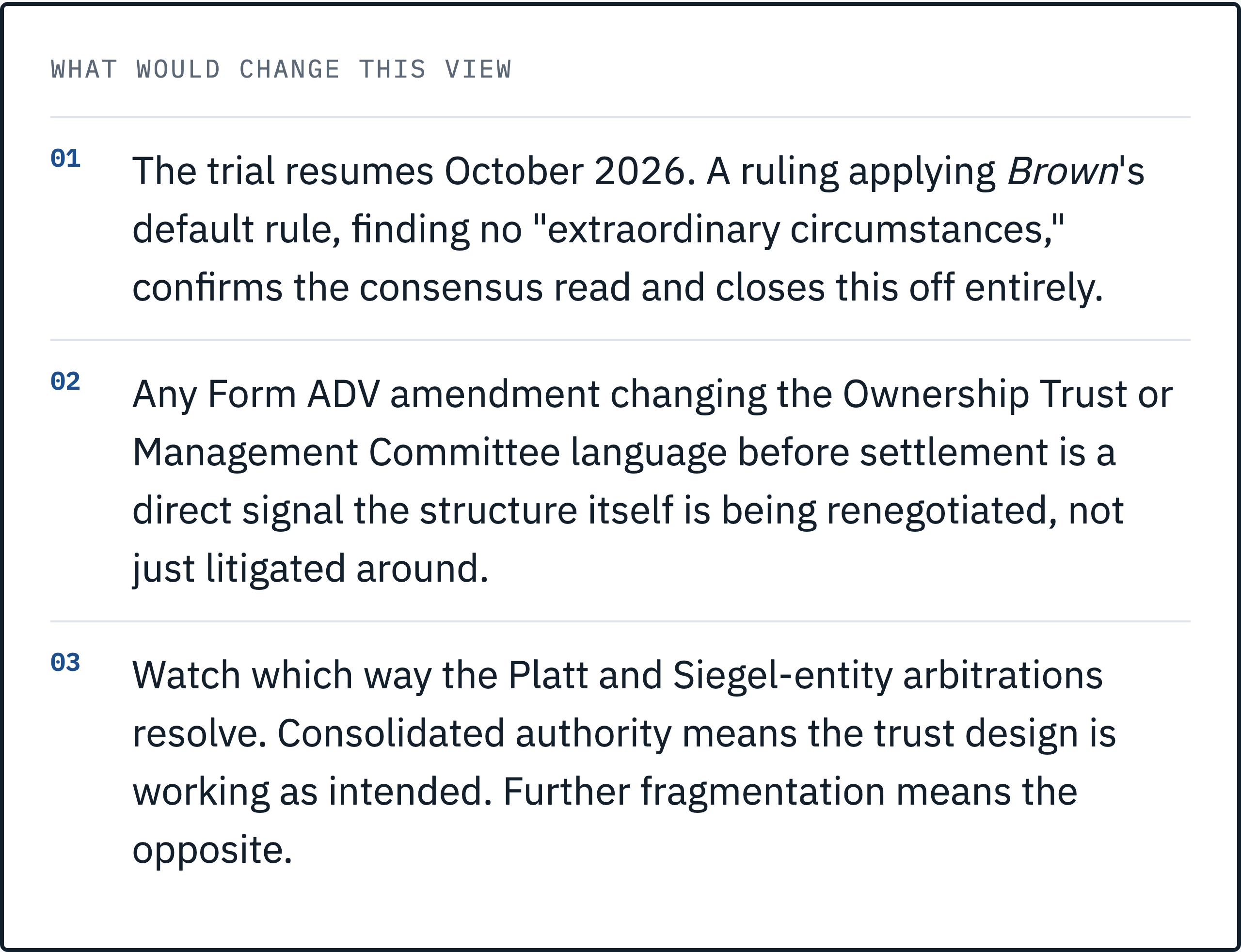
What would change this view
Watch three things, each dated and public.
The underwriting question for every LP in a founder controlled fund
The professional question this week isn’t whether Two Sigma survives a divorce. At $75 billion and growing, it almost certainly does.
The real question is whether “control via trust” holds up the first time a court outside the firm’s own governance documents gets to test it, or whether it only ever worked because nobody had tried.
My read: the ADV brochure is the tell that the Management Committee’s gridlock was real before any of this reached a courtroom. The control question Overdeck is litigating isn’t manufactured for the case. It’s the same gap the firm has been disclosing to its own clients since March 2023, arriving at a different address.
Which side of that gap would you underwrite? The trust that has held through more than three years of documented gridlock, or the trust that has never yet faced a court order it couldn’t simply absorb.
The Decision-Grade Version
This piece is complete on its own. The thesis, the evidence, and what would kill the view are all above, and nothing was held back to sell you a next step.
The Patreon note is a separate piece of work rather than a deeper cut of this article. It takes the exact SEC filing method this piece runs on Two Sigma, i.e. the three clause Schedule A and Item 4 checklist, and writes it as an instrument any reader can run themselves on any founder controlled fund they hold. Written for people who do their own due diligence.
→ Read the Two Sigma governance checklist note
→ Or join the Patreon community for every note
More research like this: YouTube · LinkedIn
Cover photograph: Tdorante10, CC BY-SA 4.0, via Wikimedia Commons.