


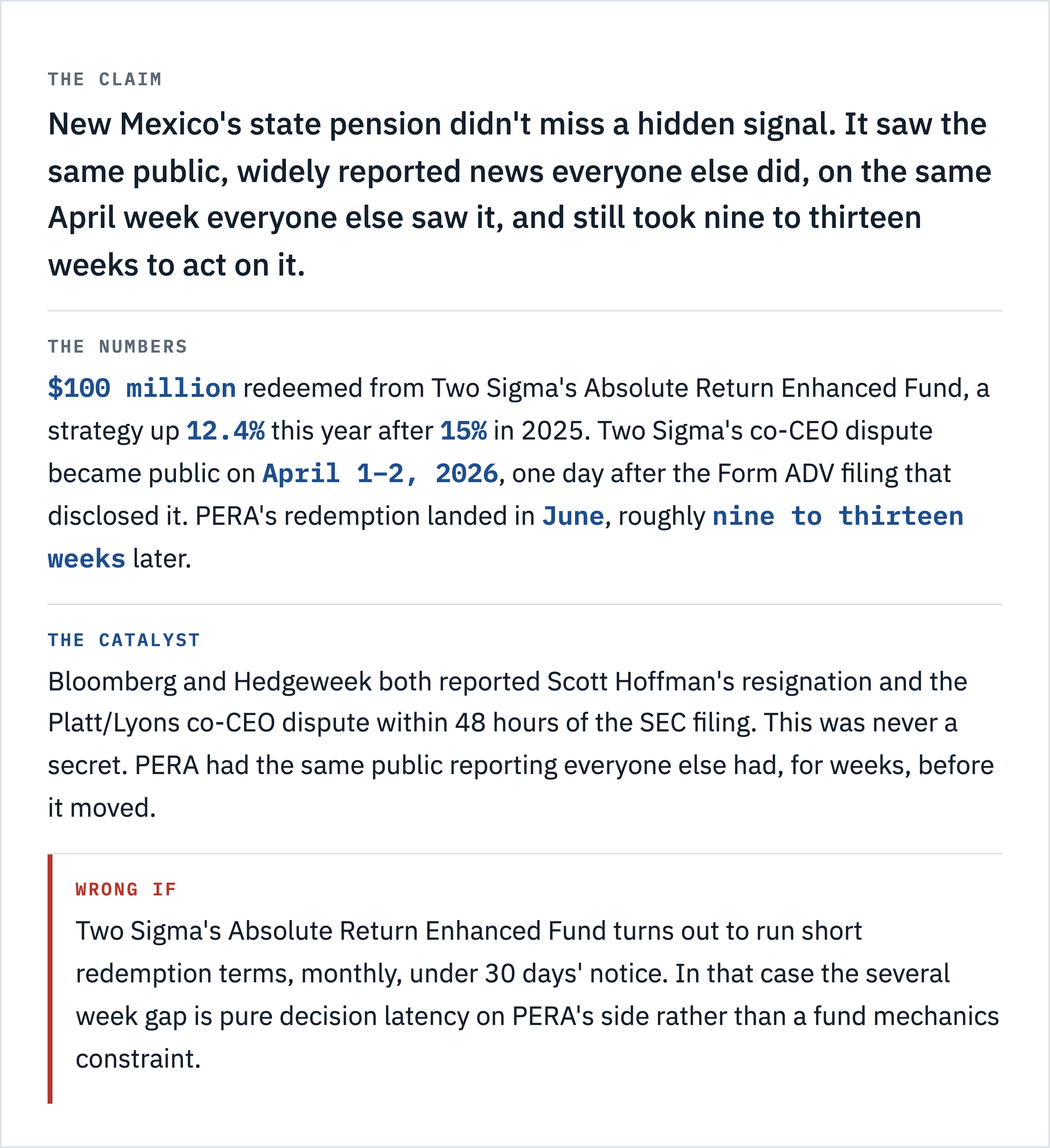
Two Sigma’s Absolute Return Enhanced Fund gained 15% in 2025 and is up 12.4% this year. In June, New Mexico’s Public Employees Retirement Association pulled roughly $100 million out of it anyway.
PERA’s own explanation, as reported by Hedgeweek, was that organizational issues at the firm had created “too much uncertainty, with no clear timetable for resolving the internal conflict.” The pension said this. It said so even as it acknowledged the strategy had “outperformed both the pension’s benchmark and comparable funds.” That’s a $100 million redemption from a fund that was working, on grounds that had nothing to do with the fund working.
I don’t think that’s the interesting part. Institutional investors pulling money over governance risk instead of performance risk is a known move, documented for decades in fund formation practice. What’s interesting is that the governance risk here was never obscure. It was on Bloomberg. The gap isn’t information. It’s decision speed.
Here is the short version of how I got there. I expected to find a hidden disclosure, a fact PERA should have caught and did not. It wasn’t hidden at all. The method was simple: pull the actual filing, pull the actual press dates, and put them on one timeline. The outcome flipped the story on its head.
The consensus: fast public news gets a fast institutional reaction
Ask an allocator what happens when a manager’s leadership structure blows up in the trade press, not in a quiet filing nobody reads but in an actual Bloomberg headline, and the working assumption is that a professional monitoring program reacts inside days, not months. That’s the whole pitch of an active manager monitoring program: pay a team or a consultant to watch the wire, and when something material breaks, the institution moves faster than a retail investor reading the same story a week later.
I think that’s a reasonable baseline, and it makes New Mexico’s timeline the thing that needs explaining, not excusing. PERA is not a small, understaffed plan. It runs an active monitoring program, by its own account. The news wasn’t buried. It named the two men, the disputed title, and the arbitration in the first 48 hours. Nothing about it was quiet.
The variant view: the delay sat between the headline and the wire transfer
Two Sigma Investments, LP filed its 2025 Annual Amendment to Form ADV on March 31, 2026, signed by James G. Hein, Jr. Buried in Schedule D’s free text Miscellaneous section, in the firm’s own words, is this:
“As of March 16, 2026, Dr. Siegel designated Seth Platt as his Executive Manager and as co-CEO. There is disagreement about whether, when designated, an Executive Manager becomes a co-CEO or whether the appointment of a co-CEO requires approval by both members of the Management Committee... Mr. Platt has moved to terminate Mr. Lyons given his view that Mr. Lyons undermined his authority as Executive Manager. Mr. Overdeck believes Mr. Platt’s actions in this regard are imprudent and baseless and has placed the termination into dispute resolution, which means that the termination cannot take effect without Management Committee agreement or resolution through arbitration.”
That’s a signed, dated, federally filed statement that the governance structure built around Two Sigma’s two founders had broken down to the point where one side was trying to fire the other side’s designated co-CEO. It reached the trade press almost immediately. One day, not five months. Bloomberg’s piece on Hoffman’s resignation ran April 1, and Hedgeweek’s followed April 2, both reporting the Platt/co-CEO ambiguity and the move against Carter Lyons, citing the same March 31 filing this article quotes (Bloomberg; Hedgeweek).
Two Sigma’s disclosure to press pipeline, on this filing, worked about as fast as institutional disclosure ever works. The interesting number isn’t how long the market took to notice. It’s how long PERA took to act once it had.
Separately, and later, a second and different set of facts became public: the Siegel family’s arbitration referral over a former employee’s severance claim, and John Overdeck’s own account, given in his divorce trial, that the firm had lost “a major investor” once before. That investor withdrew in 2023, according to a person familiar with the matter cited by Hedgeweek (Hedgeweek). Those specifics didn’t surface until Bloomberg and Hedgeweek reported them around August 17-27 (Hedgeweek; Bloomberg). That part genuinely lagged. The April news, the one that explains PERA’s stated rationale, did not.
Where the two founders’ structure actually came from
This did not start as a fight between two people with no formal roles. In August 2024, Overdeck and Siegel both stepped back from the Co-CEO title they had held since founding the firm and installed Carter Lyons and Scott Hoffman as Co-CEOs, effective September 30, 2024 (Two Sigma). One structure, two men sharing one title. That arrangement was the firm’s own governance fix for exactly the kind of stalemate risk a founder controlled shop always carries, and it held for about eighteen months.
It broke in two directions at once this year. Overdeck returned to his own seat on the management committee, which is what Hoffman later cited when he resigned, describing “ongoing governance challenges” that followed directly from that return (Hedgeweek). Siegel then named Seth Platt. Platt would replace Hoffman. That triggered the exact dispute Two Sigma disclosed in its March ADV filing: whether naming a replacement Executive Manager automatically confers the Co-CEO title, or requires sign off from both sides of a committee that, by this point, could not agree on much. Platt then moved to fire Lyons. He moved fast. Overdeck blocked it. He pushed the whole question into arbitration. The two founder veto structure had failed. At the one thing it existed to prevent.
Read that sequence next to the ADV language above and the disclosure was not vague. It named both principals, dated the disagreement, and stated plainly that a live termination fight could not resolve without either committee agreement or arbitration. Bloomberg had the same facts within a day. Same day, same story.
Peer multi strategy managers price this exact structural risk in how they lock up capital. D.E. Shaw, Millennium and Citadel lock up cash for years; Rokos chose the opposite. A founder controlled shop with a fragile succession fix is precisely the kind of manager a longer lock up is meant to protect against a fast exit like PERA’s.
Lay the dates out in order and the sequence reads clean. September 2024: Lyons and Hoffman become Co-CEOs. Early 2026: Overdeck reclaims his committee seat. March 16: Siegel names Platt. March 31: the ADV filing discloses the fight. April 1 and 2: Bloomberg and Hedgeweek both report it. Then a long stretch with no new public fact. Sometime in June: PERA redeems. The story moved fast. The money moved slow.
The mechanism: public disclosure has one clock, institutional redemption has another
A governance blowup moving through an allocator’s process runs on two separate clocks, and conflating them is what made my first read of this story wrong.
Clock one: how fast the information becomes actionable. Here it was fast. The ADV filing posted March 31. Bloomberg and Hedgeweek both had the story by April 2. They cited the filing directly. Two Sigma did not bury this in language nobody parses; a fund’s own free text disclosure requirement, plus a wire service reading EDGAR the way wire services do, moved this from private dispute to public headline in under 48 hours.
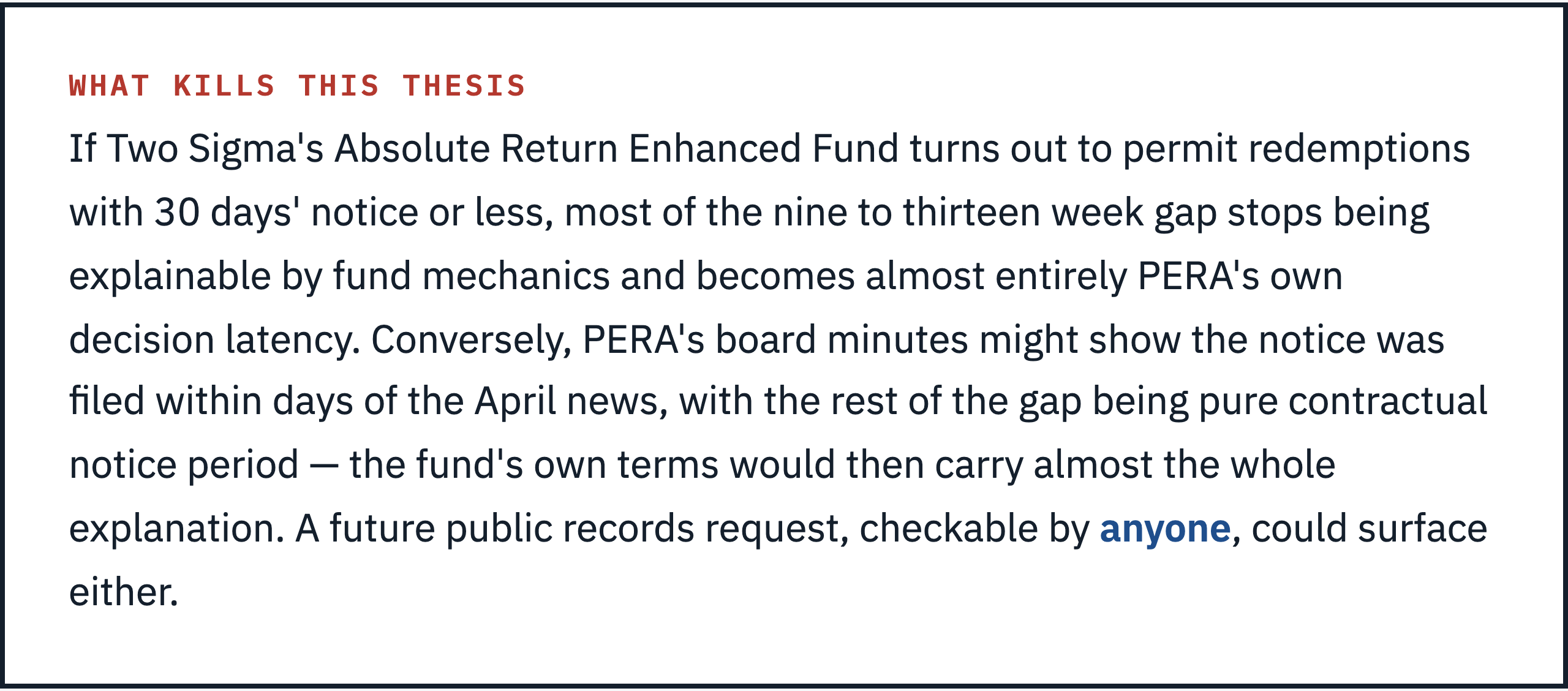
Clock two: how fast an allocator can actually redeem, even once it decides to. This is the clock that matters here, and hedge fund redemption terms are not instant by design. Industry-standard terms permit redemptions on a quarterly basis, typically on 30 to 90 days’ prior notice to the manager, with proceeds paid out within 30 days after that (Proskauer). Say Two Sigma’s Absolute Return Enhanced Fund runs anywhere near that standard. An LP that decided to redeem the day the news broke, April 2, could easily not see the money move until May or June under the fund’s own mechanical terms. That holds independent of how fast or slow PERA itself was to decide.
I cannot confirm Two Sigma’s specific notice period. Not for this fund. That is a real gap, and it is the one place this piece’s mechanism claim is a plausible industry standard inference rather than a verified fact. What can be said is that the gap between the April news and the June redemption, somewhere around nine to thirteen weeks depending on the exact June date, is at least consistent with a quarterly redemption structure carrying a 60-to-90-day notice window, layered on top of whatever time PERA’s own investment committee needed to review the news, decide, and file the notice in the first place. Both clocks run inside that gap. Neither one alone explains it.
A tighter version of this same mechanism shows up wherever a fund has formalized its own version of the second clock. Blue Owl’s redemption gate costs the fund itself $12 million a year to run, precisely because the gate is the second clock, priced and disclosed rather than left to an allocator’s own committee calendar.
That’s the finding, reframed from where I started: the redemption right was never hard to find, and the news was never hard to find either. What actually took time was moving through the machinery, on both sides, that turns a headline into a wire transfer.
I will name the version of this I cannot independently verify, because I think it matters more than it first looks. At least one compliance vendor, Dasseti, markets an AI tool that claims to read Form ADV’s narrative text directly and flag conflicts and risk language, not just the numeric fields. Whether PERA’s own monitoring stack uses anything like it is not knowable from here. Neither is whether it flagged this specific paragraph. It does not change the finding either way. Even a tool that read Schedule D the moment it posted on March 31 would have surfaced the same facts Bloomberg published on April 1. At most, it would have given PERA a one day head start over the wire services. It would not have produced the weeks of lead time the redemption gap implies. The bottleneck sits downstream of detection, wherever detection happens.
Two clocks explain the shape of the gap. They don’t tell you what your own number would be. I built a five input audit: trigger to filed lag, filed to press lag, your fund’s own notice period, your own committee’s cadence, and the compounded sum. It’s worked through Two Sigma’s real filing as the template, in a $5 institutional note on Patreon. It’s the number almost no allocator has written down before they need it.
A firm whose internal awareness has outpaced its disclosures before
There is a second, older instance of this pattern at Two Sigma, on a completely different matter. It is worth naming because it is a more extreme version of the same shape: something true inside the firm for years before it became public.
In January 2025 the firm settled SEC charges for failing to fix known vulnerabilities in its investment models across roughly four years, from 2019 to 2023. It separately settled charges for violating the whistleblower protection rule, by requiring departing staff to falsely attest they had never filed a complaint with a government agency. Two Sigma Investments LP and Two Sigma Advisers LP paid $90 million in penalties combined and had already voluntarily repaid $165 million to affected clients during the investigation (SEC press release 2025-15).
In September 2025 the SEC separately charged a former Two Sigma researcher, Jian Wu, with deliberately manipulating those same models between November 2021 and August 2023. The alleged goal was simple. Replicate other models’ forecasts without authorization. The SEC’s own release ties the scheme to “at least $165 million in harm to certain clients” (SEC litigation release LR-26398). Here is how I am reading these two matters together. Wu’s alleged manipulation window sits entirely inside the settlement’s broader four year vulnerability window. Both releases cite the identical $165 million figure. Same number, twice. My read is these are very likely one underlying root cause, described across two separate enforcement actions filed eight months apart, rather than two independent examples of the same failure mode. Treated that way, it is still a real data point. The facts behind a $90 million penalty were known internally as early as 2019 and were not fully public until 2025. That is a several year gap. It dwarfs the co-CEO dispute’s one day one.
What $232.8 billion actually means
Two Sigma’s headline regulatory assets under management figure, $232.8 billion as of January 31, 2026, is gross. It includes leverage. It isn’t the same thing as net investor capital. The firm’s own ADV instructions require that distinction, and press coverage routinely drops it: both Bloomberg and Hedgeweek cited Two Sigma as an “$80 billion” or “$70 billion” fund in their own coverage of this same dispute. My guess is those smaller figures track a narrower measure, most likely net assets in a specific fund family rather than the full regulatory total, though I can’t confirm the exact reconciliation from public data alone.
I flag this because it matters for reading the PERA number correctly. $100 million divided by $232.8 billion is 0.00043. I make that four hundredths of one percent of the firm’s reported book. This was never a redemption that threatened Two Sigma’s business. Not even close. I read it as a signal. It was sized to be visible to other allocators watching the same dispute, small enough that Two Sigma’s balance sheet barely registers it.
The discriminator: is nine to thirteen weeks actually slow?
Here is the honest counterargument, the one a fund operations person would raise first, and I’m not going to dress it up. Nine to thirteen weeks for an institutional LP to review a governance crisis, get investment committee sign off, and route a redemption notice through a fund’s own 60-to-90-day mechanics is not slow at all. It might be close to the fastest this kind of decision can move through a public pension’s process. Maybe this is just how slow institutions are. Under that reading, there is no real gap to explain. No gap at all. PERA may have acted as fast as its own machinery allows. The story could be unremarkable.
I take that seriously, and I cannot fully rule it out, because PERA has never stated on the record what date it filed its redemption notice, what its investment committee discussed, or when. What keeps me from fully accepting the fastest possible speed reading is the fund’s own quoted rationale: “too much uncertainty, with no clear timetable for resolving the internal conflict.” That reads as language describing what is still unresolved, not language describing a decision already made and simply awaiting paperwork. Picture PERA deciding by early April and spending the rest of the gap purely on notice mechanics. I’d expect a different sentence from them. Something closer to “the dispute remained unresolved when our notice period expired” than “no clear timetable.” That’s a real distinction. It’s PERA’s own choice of words, not mine.
A public pension the size of New Mexico’s typically runs its investment decisions through a standing investment committee. It meets on a fixed monthly or quarterly calendar. Not on demand the day a story breaks. Even a fast institutional reaction to the April news would likely need to clear at least one scheduled committee meeting. Only then could a formal redemption instruction go out. I’d guess that alone accounts for several weeks of the gap. I say guess deliberately. PERA’s specific committee calendar for this period is not something that could be verified from public sources, and naming the assumption seemed better than dressing it up as a fact.
The narrative disclosure itself is a separate, cheap check any allocator can run before a gap like this one ever opens. I’ve written up the ninety second ODD test that FINRA’s newer cyber reporting channel makes worth running on any manager, and it applies just as well to a governance narrative buried in Schedule D.
Three things I can’t rule out
Three real gaps remain. I don’t know PERA’s exact redemption date within June, or its exact investment committee timeline. Without that, “nine to thirteen weeks” is a range built from one confirmed endpoint, the April news, and one imprecise endpoint, the month of June. It is a range, not a single confirmed figure.
I don’t know Two Sigma’s specific redemption terms for the Absolute Return Enhanced Fund. The 30-to-90-day, quarterly redemption framing is an industry standard inference from Proskauer’s general market description, not a fact about this specific fund’s governing documents, which aren’t public.
One redemption isn’t a base rate. This piece shows one institutional LP’s reaction time to one piece of unambiguous, fast reported news. It doesn’t establish how quickly allocators generally move once a story like this breaks, or whether PERA was typical or unusually deliberate.
What would prove this wrong
Know your own redemption clock before you need it
Two Sigma’s Absolute Return Enhanced Fund is still up double digits this year. The $232.8 billion the firm reports managing hasn’t visibly moved because of any of this. What changed is that a $100 million allocator decided a fund’s returns were no longer the only variable worth pricing. It made that call on information that had been sitting in the trade press, cited to the firm’s own SEC filing, for weeks before anyone pulled a wire.
If you’re allocated to a multistrategy or quant manager with a founder led or dual CEO structure, the actionable version of this isn’t “watch for hidden filings.” The filing wasn’t hidden; Bloomberg had it in a day. The actionable version is narrower: know your own fund’s redemption notice period before you need it, and know how many committee meetings stand between “we should redeem” and a notice actually going out. Both numbers are already sitting in your own subscription agreement and your committee’s standing calendar, not in anything Two Sigma or PERA controls. Those two numbers, added together, are the real distance between a headline and a wire transfer, and most allocators only learn them under pressure, mid crisis, instead of in advance.
The Decision-Grade Version
This piece is complete on its own. The thesis, the evidence, and what would kill the view are all above, and nothing was held back to sell you a next step.
The Patreon note is a different piece of work, not a deeper cut of this article. It takes one method from inside this story, a five input audit for measuring your own redemption latency gap before a governance headline forces the question, and writes it the way an ODD team would actually run it: pull the manager’s own Form ADV, size your fund’s notice period, size your committee’s cadence, add them together. Written for people who sit on an investment committee or run operational due diligence for a living.
→ Read the redemption latency audit note
→ Or join the Patreon community for every note
More research like this: my YouTube channel breaks down the filings on screen, and I post shorter reads on LinkedIn.
If your manager’s governance blew up on Bloomberg tomorrow, how many weeks would your own process need before the money actually moved?
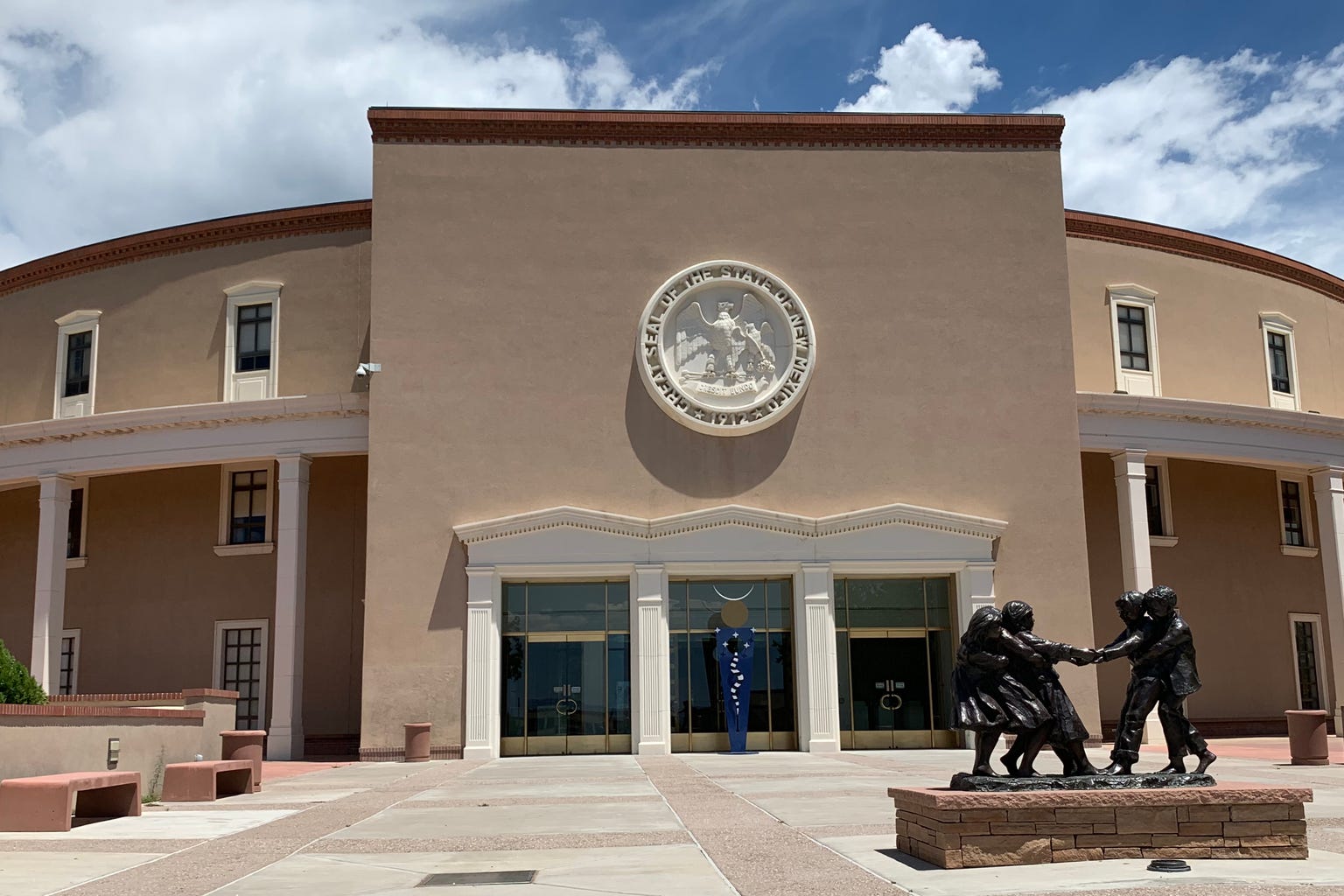
Cover photograph: F McGady, CC BY 4.0, via Wikimedia Commons.