


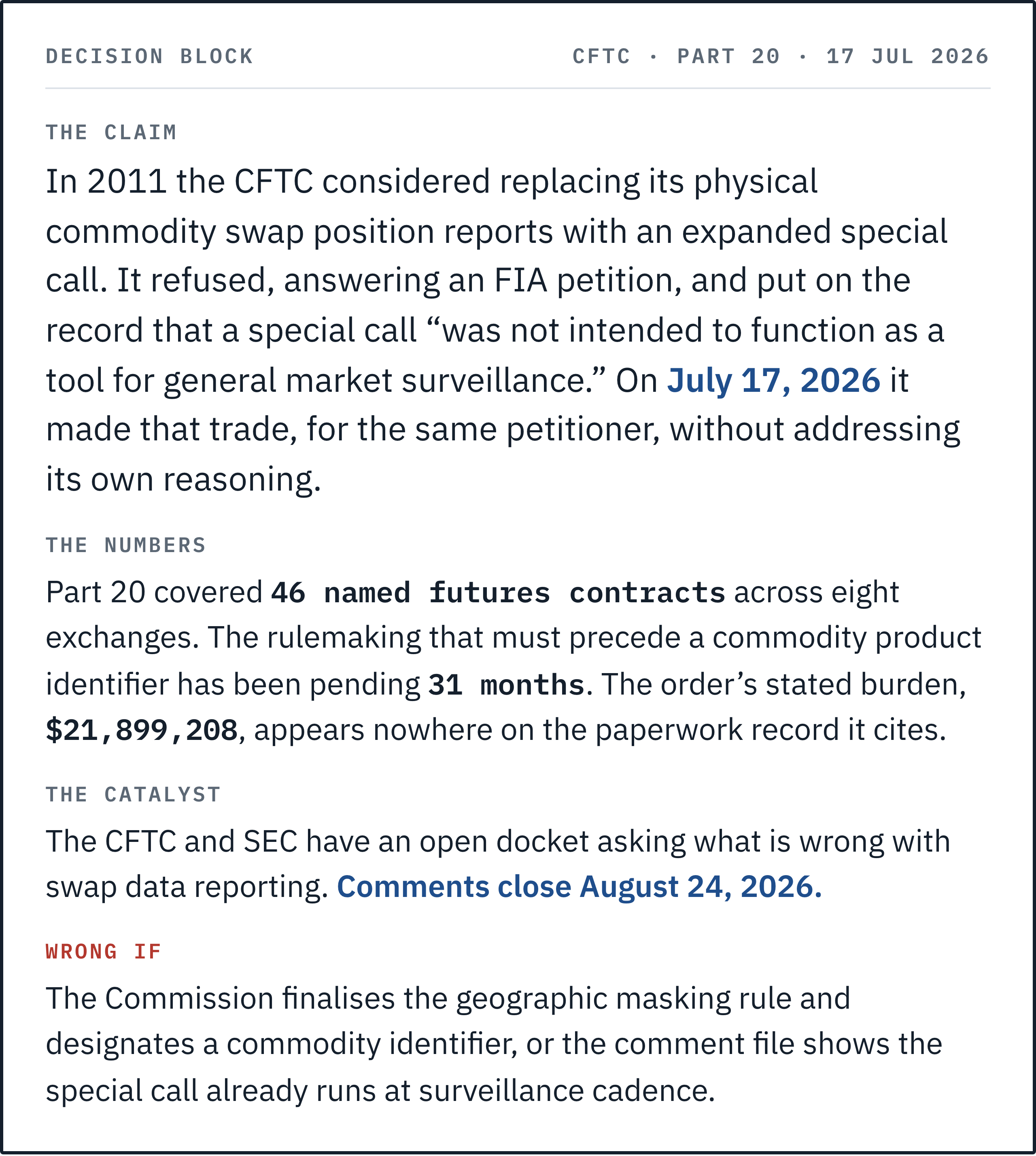
In 2011 the CFTC was asked to replace its physical commodity swap position reports with an expanded special call. It refused, answering a Futures Industry Association petition, and put its reasoning on the record: a special call “was not intended to function as a tool for general market surveillance.” On July 17, 2026 it made that trade, for the same petitioner, and never addressed what it had written.
What the Commission did, and when
Part 20 was scaffolding, adopted in July 2011 during Dodd-Frank implementation. Clearing organizations, clearing members and swap dealers had to file position reports on physical commodity swaps, converted into futures equivalents.
Crucially, it carried its own demolition clause. Section 20.9(a) says the rules go dark on a Commission finding that repositories “are processing positional data and that such processing will enable the Commission to effectively surveil trading in paired swaps and swaptions.”
On July 17, 2026 the Commission made that finding, publishing it July 21. Routine reporting stopped.
Under §20.9(b) it kept the recordkeeping and special call provisions of §20.6 and §20.5(b). It kept more than the coverage has noticed: the §20.1 definitions, the §20.2 contract list, the §20.8 delegations, and the futures equivalency guidance in Appendix A. The conversion methodology survives in force. Only the output stopped arriving.
Retention of all that is what the order calls “a transitional bridge pending full implementation of the UPI framework for the other commodity asset class.”
I’ll put the case for it at full strength first. It’s stronger than a critic would like.
The case for the order, which is better than its critics allow
Nothing here was sprung on anyone, and I should say that plainly. Chairman Selig told the ISDA annual meeting on April 30, 2026 that “it is reasonable to consider whether certain requirements, such as those under Part 20, should finally be sunset.” That was eight weeks before the comment docket below even opened. FIA had petitioned in September 2025. FIA, ISDA and SIFMA petitioned jointly in May 2026.
Start with speed, where I have to concede the point. Part 20 dealer reports arrived on a T+2 deadline. Repository reporting arrives next day.
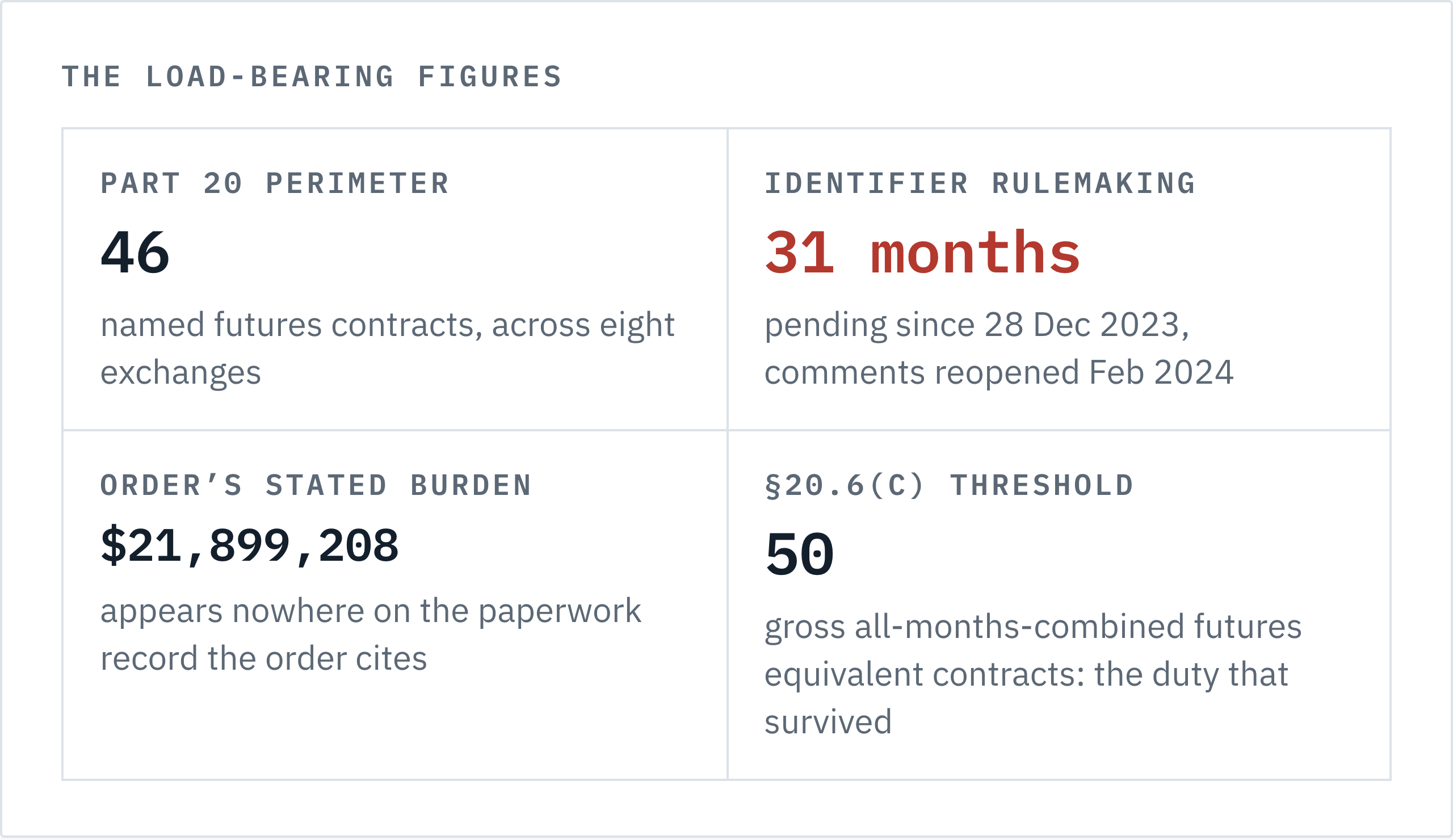
Coverage went the same way. Part 20 reached 46 listed contracts above a 50-contract threshold, while Parts 43 and 45 reach every swap.
And the retained call digs deeper than the daily file ever did. Section 20.6(c) pulls records of “transactions in the cash commodity underlying such positions or its products and byproducts, and all commercial activities that are hedged.” No position report ever carried any of that.
And the finding rests on more than one sentence. It names four grounds. One paragraph asserts directly that repositories “collect, and can provide to the Commission, data identifying the futures contracts and commodities underlying open swaps, including whether a swap references or is economically related to the futures contract relevant to the Commission’s public reporting and position-limits rules.”
I want to give that its due, because it is not an idle claim. Under §43.6(b)(5) repositories already group other commodity swaps “by the relevant contract as referenced in appendix B of this part.” That is a Commission-published list of named futures contracts. It has existed since 2012 and owes nothing to any product identifier.
Then there’s the money. The Commission says it “makes limited use of Part 20 data,” that the data “are not used in the Commission’s enforcement program,” and that they’re “used only occasionally in the Commission’s market oversight function.” I measured where CFTC enforcement dollars go in an earlier piece. Norton Rose Fulbright relays the Commission’s framing as “a bridge measure” and raises no concern anywhere.
Put like that, I think it’s a coherent modernisation. If that were the whole story I’d have written nothing.
The Commission already answered this question, in 2011
Here’s what changed my mind, and it’s sitting in the release that created Part 20.
FIA and a working group of commercial energy firms opposed the 2011 rules. Their proposed alternative was an expanded special call. Keep the authority to demand records, drop the routine filing. That’s it, and it is the architecture of the 2026 order.
One difference is real and I’ll deal with it now rather than bury it. In 2011 the special call would have been the only window into these positions, because no commodity repository existed yet. In 2026 it sits on top of a working Parts 43 and 45 regime. That is a genuine change in the surrounding facts, and it is the best argument the Commission has.
The Commission refused, and explained itself:
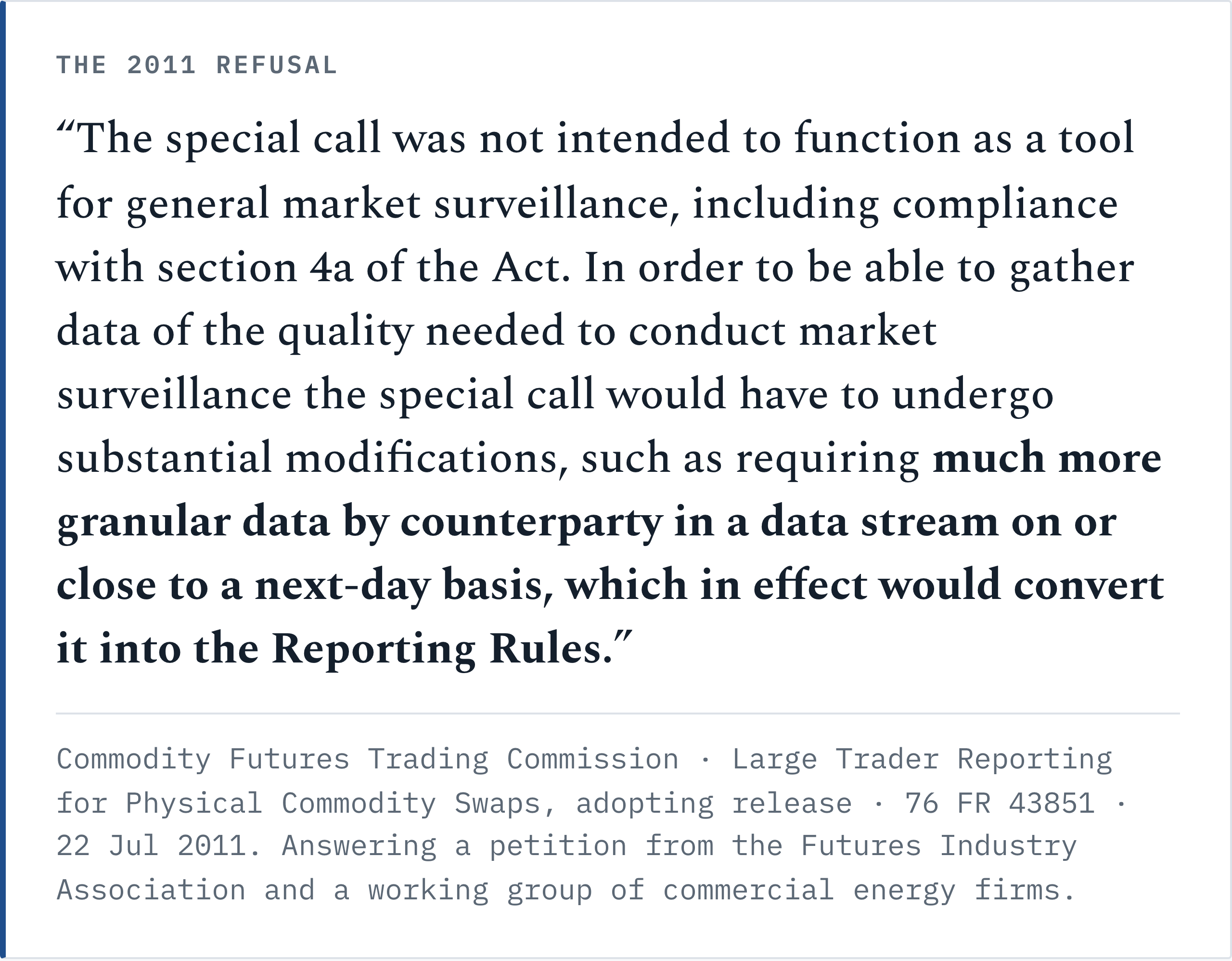
Same trade association. Materially the same proposal. Opposite outcome. As far as I can tell the 2026 order does not mention the 2011 analysis anywhere.
On the Commission’s own file sits a reasoned finding that the instrument it just adopted cannot do the job it says the instrument will do.
Any agency is entitled to change its mind. What it owes when it does is an account of why the earlier reasoning no longer holds, and I can’t find one here.
Notice what the 2011 objection rested on. Technology and data quality are nowhere in it. The Commission’s complaint was about the shape of the instrument: a targeted call “gathers information related to specific products from a limited set of market participants,” while surveillance needs a standing stream by counterparty.
In my view that distinction has not aged, and it is what survives the change in surrounding facts. Repositories got better. The special call did not become a standing stream, and the 2011 objection was aimed at the call, not at the state of the repositories. Nothing in the 2026 order argues otherwise. The order argues the reverse, promising recipients “a reasonable period of time to respond.”
So the question the order had to answer, and doesn’t, is narrow: do Parts 43 and 45 now deliver the “granular data by counterparty in a data stream on or close to a next-day basis” that the 2011 Commission said the job requires? On the transaction leg, plainly yes. On the futures equivalent position leg, the order says its own systems are not configured to produce it.
Why the shape of the instrument is the argument
Strip the technology away and I think the 2011 point is about search order.
Think about a routine position file. It tells you where to look. Every reportable book arrives on a cadence, in one measure, whether or not anyone suspects anything.
A special call inverts that. Someone has to form a suspicion first, then scope a request, then issue it. Here the order is explicit: any call “will be appropriately scoped and will seek only records and information relevant to the Commission’s surveillance or oversight interest giving rise to the call.”
I read that sentence as the concession. A call requires an interest giving rise to it.
For finding concentration nobody has noticed yet, an instrument that fires on prior suspicion is a different class of tool from one that arrives on a schedule. No amount of data quality closes that gap. A smoke alarm and an excellent fire inspector who visits when called are not substitutes.
There is a second thing the daily file carried that the coverage keeps missing. Section 20.4 never asked a dealer only for its own book. It made each reporting entity combine its counterparty’s positions “in a single consolidated account that it shall attribute to that specific counterparty,” reported with an identifier and the counterparty’s name.
So the Commission received a per trader position, assembled and attested by the dealer facing them. Repository data is transaction level. Building a trader’s aggregate exposure from it is the Commission’s own inference problem. I’ve read hedge fund positioning straight out of the CFTC’s own numbers before.
I should say that industry reads this exactly the other way. FIA argues repository data is higher quality precisely because it is ingested by two repositories rather than assembled by dozens of dealers. That’s a real argument and it has force. My answer is narrow: attestation and aggregation are different properties, and the 2026 order gains one while giving up the other.
The provision that was drafted for this, and went unused
Section 20.9(b) lets the Commission keep any part of Part 20 supplying data “that materially improves the accuracy and surveillance utility” of what repositories process. The Commission invoked it.
Now read what (b) was drafted for, from the 2011 release:
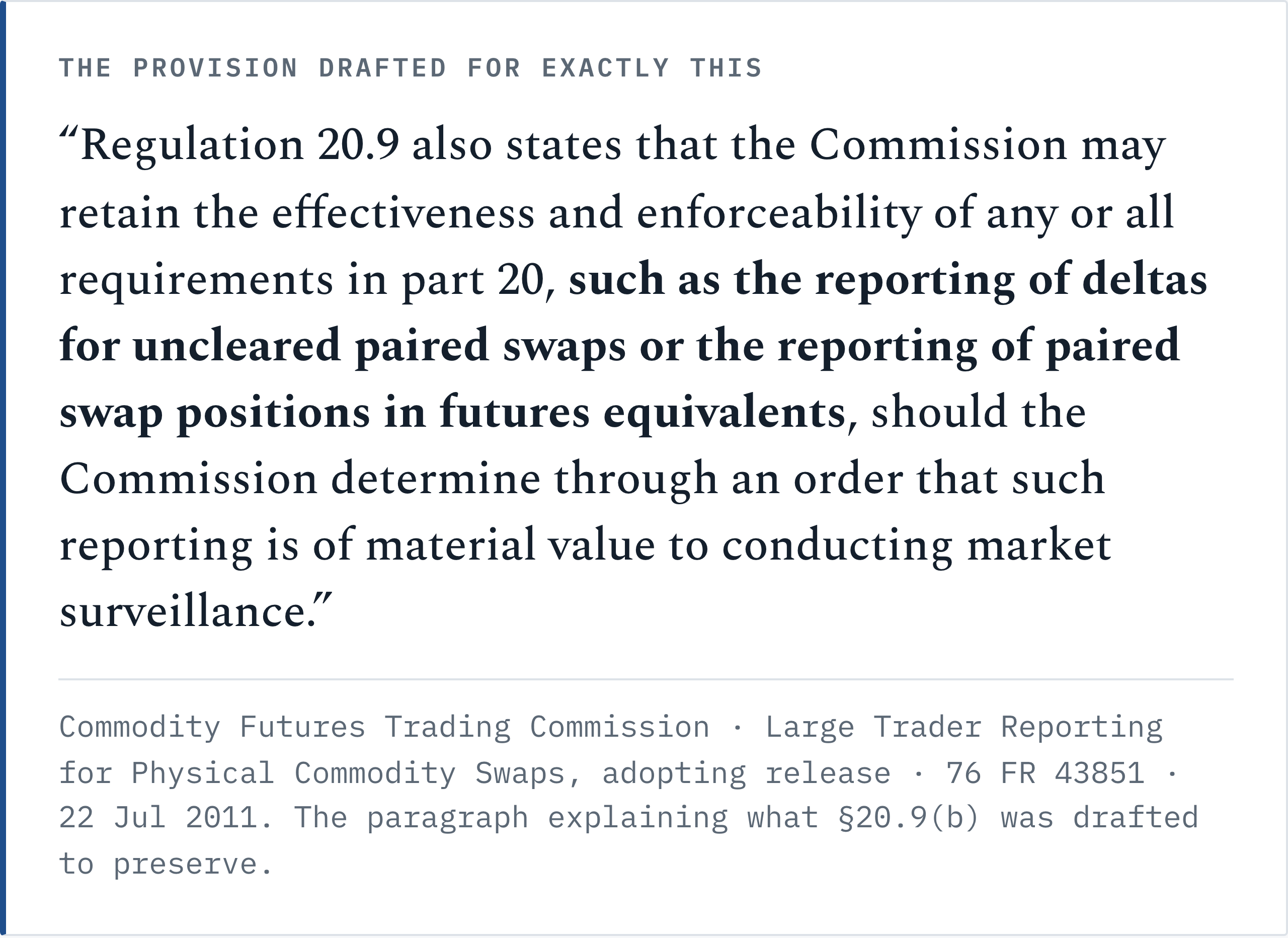
Futures equivalent position reporting is the drafters’ own worked example of what paragraph (b) exists to preserve. It is named in the text.
The Commission reached for that provision and used it to keep the recordkeeping instead of the reporting the provision names.
What the conversion needs, and where the gap really is
I want to be precise about the technical gap, because my first read of it was too strong.
A futures equivalent under §20.1 is “an economically equivalent amount of one or more futures contracts,” computed per Appendix A. Its worked example is a six month WTI swap at 100,000 barrels a month. Total notional is 600,000 barrels. Divide by a 1,000-barrel contract and you get 600 futures equivalent contracts, apportioned across referent months by the fraction of the swap’s days falling in each.
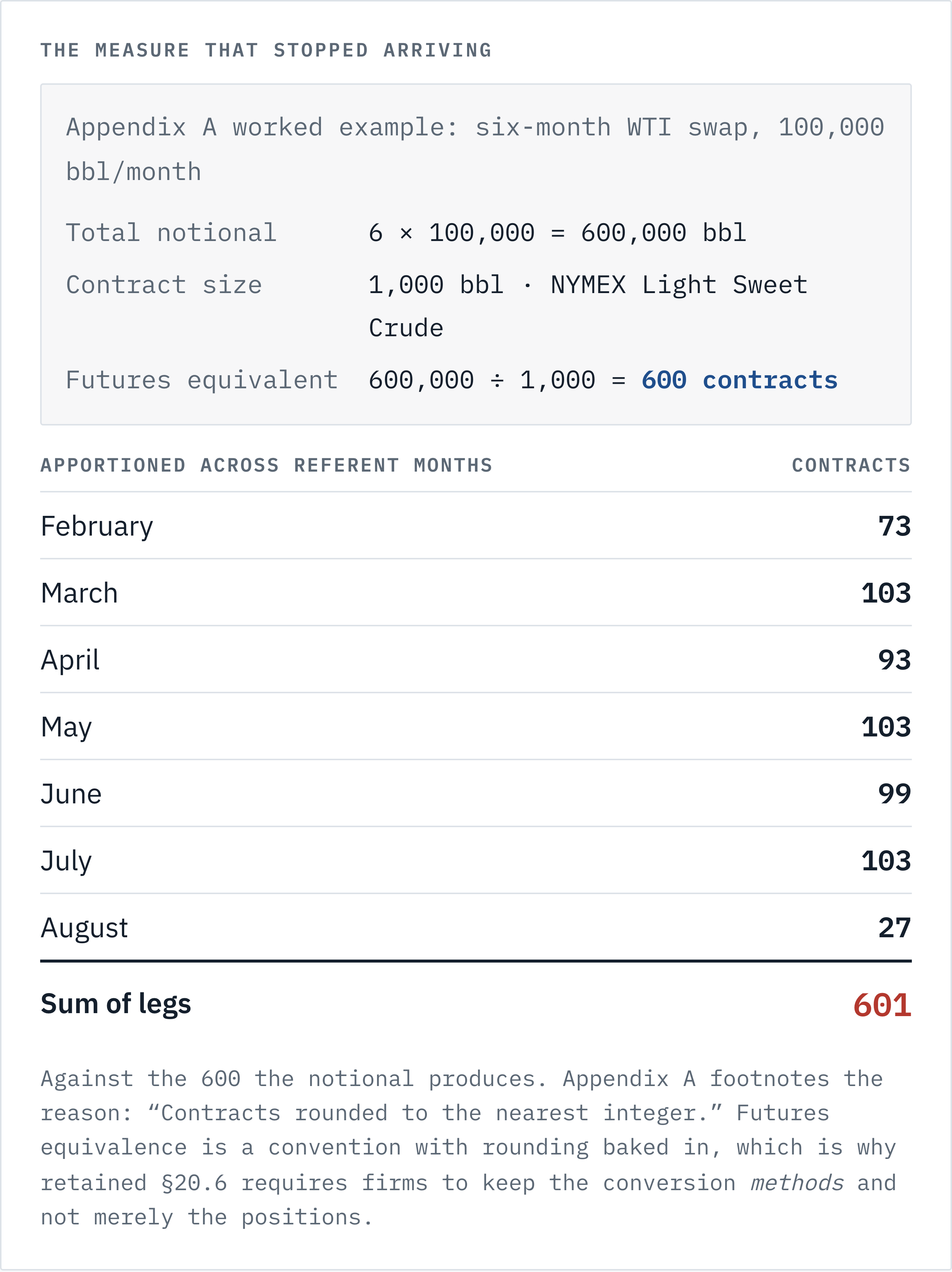
I worked that conversion leg by leg in the Patreon note on this order, with the month-by-month apportionment table, and the three limitations I couldn’t close are set out there as well.
Both halves are reconstructible in principle. The Parts 43 and 45 Technical Specification of March 2023 carries notional quantity for commodity trades in exactly Appendix A’s shape, with quantity frequency and unit of measure beside it. Section 43.6(b)(5) supplies a referent contract classification. Anyone claiming the Commission has gone blind hasn’t read the spec, and I’m not claiming it.
What the specification does say, at §1.4.2, is that for commodities firms “report product-related data elements as specified by the relevant SDR until the Commission designates a UPI pursuant to § 45.7.” Section 1.4.4 adds that repositories disseminate “product-related data elements unique to each SDR.”
Read the headings, though. Those sections govern reporting to a repository, and public dissemination. The leg that matters for §20.9(a) is repository to Commission, and it runs on an SDR Guidebook that is not public. That is the more troubling point and the more honest one. The document determining what the Commission actually receives cannot be read from outside, so nobody but the Commission can check the sufficiency finding.
The order concedes the outcome anyway. Its systems “are not presently configured to process that data into the same futures-equivalent form, in part because the UPI framework for the other commodity asset class is not yet fully implemented.” It can perform the conversion “at least in part.”
That is a normalization problem across a small number of repository vocabularies, not a blackout. And it remains unresolved, undated and unpublished.
The bridge with no far bank
The order calls the retained authority a transitional bridge. I went looking for the crossing.
Engineering turns out not to be what’s holding it up. The Derivatives Service Bureau already publishes fourteen commodity product templates covering swaps, forwards and options, basis swaps and index products included. The same dealers generate commodity identifiers for European reporting today.
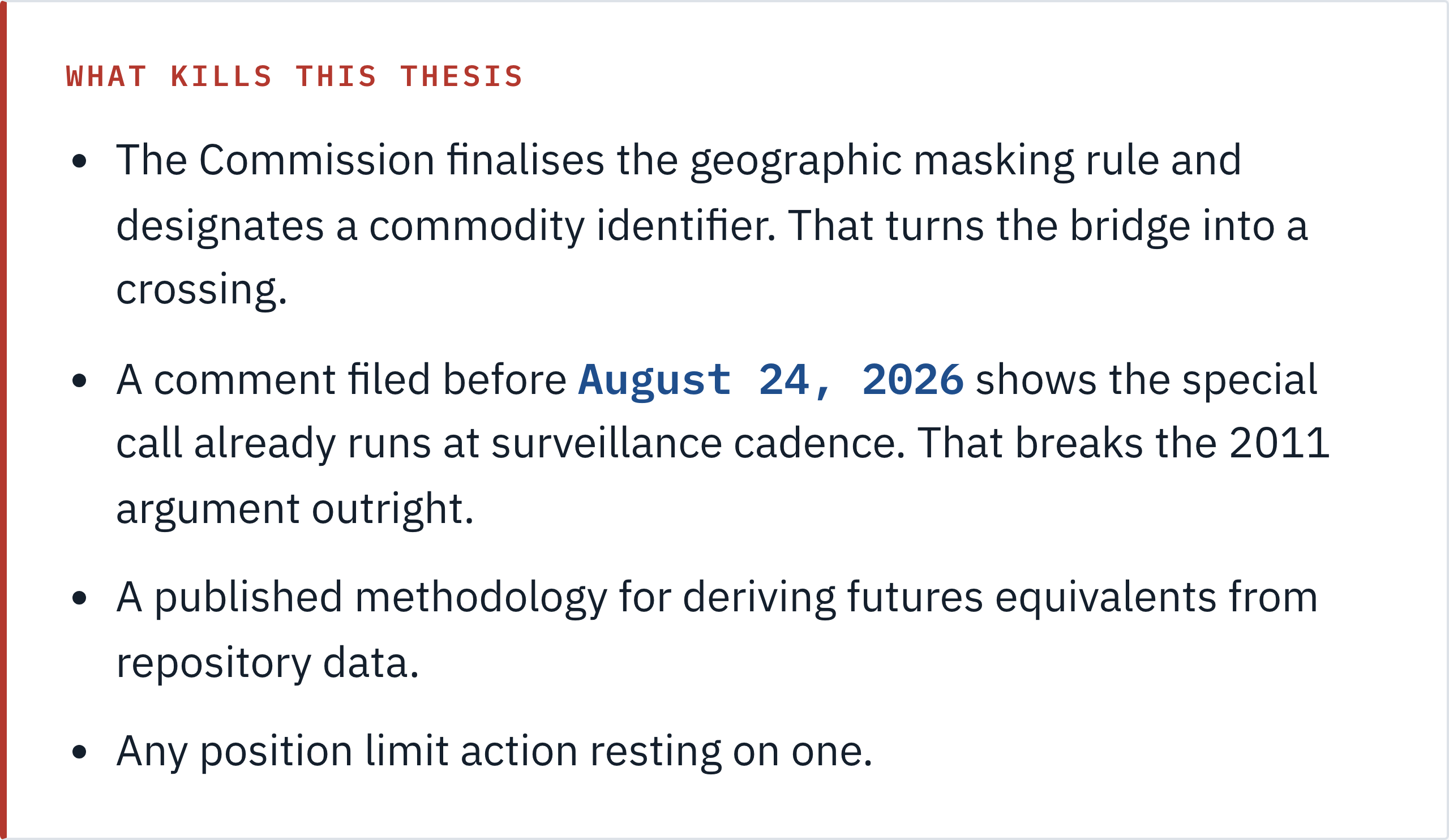
What blocks it is legal, and the Commission documented that in December 2023. “Geographic locations, such as delivery points, are often key product characteristics of the other commodity asset class swap products.” Designating a commodity identifier, absent modifications to Part 43, “could result in RCPs reporting to SDRs a UPI that contains detailed geographic information in contravention of” §43.4(c)(4)(iii) and appendix E, breaching the counterparty anonymity the statute requires.
The Commission proposed the fix in that same document. It reopened comments in February 2024.
It has never finalised it. Thirty-one months, and the enabling rule is still a proposal while the interim measure it was meant to replace has already stopped arriving.
The 2,000 contracts, and who is counting them
One consequence of all this is testable, and I’d start here if I were checking the Commission’s homework.
Appendix E to Part 150, footnote 2, sets “an additional 2,000 contract limit, net long or net short, applies across all cash-settled economically equivalent NYMEX Henry Hub Natural Gas (NG) OTC swaps.”
Read it carefully. That is a hard federal number, written in contracts, and it applies to swaps. Testing whether a firm sits inside it means expressing a swap book in futures equivalents, which is the operation the order says its systems aren’t configured to perform.
Let me not overstate it, because the objection is good. An “economically equivalent swap” under §150.1 needs “identical material contractual specifications, terms, and conditions” to the referenced contract. So this conversion is close to division by contract size. It is nothing like the apportionment across referent months that Appendix A describes for the broader population of paired swaps. Narrow definition, easy arithmetic.
The point survives in a smaller form, and I think it’s the right size. There is a numeric federal cap on OTC swap positions, denominated in exactly the unit the Commission has stopped receiving, and nothing public describes how the Commission now computes it. Whether that’s a problem or a solved routine isn’t something anyone outside the building can tell, which is the recurring shape of this whole order.
The paperwork file says something different about the same reports
The order’s cost figure carries a citation, so I pulled it. Footnote 4 puts the burden at $21,899,208 and points to OMB Collection 3038-0095, ICR 202402-3038-003, concluded September 16, 2024.
That record lists an annual cost burden of $33,895,705, down from $41,590,793. The string 21,899,208 appears neither on the record nor in the supporting statement behind it. I can’t reconstruct the order’s number and I won’t guess at a derivation I can’t see.
Before reading anything into that, note the direction. The order’s figure is lower, so whatever this is, I can’t call it a burden inflated to justify relief.
Elsewhere on that same record, the Commission describes this collection to a different audience. Reporting parties submit positions “on a futures equivalent basis so as to allow the Commission to assess a trader’s market impact across differently structured but linked derivatives instruments and markets.” Swaps position reports “represent a critical component for the implementation of an effective surveillance-based regulatory approach.”
Two caveats belong here, and I’d rather state them myself than have them found later. The filing was an “extension without change,” so that wording may be older than 2024. And industry was contesting the same renewal at the time.
What I can’t rule out
My strongest counterargument is the Commission’s own, and it is unrebutted: it barely used the data. If Part 20 fed nothing in enforcement and little in oversight, the loss is smaller than my argument implies, and internal usage isn’t something I can measure from outside.
Second, and this one cuts hard: the surviving regime beats the old one on almost every axis I can measure. Every swap instead of 46 contracts. Next day instead of T+2. Cash market and hedging records instead of positions alone. My case rests on the shape of the instrument. A reader who weights coverage over shape should reach a different answer, and I wouldn’t argue with them.
Third, the perimeter I complain about was reasoned, not forgotten. The 2021 position limits rule picked its 25 core contracts from a candidate pool of 30 on published liquidity and delivery criteria, and explained why Random Length Lumber and CBOT Ethanol missed. It still holds that federal limits reach 25 contracts where Part 20 watched 46, that eleven of those 46 appear zero times in that rule, and that for the 16 non-legacy contracts, which include every energy and metals contract, “only Federal spot-month limits apply.” They’re different perimeters, drawn for different purposes. The order treats the narrower one as a reason to stop collecting the broader measure.
One thing I want to be straight about: I can’t size this, and I’m not going to pretend otherwise. Nothing here is a position or a trade. The exposure is operational and legal, it falls on firms running physical commodity swap books, and the only quantity I can put on it is the one in the close: the number of days between a special call landing and your answer. Anyone offering you a basis-point figure for a surveillance gap is guessing.
What a commodity desk should do about it
One operational point gets lost in the coverage, and it cuts against the relief.
Filing stopped. The obligation to compute didn’t. Section 20.6 still makes clearing organizations and reporting entities keep “methods used to convert paired swaps or swaptions into futures equivalents.” Section 20.6(c) reaches every person holding 50 or more gross all-months-combined futures equivalent positions in a commodity.
Reading yourself against that threshold means running the conversion. A firm that decommissions its Part 20 engine along with the daily file has kept the obligation and thrown away the tool that satisfies it.
I’d treat that as the practical takeaway. Relief is real on the filing and thinner on the capability, and the two are easy to confuse in a cost-saving memo. My read is that the conversion logic is now cheaper to maintain than to rebuild under a deadline, because a special call arrives with a clock attached and the Commission kept Appendix A in force precisely so it can ask in that measure.
There’s a second thing worth noticing, and it’s why I think this piece needed writing. I checked Gibson Dunn, Norton Rose Fulbright, DerivSource, Traders Magazine, and the public interest groups who usually object to exactly this. Every note I read describes the order accurately. Not one mentions that the Commission rejected this trade in 2011. The record is public and it is one document. To my mind it is the first thing the order should have distinguished.
📊 The Decision-Grade Version
Everything above stands on its own: the thesis, the record, the steelman and what would kill the view. I held nothing back to sell you a next step.
That note is a different piece of work rather than a deeper cut. I took one procedure out of this story, the futures equivalent conversion the Commission stopped receiving, and wrote it the way a desk would run it: Appendix A leg by leg, the threshold that still binds, and the three failure modes that would make it wrong.
→ Read the futures equivalent conversion note
→ Or join the Patreon community for every note
More of this work: YouTube · LinkedIn
If you run a commodity book, the question is narrow and answerable. Did you keep the futures equivalent conversion running after July 17, and if a special call landed next week, how many days would it take you to answer it?
Cover photograph: G. Edward Johnson, CC BY 4.0, via Wikimedia Commons.