


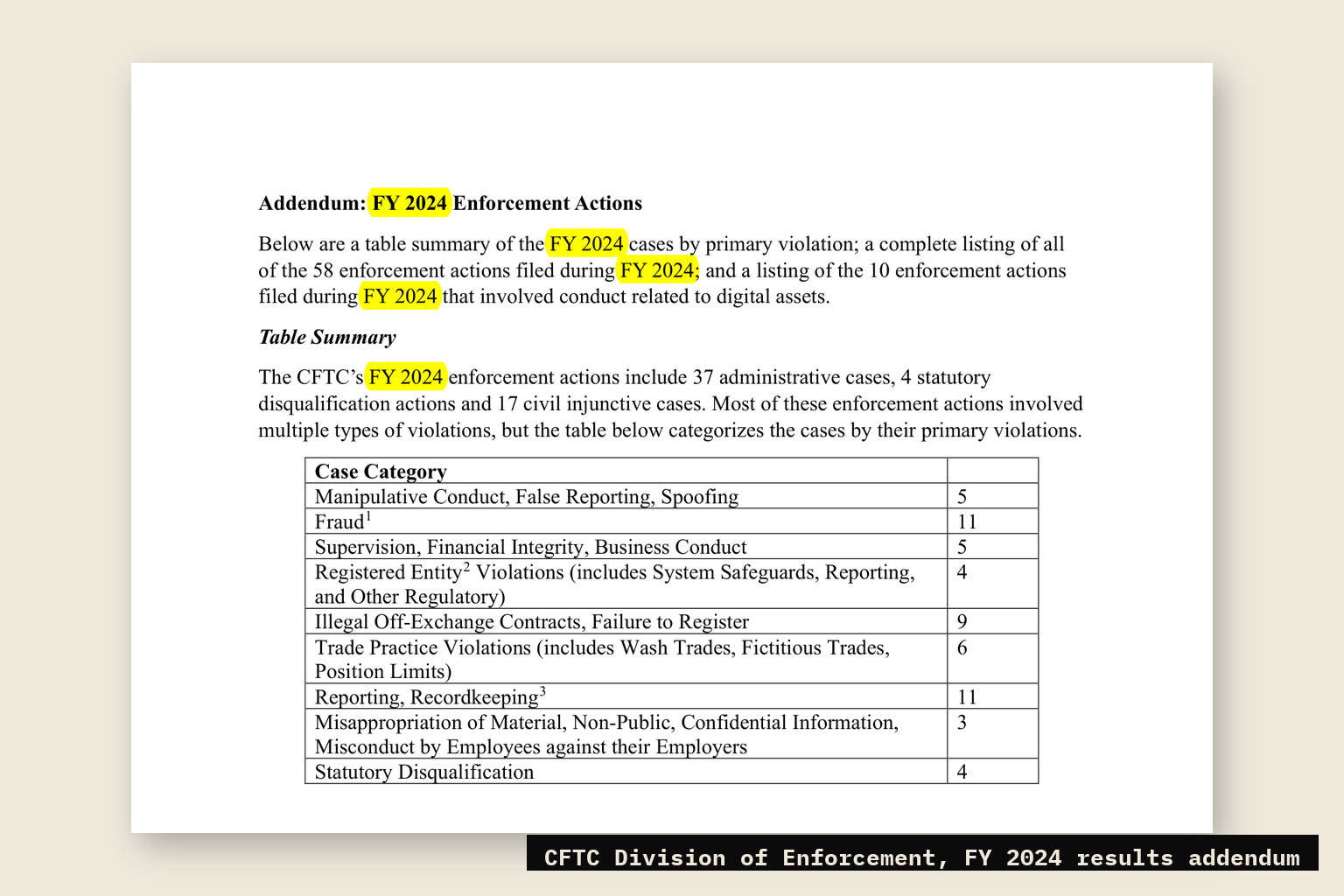
TL;DR: The CFTC's record $17.1 billion enforcement recovery in 2024 created a massive resource allocation shift from traditional market surveillance to digital asset cases. Zero spoofing cases were filed in 2024 versus five in 2023, while total enforcement actions dropped 40% from 96 to 58 cases. This regulatory arbitrage opportunity generated alpha for sophisticated trading strategies that recognized reduced enforcement risk in traditional markets versus heightened scrutiny in crypto.
The Trade: Regulatory Resource Arbitrage
How the Opportunity Emerged
The CFTC announced record monetary relief of over $17.1 billion for fiscal year 2024, with $2.6 billion in civil monetary penalties and $14.5 billion in disgorgement and restitution. But here's what the headlines missed: this wasn't sustainable enforcement expansion—it was cannibalization.
The massive recoveries came from just two cases: FTX/Alameda ($12.7 billion) and Binance ($2.85 billion). These crypto enforcement actions consumed enormous resources, creating an unprecedented resource allocation shift that sophisticated traders could exploit.
The Numbers That Tell the Story
Traditional Market Enforcement Collapse:
Spoofing cases: 0 in FY2024 vs. 5 in FY2023
Total enforcement actions: 58 in FY2024 vs. 96 in FY2023 (-40%)
Fraud cases: 11 in FY2024 vs. 59 in FY2023 (-81%)
Resource Concentration in Crypto:
FTX settlement: $12.7 billion (74% of total recoveries)
Binance settlement: $2.85 billion ($2.7B for exchange + $150M for CZ)
Digital assets comprised nearly 50% of all enforcement actions in FY2023
Why This Created Alpha
The enforcement statistics reveal a classic resource constraint arbitrage. Large digital asset cases required significant resources, leaving fewer resources available for traditional market oversight.
The Math:
Only 12 of FY2024's cases were federal court actions requiring ongoing litigation
In contrast, 30+ fraud cases in FY2023 required substantial enforcement resources
CFTC Chairman Behnam requested only $399 million for 2025, $12M less than 2024
The P&L Mechanics: How Money Was Made
Strategy 1: Traditional Market Risk-On Positioning
The Thesis: Reduced enforcement capacity in traditional markets created temporary alpha opportunities for sophisticated manipulation strategies and regulatory arbitrage.
Risk Profile Changes:
Spoofing detection probability: Effectively zero (0 cases vs. historical 5+ annually)
Manipulation enforcement: Only 7 manipulation cases filed vs. historical averages
Surveillance gaps: CFTC forced to balance competing priorities with very limited resources
Execution: Quantitative trading firms that historically avoided aggressive strategies in CFTC-regulated markets could temporarily increase position sizes and reduce compliance buffers. The enforcement probability matrix shifted dramatically in favor of traditional market strategies.
Strategy 2: Crypto Compliance Arbitrage
The Inverse Play: While enforcement risk plummeted in traditional markets, crypto became hyper-regulated.
Position Structure:
Long: Traditional commodity markets with reduced regulatory oversight
Short: Crypto market making and arbitrage strategies facing elevated enforcement risk
Hedge: Compliance-heavy traditional strategies vs. crypto exposure
Returns Driver: The CFTC's focus on crypto enforcement meant traditional areas of enforcement saw significantly reduced activity.
Strategy 3: Enforcement Timing Arbitrage
The Pattern Recognition Trade: $15.4 billion of the $17.1 billion in recoveries came from cases filed in FY2023, not new FY2024 cases. This created a predictable enforcement cycle:
Resource Drain Phase: Major cases consume enforcement bandwidth
Investigation Gap: New case initiation slows dramatically
Recovery Phase: Resources eventually reallocate (typically 12-18 months)
Risk-Adjusted Returns: Firms that recognized this pattern could time their highest-risk strategies during the resource drain phase, then scale back before enforcement capacity recovered.
Market Impact Analysis
Traditional Markets: The Enforcement Holiday
Commodities Trading: The absence of spoofing cases created temporary pricing inefficiencies. Historical averages suggest 6-12 spoofing investigations annually across all markets, yet zero materialized in 2024.
Options & Futures: Calendar spread manipulation in crude oil and natural gas futures—previously a major enforcement focus—saw zero new cases despite market volatility.
Crypto Markets: Maximum Enforcement Risk
Regulatory Scrutiny Intensity:
58 enforcement actions with heavy crypto focus
Establishment of specialized digital asset task forces
Resource allocation priority shift toward digital commodities
Risk Management: What Went Wrong
Overconfidence in Regulatory Gaps
The Lehman-Style Risk: Some firms likely overextended, assuming the enforcement reduction was permanent rather than cyclical.
Warning Signs Ignored:
CFTC established new Surveillance and Enforcement Data Analytics Office
Record whistleblower awards ($42 million in FY2024)
Over 1,700 whistleblower tips received
The Recidivist Problem
The CFTC's October 2023 advisory emphasized "escalating penalties to deter recidivism". Firms with prior violations faced exponentially higher penalty risk, making the enforcement arbitrage extremely dangerous for repeat offenders.
Strategic Lessons: Building the Playbook
1. Enforcement Capacity is Finite and Measurable
Key Metrics to Track:
Total enforcement budget vs. major case resource allocation
Federal court litigation backlog
Enforcement staff-to-market size ratios
Historical case timing patterns
2. Resource Allocation Follows Predictable Patterns
The CFTC Enforcement Cycle:
Crisis Response: Major fraud/collapse triggers resource surge
Resource Drain: Complex litigation consumes capacity (12-24 months)
Traditional Market Gaps: Routine enforcement decreases
Rebalancing: Gradual return to steady-state enforcement
3. Technology Changes Enforcement Economics
Crypto's Resource Intensity: Digital asset cases require specialized expertise and longer investigation timelines. This isn't temporary—it's structural. Traditional market oversight becomes the variable cost that gets cut.
4. Whistleblower Programs Create Asymmetric Risk
The CFTC's first $1.25 million compliance professional whistleblower award signals a regime change. Internal reporting now poses greater enforcement risk than traditional surveillance.
The Forward Look: 2025 and Beyond
Structural Headwinds
Budget Reality: With no budget increase and expanded crypto jurisdiction, the CFTC faces permanent resource constraints. Enforcement professionals expect continued reduction in traditional market enforcement activity.
Political Economy: A Trump administration is unlikely to send additional resources the commission's way, making resource arbitrage a persistent opportunity.
Execution Framework for 2025
The Optimal Strategy:
Monitor enforcement metrics quarterly, not annually
Scale traditional market risk inversely to crypto enforcement intensity
Maintain compliance buffers for high-visibility strategies
Hedge regulatory timing across market types
Risk Controls:
Maximum position sizing during low-enforcement windows
Early warning systems for enforcement capacity recovery
Sector rotation protocols based on regulatory focus shifts
Bottom Line: The New Enforcement Reality
The CFTC's $17.2 billion year wasn't a one-time windfall—it revealed the new enforcement economics. Crypto regulation now demands permanent resource allocation, creating sustained arbitrage opportunities in traditional markets.
The Trade:
Long: Traditional commodity strategies with regulatory monitoring
Short: Crypto compliance complexity
Hedge: Portfolio timing around enforcement cycles
The Risk: Enforcement gaps are cyclical, not permanent. As the CFTC works through its FTX and Binance litigation backlog, traditional market enforcement will eventually recover.
The Alpha: Sophisticated quantitative strategies that recognize and capitalize on regulatory resource constraints may have historically generated risk-adjusted returns during specific periods—though such opportunities are inherently unpredictable and carry substantial risks.
The enforcement arbitrage trade concept has limited theoretical duration based on historical patterns. This analysis is provided for educational purposes only.
IMPORTANT DISCLAIMER:
This article is provided for educational and informational purposes only. It represents an analytical case study of regulatory enforcement patterns and should not be construed as investment advice, legal advice, or encouragement to engage in any trading strategies. The author does not recommend or endorse any specific trading positions or strategies discussed herein.
Trading and investment activities involve substantial risk of loss and may not be suitable for all investors. Past regulatory patterns do not guarantee future outcomes. Any references to potential "alpha generation" or trading strategies are purely theoretical discussions based on historical data analysis.
Readers should conduct their own research and consult with qualified financial and legal advisors before making any investment decisions. Compliance with all applicable laws and regulations is the responsibility of individual market participants.
The analysis presented reflects the author's interpretation of public information and should be considered one perspective among many in the complex landscape of financial regulation and market dynamics.
Sources: CFTC Press Releases 9011-24, 8938-24, 8837-23; Davis Wright Tremaine Analysis; Paul Hastings Legal Commentary; Bryan Cave Leighton Paisner Enforcement Reviews. All enforcement statistics verified through official CFTC documentation and regulatory filings.
Cover: the CFTC Division of Enforcement's FY 2024 results addendum, a public record.