


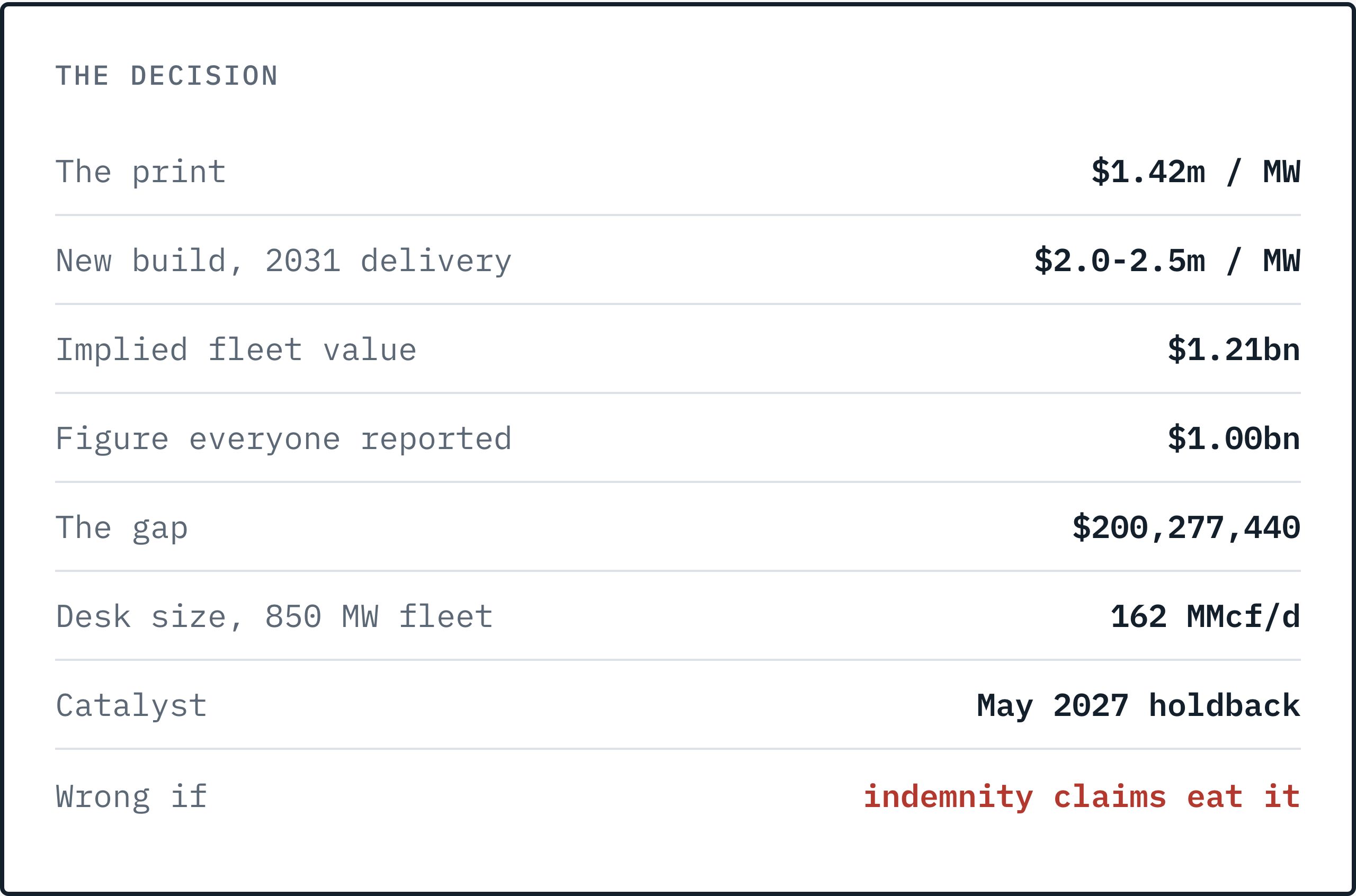
The claim: The SpaceX job posting everyone read as fuel procurement asks for profit and loss generation, pricing inefficiencies and CFTC compliance, which is a merchant desk specification, and it makes SpaceX the fourth buyer of this size to become an energy trader after Amazon, Google, Microsoft and Meta. The hardware that made it necessary is already paid for: a 5% stake carried at $7.2m paid out $60.4m in under seventeen months, pricing the mobile turbine fleet at $1.21bn against the $1bn that got reported.
The numbers: $50,392,931 of cash plus a $10,013,872 holdback to a 5% holder, and 850 MW across 30 mobile turbines (Duos 10-Q, 19 Aug 2026). $1,421 per kW implied, against $2,000 to $2,500 for new build you cannot take delivery of before 2030.
The catalyst: the holdback runs 12 months from 26 May 2026 and settles the price question in a public filing around May 2027.
Wrong if: the holdback is consumed by indemnity claims, or the distribution to Duos was not pro rata, in which case the reported $1bn is closer to right than my $1.21bn.
The consensus: SpaceX is integrating backwards into its own fuel chain
SpaceX needs power on a schedule no utility can meet and methane on a schedule no supplier is set up for, so it is integrating backwards into both.
That version is coherent and I want to give it full weight. The company committed $16.8bn in early August to a first phase of Terafab in Grimes County with Tesla and Intel. At a county public meeting on 6 August, Riley Trettel, who runs energy and data centre development for SpaceX, put it in five words: “We’re bringing our own power.” Gas fired plants, he said, and very large battery arrays. Starship’s Raptors burn liquid methane. ERCOT interconnection queues are long, turbine order books are longer, and a fab that flickers scraps wafers. A gas trader is what you hire when you’ve decided to own the fuel chain. I’d have believed that too, right up until I read the responsibilities.
The posting asks for P&L, and procurement desks do not have one
I went looking for a procurement story. The posting doesn’t contain one. Almost every outlet described the SpaceX listing without quoting it, so I read it myself. The successful candidate will “identify pricing inefficiencies and manage profit/loss across various market segments” and “manage trading positions based on fundamental and technical market signals.” Preferred experience includes “storage optimization” and a “track record of P&L generation.” The role must “ensure compliance with CFTC/FERC regulations.” Familiarity with Endur is listed as a plus. I read each of those as a tell. A company that only wants to buy gas doesn’t manage positions on technical signals. It doesn’t need a P&L, because its objective is a low and stable delivered cost and a P&L invites trading against that. It doesn’t need CFTC compliance, which attaches to derivatives a pure physical buyer never touches. And it doesn’t need Endur, the trade capture system merchant energy books run on. That’s a merchant desk. I don’t think it’s a close call. Storage optimization is the one I’d point a PM at first: buy gas when the curve is in contango, inject it, sell it forward at the spread less carry. It’s a spread business with a term structure view. Nobody does that to keep a chip fab lit. Alcoa hedges power and airlines hedge jet fuel, so the rival reading is ordinary hedging in modern dress. Two things kill it: hedgers use bank counterparties and confirmations rather than Endur, and CFTC compliance attaches to derivatives a pure physical buyer never touches.
One detail I can’t place: the role requires Air Force background checks and up to 50% travel, which points at a physical delivery footprint on a federal launch range, though it may just be the badge rule at that address.
Meta filed to become a power marketer, and SpaceX is the fourth one in
The obvious objection, and it is the right one: why is a job ad news when every large buyer is doing this?
It’s a fair hit. Amazon, Google and Microsoft are already active power traders on their own regulatory filings. I looked at how a dedicated commodity desk actually generates that edge in InCommodities and Danske Commodities, which is the shape SpaceX is hiring toward. In September 2025 Meta went further, filing a market-based rate tariff at FERC through a wholly owned subsidiary, Atem Energy LLC, formed in the application’s words to act as a power marketer selling “energy, capacity, and certain ancillary services” at wholesale across six ISOs.
So SpaceX is not first. I read it as the fourth buyer of this size to stop being a customer of the energy market and start being a participant in it, and the pattern is what matters here, more than the job ad itself. Four in eighteen months.
Two things make the SpaceX version different, and both are about Texas. Meta’s filing names six ISOs and ERCOT is not one of them, because ERCOT is not FERC-jurisdictional. And Meta filed to sell POWER, while SpaceX is hiring to trade the fuel, one layer down, in the only large US grid where fuel and power fail together.
I should be straight about the evidence. A job posting proves what an employer asks for, never what it does. My whole reading of SpaceX’s intent rests on one document, and a recruiter adapting a merchant trading template would produce the same words. What persuades me anyway is that Endur and CFTC compliance don’t migrate into a procurement template by accident, and that the hardware was bought fourteen months earlier.
Duos Technologies’ 5% stake prices the fleet at $1.21bn
Here’s where the private company becomes readable, and I get there through somebody else’s balance sheet. The sequence matters, so take it one date at a time.
On 31 December 2024 Fortress Investment Group closed on 850 MW of mobile turbines. On 14 May 2026 the FTC issued an antitrust early termination notice, transaction 20261350, which reporting ties to Elon Musk. On 26 May 2026 substantially all of those assets changed hands. On 6 August 2026 SpaceX committed to Terafab and said it would generate its own. On 21 August 2026 the gas trading role was posted. Fourteen months from turbines to trader.
A Jacksonville microcap called Duos Technologies Group is how that first date is readable. (I have used SpaceX’s own filings this way before, on its first AI profit and the depreciation add-back underneath it.) It helped Fortress buy, in the filing’s words, “approximately 850 megawatts of electrical generation capacity (consisting of 30 mobile gas turbine generators)” plus balance-of-plant from Atlas Corporation and APR Energy Holdings, through a vehicle later renamed New APR Energy, LLC. Duos took an asset management agreement and a 5% non-voting interest in the parent, carried at $7,233,000.
One line explains how a fleet like this becomes available at all. Duos discloses that “Chuck Ferry, our then Chief Executive Officer, was formerly the CEO of APR from 2018 to 2020.” The microcap that helped Fortress buy APR’s turbines was run by the man who had run APR. Assets like this don’t sit on a screen.
Duos filed an 8-K two days after closing and the press backed a valuation out of it. The 10-Q gives the schedule exactly:
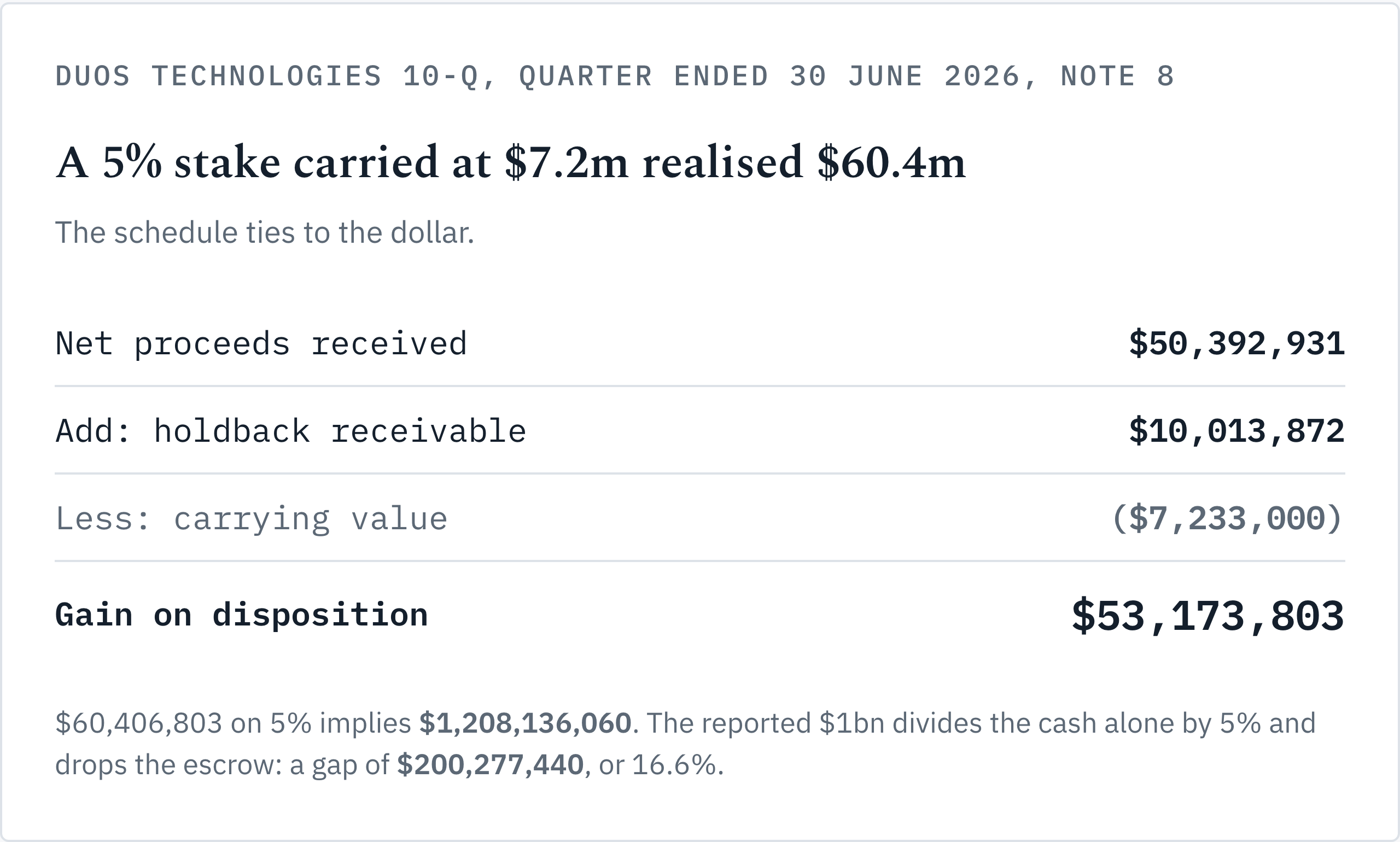
So a 5% holder realised $60,406,803. Divide by 0.05 and I make that $1,208,136,060.
The reported $1bn is $50.4m of cash divided by 5%, and it quietly drops the escrow. That escrow is no maybe in Duos’s own accounting: the company booked it as a receivable, ran it through the gain, and told the SEC anything left after twelve months gets distributed. The gap is $200,277,440, or 16.6% of the larger number. The outlet that ran the figure even showed its working, saying the value was “backed out from disclosures showing a minority stakeholder received roughly $50.4 million for a 5% stake.” The escrow was in the open and left out anyway. Nobody recomputed.
Careful about what that licenses. Grossing up a distribution to a non-voting holdco member measures equity proceeds and assumes a flat waterfall. Duos supports the assumption, calling the $60m the realisation of its 5% interest, but debt, fees or a preference would move the true consideration. So I’d call it $1.0bn to $1.21bn, with the circulating number at the bottom.
The return is cleaner and I have more confidence in it. $7,233,000 became $60,406,803 in under seventeen months. I make that 8.35 times money, or 6.97 on cash alone. Duos ended the quarter with $112.3m of cash against $15.5m at year end and reported $1.58 of basic EPS, for a company that lost money from operations.
Fortress bought turbines at the end of 2024. Musk bought a clock.
$1.42m per megawatt buys a delivery date, and the trade does not repeat
Divide $1,208,136,060 by 850 MW and I get $1.42m per megawatt, about $1,421 per kW. Across 30 units that’s roughly $40m per turbine.
Price the alternative. Recent US combined cycle projects report installed costs moving toward $2,000 to $2,500 per kW, and money is not the constraint. GE Vernova’s backlog ran 80 GW in December 2025 and closed the second quarter of 2026 at 116 GW, with reservations now taken for 2031 delivery.
So I make the trade 57% to 71% of new build cost, for capacity that exists today instead of 2031. Time was the product. Not steel. The buyer did not purchase generation, which anyone can order with five years to wait. He purchased the five years.
Two things anchor it. APR Energy sold to Atlas Corp for $750m in February 2020. That was the whole company. Six years later an 850 MW slice of its assets implies $1.21bn. And the immediacy is not my inference: Fortress’s own announcement of the 2024 purchase called the portfolio “immediately available for deployment.”
One thing I can’t give you is the fab’s own requirement. SpaceX has not disclosed Terafab’s load, so every figure here rests on the 850 MW that was actually bought.
Then ask whether it repeats. I think not. ERCOT’s large load queue went from 63 GW in December 2024 to near 230 GW by March 2026, three quarters of it data centres, against a fleet serving about 105 GW. Published counts run 226 GW to 410 GW depending on duplicate treatment. Against that, Aggreko, the largest operator in mobile power, ran about 9.6 GW worldwide in 2021 and the whole global power rental industry turned over roughly $11.7bn in 2025. APR’s 850 MW is under a tenth of one Aggreko. That is the entire pool.
So the world stock of fast deployable thermal capacity sits in the low tens of gigawatts against one grid’s queue of over two hundred. Nobody publishes that stock figure and I should say so: I built it from a dated fleet number and an industry revenue line, and it’s the least evidenced thing here. It would have to be wrong by an order of magnitude to change the conclusion.
This was an inventory arbitrage on a fixed stock, available once, to a buyer who could write a cheque with no board process and knew which yard the turbines sat in. A fund can’t replicate it. I have written the desk-level version of this section as a separate note: the capacity bound sized, the regime conditions that hold it, and the three risks with probabilities and early warning signs attached. The decay is visible too: GE Vernova is taking annualised production from roughly 20 GW toward 24 GW by 2028, and when OEM throughput catches the queue the immediacy premium compresses and the $1.42m print goes with it. Two to four years, and it closes from the supply side. I’d not bet on demand cooling. Size the other half in the same units: if used mobile capacity reprices toward refurbishment value instead of 57% of new build, an 850 MW fleet bought at $1.21bn is worth a few hundred million less, and the buyer still holds turbines burning 50% more gas per MWh than the plant he could have ordered. That’s the cost of being early.
850 megawatts of aeroderivative turbines burn 59 Bcf. Starship burns 5.4.
Every headline framed this as rocket fuel. The arithmetic doesn’t support that, and I’d sooner show the working than assert it. The APR fleet is 20 GE TM2500s and 10 Pratt & Whitney FT8 mobile packs. TM2500s run 8,830 to 9,705 Btu/kWh; the FT8 starts near 9,018 at ISO and degrades toward 10,400 in heat. Blended, in Texas, I’ll use 9,700 Btu/kWh and assume an 85% capacity factor. Both are mine, so flex them: at 8,830 the fleet burns 53.9 Bcf, at 95% it burns 66.2. The conclusion survives every version.
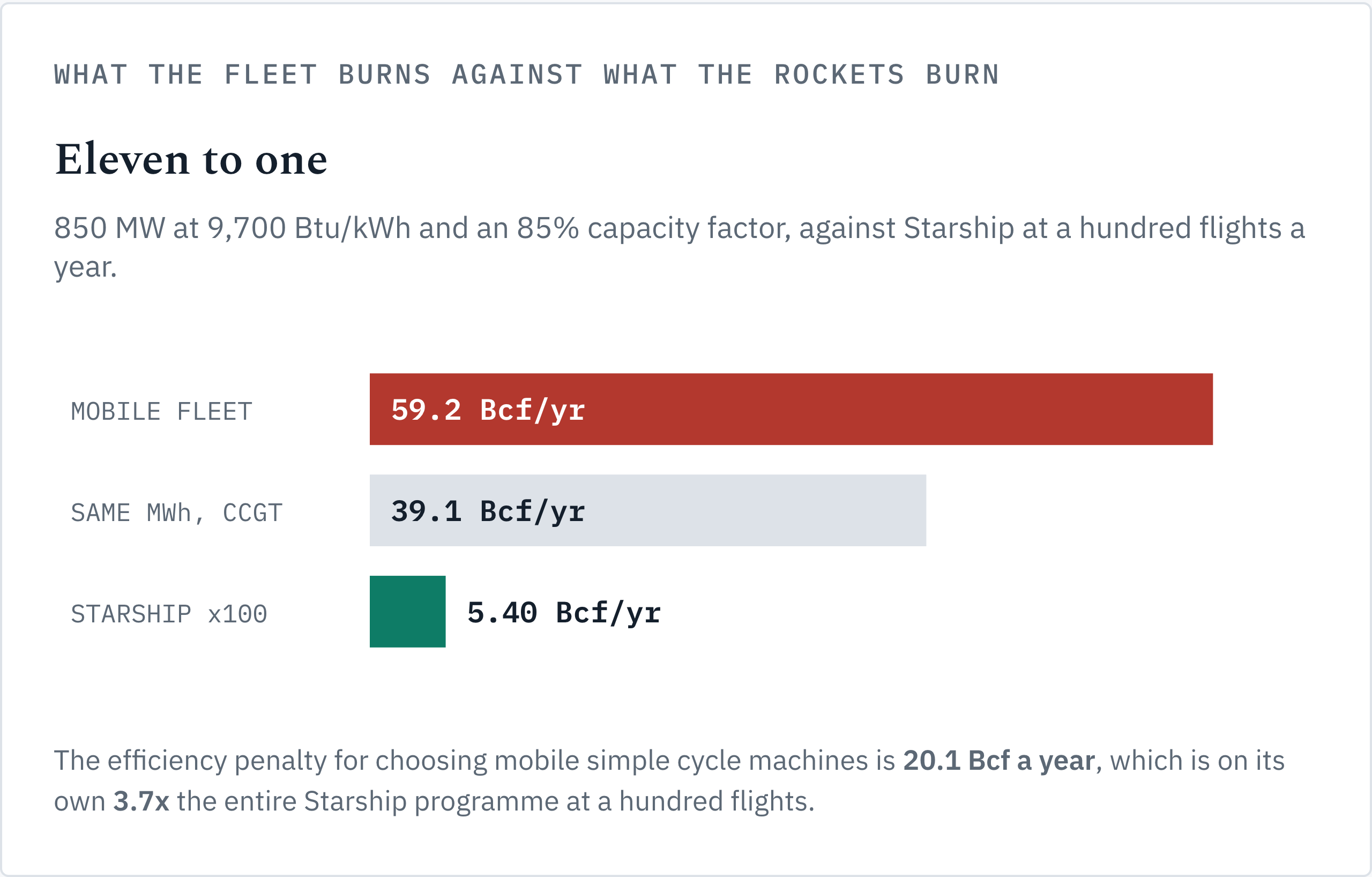
850,000 kW × 8,760 h × 0.85 = 6,329,100,000 kWh. At 9,700 Btu/kWh and 1,037 Btu per cubic foot I make that 59.2 Bcf a year, about 162 MMcf/d.
The same electricity from a modern combined cycle plant at 6,400 Btu/kWh is 39.1 Bcf a year, so the penalty for choosing mobile simple cycle machines is 20.1 Bcf a year. Against that, the rockets. Super Heavy carries 3,400 t of propellant and a Block 2 ship 1,500 t, so a stack is 4,900 t at a 3.6:1 oxidiser-to-fuel ratio, which I make 1,065 t of methane per launch. At 55.5 MJ/kg a tonne is 52.6 MMBtu, so a launch is 54.0 MMcf. At a hundred launches a year, far above any cadence yet flown, Starship needs 5.40 Bcf. That counts launches only, so it excludes static fires, proof tests and scrubs, and the true rocket number is higher.
Eleven to one.
The turbine fleet burns roughly eleven times the gas the entire Starship programme would at a hundred flights a year, and the efficiency penalty alone is 3.7 times the rockets. A gas desk sized for launch operations is small. 162 MMcf/d is a real one: throughput comparable to a mid-size marketer, and the reason the posting asks for a team.
One caveat I’m not burying: rocket grade methane is liquefied and purified far beyond pipeline spec, so this is an energy equivalence and not a substitutability claim.
Waha went to minus $6.34 and back to plus $2, and a pipeline did all of it
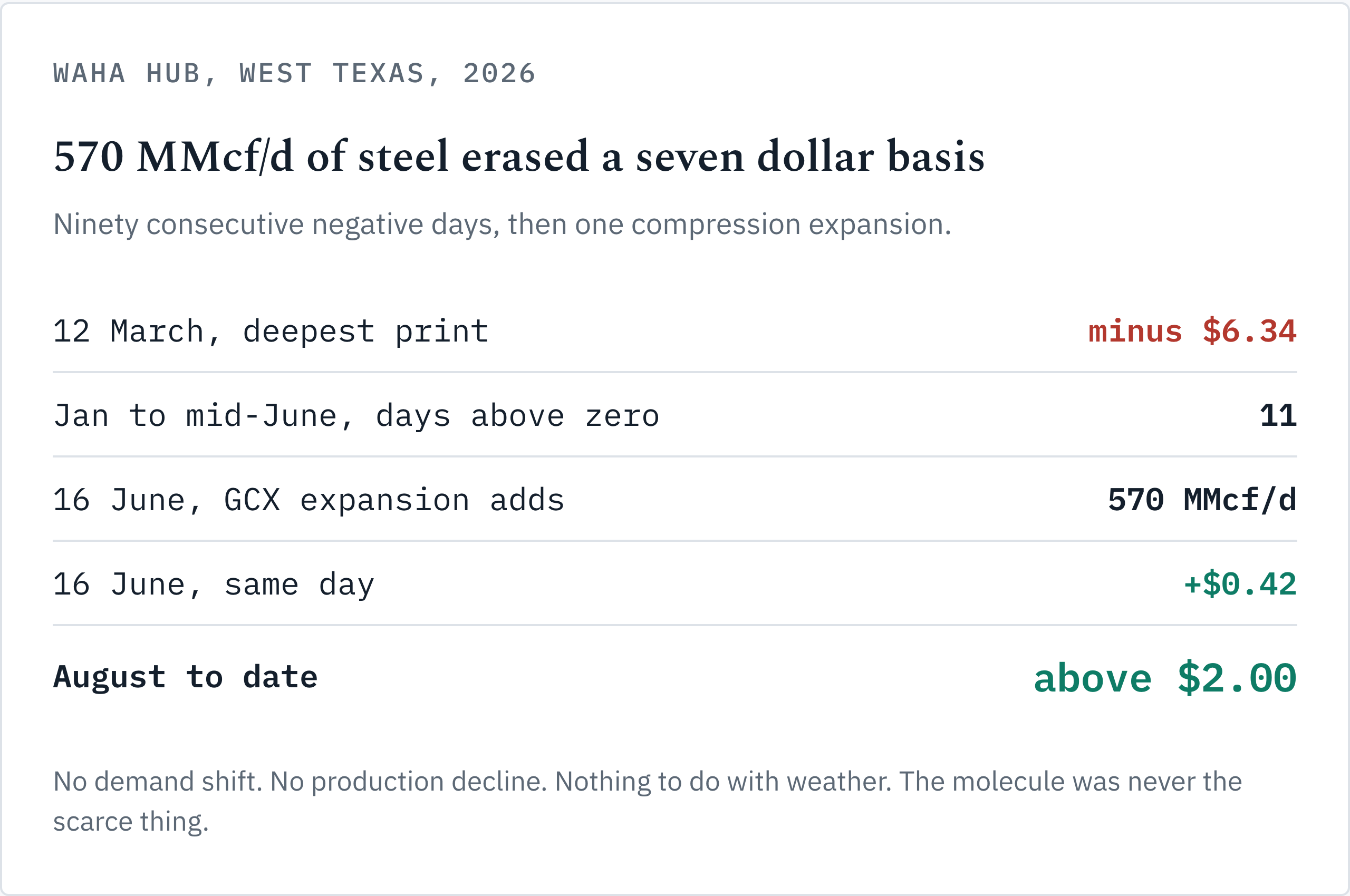
Here’s the objection I’d raise. If the point is fuel security, why build a desk where gas has been free? Through spring 2026 the Waha hub in West Texas ran below zero for a record ninety consecutive days, hitting minus $6.34/MMBtu on 12 March. Between January and mid-June it cleared zero on eleven days, most during a January freeze off. Producers were paying to have gas taken away. You don’t staff a trading floor for that.
Then somebody built a pipe.
On 16 June, Kinder Morgan’s compression expansion on Gulf Coast Express added 570 MMcf/d of takeaway, and Waha turned positive the same day at plus 42 cents. It averaged around $1.64 in July and has run above $2.00 in August, with Hugh Brinson and Blackcomb still to commission fully, while Permian production set a record 24.9 Bcf/d. The basis just went away.
Five hundred and seventy million cubic feet a day of steel erased a seven dollar basis. No demand shift. No production decline. Nothing to do with weather. One compressor station.
That is the argument, run as a natural experiment. The molecule was never the scarce thing. Transport was. The gap between a wellhead giving gas away and a turbine 400 miles east that needs it at 3 a.m. in January is pipe, storage and firmness, and each trades as a basis position instead of a purchase order. Which is why the posting asks for pipelines, storage optimisation and counterparties in the same breath as P&L.
The tail is not theoretical. The FERC and NERC report on the February 2021 freeze found 1,045 units carrying 192,818 MW suffering 4,124 outages, derates or failures to start. Freezing caused 44.2%, fuel issues 31.4%, and gas supply was 87% of that fuel bucket, which is 27.3% of every outage in the event. Texas, Oklahoma and Louisiana production fell 21 Bcf/d at the 17 February low. The report lists the causes of wellhead outages as freezing, “loss of power,” and precautionary shut-ins. Gas needs electricity to move and electricity needs gas to be made. Owning both ends of that loop doesn’t break it. It puts you on both sides at once.
And the detail that should worry any owner of thermal generation in ERCOT: 81% of the freeze-related outages happened at temperatures above the unit’s own stated ambient design temperature, across about 63,000 MW. The equipment didn’t fail because the weather beat its specification. It failed inside its specification. Design margin held. The units went anyway.
Texas already decided that owning your own generation does not buy you out
I think this is the most underpriced constraint in the AI power conversation, and it’s statutory.
Texas Senate Bill 6 applies to any single site load at or above 75 MW. Loads interconnected after 31 December 2025 must install equipment letting ERCOT directly curtail them during firm load shed events and emergencies, customers must disclose on-site backup generation equal to or greater than half the proposed load, and ERCOT can require them to deploy that generation, or curtail, when the grid is in trouble.
I read that twice. Building your own plant next to your own load doesn’t exempt you from curtailment in ERCOT. It hands the grid operator a call on your generator.
Self-supply is not sovereignty. It’s a different counterparty.
There’s an exception for critical load industrial customers and critical natural gas facilities, and a chip fab may qualify. No public filing tells me whether Terafab will claim it. The independence people assume only arrives if the site is islanded and never interconnects, which the desk would then supply with no grid backstop at all.
Either way I think the desk gets more necessary. Interconnected, it manages a generator ERCOT can call. Islanded, it’s the only thing between a $16.8bn fab and a cold start. Both roads need a trader.
Five things I cannot rule out, starting with an unnamed buyer
SpaceX files nothing. It’s private, so every statement about its intent here comes from a job posting and press reporting. I’ve leaned on Duos’s filings because they’re the only audited surface anywhere near this.
What Fortress paid in 2024 is not public, and it’s the number that would settle this. If Fortress bought cheap and resold at a markup, $1.42m per MW is a dealer’s spread and not a scarcity price. A reader who has it can price the whole trade against me.
Grossing up may overstate. Holdco debt or an uneven waterfall would make $1.21bn too high. My defence is that Duos itself calls the $60m the realisation of its 5% interest.
The buyer is not named in any filing I can audit. Duos says only “a third party.” Every identification of Musk traces to reporting on an FTC notice I couldn’t read directly. The money is filed and auditable. The name isn’t. I’ve written it as reporting.
The 850 MW may not be Terafab’s. Reporting ties APR to xAI, and this is the weakest link in the piece: I’m joining a turbine purchase to a chip fab across two Musk entities on circumstantial timing, and no filing makes that join for me. If the fleet never reaches Grimes County the burn arithmetic still holds for whatever campus it powers, but the neat line gets a lot longer.
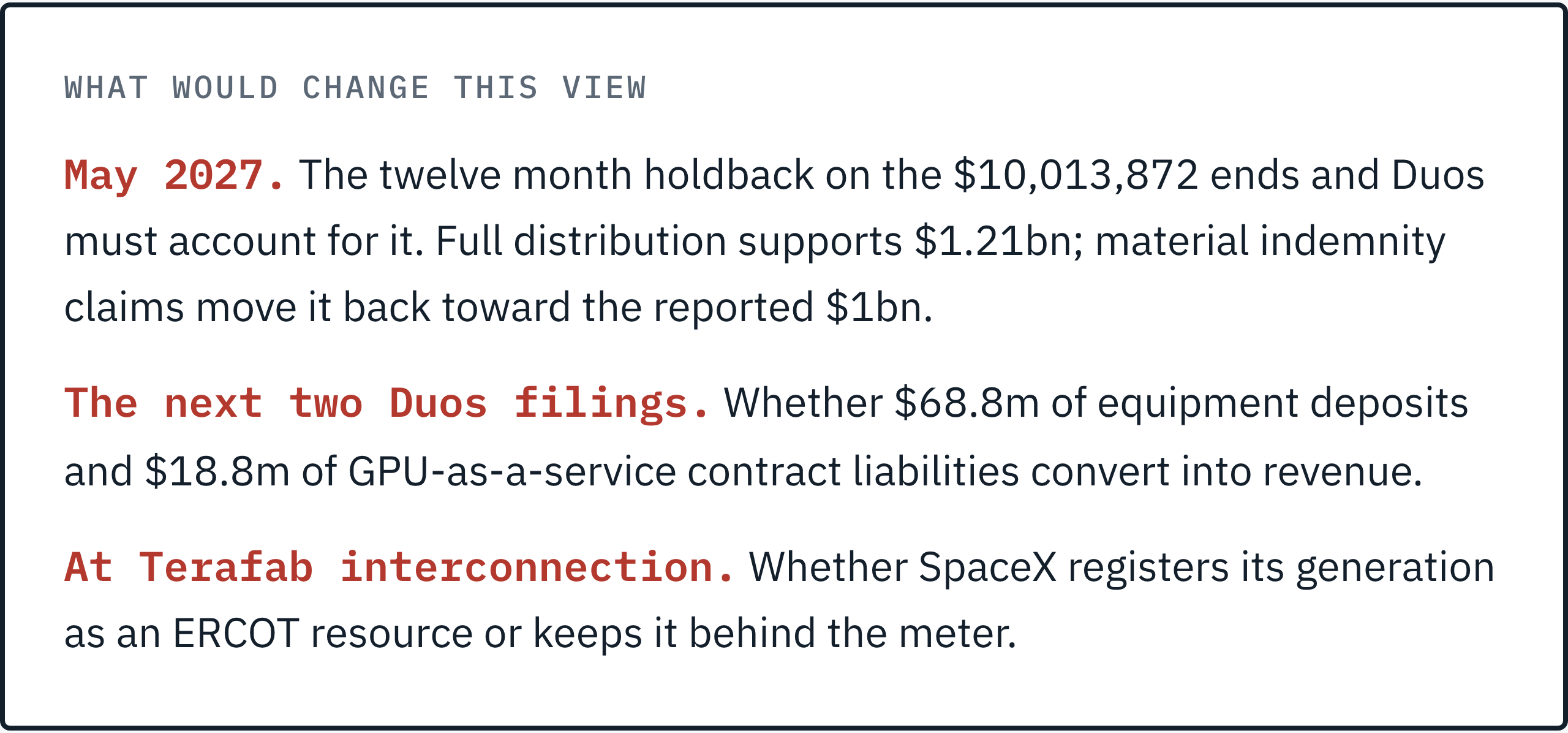
What would change this view: the May 2027 holdback, and two others
Three dated, public, resolvable tests, and I’d hold the argument to them.
May 2027. The 12-month holdback on the $10,013,872 ends and Duos has to account for it. Full distribution supports $1.21bn. Material indemnity claims move it back toward the reported $1bn, and I’d take the correction.
The next two Duos filings. The company put $68.8m into equipment deposits and booked $18.8m of GPU-as-a-service contract liabilities, rotating out of power hardware into compute. If those convert to revenue, the microcap that sold the turbines becomes a read on the same demand curve from the other side.
ERCOT registration. If SpaceX registers Terafab’s generation as an ERCOT resource instead of islanding it, the desk is a market participant and my “he bought a calendar” framing understates the ambition. If it stays behind the meter, the gas book is a cost and risk operation with a P&L bolted on, which is what I currently think it is.
What I would do with it: long firm transport, and watch the $1.42m print
For anyone underwriting the AI power trade, the output is the price. $1.42m per MW is now an observable clearing level for immediately available thermal capacity, against $2.0m to $2.5m for new build delivering in 2030 or 2031. That spread is the market pricing time, and it’s wide enough that I’d expect more distressed and end-of-life fleet M&A before relief from the OEM order books.
For gas, the position is long firm transport and storage into Texas load centres. Waha went from minus seven to plus two because 570 MMcf/d of pipe opened, which tells you which half of that market was ever scarce.
And for anyone holding IPPs or gas marketers on the AI demand thesis, this cohort points the other way. Amazon, Google and Microsoft trade power, Meta filed to market it, SpaceX is hiring to trade the fuel. They’re buying the generation, the pipe and now the desk. That’s demand for molecules and disintermediation of margin, and those don’t net off.
The question I would put to a room of PMs: at $1.42m per MW for used mobile turbines against $2.0m to $2.5m for new build you cannot take delivery of until 2031, which of those two numbers is the mispriced one?
📊 The Decision-Grade Version
This piece is complete on its own: the thesis, the evidence, and what would kill the view are all above, and nothing was held back to sell you a next step.
The Patreon note is a different piece of work, not a deeper cut of this article. It takes the part a desk would actually act on, the capacity bound and the regime conditions around that $1.42m per megawatt print, and writes it the way a desk would use it: what is priced, where the edge stops repeating, the regime that breaks it, and three risks with probabilities and early warning signs attached. Written for people who put capital behind a view.
→ Read the turbine-pricing note
→ Or join the Patreon community for every note
I publish the films at @TheMathematicalTrader and post the working notes on LinkedIn.
Cover photograph: Mobilus In Mobili, CC BY-SA 2.0, via Wikimedia Commons.