


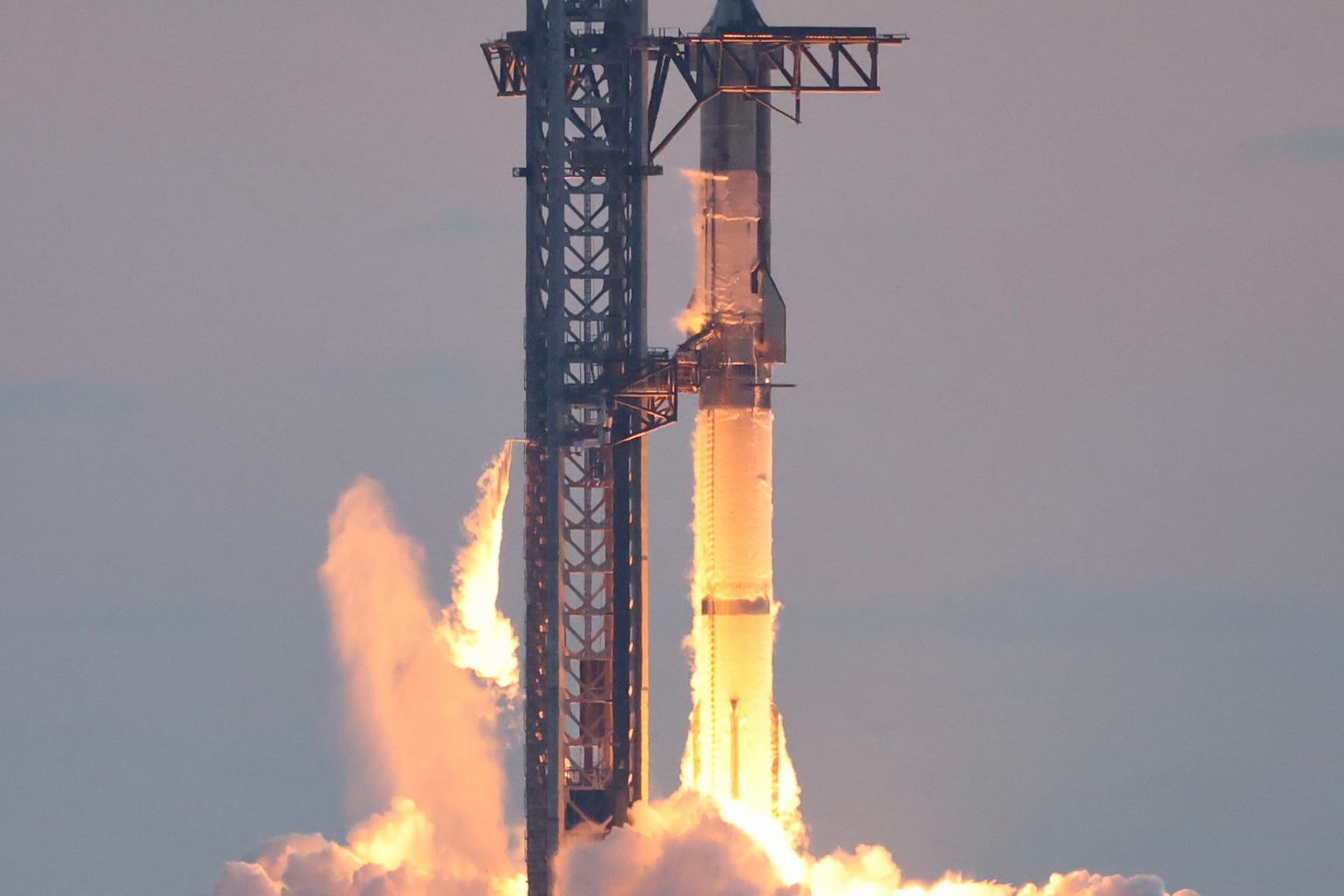
The market sold an $18bn capex number. The filings show the quarter’s headline milestone is an accounting identity, and the only price-contingent clause in the capital structure had already expired.
▶ Watch the film: the reconciliation, worked line by line from the filing · 7:56
It puts SpaceX’s own earnings exhibit on screen and walks the four add-backs in the order the company prints them, so the document is visible as the arithmetic runs.
The trade this changes, and what the tape got wrong
SpaceX reported its first quarter as a public company after the close on 4 August 2026. Revenue was $7,814m, up 92% on the $4,071m of Q2 2025. The net loss narrowed to $541m from $1,010m. Adjusted EBITDA came in at $3,538m, up 191%. Every one of those figures is in the company’s own earnings release, filed as an exhibit to the 8-K.
The stock closed $125.33 on the day of the release and $108.27 the day after, a fall of 13.6%, against a $135 IPO price and the $225.64 peak set on 16 June.
The explanation ran everywhere within the hour, and it was capital expenditure: capex went from $10,107m in Q1 to $18,369m in Q2, of which $15,828m was AI infrastructure. That account is accurate, and it is what a terminal gives you in ten minutes. It also misses the two things in the filings that change how this equity should be sized, both of which required reading the 10-Q and the prospectus instead of the release.
The first is that the quarter’s proudest number is an accounting identity. The second is that the supply clause the entire market spent July watching had already resolved, permanently, in a direction almost every outlet described backwards.
The bear case at its strongest, before I argue with it
The people who sold this on 5 August were not being stupid, and their case deserves stating properly.
A company spending 2.35 times quarterly revenue on capital assets is making a concentrated, non-reversible bet on one technology cycle. AI infrastructure depreciates over a few years where launch hardware depreciates over decades, so the cost lands on a short clock regardless of whether the revenue shows up. Free cash flow for the half is negative $25.0bn. Group debt and finance leases went from $22.9bn to $39.4bn in six months. No return metric was disclosed against the $15,828m, so nobody outside the company can check what it earns. And asked directly about the spending, Musk moved a $1tn revenue target a year closer instead of answering, which tells you something about what was available to disclose.
Hold all of that and “sell” is a coherent conclusion. Several good funds reached it and were paid inside a day, and nothing below argues they were wrong. What I argue is narrower: the reason the tape gave was not the constraint that binds, and the two things that changed this quarter sat in documents nobody read that day.
The AI segment’s profit is its own depreciation, to the dollar
The release leads on it: the AI segment reached positive Adjusted EBITDA of $1,146m, against negative $276m a year earlier. That was the quarter’s evidence that the compute build is starting to pay.
Read the reconciliation directly underneath it. The AI segment’s GAAP loss from operations was $1,257m. The distance between the loss and the profit is entirely add-backs:
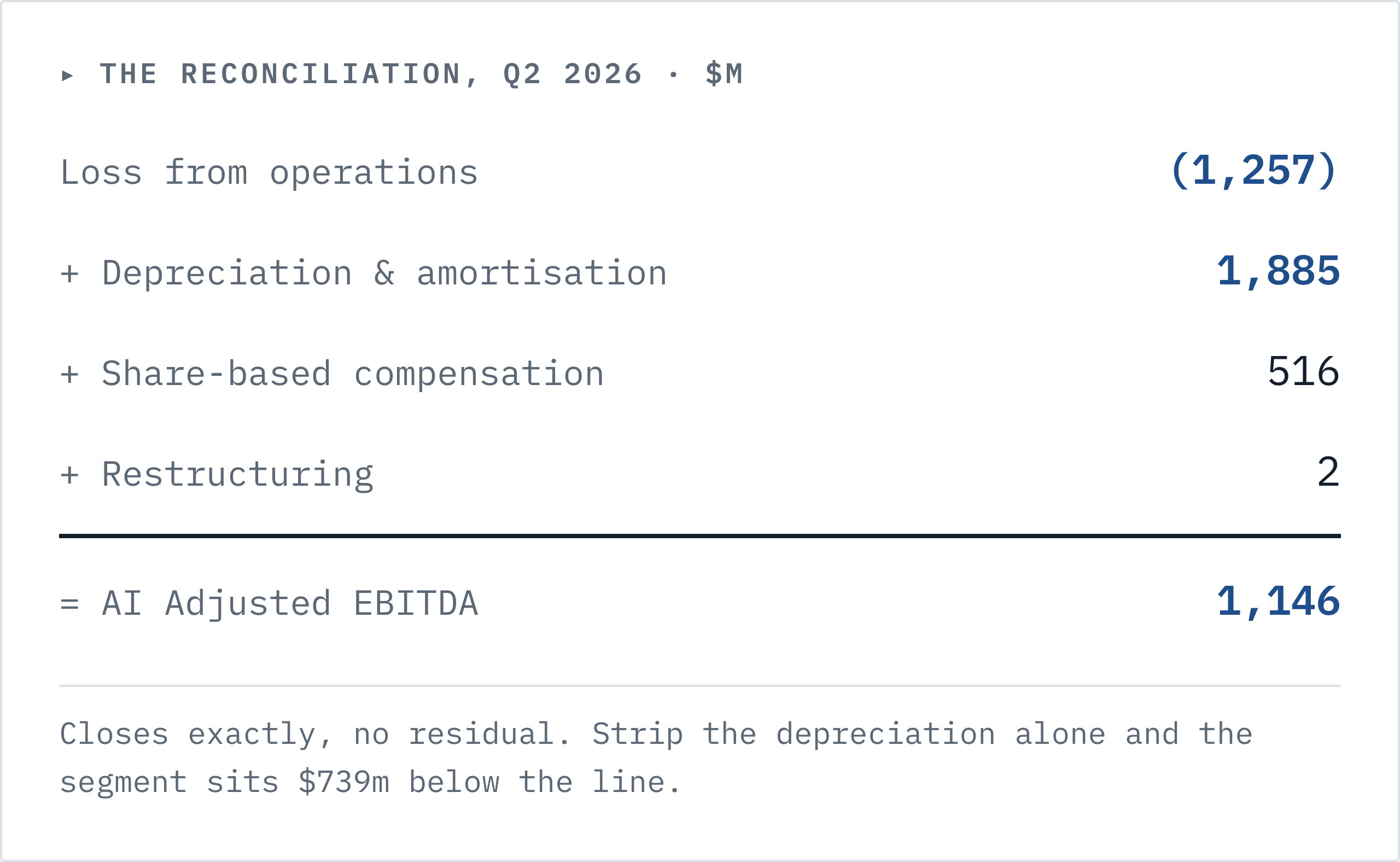
The arithmetic closes exactly. The segment’s entire adjusted profit comes from adding back $1,885m of depreciation on the assets that the $15,828m of quarterly capex is buying, plus half a billion of stock compensation. Strip the depreciation alone and the segment is $739m under water on the measure the release celebrates.
This is not an accusation of anything improper. Adjusted EBITDA is disclosed, reconciled and labelled non-GAAP, and the company says plainly that it “should not be considered in isolation.”
The obvious objection deserves answering first, because it’s what a sceptical reader says immediately: adding back depreciation is what EBITDA is. That’s correct, every capital-intensive business shows that gap, and pointing at one is not analysis.
Three things make this one worth the ink anyway. The magnitude: the add-back is 1.6 times the profit it produces, so the metric is composed of depreciation rather than merely adjusted by it. The direction: AI D&A grew 132% year over year while the segment crossed zero, so the add-back is outrunning the thing it should be a footnote to. The timing: the $15,828m spent this quarter is largely not yet in service, so its depreciation is not in the $1,885m at all.
So the issue isn’t that EBITDA excludes depreciation. It’s that this segment was declared profitable for the first time on a measure structurally unable to reflect the spending that defines it, in the quarter that spending grew twenty-one-fold.
The trajectory is the argument. AI segment D&A ran $811m, then $1,493m, then $1,885m across the last three quarters. AI capex over the same three ran $749m, $7,723m, $15,828m. Depreciation is chasing capex up with a lag, and the lag is the whole question.
Group PP&E went from $42,602m to $65,736m in six months, per the 10-Q, and group D&A ran $5,290m against $2,970m a year earlier. On the assets bought this quarter, the depreciation has not started.
I work the reconciliation quarter by quarter, against the disclosed compute build, in the companion note: SpaceX’s First AI Profit Is $1,146m. Its Own Depreciation Add-Back Is $1,885m.
The balance sheet closes the affordability question
The coverage framed the spend as unaffordable. The 10-Q says otherwise, and this part is not close.
SpaceX ended the quarter with $93,522m of cash and cash equivalents plus $6,487m of marketable securities, which is the $100bn the CFO cited. Against Q2 capex of $18,369m:
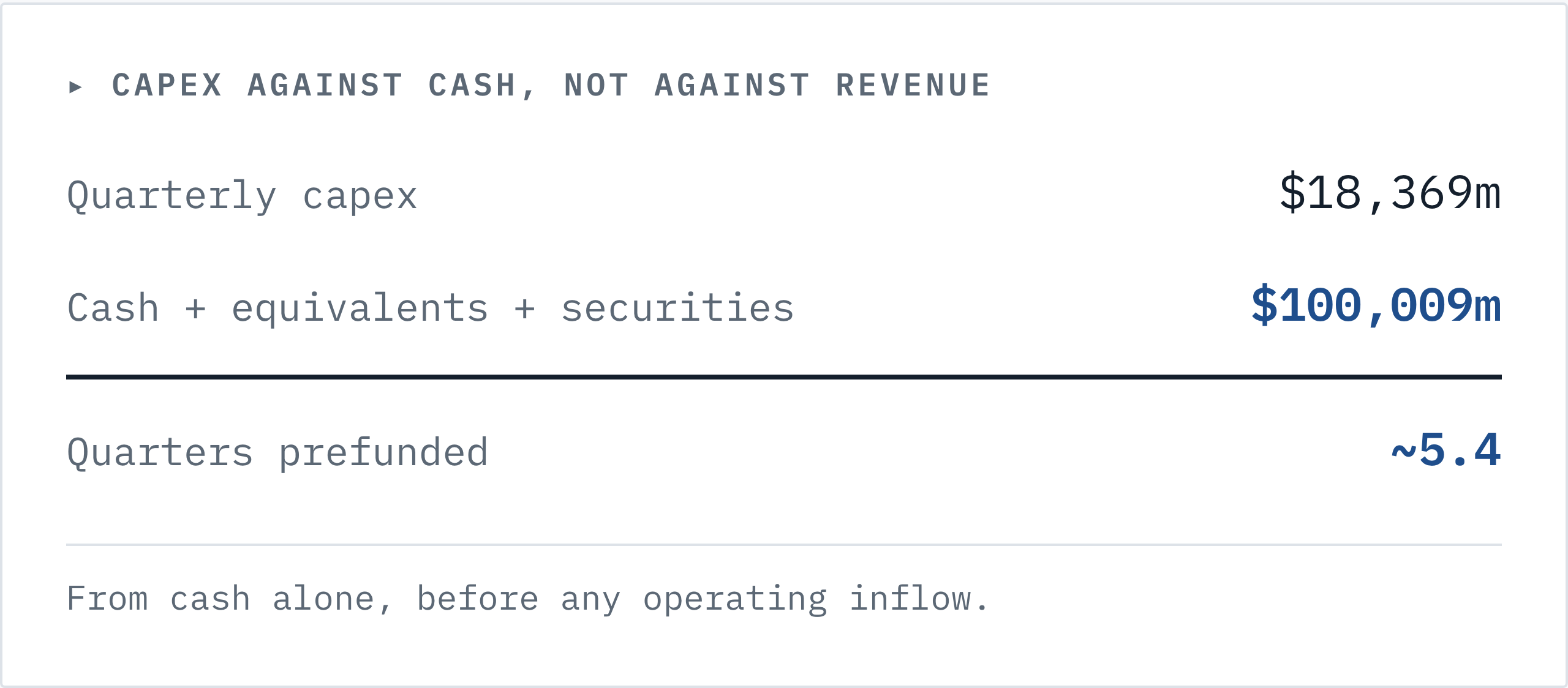
A company with 5.4 quarters of capex in cash, a narrowing loss and 92% revenue growth has no funding problem at this horizon. Whatever was repriced on 5 August, it was not the ability to pay.
The cash did not come from operations, going from $24,747m at year-end because the June IPO raised $85,675m net on 638.9m shares at $135, and because a $25bn inaugural bond issue closed on 26 June across five tranches at a weighted average 5.855%. The company raised the money before spending it, the opposite of what the “burning cash” framing implies.
The genuine cash figure the coverage should have led on is further down the same statement. Operating cash flow for the six months was $3,466m; purchases of property, plant and equipment were $28,476m. Free cash flow for the half was therefore negative $25,010m. That is the real number, it is far larger than anything the wires quoted, and it is entirely prefunded. Both halves of that sentence are true and they point in opposite directions, which is exactly why the affordability framing was the wrong argument to have.
The price condition did not fail narrowly. It failed 0-for-10
SpaceX’s post-IPO lockup is staggered. The final prospectus sets out the schedule for the shares under the 180-day lockup, and every tranche in it is a percentage of one base. Up to 911.5 million shares represent 20%; 455.8 million represent 10%; 319.0 million represent 7%. All three imply the same base of roughly 4,557m shares.
One tranche in that schedule, and only one, releases on a price rather than a date. In the prospectus’s own words:
“if the reported closing price of our Class A common stock on Nasdaq is at least 30% greater than the public offering price set forth on the cover page of this prospectus for at least five of the ten consecutive trading days ending on, and including, the First Earnings Release Date”
Thirty percent above $135 is $175.50. The First Earnings Release Date was 4 August. So the test window was the ten trading days ending on 4 August, and here is every close in it, from the price history:
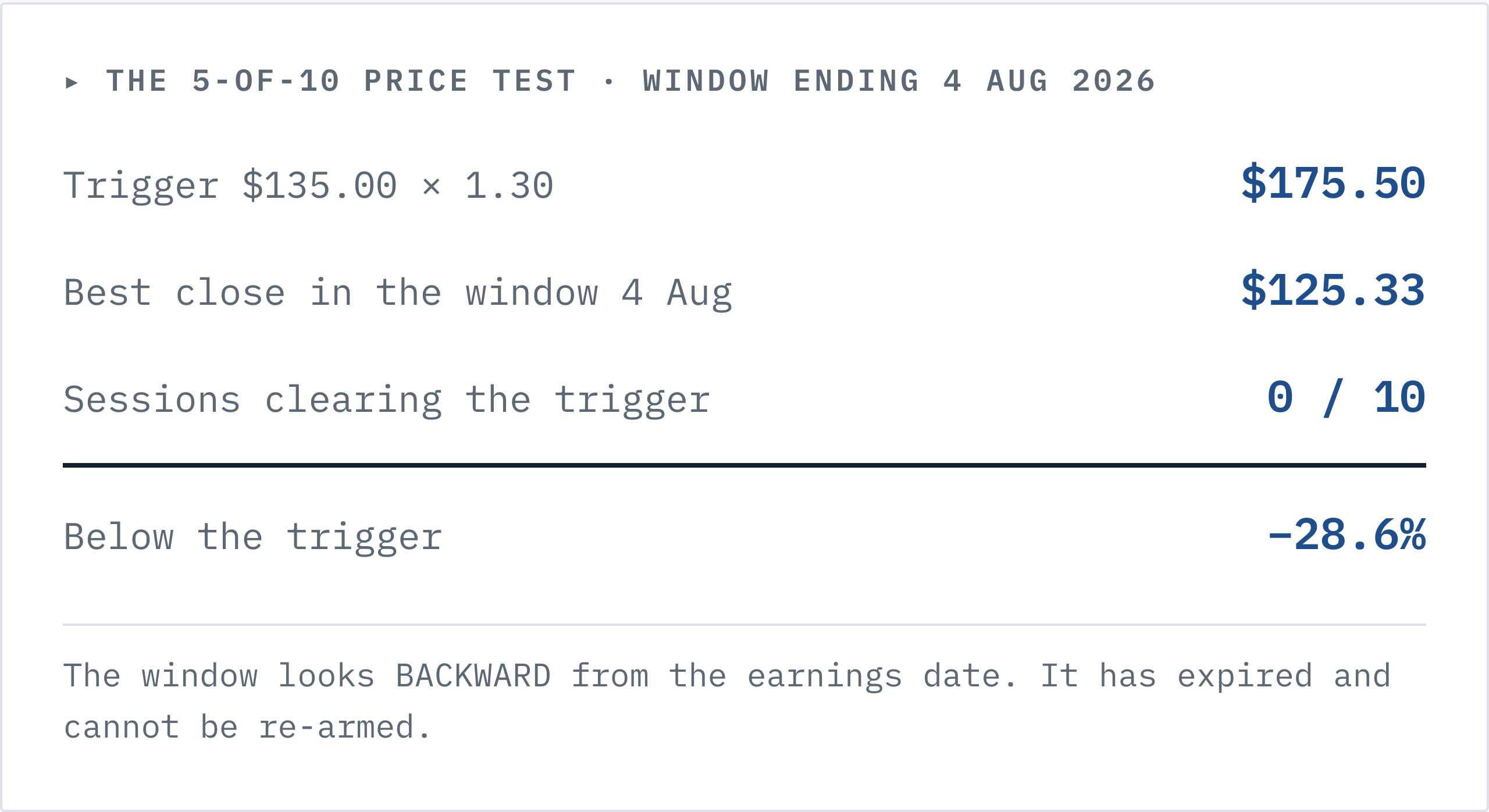
Not one session cleared $175.50. The best close in the window was $125.33, 28.6% below the trigger. The Motley Fool reported simply that “that didn’t happen.” Put the filing against the tape and you can say how badly: it was never in contention, and the stock hadn’t closed above $175.50 at any point in the month before the window even opened.
The window looks backward, and it has closed. This is the detail that inverts most of the commentary, and I’ll be direct that it inverted the first draft of this piece too. I had it as a live trigger. It isn’t one. The condition was never a standing option that re-arms on a rally; it was a one-time test against a fixed ten-day window ending on a fixed date. That date has passed and the test failed, so no future price path can satisfy it. If you’re still watching $175.50 as a supply level, you’re watching a clause that no longer exists.
