



RBI’s August 5 press conference primed the market for a patient, extended hold, but the MPC’s own minutes, released two weeks later, show Deputy Governor Poonam Gupta already telling her own colleagues that a hike case “may emerge during the course of the year,” a signal her governor’s press conference never gave.
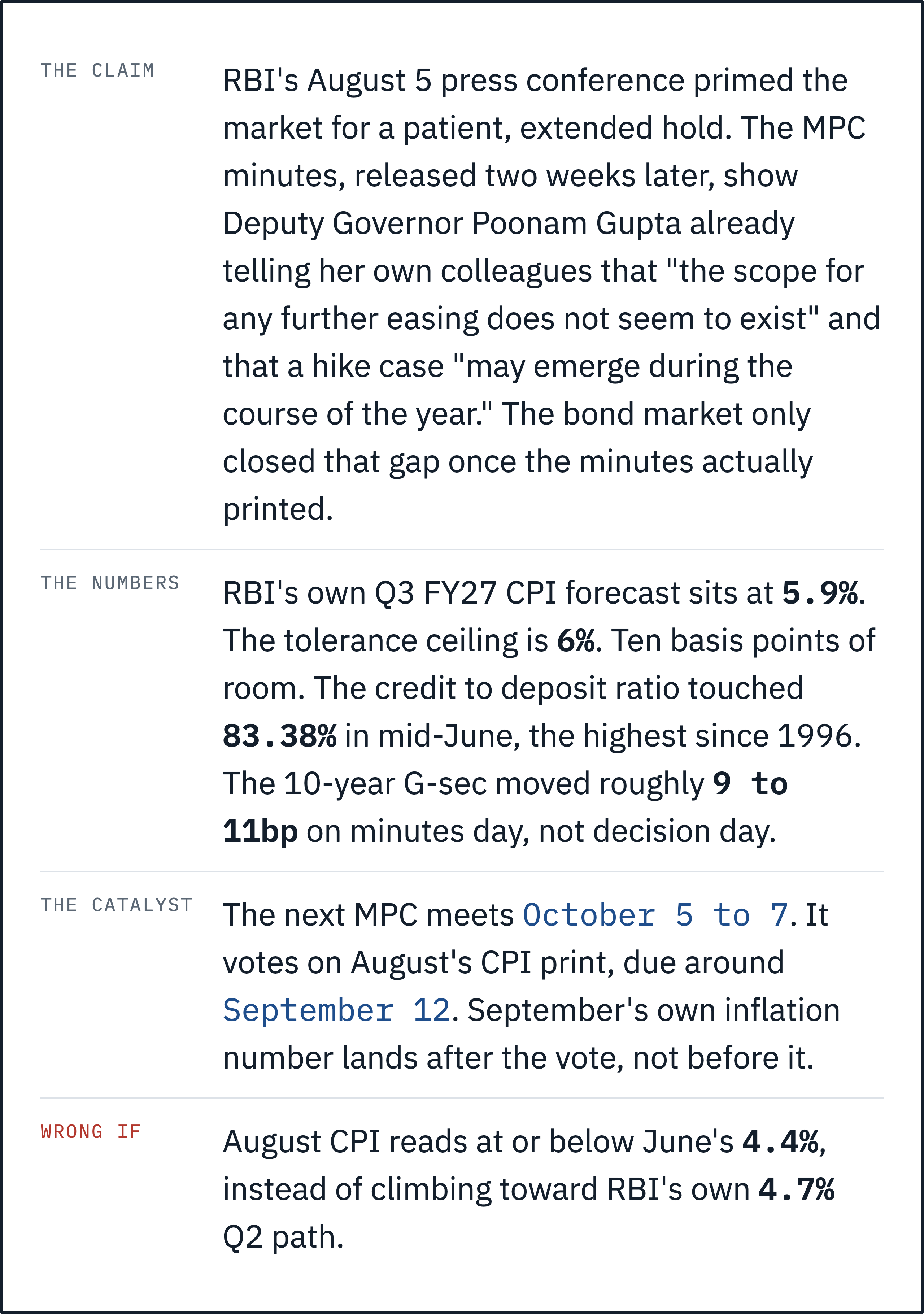
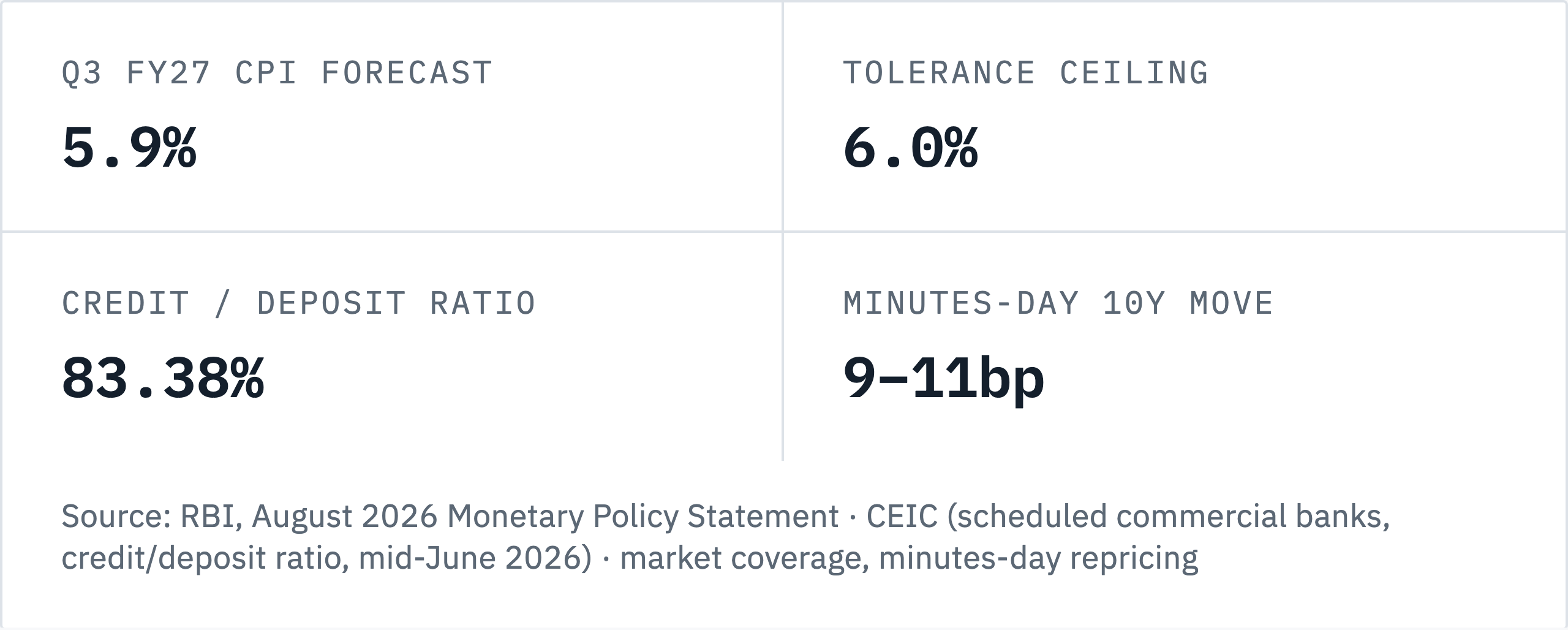
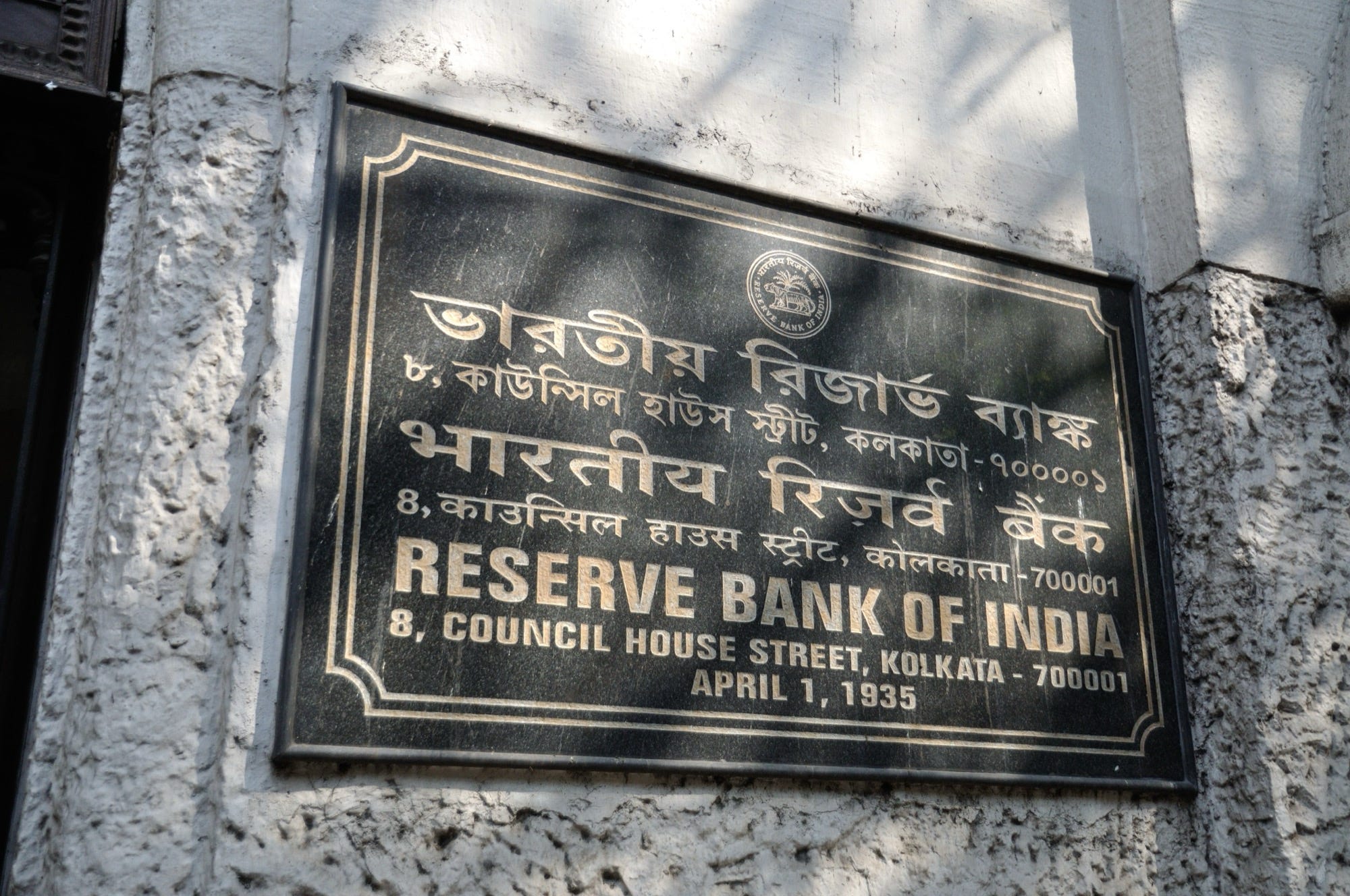
Photo: Biswarup Ganguly · CC BY, adapted · via commons.wikimedia.org

Every desk that watched Governor Sanjay Malhotra’s August 5 presser walked away with the same read. Neutral stance. Fourth straight hold. “Neither dovish nor hawkish,” in his own words. I don’t think that read was wrong on the day. I think it was incomplete. And the incompleteness shows up in the bond market’s own behavior two weeks later, which is not something you get to say about most consensus mispricings.
The consensus, and it deserves to be taken seriously
The case for “RBI stays on hold well into 2027” is not a strawman. It rests on real evidence. Headline CPI ran below the 4% target for 16 consecutive months before finally crossing it in June 2026 (Business Standard). Real GDP grew 7.8% in Q4 FY26 and 7.7% for the full year, beating the consensus of economists tracking the print (Forbes India). At the same meeting, the MPC raised its FY27 growth forecast to 6.7% from 6.6%. It cut its inflation forecast to 5.0% from 5.1%.
I read that as a committee with room to wait. Four holds deep, growth beating forecast, inflation forecast trimmed. Malhotra’s own words in the minutes back it up: he told colleagues he would “prefer to wait for more certainty to emerge on the inflation trajectory” (Deccan Chronicle). That’s a patient central banker’s sentence. Fair enough. I want to take it seriously, not knock it down cheap, because the discriminator later in this piece depends on it.
The variant view: what the committee actually said
I opened those minutes expecting confirmation of Malhotra’s patience. I found Gupta’s hike language instead. Here is what the same minutes contain, from the member statutorily in charge of monetary policy. Deputy Governor Poonam Gupta said that with headline inflation projected to peak “as high as 5.9 per cent in Q3 2026-27, a case for a hike may emerge during the course of the year,” seeing limited scope left for further easing (Deccan Chronicle; Outlook Business). Malhotra’s own recorded language goes further than his presser did too: “a sustained increase in both headline and core inflation could require the RBI to reconsider the policy rate.” That’s a different sentence than “neither dovish nor hawkish.” The committee is not unanimous: external member Nagesh Kumar is on record in the same minutes saying there was no case for monetary policy action (BusinessToday). Calling this “what the committee actually said” oversells one member’s view as the room’s consensus. The document shows a spread, Kumar’s dovish end to Gupta’s hawkish one. The hawkish end moved the bond market. That’s the end that counts here.
The gap between the presser and the minutes isn’t RBI being cagey. It’s structural. India publishes the decision the day it’s voted. Minutes follow fourteen days later. For two weeks, the market prices the vote without the reasoning behind it.
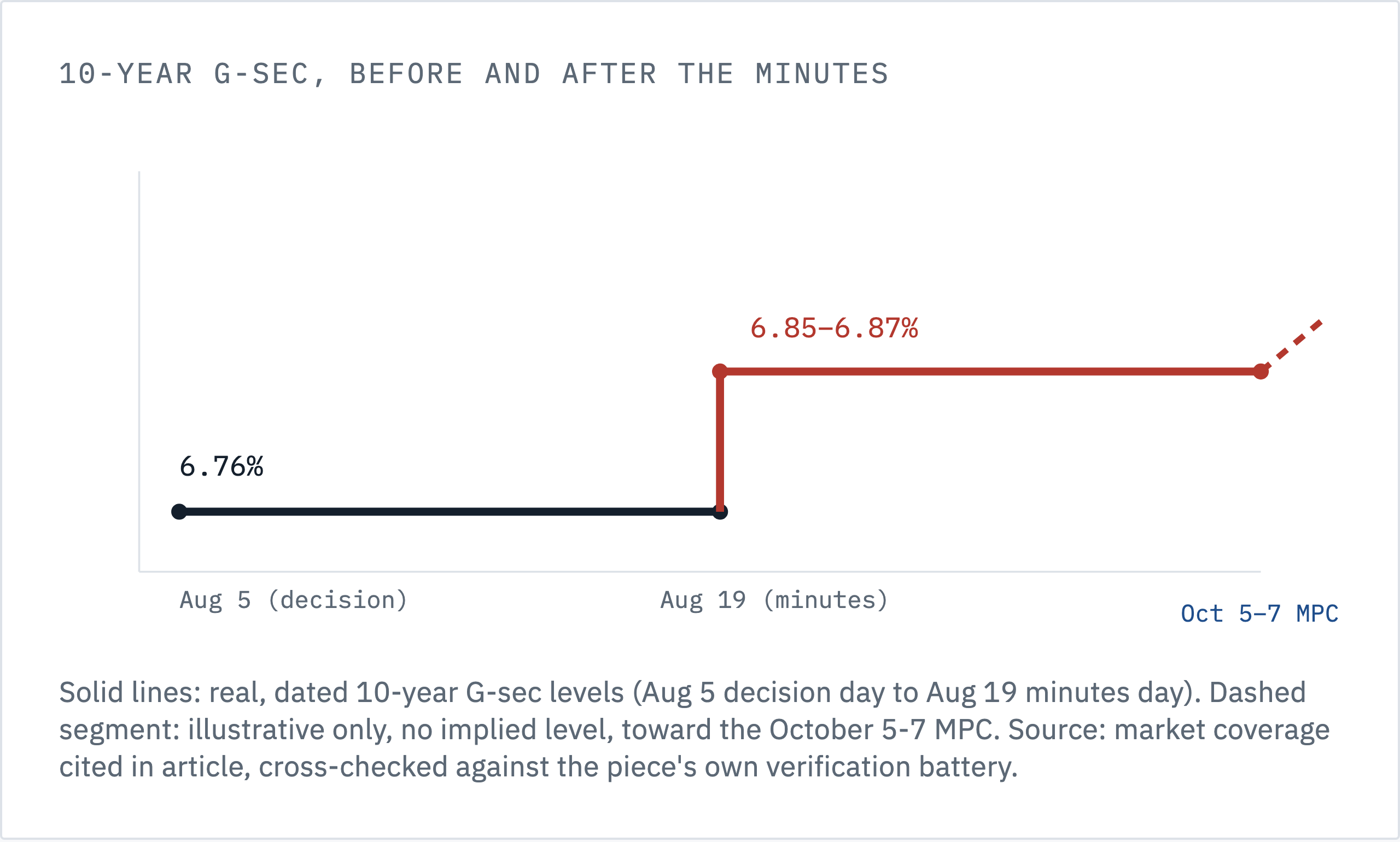
The bond market’s own reaction is my proof this was a real information event, not a stale rehash. The 10-year G-sec eased toward roughly 6.76% on the dovish August 5 announcement. It climbed to the highest level in eight weeks, near 6.85 to 6.87%, after the minutes landed on August 19. Press coverage tied that move specifically to Gupta’s hike language, not to the crude price move happening at the same time. Had the market already priced the committee’s true reasoning on decision day, the minutes would have moved nothing. They moved yields. I read that gap as the trade. Fourteen days, one repricing.
SBI Research, the State Bank of India’s own economics desk, independently models the same trajectory. It projects CPI could breach 6% in October or November, then ease back toward 5% in Q4, timed almost exactly against the MPC’s own October window (BusinessToday; ANI). ICRA’s own chief economist is more cautious in her own words: a “neutral pause,” hikes not imminent, though December is live if inflation broadens rather than stays food and fuel driven (Business Standard). Goldman Sachs put a number on it: Santanu Sengupta now expects quarter-point hikes in December and February, and Nomura’s Sonal Varma said the minutes challenged her own call for an extended pause (ThePrint). SBI Group’s own chief economic adviser, Soumya Kanti Ghosh, put it plainly: a “clear disconnect” between what RBI says and does, “ultimately RBI actions are louder than words.” I would not call all of this independent. Gupta, SBI, ICRA, Goldman, and Nomura are largely reading the same 5.9% forecast. One signal read five times, not five models agreeing. Still, nobody serious calls the hawkish read a misreading. Five desks, one number.
What’s moving this quarter, in four parts
The first channel is disclosure structure, already covered above. RBI publishes minutes fourteen days after every decision, so the lag itself is routine. What was not routine is how wide the gap turned out to be: a genuine 9 to 11 basis point move on minutes day, not decision day, is the market telling you it did not have this priced. A lag that usually produces no surprise produced a real one this time. Nine to eleven basis points says so.
My second channel is that this inflation trajectory is not one shock. It is three, arriving together. Food inflation ran 5.52% in July against a headline of 4.45%, and the print names onion, ginger, garlic, and gold and silver jewellery as the drivers pushing prices up, even as potato, tomato, and a few other vegetables pulled the other way (Forbes India). One figure I found, sourced to a single outlet, put the monsoon rainfall deficit at roughly 43% below normal through late June. I could not independently confirm it, so I am flagging it, not asserting it. Layer on a gold and silver spike sitting inside RBI’s own “core” basket. That is why RBI’s headline core reads 4.3% while core excluding precious metals reads closer to 2.3 to 2.9%, a split most retail coverage collapses into one number without explaining. Layer on an oil shock too. Brent moved from above $110 earlier this year down to the high $60s by late June, back into the $80s through early August, then to roughly $93 by August 24, on an active Iran conflict and repeated disruption risk to the Strait of Hormuz (CNBC); I built the leverage and FOMC side of that same energy shock out in full here. India imports roughly 85% of its crude. Food, precious metals, and imported energy are three separate transmission channels converging on the same Q3 window RBI itself forecasts as the peak. A committee facing one shock waits it out. A committee facing three starts hedging its own optionality. That is the language Gupta used. Three shocks, one basket.
The third channel is not evidence for the thesis. It answers the objection I’d raise myself: that RBI can’t be hawkish alone, so the Fed must give it cover one way or another. The Fed held at 3.50 to 3.75% in July with a three way hawkish dissent from Hammack, Kashkari, and Logan, all three pushing for a hike (Federal Reserve), on the same proximate cause hitting India: the Iran conflict’s energy shock. Hike odds for the September FOMC ran near 65% right after that meeting (Chase). A weak July jobs report then knocked them down hard, to 44.4% by August 7, the day the miss hit (CNBC). I watched that go sixty five to forty four in a week. I would not build a channel on “the Fed is hawkish too” when its own pricing swings that much. RBI’s setup does not depend on the Fed moving in lockstep. One shock, two reactions. Gupta’s language is forced by domestic food, energy, and precious metals inflation, not imported from Fed policy, so it does not unwind just because Fed odds do.
Underneath all three sits a fourth channel, quieter but structural. The credit to deposit ratio’s record high of 83.38% sits well above RBI’s traditionally comfortable band of 60 to 75%. Credit is growing 19.3% year over year. Deposits are growing 15.4%, itself the fastest pace since December 2016. Nineteen point three minus fifteen point four is a 3.9 point gap. Somebody is funding it. Banks are already funding loan growth through costlier wholesale deposits, before the repo rate moves at all. I read that as a real tightening in lending conditions, running independent of the MPC’s vote, in parallel with RBI’s headline VRRR absorption. That absorption pulled in escalating sums through August: ₹1.3 trillion, then ₹1.5 trillion, then ₹2 trillion, then ₹2.5 trillion in successive weekly auctions (Business Standard). System level liquidity looks like a surplus RBI is mopping up. Bank level liquidity looks tighter than that headline suggests. Both are true at once. Two liquidity stories, same week. I think that is a real source of confusion in how this setup is being read right now.
The discriminator: hike risk, or just pricing out cuts
The rival explanation is simple, and I want to name it first. MPC members flag inflation risk routinely, because naming risk is their job, not a hike signal. RBI has a demonstrated, multi year pattern of tolerating inflation above target without tightening as aggressively as a textbook Taylor rule predicts. One recent piece of commentary makes this case precisely: India’s real repo rate has averaged just 1.1% since 2015, low for an economy growing this fast, even with inflation over the same period averaging roughly 5% (Business Standard). A Boston Fed working paper on India backs the pattern. A backward looking Taylor rule shows no robust increase in RBI’s responsiveness to realized inflation after 2015. The gap disappears once you use RBI’s own forward looking, forecast based reaction function instead (Garga, Gryzb and Sengupta, Federal Reserve Bank of Boston). That is a real point against my own reading, and I am not going to soften it: an institution with a 1.1% real rate for a decade does not look like one on the edge of a hiking cycle. Read generously, this is exactly what is happening now. RBI is reacting to its own forecast of 5.9%.
So which is it? The honest answer, in my view, is that the real discriminator is smaller than “hike versus hold.” The market does not need to price a hike as the base case to be mispriced today. It needs to stop pricing further cuts. Gupta’s own words come close to saying that outright, and the market was not pricing it by the time the minutes came out. A genuine hike is the tail case SBI Research and ICRA are separately flagging, contingent on August and September confirming the 5.9% trajectory. Those are two different bets with two different position sizes. I would argue conflating them is the single most common mistake in how this is being traded right now.
I turned that exact discriminator into a position, with sizing and the level that kills it, in the trade note built alongside this piece: the front end trade sized off the stop pricing cuts case.
Where this call could be wrong
I owe you the weak points myself. RBI’s own minutes PDF sits behind a CAPTCHA wall that blocked automated access, so the Gupta and Malhotra quotes above come from independently reporting outlets converging on the same substance. Treat the wording as close to verbatim, not certified. The correlation during stress literature I lean on below carries a live academic rebuttal too: Forbes and Rigobón showed that correlation coefficient contagion tests are biased by heteroskedasticity, and found no real increase across several classic crisis episodes once corrected for it (Forbes and Rigobon, NBER). I am citing the finding that correlations rise under stress because it matches what actually happened in India’s own 2013 and 2020 episodes, covered below. The statistical debate itself is not settled. And the US-India tariff picture, touching the current account leg of this framework, has moved through four legal regimes in twelve months: an IEEPA rate, a Supreme Court reversal, a Section 122 stopgap, a Section 301 successor (WilmerHale). I could not pin down which regime governs India’s exports this week. A live gap in my own research, and I am not smoothing it over. Named it, moved on.
What would change this view
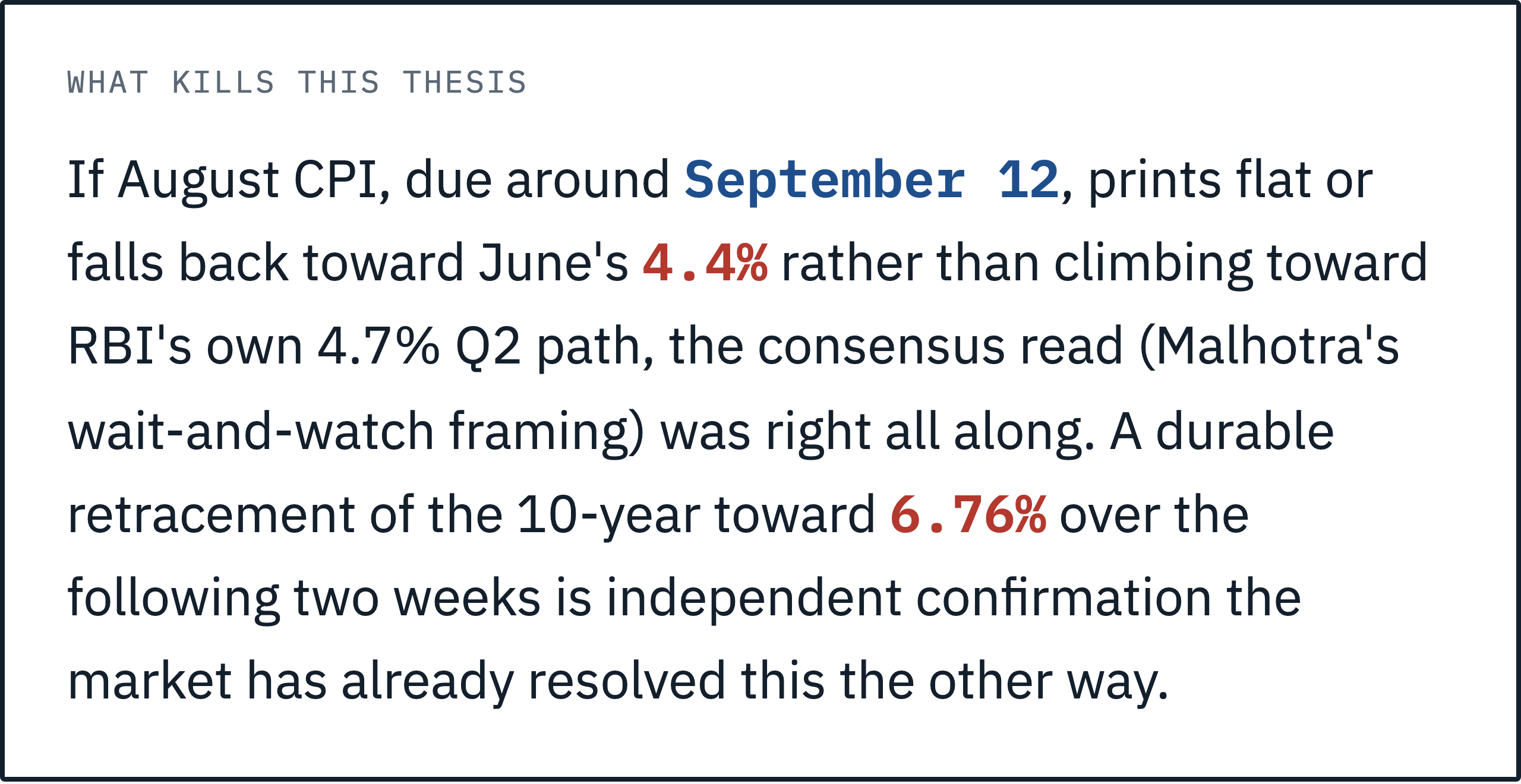
The cleanest falsifier I can name sits before October even convenes, and it turns on one print.
I’d also watch whether the 10-year G-sec gives back the move it made after the minutes, over the following two weeks. A durable retracement toward 6.76% tells me the market is reverting to its earlier read, and the hawkish repricing didn’t carry forward.
The redemption and liquidation framework
If the thesis above holds, this is the part I think matters most: a fund needing cash fast, into a rate repricing shock landing on top of system liquidity that is already tight. I built this same liquidation sequence for the April 2026 MPC, against a war shock that time. The mechanics carry over even though the trigger here is a communication lag. Almgren and Chriss split execution cost into two pieces: a temporary component, the price concession for demanding liquidity now, and a permanent component, the lasting move your own selling causes. Empirical work broadly supports a square-root relationship between order size and impact, not a linear one (Almgren-Chriss framework, surveyed via Gatheral). Cut your participation rate in half, and I’d expect impact to fall by roughly 30%, not by half. Slowing down helps. In my experience it helps less than intuition suggests, once a book is under real stress.
Coval and Stafford’s work on mutual fund fire sales is the sharper warning of the two. Funds facing large outflows create measurable price pressure specifically in the securities other distressed funds hold in common. The mispricing reverts only over the following twenty four months (Coval and Stafford, NBER). My takeaway for sequencing: your most crowded positions move against you hardest in a forced sale, because everyone else is selling the same names at once. Liquidate the crowded, highest participation names first, while the book is still deep. Sell the popular names early. I wouldn’t save them for last on the assumption they’re easy to sell whenever you get to them.
Two India episodes show what this actually costs when it goes wrong. In 2013, the taper tantrum took the rupee from roughly 55 to nearly 69 against the dollar in three months, put India on the “Fragile Five” list (Business Standard), and only stabilized once Governor Raghuram Rajan’s FCNR(B) swap window mobilized $26 billion from NRI deposits, a fix on the liability side, not a rate response (SPJIMR). In April 2020, Franklin Templeton froze ₹25,658 crore across six debt schemes and roughly 300,000 investors, when bond market illiquidity made orderly redemption impossible. It took past 2021, and a Supreme Court order forcing investor consent, before the wind-up finally returned 109.25% of the frozen AUM (Franklin Templeton India). I read both as the same lesson, from two different asset classes. The real cost of a forced liquidation isn’t the first trade’s price impact. It’s the multi quarter tail of being unable to trade at all, once depth truly vanishes. The first trade is cheap. The tail isn’t.
SEBI’s post-Franklin Templeton liquidity framework is the regulatory answer, and I’d argue it’s the right template even outside a fund wrapper: a minimum 10% liquid asset holding for most open ended debt schemes, mandatory monthly stress testing, and a swing pricing regime that goes mandatory during a declared “market dislocation,” applied at the investor level with a ₹2 lakh exemption (SEBI). As of April 2026, funds must publish monthly the days required to liquidate 25% and 50% of a portfolio against 30- and 90-day average volumes. That’s the participation rate math from above, turned into mandatory disclosure instead of an internal model nobody outside the fund ever sees.
Executing it: India’s specific constraints
India’s market structure sets hard limits that a global playbook, borrowed wholesale from somewhere else, will not tell you about. NSE and BSE’s market wide circuit breakers trigger on a 10, 15, or 20% index move and halt trading on both exchanges at once, across equities and derivatives (NSE circuit breaker rules). The halt shrinks the later in the session the move happens. It only fires on falling prices; there is no equivalent halt for a spike. Block deals require a minimum ₹25 crore order. They execute only inside two narrow windows, 8:45 to 9:00am and 2:05 to 2:20pm, within a 3% band of the reference price, and must settle by delivery with no intraday reversal (NSE block deal window FAQ). A truly large line cannot be worked continuously all day here; it has to be planned around those two windows or split into the continuous session. Together, those two facts are the single most underappreciated execution constraint in this framework. Plan around the clock, not just the size.
Here is the sequence I would actually run. Hedge the beta first, with index futures or options, the most liquid leg, adjustable in minutes, not days. Liquidate the most crowded, highest participation cash positions next, while depth is still real, using a volume weighted or capped participation algorithm rather than an aggressive market order. Almgren and Chriss say the temporary impact cost compounds fast once a seller becomes a meaningful share of the day’s volume. Route anything above ₹25 crore into the two block windows where possible; the price improvement beats working a large clip through the open book. Leave the hardest to model legs for last, small and mid cap positions, sized against a fund’s own liquidation day disclosure where SEBI’s framework applies. Unwind the hedge only after the cash book is flat. Closing it early turns a controlled liquidation back into naked directional exposure, during the one stretch of time a fund is least equipped to carry it. Sequence beats speed here.
Correlation is why I think sequencing matters this much, with the Forbes-Rigobón caveat from the earlier section attached firmly. Several independent studies find cross asset correlation rising specifically during acute stress windows, the opposite of what a diversified book assumes going in. If that holds even partially in a rate repricing shock triggered by an October surprise, the instinct to sell illiquid names last, because they’re a small position anyway, gets it backward, in my read. Everything starts moving together right when the diversification benefit is needed most. Small does not mean safe.
What I would actually do with the next thirty days
I’d frame the next thirty days as a run up, not an event on its own. Watch Kevin Warsh’s first Jackson Hole address as Fed Chair on August 28. That’s a genuine unknown as I write this; the symposium hasn’t happened yet. Watch August 31, three days later: RBI’s own Q1 FY27 forecast sits at 7.0% growth, and the MSCI review takes effect the same day, an estimated $2.3 billion of passive inflow per JM Financial (Outlook Business). Then the real tripwire: August CPI around September 12, the print RBI itself will be watching, and the September 16 FOMC, where Fed hike pricing has already swung hard once this cycle and sits well under 50% as I write this. Only after all of that does October 5 to 7 actually convene.
None of this is a call to get defensive across the board. FII flows turned positive in July, ₹20,200 crore, and continued into August. I don’t read that as a conviction call either way; it looks more like a coiled position than a clear signal. I’d apply the same instinct to the front end of the rate curve myself. I wouldn’t carry an aggressive duration long into September 12 on the assumption that Malhotra’s press conference was the whole story. The committee already told you, in its own words, published two weeks late, that it might not be.
Where do you actually sit: are you still pricing the RBI that held its ground on August 5, or the one whose own deputy governor said the easing cycle might already be over?
The Decision Grade Version
This piece is complete on its own. The thesis, the evidence, and what would kill the view are all above, and nothing was held back to sell you a next step.
The Patreon note is a separate piece of work rather than a deeper cut of this article. It takes one trade from inside this story, i.e. the front end duration avoidance tilt into the October MPC, and writes it the way a desk would act on it: the position, the levels, the sizing, and the risk that would take it off. Written for people who put capital behind a view.
→ Read the RBI reaction function trade note
→ Or join the Patreon community for every note
I also cover this on YouTube, and I’m on LinkedIn if you want to talk about any of this directly.
Cover photograph: Gppande, CC BY-SA 3.0, via Wikimedia Commons.