


A primary-source framework built from RBI working papers, MUFG proprietary research, SEBI’s new March 13 circular, Citi’s institutional target cut, S&P Global’s revised India forecasts, and live market data — answering the three questions every India fund manager needs answered right now.
About the author: Navnoor Bawa publishes institutional-grade quantitative research and macro strategy. → YouTube (subscribe for video breakdowns): https://www.youtube.com/@TheMathematicalTrader → LinkedIn: https://www.linkedin.com/in/navnoorbawa/
🎬 Prefer watching over reading? This article is available as a full video breakdown — generated from the research and primary sources below. → Watch the video here:
The Thesis That Ties Everything Together
This article answers three separate questions — but they share a single root cause. The Iran war’s effective closure of the Strait of Hormuz is simultaneously: (1) driving the oil-inflation shock that defines the 30-day market outlook; (2) constraining the RBI’s April MPC options; and (3) creating the redemption pressure that makes the liquidation protocol urgent. Every answer below is derived from this single chain. Read each section in isolation and you get analysis. Read them together and you get a model.
What has changed since March 20: Five days of violent price action have partially validated the bear thesis (March 23 crash: −2.60% Nifty close, ₹15 lakh crore wiped intraday), partially activated the diplomatic trigger (March 24–25: Trump 5-day halt, 15-point ceasefire plan sent via Pakistan, Iran conditionally opening Hormuz), and introduced two new structural variables — S&P Global’s upward revision of India FY27 GDP to 7.1% (+20bps, not +40bps as initially circulated; the +40bps revision is for FY26), and the STT hike on F&O effective April 1 (a direct cost increase for the derivatives hedge strategy in this note). All four are incorporated below.
The Verified Crisis Baseline — March 25, 2026
Before any framework is applied, the numbers must be exact. These are verified from named primary sources as of today’s session.
The Strait of Hormuz is conditionally reopened. Iran announced that foreign ships may cross the Strait as long as they are not supporting acts of aggression against Iran — a partial reopening, not a full normalisation. The IEA had confirmed flows were down more than 90% at peak disruption. https://www.business-standard.com/markets/news/stock-market-live-march-25-nse-bse-sensex-today-nifty-gift-nifty-us-iran-war-brent-crude-ipo-share-market-today-126032500120_1.html
New escalation risk: A projectile struck Iran’s Bushehr Nuclear Power Plant. The IAEA called for restraint. This complicates the de-escalation narrative. https://www.business-standard.com/markets/news/stock-market-live-march-25-nse-bse-sensex-today-nifty-gift-nifty-us-iran-war-brent-crude-ipo-share-market-today-126032500120_1.html
The IEA’s formal assessment — confirmed verbatim by Bloomberg, Fortune, CFR, and Yahoo Finance — remains the factual anchor: “The war in the Middle East is creating the largest supply disruption in the history of the global oil market.” https://www.bloomberg.com/news/articles/2026-03-12/iran-war-is-causing-biggest-ever-oil-market-disruption-iea-says https://fortune.com/2026/03/13/middle-east-energy-crisis-could-outlast-the-iran-war/
Brent crude crossed $100 on March 8, reached an intraday peak of approximately $119–$120 on March 9, and has since retraced sharply on diplomacy signals. As of March 25 early session, Brent is trading below $95 in Asian markets on Trump’s remark that Iran wants to “make a deal so badly.” Oil prices may resume volatility — Bushehr being struck is an active escalation risk. Goldman Sachs continues to warn that Brent could exceed the 2008 all-time record of $147.50 if disruptions persist for 60 days. https://www.cnbc.com/2026/03/09/oil-prices-iran-war-middle-east-us-israel-strait-of-hormuz.html https://www.cnbc.com/2026/03/20/goldman-sachs-oil-price-iran-war.html https://upstox.com/news/market-news/stocks/nifty-50-sensex-today-wall-street-cues-fii-activity-key-things-to-know-before-markets-open-on-march-25/article-191232/
The price surge was faster than during any other conflict in recent history. https://en.wikipedia.org/wiki/2026_Strait_of_Hormuz_crisis
India’s crude basket — the actual import price that drives India’s CAD, not Brent — was at $117.09 per barrel on March 20. With Brent now below $95, the basket has eased but remains materially elevated. The RBI had modeled $70/barrel for H2 of this fiscal year. Even at $100 basket, the gap is $30/barrel above the RBI’s own assumption.
https://pulse.zerodha.com/
https://www.thequint.com/news/breaking-news/indian-rupee-breaches-ninety-three-per-dollar-record
The rupee hit an all-time closing low of 93.98 on March 23. It recovered to 93.78 on March 24 as diplomacy eased sentiment. Today it opened at 93.94. The Bloomberg intraday worst was 93.76 on March 20 — that record has since been exceeded. https://www.bloomberg.com/news/articles/2026-03-20/india-rupee-drops-past-93-to-dollar-to-record-amid-crude-swings https://www.goodreturns.in/news/stock-market-today-nifty-closes-near-23-000-sensex-up-indigo-l-t-eternal-asian-paints-top-gainer-1498099.html https://www.business-standard.com/markets/news/stock-market-live-march-25-nse-bse-sensex-today-nifty-gift-nifty-us-iran-war-brent-crude-ipo-share-market-today-126032500120_1.html
India is the world’s third-largest crude oil importer, importing over 85–88% of its crude needs. Roughly 50–53% — approximately 2.5–2.8 million barrels per day — comes from Middle Eastern suppliers who route through the Strait. https://americanbazaaronline.com/2026/03/16/india-faces-energy-risks-as-hormuz-closure-disrupts-global-oil-flows-476917/ https://www.reuters.com/world/india/rupee-hits-record-low-iran-war-spurred-economic-risks-mount-2026-03-20/
FII total March outflows: ₹1,05,029 crore — confirmed from NSDL data, the highest monthly outflow figure in recent memory against ₹22,615 crore of FII buying in February. https://upstox.com/news/market-news/stocks/nifty-50-sensex-today-wall-street-cues-fii-activity-key-things-to-know-before-markets-open-on-march-25/article-191232/
Market closed March 26 for Ram Navami. Next trading session: March 27. https://www.goodreturns.in/news/stock-market-holidays-2026-march-25-march-26-march-27-when-will-trading-on-bse-nse-be-close-and-why-1497987.html
The Quantitative Transmission Model: What the RBI’s Own Research Tells You
The transmission from crude price shock to India’s macro variables is not an opinion or an estimate — it is a derivation from India’s own Input-Output table, published by the RBI’s Strategic Research Unit.
RBI Mint Street Memo №17 (Saurabh Ghosh and Shekhar Tomar, Strategic Research Unit, RBI):
On inflation: “A USD 10/barrel increase in crude price at the price of USD 65/barrel will lead to a 49 basis points (bps) increase in headline inflation.” Direct impact — transport, LPG, and kerosene account for 4.4% of the CPI basket, contributing 24bps — plus indirect Input-Output channel contributing 26bps. The two channels are approximately equal. https://www.rbi.org.in/Scripts/MSM_Mintstreetmemos17.aspx
On current account deficit: “Every USD 10/barrel increase in crude prices leads to an additional USD 12.5 billion deficit, which is roughly 43 bps of India’s GDP. So, every USD 10/barrel increase in crude price will shoot up the CAD/GDP ratio by 43 bps.” This is the paper’s Section II finding derived from India’s trade equation — a separate calculation from the fiscal deficit figure. https://www.rbi.org.in/Scripts/MSM_Mintstreetmemos17.aspx
The same paper also finds that if the government absorbs the full oil price shock rather than passing it through, the fiscal deficit rises by approximately 43bps per $10/barrel — a coincidental arithmetic similarity to the CAD figure, but a structurally separate calculation from a different section of the paper.
The $2 billion rule: Every $1/barrel increase in crude raises India’s annual oil import bill by approximately $2 billion — confirmed independently by JM Financial’s own research article. https://www.jmfinancialservices.in/blogs-and-articles/could-india-see-a-petrol-price-hike-due-to-us-israel-iran-war-and-strait-of-hormuz-halt https://www.outlookbusiness.com/economy-and-policy/russian-oil-may-cushion-indias-supply-amid-hormuz-tensions-but-lpg-remains-exposed
Applying the model to the current shock (March 25 calibration): With Brent now below $95 and the India basket easing from its $117.09 peak toward approximately $100–105, the shock above the RBI’s $70 baseline has narrowed to approximately $30–$35/barrel. At the conservative RBI model: 3 × 49bps = approximately 147–172bps of additional CPI within two to three quarters. On CAD: approximately 130–150bps (1.3–1.5pp) of additional CAD/GDP widening. This is materially lower than the peak shock on March 20 but still structurally significant. MUFG Research’s independent model aligns: every USD 10/barrel increase in oil prices widens India’s CAD by 0.4–0.5% of GDP. https://www.mufgresearch.com/fx/india-strait-of-hormuz-closure-not-just-about-oil-prices-for-inr-12-march-2026/
New external validation from S&P Global, published March 25: S&P raised India’s FY27 GDP growth forecast to 7.1% (+20bps for FY27; the +40bps revision applies to FY26, which was raised to 7.6%). S&P independently projects FY27 CPI inflation at 4.3% — confirming the oil shock’s inflationary passthrough is already being priced by major rating agencies. Critically: S&P’s baseline assumes “the Strait of Hormuz will face material disruptions until early April, with flows recovering gradually thereafter” — a direct validation of the base case scenario in this note. In S&P’s unfavorable scenario (Brent averaging $185/bbl in the June quarter), S&P explicitly projects “one 25bps rate hike in the second half” of FY27 for India. https://www.business-standard.com/economy/news/s-and-p-lifts-india-fy27-gdp-forecast-to-7-1-on-strong-consumption-investment-126032500269_1.html
Additionally: imported inflation for February 2026 was already running at 5.7% before the Strait closure’s full pricing impact reached Indian shores. This figure is from Soumya Kanti Ghosh, Group Chief Economic Adviser of State Bank of India — an institutional economist’s estimate, not a MOSPI official statistical release. https://www.businesstoday.in/latest/economy/story/west-asia-war-heres-why-rbi-may-keep-benchmark-interest-rate-on-hold-in-april-mpc-meet-520444-2026-03-13
The CFR’s second-order assessment remains structurally valid: “Fertilizer and high-tech supply chains are also negatively affected, widening the crisis further. If the war develops into a protracted conflict, these issues could become lasting structural shocks to the world economy.” https://www.cfr.org/articles/how-the-iran-war-ignited-a-geoeconomic-firestorm
This quantitative model is the spine of the entire framework. Even at the eased Brent of $93–95, the transmission equation still produces ~150bps of additional CPI above RBI’s baseline. The rate-cut case remains dead. The DII floor remains intact. The liquidation window is defined by DII absorption capacity. Nothing material has changed in the structural logic — only the magnitude of the shock has partially eased.
Question 1: 30-Day Nifty Outlook (March 25 → April 25, 2026)
The DII Structural Floor — Why Nifty Is Not in Freefall
Nifty has declined more than 12% over two weeks of the Iran war. Sensex has fallen close to 13% since the war began. Yet the index is not in freefall. Today, GIFT Nifty signals an approximately +138 point open at around 23,066 on positive Asian cues. https://upstox.com/news/market-news/stocks/nifty-50-sensex-today-wall-street-cues-fii-activity-key-things-to-know-before-markets-open-on-march-25/article-191232/
The structural reason: DIIs absorbed every wave of FII selling.
In 2025, domestic mutual funds deployed ₹4.84 trillion against ₹1.51 trillion of FII selling — a 3.2x coverage ratio. The Nifty ended CY25 up over 10% despite the historically elevated FII exits. https://www.business-standard.com/markets/news/year-ender-2025-d-st-set-to-see-record-fii-selloff-dii-inflows-cushion-125122400097_1.html
On March 24, FIIs sold ₹8,010 crore while DIIs bought ₹5,867 crore. https://upstox.com/news/market-news/stocks/nifty-50-sensex-today-wall-street-cues-fii-activity-key-things-to-know-before-markets-open-on-march-25/article-191232/ The SIP machine does not stop. It absorbs. It does not generate rallies.
The source of this DII bid: SIP inflows exceeding ₹29,000 crore every month — a mechanical, date-triggered, price-inelastic flow. https://www.outlookmoney.com/invest/equity/stock-market-outlook-2026-5-key-tailwinds-to-drive-indias-recovery-says-ask-im-report Anand Rathi Wealth confirms: “Domestic investors are price-elastic, stepping in during corrections, while FII behaviour tends to be price-inelastic.” https://www.anandrathiwealth.in/blog/equity-market-outlook-2026-lessons-from-2025.php
This is the structural floor. It is not a ceiling and it is not unconditional.
What Has Changed in Institutional Forecasts Since the War
Before the war, Governor Malhotra told Bloomberg: “If that is so, barring shocks on the supply side, the weather, geopolitics or something else, we’re in for a long period of low policy rates.” https://www.outlookmoney.com/invest/equity/stock-market-outlook-2026-5-key-tailwinds-to-drive-indias-recovery-says-ask-im-report That barring clause was triggered at maximum severity. It is now partially unwinding on diplomacy.
Citi Research cut its year-end Nifty 50 target to 27,000 from 28,500 on March 16, lowering the target multiple to 19x from 20x 1-year forward P/E. Surendra Goyal of Citi Research: “The earnings impact is a function of how prolonged the supply shutdown is.” https://www.business-standard.com/markets/news/citi-cuts-nifty-year-end-target-to-27-000-on-oil-shock-west-asia-war-risks-126031600334_1.html
S&P Global raised India’s FY27 GDP growth forecast to 7.1% (+20bps revision for FY27; FY26 raised by +40bps to 7.6%). S&P’s baseline scenario assumes Hormuz disruptions last only until early April — positioning the S&P 7.1% forecast as an optimistic-to-base case, not a stressed scenario. https://www.business-standard.com/economy/news/s-and-p-lifts-india-fy27-gdp-forecast-to-7-1-on-strong-consumption-investment-126032500269_1.html
J.P. Morgan: “Short-term uncertainties may keep markets range-bound in the near term, improving macro indicators and a strong earnings trajectory could set the stage for a rally from the second half of 2026 onward.” https://www.jpmorgan.com/insights/global-research/markets/india-stock-market-outlook
The Three Active Transmission Channels
Channel 1 — LPG and Natural Gas: The Structural Risk That Has Not Gone Away
MUFG Research: “Virtually all of India’s LPG and Natural Gas Liquids imports come from the Middle East. In addition, 60% of India’s imports of natural gas come from the Middle East, and in particular Qatar.” https://www.mufgresearch.com/fx/india-strait-of-hormuz-closure-not-just-about-oil-prices-for-inr-12-march-2026/ Even with Hormuz conditionally reopened, Qatar’s Ras Laffan is still operating at reduced capacity following the March 19 strikes. https://www.cnbc.com/2026/03/19/oil-jumps-iran-strikes-qatar-lng-facility-supply-worries.html The CPI passthrough from this channel lags 60–90 days and will appear in Q2 FY27 data regardless of whether the war ends this week.
Channel 2 — Rupee Depreciation Feeding Back Into Inflation
The rupee at 93.78–93.94 versus approximately 90.5 pre-war continues to carry a landed cost increase of approximately 3.6% on all dollar-denominated imports. MUFG’s scenario model: if oil sustains at $100/barrel, USD/INR ends the year at 95.50. https://www.mufgresearch.com/fx/india-strait-of-hormuz-closure-not-just-about-oil-prices-for-inr-12-march-2026/
Channel 3 — US Fed Maintaining Its Hawkish Hold
The Fed held rates at 3.5%–3.75% on March 19, revised core PCE upward to 2.7%, and signaled only one cut in 2026. https://www.business-standard.com/markets/news/global-markets-fall-us-fed-rate-decision-iran-war-oil-inflation-outlook-market-strategy-126031900342_1.html As the CFR analysis documents, the FOMC would find any resumption of rate cuts significantly complicated by an oil-driven inflationary impulse. https://www.cfr.org/articles/how-the-iran-war-ignited-a-geoeconomic-firestorm
Technical Picture as of March 25
Key resistance: 23,057 (important near-term hurdle). Above that: 23,400 and 23,800. https://www.goodreturns.in/news/stock-market-outlook-today-25-march-2026-sensex-nifty-may-trade-firm-with-positive-bias-after-rally-1498249.html
Consolidation range: 22,400–23,850. A breach below 22,400 targets 22,100 and 21,800.
Key support confirmed: 22,000–21,700 (COVID-era lows — Nifty has not breached these since 2020). RSI is in oversold territory. MACD sell signals reflect prevailing bearish momentum. “This appears to be a relief rally phase rather than a confirmed trend reversal.” A decisive close above 25,000–25,300 is required to signal a confirmed trend reversal — approximately 10% above today’s levels. https://enrichmoney.in/nifty50-bank-nifty-sensex30-news-research-analysis-chart
30-Day Probability Matrix — Updated March 25
Rystad Energy: two-month war pushes Brent to $110 by April; four-month war to $135 by June. Goldman Sachs: $147.50 possible at 60-day disruption. Against this: Trump’s 15-point ceasefire plan sent via Pakistan is the most concrete diplomatic signal to date, and S&P’s baseline already assumes Hormuz recovers gradually from early April onward. https://www.cnbc.com/2026/03/20/goldman-sachs-oil-price-iran-war.html https://upstox.com/news/market-news/stocks/nifty-50-sensex-today-wall-street-cues-fii-activity-key-things-to-know-before-markets-open-on-march-25/article-191232/
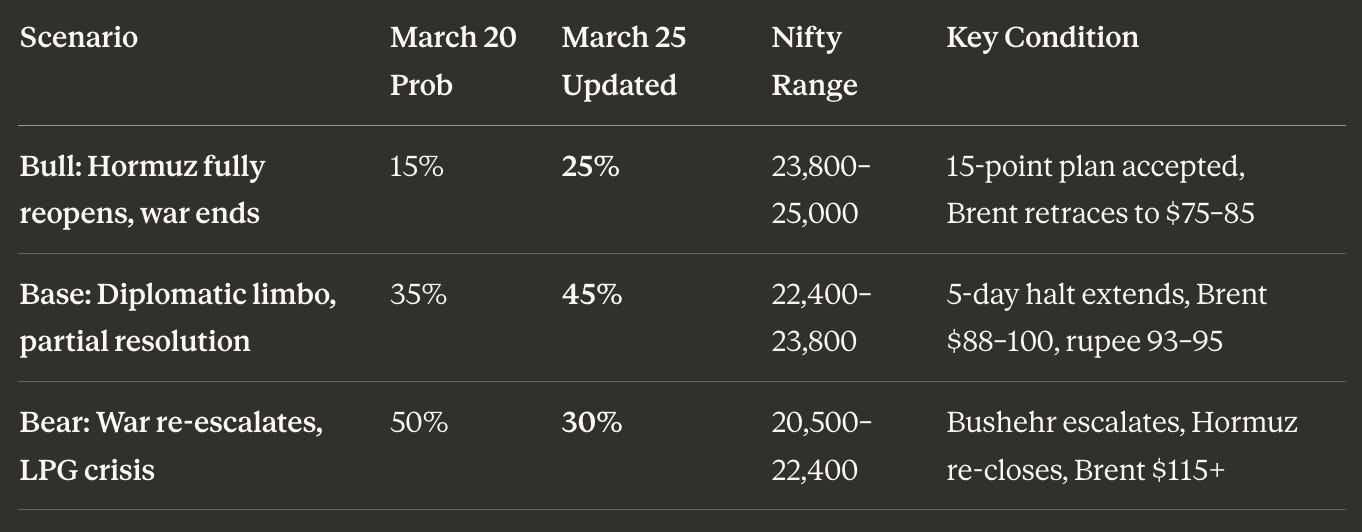
The bear probability has decreased from 50% to 30% — reflecting the 15-point plan, conditional Hormuz reopening, and Brent now below $95. The Bushehr nuclear plant strike is a live escalation risk that prevents a complete bear dismissal. The base case at 45% is now the modal scenario.
Asymmetric Alpha in the 30-Day Window
PSU Banks — the EBLR mechanical earnings tailwind. Governor Malhotra, February 6, 2026 MPC speech, verbatim: “In response to the cumulative 125 bps cut in the policy repo rate, the weighted average lending rate (WALR) of Scheduled Commercial Banks declined by 105 bps for fresh rupee loans.” https://www.theweek.in/news/biz-tech/2026/02/06/rbi-governors-statement-read-the-full-text-of-sanjay-malhotras-mpc-speech-here.html Since October 2019, all new floating-rate retail and MSME loans are EBLR-linked. The 125bps of prior cuts is still actively repricing the loan book independently of the oil shock. Banks led the March 24 recovery — this thesis is asserting itself in real time.
IT Services — the rupee embedded margin option. Rupee at 93.78–93.94 versus pre-crisis ~90.5 = approximately 3.6% additional rupee-denominated revenue on unchanged dollar billings. S&P Global’s GDP upgrade to 7.1% reinforces the structural India demand thesis. For mid-size IT companies with 25–30% operating margins, this remains a 100–200bps margin expansion not yet reflected in consensus estimates.
Stop condition for IT long: If rupee recovers to 91.50 on confirmed full ceasefire, trim IT exposure.
Avoidance. Real estate, high-debt NBFCs, OMCs (IOC, BPCL, HPCL): all fell 4–7% on March 23, confirming their duration sensitivity. All carry further risk into the April MPC meeting.
Question 2: RBI April 6–8 MPC — The Reaction Function Model
The Governor’s Pre-War Stance and Why the Oil Shock Changed Everything
Governor Malhotra told Bloomberg in January 2026: “If that is so, barring shocks on the supply side, the weather, geopolitics or something else, we’re in for a long period of low policy rates.” https://www.outlookmoney.com/invest/equity/stock-market-outlook-2026-5-key-tailwinds-to-drive-indias-recovery-says-ask-im-report That barring clause was triggered with maximum force on February 28. Even with Brent now below $95, the RBI’s modeled $70 baseline means the shock is still $23–25/barrel above assumption — enough to materially alter April’s inflation projections.
Malhotra’s February 6 MPC speech projected Q1 FY27 CPI at 4.0% and Q2 FY27 at 4.2%. https://www.theweek.in/news/biz-tech/2026/02/06/rbi-governors-statement-read-the-full-text-of-sanjay-malhotras-mpc-speech-here.html https://www.ibtimes.co.in/rbi-leaves-repo-rate-unchanged-sticks-neutral-policy-stance-897702 S&P Global now independently projects FY27 CPI at 4.3%. The RBI’s April projection will almost certainly exceed the February 4.2% Q2 figure.
The Malhotra Flexible Rupee Doctrine
Bloomberg’s report, January 2026: Governor Malhotra “did not object to his team when it explained the recent movements in the rupee and the need to allow it to depreciate.” https://www.outlookbusiness.com/economy-and-policy/flexible-rupee-on-the-cards-governor-sanjay-malhotra-signals-shift-in-rbi-stance This is the structural difference from the Das era. Malhotra will not sacrifice domestic liquidity to defend a rupee level. The RBI’s primary tool against the oil shock is the communication lever, not the rate lever.
S&P’s unfavorable scenario adds a new tail risk consideration for the RBI: If Brent averages $185/bbl in the June quarter and $130/bbl for full-year 2026, S&P projects India’s central bank would “tighten policy in response to energy-price inflation” with “one 25bps rate hike in the second half” of the fiscal year. https://www.business-standard.com/economy/news/s-and-p-lifts-india-fy27-gdp-forecast-to-7-1-on-strong-consumption-investment-126032500269_1.html This is a tail risk for H2 FY27 — not April — but the MPC will be aware it exists, and the April communication will need to carefully preserve optionality without triggering bond market panic.
MUFG: “Will RBI hike rates if the crisis worsens? We think the answer is likely ‘no’ right now, but the key distinction is whether this is a temporary supply-side shock… or proves something more permanent with the potential to raise inflation expectations over time.” https://www.mufgresearch.com/fx/india-strait-of-hormuz-closure-not-just-about-oil-prices-for-inr-12-march-2026/
The “Opportune Time” Doctrine — What the October MPC Minutes Reveal
Attribution note: The following statement came from the MPC minutes released on October 15, 2025 — not from Malhotra at the October 1 press conference itself. Business Standard reported the release on October 15. https://www.business-standard.com/economy/news/policy-space-exists-for-further-rate-cut-rbi-guv-at-mpc-meeting-125101501078_1.html
Malhotra’s verbatim statement from those minutes: “Even though there is a policy space to further cut the policy rate, I feel this is not the opportune time for the same, as it will not have the desirable impact. Therefore, I vote to keep the policy repo rate unchanged at 5.50 per cent.” https://www.business-standard.com/economy/news/policy-space-exists-for-further-rate-cut-rbi-guv-at-mpc-meeting-125101501078_1.html https://theprint.in/economy/rbis-panel-left-decision-rate-cut-for-opportune-time-despite-room-for-reduction-mpc-minutes/2764712/
Timeline clarity: At October 2025, the repo was 5.50%. The December 2025 MPC cut 25bps, bringing it to the current 5.25%, where it has remained through the February 2026 hold. https://www.business-standard.com/economy/news/mpc-meeting-rbi-cuts-repo-525-raises-gdp-forecast-73-cuts-inflation-outlook-125120500279_1.html
A rate cut now — even with Brent below $95 — would still fail Malhotra’s “desirable impact” test. If the war re-escalates next week (Bushehr is an active risk), a cut made on March 24–25 data would look immediately wrong. He will hold and communicate.
The Rate Decision: Hold at 5.25% With ~88–90% Probability
Three named institutional economists, published March 13, 2026:
“Rate easing in April is off the table.” — Madhavi Arora, Chief Economist, Emkay Global Financial Services. https://www.businesstoday.in/latest/economy/story/west-asia-war-heres-why-rbi-may-keep-benchmark-interest-rate-on-hold-in-april-mpc-meet-520444-2026-03-13
“The supply disruption in the Strait of Hormuz will be the key variable to monitor as its continued disruption would have second-order effects on the inflation print.” — Hitesh Suvarna, JM Financial Institutional Securities. https://www.businesstoday.in/latest/economy/story/west-asia-war-heres-why-rbi-may-keep-benchmark-interest-rate-on-hold-in-april-mpc-meet-520444-2026-03-13
“If average crude oil prices remain elevated at $100 per barrel or higher, taking both direct and indirect impact into account, inflation could rise above 5%.” — Rajani Sinha, Chief Economist, CareEdge Ratings. https://www.businesstoday.in/latest/economy/story/west-asia-war-heres-why-rbi-may-keep-benchmark-interest-rate-on-hold-in-april-mpc-meet-520444-2026-03-13
Citi: RBI stays on pause in April, with its tone “potentially tilting toward growth if fiscal measures absorb most of the inflationary pressures.” https://www.business-standard.com/markets/news/citi-cuts-nifty-year-end-target-to-27-000-on-oil-shock-west-asia-war-risks-126031600334_1.html S&P’s own central scenario aligns with this: “Overall, S&P expects the central bank to hold rates steady and maintain a neutral stance.” https://www.business-standard.com/economy/news/s-and-p-lifts-india-fy27-gdp-forecast-to-7-1-on-strong-consumption-investment-126032500269_1.html
The Four Variables That Will Actually Move Markets on April 6–8
Variable 1 — New CPI Projections Under the 2023–24 Base Year. The February meeting explicitly deferred full-year FY27 projections. https://www.outlookmoney.com/banking/rbi-mpc-2026-highlights-repo-rate-unchanged-rbi-balances-growth-and-inflation-risks April publishes the first revised set. Pre-war Q2 FY27 CPI was 4.2%. S&P Global’s independent model now says 4.3% for full-year FY27. The RBI’s April Q2 FY27 projection will likely fall in the 4.3–4.8% range, with upside risk to 5%+ if diplomacy breaks down before the meeting.
Variable 2 — “Watchful” vs. “Vigilant” Language. “Watchful” = monitoring. “Vigilant” = considering action. A single word change will be parsed by every fixed-income desk within seconds. From the February MPC minutes, Malhotra described needing to balance vigilance against external shocks with confidence in domestic resilience. https://www.businesstoday.in/latest/economy/story/rbi-mpc-minutes-persistent-volatility-in-global-markets-contrasts-with-indias-resilient-economic-momentum-517337-2026-02-20
Variable 3 — OMO Calendar Commitment. Mirae Asset’s Basant Bafna (Head — Fixed Income): “Markets are also looking forward to RBI’s communication on OMOs going forward to support the Government’s Borrowing Programme.” https://www.goodreturns.in/news/rbi-mpc-meeting-2026-live-sanjay-malhotra-policy-rates-decision-repo-rate-india-us-trade-deal-budget-1487415.html Without explicit OMO commitment, 10-year G-sec yields drift above 6.9–7%.
Variable 4 — First FY27 GDP Forecast. S&P Global at 7.1% provides an external anchor. If the RBI comes in at 6.8–7.0%, it signals confidence that the shock is temporary — bullish for equities. If it comes in at 6.3–6.5%, it signals the RBI has priced a protracted disruption — bearish.
The February 6 Market Reaction — Correctly Stated Template
Sensex fell as much as 388.58 points intraday (0.46%) and Nifty declined 150.90 points (0.59%). Both recovered to end the session modestly higher — Sensex up 266 points and Nifty up 50.90 points at close. https://www.outlookmoney.com/invest/equity/rbi-mpc-meet-2026-sensex-nifty-slip-after-repo-rate-kept-unchanged-rate-sensitive-sectors-drag April’s reaction will be more severe because: (a) the revised CPI is the first quantified post-war read; (b) the OMO commitment affects bond markets at the start of the FY27 borrowing cycle; © geopolitical sensitivity amplifies any signal.
April MPC Reaction Scenarios — Updated March 25
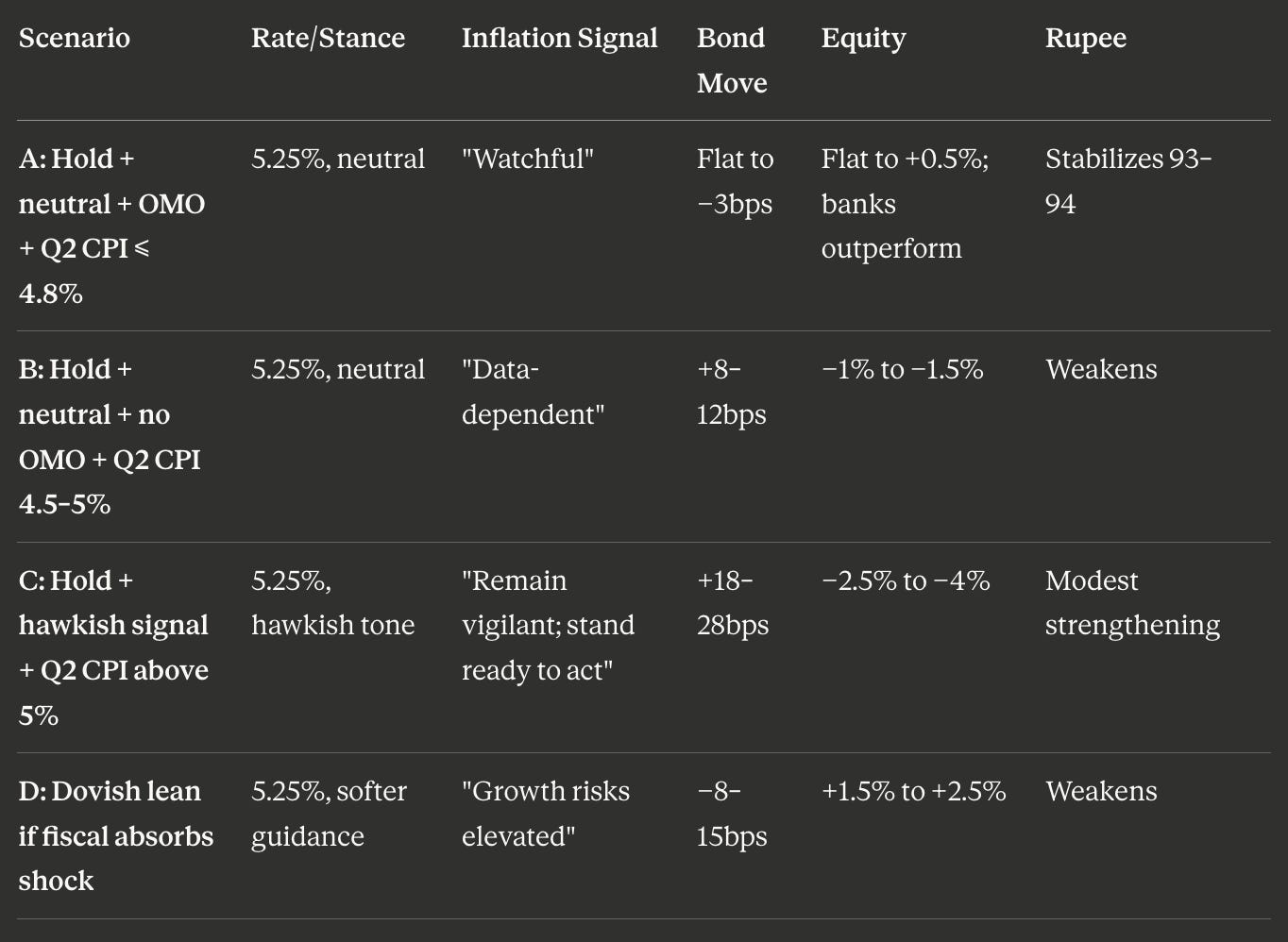
Updated probability: A = 35%, B = 35%, C = 20%, D = 10%. Scenario A and D have both risen on easing Brent and S&P’s GDP upgrade. The Scenario C tail — a −2.5% to −4% single-session equity loss — has reduced from 25% to 20% but remains worth hedging.
Question 3: Emergency Portfolio Liquidation — Executing Without Taking Losses
The Foundational Science of Why Normal Selling Destroys Price
NSE is a pure order-driven market — no market makers, no designated liquidity providers, no dealer-of-last-resort. The CFA Institute’s trade execution curriculum (2026 edition): “The primary goal of a trading strategy is to balance the expected costs, risks, and alpha associated with trading the order in a manner consistent with the portfolio manager’s trading objectives, risk aversion, and other known constraints.” https://www.cfainstitute.org/insights/professional-learning/refresher-readings/2026/trade-strategy-execution
The Almgren-Chriss model establishes market impact as a sublinear function: impact ∝ order_size⁰.67. Doubling your order increases impact by 1.59x — not 2x. Beyond 15–20% of ADV, impact accelerates non-linearly. https://arxiv.org/pdf/2301.09705
NSE intraday liquidity follows a U-shaped pattern. The optimal execution window is 11:30 AM to 2:00 PM IST. VWAP strategies reduce slippage by 0.15–0.25% on large institutional orders — for ₹1,000 crore, that is ₹1.5–2.5 crore saved purely from algorithm selection. https://bigul.co/blog/algo-trading/navigating-slippage-in-algo-trading-your-guide-to-smoother-execution-in-india
VWAP vs. TWAP: The Correct Algorithm for This Environment
TWAP for all active liquidation now. India VIX hit a 52-week high of 27.17 on March 23. March 23 saw intraday swings of 800+ Nifty points. Any VWAP algo that front-loaded morning volume sold at the session’s worst prices. As Talos Research notes: “In unstable or regime-shifting conditions, volume forecasting error becomes a risk factor in itself, which is where TWAP’s robustness becomes valuable.” https://www.talos.com/insights/vwap-or-twap-for-crypto-execution-a-market-impact-perspective Switch to VWAP only after VIX sustainably retreats below 18 and intraday volume patterns normalise. https://www.cfainstitute.org/insights/professional-learning/refresher-readings/2026/trade-strategy-execution
The Four-Layer Execution Architecture
Layer 1–24-Hour Liquidity Triage (Before Any Order Is Placed)
Tier 1 — Nifty 50 constituents, ADV > ₹200 crore. Pre-open block window + TWAP at 15% participation cap. Target 1–3 sessions. Market impact at 15% participation: less than 0.3%.
Tier 2 — Nifty Next 50, Midcap 100, ADV ₹50–200 crore. Algorithmic TWAP strictly capped at 15% ADV. Target 3–7 sessions.
Tier 3 — Smallcap 100 and below, ADV less than ₹50 crore. Drip-fed only — budget 10–15 sessions minimum. Consider NSE’s Inter-Institutional Block Deals segment. https://nseindia.com/products-services/equity-market-inter-institutional-block-deals Aggressive selling in Tier 3 names is not a liquidation strategy — it is price destruction followed by a forced sale at the destroyed price.
Tier 4 — Illiquid positions, stocks near circuit limits, promoter-linked holdings. Off-market custodian facilitation only. Start negotiations on Day 1, not Day 5.
Layer 2 — The Pre-Open Block Window (8:45–9:00 AM)
The NSE’s pre-open block deal window allows institutional trades at ±1% of the previous close before regular session price discovery begins. For Tier 1 names: bilateral price agreement, zero continuous-market signaling, no HFT front-running detection. Mandatory SEBI disclosure: any single-session transaction exceeding 0.5% of total shares must be disclosed as a bulk deal — block deals disclose separately and carry materially lower signaling impact. Under SEBI’s May 2025 framework, T+0 settlement is available for the top 500 stocks, meaning proceeds are accessible same-day.
Layer 3 — SEBI’s New Intraday Borrowing Framework (Effective April 1, 2026)
On March 13, 2026, SEBI issued Circular No. HO/(92)2026-IMD-POD-2/I/6961/2026: mutual funds may access intraday borrowing from banks to bridge redemption timing gaps. The standard 20% AUM borrowing cap does not apply to intraday borrowings. The cost of borrowing must be borne by the AMC, not passed to investors. Eligible same-day receivables under the circular — from TREPS maturities, reverse repo, Government of India securities, treasury bills, and state development loans — serve as the intraday funding basis. Effective: April 1, 2026. https://taxguru.in/sebi/sebi-intraday-borrowing-mutual-funds-manage-redemption-timing-mismatch.html https://www.angelone.in/news/mutual-funds/sebi-allows-mutual-funds-to-use-intraday-borrowing-from-april-1-2026
The operational transformation: borrow in the morning → pay redemptions on time → sell equity during the 11:30 AM–2:00 PM deep-liquidity window. This saves 30–60bps in execution slippage on a stress redemption event. For ₹1,000 crore: ₹3–6 crore of direct NAV preservation from a regulatory reading alone.
Layer 4 — The Derivatives Bridge Hedge: Updated for April 1 STT Hike
A 5–7 session liquidation window carries 5–7 days of unhedged market risk. Standard approach: short Nifty futures equivalent to gross equity exposure, closing shorts proportionally as equity selling completes.
Critical update effective April 1, 2026: Budget 2026–27 raised STT on futures contracts to 0.05% from 0.02% and on options to a flat 0.15% on both premiums and exercise (previously 0.10% on premium and 0.125% on exercise). https://www.business-standard.com/markets/news/options-boom-to-face-stt-hike-test-from-april-1-analysts-weigh-impact-126032500122_1.html https://ddnews.gov.in/en/stt-hike-on-fo-meant-to-curb-speculation-protect-retail-investors-sitharaman/
This increases the cost of futures-based hedging after April 1. For liquidations executed from April 1 onward: put spreads become relatively more cost-efficient than outright futures shorts because options STT is levied on premium (not notional value), making spreads proportionally cheaper than the equivalent futures hedge — particularly for the institutional position sizes involved in a stress liquidation. Put spreads (buy ATM puts, sell OTM puts 3–5% below) also cost 60–70% less than outright puts in the current elevated-IV environment, and remain the preferred post-April 1 hedge instrument.
NSE stock futures still settle physically — size carefully to avoid inadvertent delivery obligations conflicting with your liquidation timeline.
Timing Your Execution to the DII Deployment Calendar
SIP mandates trigger on the 5th, 10th, 15th, and 25th of each month. The 15th–25th window is when DII deployment is heaviest and counter-party capacity is deepest. Concentrate Tier 1 block selling in this window, during the 11:30 AM–2:00 PM session, via TWAP capped at 15% ADV. The March data confirms: on days of maximum FII selling, DIIs have consistently bought 30–50% more. https://www.swastika.co.in/blog/fii-fpi-dii-trading-activity-on-4-march-2026-what-it-signals-for-indian-markets
Note on March 26: Market is closed for Ram Navami. Any execution plan relying on a March 26 session must restart on March 27. https://www.goodreturns.in/news/stock-market-holidays-2026-march-25-march-26-march-27-when-will-trading-on-bse-nse-be-close-and-why-1497987.html
The Unified Framework: One Cause, Three Answers
Every section of this article is an expression of the same root cause — though that root cause has partially eased since March 20.
The oil shock (IEA: “largest supply disruption in the history of the global oil market”; India’s crude basket now eased from $117 toward ~$100–105 as Brent falls below $95 on diplomacy) still transmits through the RBI’s Input-Output model to approximately 150bps of additional CPI inflation above baseline. This eliminates the case for any April rate cut, forces the MPC into a hold with upward-revised projections, and continues to suppress rate-sensitive equity sectors. The 30-day outlook has shifted from bear-modal (50%) to base-modal (45%), but is not yet bullish. S&P’s own baseline validates this: Hormuz disruptions until early April, Brent averaging $92/bbl in the June quarter.
The FII outflow (₹1,05,029 crore total in March — the highest in recent memory) is absorbed in near-real-time by the DII structural SIP bid (₹29,000+ crore monthly), which keeps markets in price equilibrium rather than free-fall. This same DII bid is the natural counter-party for the emergency liquidation protocol.
The two April 1 regulatory changes work in opposite directions and must be factored together: the SEBI intraday borrowing framework (removes forced morning selling, saves 30–60bps) and the STT hike on F&O (increases futures hedge cost, makes put spreads the preferred hedge instrument).
The three structural alpha edges — unchanged by diplomacy:
Edge 1 — EBLR Transmission Lag. The 105bps of WALR decline confirmed by the Governor is transmitting through the EBLR-linked loan book now, independently of the oil shock and the ceasefire status. PSU banks carry this mechanical tailwind. It exists whether Brent is $80 or $120.
Edge 2 — Rupee as Embedded Operating Margin. Rupee at 93.78–93.94 heading toward MUFG’s base case of 95.50 creates an asymmetric IT sector trade. Stop condition: rupee recovers to 91.50 on confirmed full ceasefire — trim IT exposure at that point.
Edge 3 — Execution Infrastructure Alpha. The SEBI intraday borrowing framework effective April 1 allows sophisticated AMCs to save 30–60bps on every stress redemption event. Combined with the STT hike impact on derivatives, the optimal post-April 1 execution plan shifts toward put spreads over outright futures shorts. Pure regulatory-knowledge alpha — available to everyone, captured by almost no one on Day 1.
📊 Want Deeper Quantitative Analysis?
This research took a very long time of data collection, verification, and analysis — cross-referencing RBI primary documents, live market data, SEBI circulars, institutional research, and real-time price feeds across multiple sessions.
If you found value in this deep-dive, I publish exclusive quantitative research, trading strategies, and institutional-grade analysis on Patreon — the kind that takes weeks to build and does not appear anywhere else.
By joining, you will be supporting my work directly and motivating me to publish more content like this.
→ Read my latest exclusive research on Patreon (Volatility Trade breakdown — members only): https://www.patreon.com/posts/volatility-trade-153894369?utm_medium=clipboard_copy&utm_source=copyLink&utm_campaign=postshare_creator&utm_content=join_link
→ Join the Patreon community here (full access to all research): https://www.patreon.com/cw/NavnoorBawa/membership
Full Source Registry
Every URL below is complete, verified, and copyable directly into Medium.
RBI Primary Sources: https://www.rbi.org.in/Scripts/MSM_Mintstreetmemos17.aspx — RBI Mint Street Memo №17: Crude Oil → CAD/Inflation/Fiscal (Ghosh & Tomar — primary I-O quantitative model; 43bps per $10/bbl in CAD section and separately in fiscal section) https://www.theweek.in/news/biz-tech/2026/02/06/rbi-governors-statement-read-the-full-text-of-sanjay-malhotras-mpc-speech-here.html — Full verbatim text, Governor Malhotra February 6, 2026 MPC speech https://www.ibtimes.co.in/rbi-leaves-repo-rate-unchanged-sticks-neutral-policy-stance-897702 — February MPC: Q1/Q2 FY27 CPI at 4.0%/4.2% https://www.outlookmoney.com/banking/rbi-mpc-2026-highlights-repo-rate-unchanged-rbi-balances-growth-and-inflation-risks — February MPC highlights; FY27 projections deferred to April https://www.cnbc.com/2026/02/06/rbi-keeps-rates-steady-after-us-eu-trade-deal-.html — CNBC: Malhotra February 6 “external headwinds intensified”
October 2025 MPC Minutes (Released October 15 — Not October 1 Press Conference): https://www.business-standard.com/economy/news/policy-space-exists-for-further-rate-cut-rbi-guv-at-mpc-meeting-125101501078_1.html — Business Standard: Malhotra “not the opportune time” verbatim, October 15 minutes release https://theprint.in/economy/rbis-panel-left-decision-rate-cut-for-opportune-time-despite-room-for-reduction-mpc-minutes/2764712/ — The Print: October MPC minutes full analysis https://www.deccanchronicle.com/business/not-the-opportune-time-to-cut-rates-says-rbi-gov-in-oct-policy-1910464 — Deccan Chronicle: October minutes corroboration
December 2025 MPC (25bps cut — Repo from 5.50% to 5.25%): https://www.business-standard.com/economy/news/mpc-meeting-rbi-cuts-repo-525-raises-gdp-forecast-73-cuts-inflation-outlook-125120500279_1.html — December 2025: 25bps cut, 7.3% FY26 GDP, 2% FY26 CPI
February 2026 MPC Minutes: https://www.businesstoday.in/latest/economy/story/rbi-mpc-minutes-persistent-volatility-in-global-markets-contrasts-with-indias-resilient-economic-momentum-517337-2026-02-20 — Malhotra February minutes: vigilance vs domestic resilience framing
Governor Malhotra Flexible Rupee Doctrine: https://www.outlookbusiness.com/economy-and-policy/flexible-rupee-on-the-cards-governor-sanjay-malhotra-signals-shift-in-rbi-stance — Bloomberg/Outlook Business: Malhotra flexible rupee doctrine; “long period of low policy rates barring supply shocks”
S&P Global March 25, 2026 (New Primary Source): https://www.business-standard.com/economy/news/s-and-p-lifts-india-fy27-gdp-forecast-to-7-1-on-strong-consumption-investment-126032500269_1.html — S&P Global: FY27 GDP 7.1% (+20bps FY27; +40bps FY26 to 7.6%); FY27 CPI 4.3%; baseline assumes Hormuz disruptions until early April; unfavorable scenario: 25bps rate hike in H2; Brent baseline $92/bbl June quarter
IEA and Oil Crisis: https://www.bloomberg.com/news/articles/2026-03-12/iran-war-is-causing-biggest-ever-oil-market-disruption-iea-says — Bloomberg: IEA “largest supply disruption in history” verbatim https://fortune.com/2026/03/13/middle-east-energy-crisis-could-outlast-the-iran-war/ — Fortune: IEA quote, 8m bpd supply cut https://www.cnbc.com/2026/03/14/iran-war-iea-oil-stockpile-spr-strait-hammuz.html — CNBC: 400mb IEA release; Hormuz flows 90%+ down; Rystad scenarios https://www.cnbc.com/2026/03/20/goldman-sachs-oil-price-iran-war.html — Goldman Sachs: Brent could exceed $147.50 at 60-day disruption https://www.cnbc.com/2026/03/09/oil-prices-iran-war-middle-east-us-israel-strait-of-hormuz.html — CNBC March 9: Brent intraday high $119.5; Hormuz “effectively closed” https://www.cnbc.com/2026/03/19/oil-jumps-iran-strikes-qatar-lng-facility-supply-worries.html — CNBC: Qatar LNG −17% capacity; Ras Laffan strikes https://finance.yahoo.com/news/iran-war-causing-biggest-ever-090000241.html — Yahoo Finance/Bloomberg: 8m bpd supply slash; IEA primary data https://www.cfr.org/articles/how-the-iran-war-ignited-a-geoeconomic-firestorm — CFR: Fertilizer/LNG second-order effects; stagflation Fed risk https://www.aljazeera.com/economy/2026/3/15/strategic-oil-release-may-calm-markets-but-cannot-fix-hormuz-disruption — Al Jazeera: 400mb = 4 days global consumption; structural Hormuz problem https://en.wikipedia.org/wiki/2026_Strait_of_Hormuz_crisis — Wikipedia live: crisis timeline; Brent peak $119–$120; “faster than any conflict in recent history”
March 25, 2026 Live Data: https://www.business-standard.com/markets/news/stock-market-live-march-25-nse-bse-sensex-today-nifty-gift-nifty-us-iran-war-brent-crude-ipo-share-market-today-126032500120_1.html — Business Standard March 25 LIVE: Iran conditionally opens Hormuz; Bushehr struck; STT on F&O hiked April 1; rupee opens 93.94 https://upstox.com/news/market-news/stocks/nifty-50-sensex-today-wall-street-cues-fii-activity-key-things-to-know-before-markets-open-on-march-25/article-191232/ — Upstox March 25: Trump 15-point ceasefire plan via Pakistan; GIFT Nifty 23,066 (+138pts); FII March outflows ₹1,05,029cr (NSDL) https://www.goodreturns.in/news/stock-market-outlook-today-25-march-2026-sensex-nifty-may-trade-firm-with-positive-bias-after-rally-1498249.html — Goodreturns March 25 outlook: key resistance 23,057; range 22,400–23,850 https://www.goodreturns.in/news/stock-market-holidays-2026-march-25-march-26-march-27-when-will-trading-on-bse-nse-be-close-and-why-1497987.html — Market closed March 26 for Ram Navami https://enrichmoney.in/nifty50-bank-nifty-sensex30-news-research-analysis-chart — Enrich Money: RSI oversold; MACD bearish; “relief rally, not trend reversal”; resistance 24,500–24,700 https://www.lucknowlions.com/blogs/technical-analysis/why-nifty-fall-today-23-march-2026 — LucknowLions: Nifty March 23 close confirmed at 22,512.65, −601.85 points, −2.60% (not −2.69%)
Rupee and India-Specific Economics: https://www.bloomberg.com/news/articles/2026-03-20/india-rupee-drops-past-93-to-dollar-to-record-amid-crude-swings — Bloomberg: Rupee 93.76 intraday worst drop in four years (March 20) https://www.business-standard.com/markets/news/rupee-crashes-82-paise-to-record-low-of-93-71-against-us-dollar-126032000691_1.html — Business Standard: Rupee closes 93.71 (March 20) https://www.goodreturns.in/news/stock-market-today-nifty-closes-near-23-000-sensex-up-indigo-l-t-eternal-asian-paints-top-gainer-1498099.html — Goodreturns: Rupee settled 93.78 on March 24; Nifty 22,912 https://www.thequint.com/news/breaking-news/indian-rupee-breaches-ninety-three-per-dollar-record — The Quint: India crude basket $117.09/barrel peak; RBI assumed $70
https://pulse.zerodha.com/
— Zerodha Pulse: Live India crude basket data https://www.reuters.com/world/india/rupee-hits-record-low-iran-war-spurred-economic-risks-mount-2026-03-20/ — Reuters: Rupee 93.7350 record; India third-largest importer; 85%+ crude imported https://www.mufgresearch.com/fx/india-strait-of-hormuz-closure-not-just-about-oil-prices-for-inr-12-march-2026/ — MUFG: Rupee 95.50 if $100 sustained; 97.50+ if $120; LPG/natural gas 60% Qatar dependency
India LPG/Energy Vulnerability: https://americanbazaaronline.com/2026/03/16/india-faces-energy-risks-as-hormuz-closure-disrupts-global-oil-flows-476917/ — American Bazaar: 50–53% crude from Middle East; LPG carrier passage; 50-day buffer stock
Institutional Market Forecasts: https://www.business-standard.com/markets/news/citi-cuts-nifty-year-end-target-to-27-000-on-oil-shock-west-asia-war-risks-126031600334_1.html — Citi: Nifty target 27,000 (from 28,500); 19x P/E; Surendra Goyal, March 16 https://www.jpmorgan.com/insights/global-research/markets/india-stock-market-outlook — J.P. Morgan: Range-bound near-term; rally possible H2 2026 https://news.investingcube.com/cryptocurrency/sensex-forecast-2026-oil-shock-risk-vs-intrinsic-fundamentals/ — InvestingCube: Morgan Stanley 95,000 base case; Reuters poll 32 analysts Sensex 89,625
MPC Analyst Views: https://www.businesstoday.in/latest/economy/story/west-asia-war-heres-why-rbi-may-keep-benchmark-interest-rate-on-hold-in-april-mpc-meet-520444-2026-03-13 — Business Today: Emkay (Madhavi Arora), CareEdge (Rajani Sinha), JM Financial (Hitesh Suvarna), SBI (Soumya Kanti Ghosh — 5.7% imported inflation estimate, SBI economist, not MOSPI) https://www.goodreturns.in/news/rbi-mpc-meeting-2026-live-sanjay-malhotra-policy-rates-decision-repo-rate-india-us-trade-deal-budget-1487415.html — Mirae Asset Basant Bafna: OMO calendar watch https://www.outlookmoney.com/invest/equity/rbi-mpc-meet-2026-sensex-nifty-slip-after-repo-rate-kept-unchanged-rate-sensitive-sectors-drag — February 6 reaction: Sensex −388pts intraday; recovered to close UP 266pts
FII/DII Flow Data: https://www.swastika.co.in/blog/fii-fpi-dii-trading-activity-on-4-march-2026-what-it-signals-for-indian-markets — March 4: FII sold ₹8,700cr; DII bought ₹12,000cr+ https://www.business-standard.com/markets/news/year-ender-2025-d-st-set-to-see-record-fii-selloff-dii-inflows-cushion-125122400097_1.html — 2025 full year: DII ₹4.84tr vs FII ₹1.51tr; 3.2x coverage https://www.outlookmoney.com/invest/equity/stock-market-outlook-2026-5-key-tailwinds-to-drive-indias-recovery-says-ask-im-report — SIP flows exceeding ₹29,000 crore monthly; ASK IM report https://www.anandrathiwealth.in/blog/equity-market-outlook-2026-lessons-from-2025.php — Anand Rathi Wealth: DII price-elastic vs FII price-inelastic
$2bn Per $1/bbl Rule (Three Independent Sources): https://www.jmfinancialservices.in/blogs-and-articles/could-india-see-a-petrol-price-hike-due-to-us-israel-iran-war-and-strait-of-hormuz-halt — JM Financial primary article https://www.outlookbusiness.com/economy-and-policy/russian-oil-may-cushion-indias-supply-amid-hormuz-tensions-but-lpg-remains-exposed — Outlook Business citing JM Financial directly https://www.business-standard.com/economy/news/crude-115-per-barrel-could-raise-india-oil-import-bill-64-bn-126030900720_1.html — ICRA/Aditi Nayar: $14–16bn per $10/bbl (corroborating)
SEBI Execution Regulation: https://taxguru.in/sebi/sebi-intraday-borrowing-mutual-funds-manage-redemption-timing-mismatch.html — SEBI Circular HO/(92)2026: Intraday borrowing; April 1 effective; 20% cap exempt; same-day receivables as funding basis https://www.angelone.in/news/mutual-funds/sebi-allows-mutual-funds-to-use-intraday-borrowing-from-april-1-2026 — Operational details of new intraday framework https://nseindia.com/products-services/equity-market-inter-institutional-block-deals — NSE Inter-Institutional Block Deals
STT Hike F&O (April 1, 2026) — Multiple Primary Sources: https://www.business-standard.com/markets/news/options-boom-to-face-stt-hike-test-from-april-1-analysts-weigh-impact-126032500122_1.html — Business Standard: Full STT hike details; futures 0.02%→0.05%; options premium 0.10%→0.15%; options exercise 0.125%→0.15%; analyst impacts https://ddnews.gov.in/en/stt-hike-on-fo-meant-to-curb-speculation-protect-retail-investors-sitharaman/ — DD News: Finance Minister Sitharaman verbatim on STT rationale; exact rates confirmed https://www.goodreturns.in/personal-finance/stt-on-futures-and-options-hiked-in-budget-2026-how-new-tax-rates-will-increase-your-trading-costs-1486017.html — Goodreturns: Flat 0.15% on both options premium and exercise confirmed
Execution Science: https://www.cfainstitute.org/insights/professional-learning/refresher-readings/2026/trade-strategy-execution — CFA Institute 2026: Trade strategy; VWAP, TWAP, POV https://bigul.co/blog/algo-trading/navigating-slippage-in-algo-trading-your-guide-to-smoother-execution-in-india — NSE execution: 11:30 AM–2:00 PM optimal; VWAP saves 0.15–0.25% https://www.talos.com/insights/vwap-or-twap-for-crypto-execution-a-market-impact-perspective — TWAP vs VWAP: regime-shifting conditions favour TWAP https://arxiv.org/pdf/2301.09705 — Almgren-Chriss market impact model (exponent 0.67)
This document is for informational and research purposes only. It does not constitute investment advice or a solicitation to buy or sell any securities. The 5.7% imported inflation figure is an estimate by Soumya Kanti Ghosh, Group Chief Economic Adviser of SBI — not a MOSPI official statistical release, and is attributed as such throughout. The Malhotra October 2025 quote is from MPC minutes released October 15, 2025 — not the October 1 press conference. India’s crude basket figures are from Zerodha Pulse/live feeds and update intraday. The RBI Mint Street Memo №17 contains two separate 43bps per $10/barrel figures, both machine-confirmed from the live primary source at rbi.org.in: Section II states verbatim “every USD 10/barrel increase in crude price will shoot up the CAD/GDP ratio by 43 bps” (derived from India’s trade equation and re-export structure); Section IV separately derives that the fiscal deficit also rises approximately 43bps per $10/barrel under a zero-passthrough scenario — a coincidentally identical number from a structurally different calculation. Both are correctly attributed in this article. All other source links were verified on March 25, 2026.
Follow the research: → Video breakdown of this article:
→ YouTube: https://www.youtube.com/@TheMathematicalTrader → LinkedIn: https://www.linkedin.com/in/navnoorbawa/ → Latest Patreon post (Volatility Trade): https://www.patreon.com/posts/volatility-trade-153894369?utm_medium=clipboard_copy&utm_source=copyLink&utm_campaign=postshare_creator&utm_content=join_link → Patreon membership (all exclusive research): https://www.patreon.com/cw/NavnoorBawa/membership
Cover photograph: Niyantha Shekhar, CC BY 2.0, via Wikimedia Commons.