


In March 2026 Seth Platt moved to fire Two Sigma’s co-chief executive, Carter Lyons, the firm’s filing says. Platt was co-founder David Siegel’s representative on the two-person management committee; co-founder John Overdeck sent the firing to dispute resolution. On 27 October Bloomberg reported that Two Sigma is exploring a minority stake sale to end the deadlock.
The tie-break seat, a third shareholder able to break the founders’ ties, also buys a share of Two Sigma’s earnings; on the one investor contract that prints its fees, those earnings are mostly incentive pay, which a weak year shrinks. I would pay no more per dollar of assets for the seat than buyers of a stake in rival Millennium paid in 2025; a Two Sigma stake price reported above that rate by 30 April 2028 would prove me wrong.
The investor is Hamilton Insurance Group: in 2025 its Two Sigma fund made $616.9m before fees, and Two Sigma took $315.9m. The manager kept slightly more of the year’s profit than the investor, and the seat’s price sets what ending the feud costs the founders.
I read every private fund in Two Sigma’s March filing until they added up to the filing’s own total for its pooled vehicles, and six years of Hamilton’s accounts. Five findings in those documents set the seat's price.
Two votes and no tie-breaker: the founders’ splits go to an arbitrator, at least four times so far; the seat would replace it with a vote.
An $80bn firm, a $233bn book: once the funds counted twice are taken out, the gap between the two counts is leverage.
A third belongs to insiders: Two Sigma and its people own 33.0% of the funds’ gross assets, and none of the largest fund.
Half the profit, mostly incentive: on Hamilton’s contract Two Sigma took 49.8% of six years’ profit before fees.
The price, three ways: what each 10% of Two Sigma is worth, from a rival’s sale, a founder’s divorce and a stake holder’s marks.
Two votes and no tie-breaker
Two Sigma Investments is run through its general partner, Two Sigma Management, LLC, whose co-chairmen are the two founders. The filing lists their revocable trusts as owners of between 25% and 50% each, both since January 2008. Investing.com, citing Bloomberg, wrote that the two hold roughly equal halves of the management company, though the filing puts each trust below half. Lyons has been co-chief executive since September 2024.1
The two-person management committee decides, and the filing records that it cannot agree who the chief executives are. “There is disagreement about whether, when designated, an Executive Manager becomes a co-CEO or whether the appointment of a co-CEO requires approval by both members of the Management Committee.” Platt then moved against Lyons, “given his view that Mr. Lyons undermined his authority as Executive Manager”, and the filing gives Overdeck’s answer:
“Mr. Overdeck believes Mr. Platt’s actions in this regard are imprudent and baseless and has placed the termination into dispute resolution, which means that the termination cannot take effect without Management Committee agreement or resolution through arbitration.”
Either side can freeze what the other starts, and an arbitrator breaks the tie. Hedgeweek, citing Bloomberg, reported that at least four disagreements have gone to arbitration. Platt himself is leaving once a successor is found, Hedgeweek reported on 20 October, citing Bloomberg.
Overdeck put his own priority on the record in his divorce trial, reported on 3 September: “Maintaining voting parity with Dr Siegel is a principal concern”. The filing’s matching ownership ranges show the parity he means, set by trusts we argued in September were built so no life event at either man could move control. A tie-break seat keeps the founders level with each other and hands the deciding vote to someone else.
How a minority stake would cast that vote has not been reported. Investing.com, citing Bloomberg, reported preliminary talks with a Middle Eastern investor and a US pension fund, and a lean toward selling to an existing limited partner in Two Sigma’s funds. Hedgeweek gave a timetable of 12 to 18 months and no stake size or price; the firm declined to comment.
Hamilton put the deadlock’s cost in its 10-K for 2025: “These disagreements have affected Two Sigma’s ability to retain and attract employees (including very senior employees)”. Its 2023 commitment to Two Sigma could be ended by either side if Siegel or Overdeck ceased to be involved in managing Two Sigma, or if more than 25% of the voting interests passed to outsiders in a deal that changed control.
The agreement that replaced it on 1 April 2026, two weeks after Siegel named Platt, names neither founder and turns that change in control into a notice. Hamilton’s 8-K says the old one held “certain withdrawal rights that are not contained in the Investment Agreement”. It also drops the rolling commitment periods, so Hamilton needs no special exit: it can withdraw for any reason, quarterly above its minimum and at most a twelfth a month below it.
An $80bn firm, a $233bn book
Item 5.F of the filing reads $232.8bn of regulatory assets under management, and Item 5.D puts $229.37bn of it in pooled vehicles. The SEC’s instructions say what that counts: “Include the entire value of each securities portfolio … Do not deduct any outstanding indebtedness or other accrued but unpaid liabilities.” The figure is gross assets, before any borrowing or short sale is netted off.
Two Sigma counts itself differently. It “and its affiliated investment managers had approximately $80.0 billion in assets under management as of April 1, 2026, which includes employee and proprietary capital,” a Blackstone fund’s SEC filing of 29 July 2026 says. Bloomberg’s $85bn sits near that count. The regulator’s gross figure is about 2.9 times it.
A sceptic would call the gap double counting, since Two Sigma’s funds invest in one another and a gross total could count a dollar in a feeder and again in its master. If so, stripping out the layers would bring the total down toward the firm’s own count.
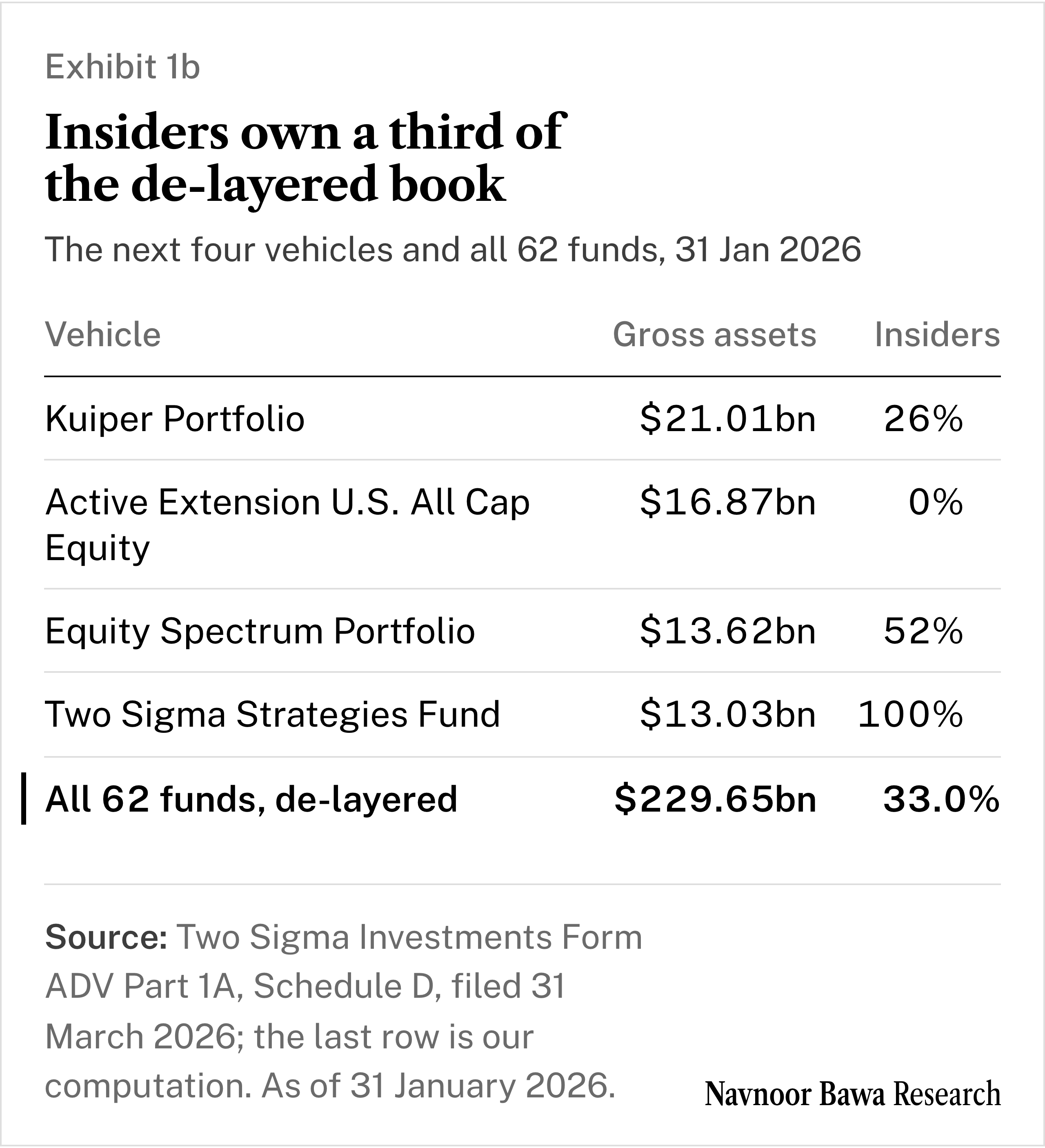
Schedule D lists all 62 private funds and their gross asset values at 31 January 2026, the read we taught on Renaissance and Citadel. Added straight, they come to $310.86bn, more than the filing’s own total; that raw sum is the pitfall. The 24 feeders that name a master invest in it, so their $47.22bn is counted twice. Eight vehicles hold stakes in the “Portfolio, LLC” trading funds, so their $33.98bn comes out too. Without both, $229.65bn is left, about 0.1% above the pooled-vehicle total.2
The de-layered total lands on the filing’s own figure, not near the firm’s count, so the gap is leverage: borrowing and short sales the gross count does not net off.
Millennium was about Two Sigma’s size when it sold its stake: Reuters put it at “more than $79 billion”. On the regulator’s gross line Millennium reports $720.8bn, about 6.6 times even the larger $109.7bn of client net assets its own brochure counts at year-end, so Two Sigma’s is the lighter gross-up. Leverage says nothing about whose money it is, and Schedule D answers that too.
A third belongs to insiders
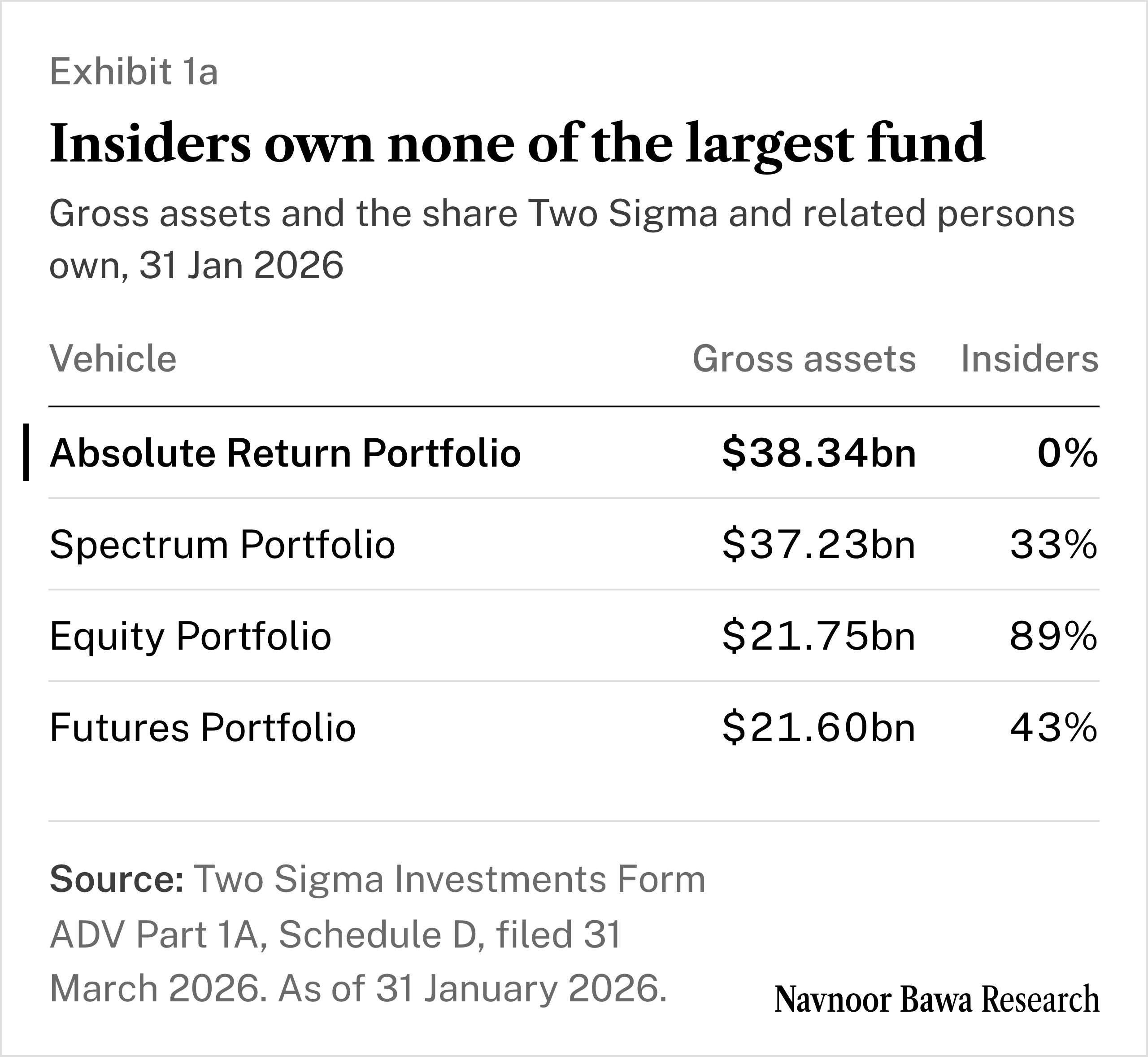
Schedule D asks a second question of each fund: how much of it the adviser and its “related persons” own, the filing’s term for the firm, its founders, its staff and its affiliates. On the de-layered base they own $75.90bn of it, or 33.0%. The base is gross assets; the filing prints no insider share of capital.
Source: Two Sigma Investments Form ADV Part 1A, Schedule D, filed 31 Mar 2026 · as of 31 Jan 2026
The last row is our computation and excludes the feeders and holding vehicles. Read down the last column: Two Sigma’s people own nothing of Absolute Return or Active Extension, while the Equity Portfolio is nearly nine-tenths theirs.
An outside client in Absolute Return, the largest fund and in Hamilton’s words “a diversified, global, equity market neutral portfolio”, therefore invests where the firm’s own people do not. Two Sigma’s brochure says only that its own funds “often have the most attractive risk-reward profiles”.
Five vehicles, most with space names, are the reverse. Two Sigma and its people own all of them, $14.16bn, nearly a fifth of what insiders own.
A stake in the management company buys a share of what these funds pay the firm; the assets stay the funds’.
Outside clients pay for a process they cannot inspect. Pennsylvania’s Public School Employees’ Retirement System said so in a 2016 memo on a Two Sigma fund. “As an investor, there is limited transparency into the models, how the models are assembled to construct a portfolio, or individual portfolio holdings.” Hamilton’s filings cannot show the models either, but they print the bill.
Half the profit, mostly incentive
A buyer’s comfortable assumption about a hedge fund firm is a steady fee annuity, which predicts that the management fee dominates the take, the fee plus the incentive allocation. Hamilton’s contract tests it.
Hamilton invests through Two Sigma Hamilton Fund, LLC, which Two Sigma Investments manages; call it the Hamilton fund. It had $2.18bn of net assets at 31 December 2025, about 2.7% of Two Sigma’s own count.
Since 1 July 2023, Hamilton’s 10-K says, Two Sigma has received “a management fee of 2.5% of the non-managing members’ equity in the net asset value of the TS Hamilton Fund per annum”. It also takes an incentive allocation of “30% of TS Hamilton Fund’s net profits, subject to high watermark provisions”, plus 25% of “Excess Profits”, defined as “the net profits over 10% for such fiscal year”.
The July 2023 recut leaned further toward incentive, cutting the fixed fee from 3% and starting a larger extra allocation at a 10% year instead of 15% (10-K for 2023; S-1).
In 2025 the Hamilton fund made $616.9m before any fee. Two Sigma’s fee was $52.6m and its incentive allocation $263.3m, a take of $315.9m. That is 51.2% of the profit, and 83.3% of the take was incentive. Hamilton still kept a 16.0% return after all fees, while Two Sigma’s take came to about 16% of the fund’s average net assets: manager and investor took about the same slice.
Over six fiscal years, FY2020 to 2025, the fund made $1,902.2m before fees and Two Sigma took $948.0m, or 49.8%. Incentive was 68.8% of that take, blending two sets of terms: 50.5% in 2020 to 2022, before the recut, more since. In FY2020 the fund lost $11.7m before fees, and Two Sigma still took $74.4m. The incentive accrues quarter by quarter, so a year that ends in a loss can still pay it.
The terms move the take in a fixed order:
The fee is charged on the fund’s value whatever it returns, so it barely moved.
The incentive is charged only on profit above a high-water mark, so it swings: in 2023, a 7.6% year after fees, it was $21.5m.
So the take follows the result: $66.7m in 2023, against $315.9m in 2025.
The annuity assumption fails on this contract. The other Two Sigma client contract on file, a Blackstone sub-advisory agreement, leaves its fee appendix blank.
The year in progress pays more on a slightly lower return. Hamilton’s 10-Q for the first half of 2026 shows the fund up 9.6% after fees, against 10.1% a year earlier. Its incentive allocation was $194.5m, against $180.7m.
On 19 October a Two Sigma spokesperson said: “Our team is focused on delivering for our investors, with 2026 shaping up to be one of the strongest years in Two Sigma’s history”. On Hamilton’s numbers a strong year is mostly incentive.
Outside money is still arriving. Form D filings for Titan, Aurora, Beacon Fund and Beacon Bridge show $2.67bn raised since May 2025, about 3.3% of Two Sigma’s own count, though a Form D counts gross sales only. Some has left: New Mexico’s pension fund PERA pulled about $100m in June 2026, and a major investor left in 2023 amid the feud and was later replaced, Hedgeweek reported, citing Bloomberg.
Investing.com, citing Bloomberg, reported at least one allocator demanding guaranteed priority access for more capital. Millennium’s 2025 sale was, in its email to staff, “a minority, passive equity interest”; a seat built to cast the deciding vote cannot be passive, and that allocator would also be buying a place in the capacity queue.
The same arithmetic reaches every founder-owned firm that sells a slice of itself, as Millennium, Brevan Howard and Verition did in 2025: a firm that earns most when it wins sells its best year at a discount.
→ Long-Term Capital Management’s 1998 bond book, rebuilt from the regulators’ reports, Trade File No. 1 on Patreon.
What is each 10% of Two Sigma worth on its own documents, once its incentive pay is priced?
Below the paid line:
The verdict: what a stake in Two Sigma is worth, the judgement behind it, and our odds a price prints
A rival’s price per dollar, a founder’s divorce and a stake holder’s marks, each worked to the firm
Hamilton’s six-year fee table, and every recent stake sale, with the three that printed a price
What to watch: three dated filings and the figure each one tests