



I’ve spent enough time inside Form ADV filings to know most of what Item 26 and Item 27 turn up is boring. An adviser either pays an administrator or it doesn’t, and plenty of funds answer “doesn’t” every filing cycle with nothing interesting behind the answer. Renaissance Technologies is one of the advisers that answers “doesn’t” for at least one of its funds. What makes its answer worth an article isn’t that Medallion Holdings LLC has no administrator. It’s that Renaissance’s own Form ADV, filed July 1, 2026, on the same schedule, in the same section, under the same signature, tells the SEC something completely different about the two funds that hold outside money.
The legend assumes the plumbing works
The version of Medallion everyone already knows is a closed shop. It stopped taking outside capital in 1993 and, by 2005, had bought out its last remaining outside investor. As of late 2016, Bloomberg reported the fund was open only to roughly 300 Renaissance employees and their families, of whom about a hundred qualified as “qualified purchasers” (generally $5 million or more to invest), with the rest admitted as “accredited investors” (generally $1 million or more). Both figures are a decade old, the last public snapshot of who was actually in the fund. That’s a structure that answers to nobody but its own payroll, and the strongest version of that story is worth taking seriously before I depart from it: a fund with no outside limited partners has, on paper, no outside limited partners to protect. Nobody’s redeeming a pension fund’s capital against a number Renaissance made up, and if the same people setting the number want to mismark their own retirement savings, I’d argue that’s their business, not the SEC’s.
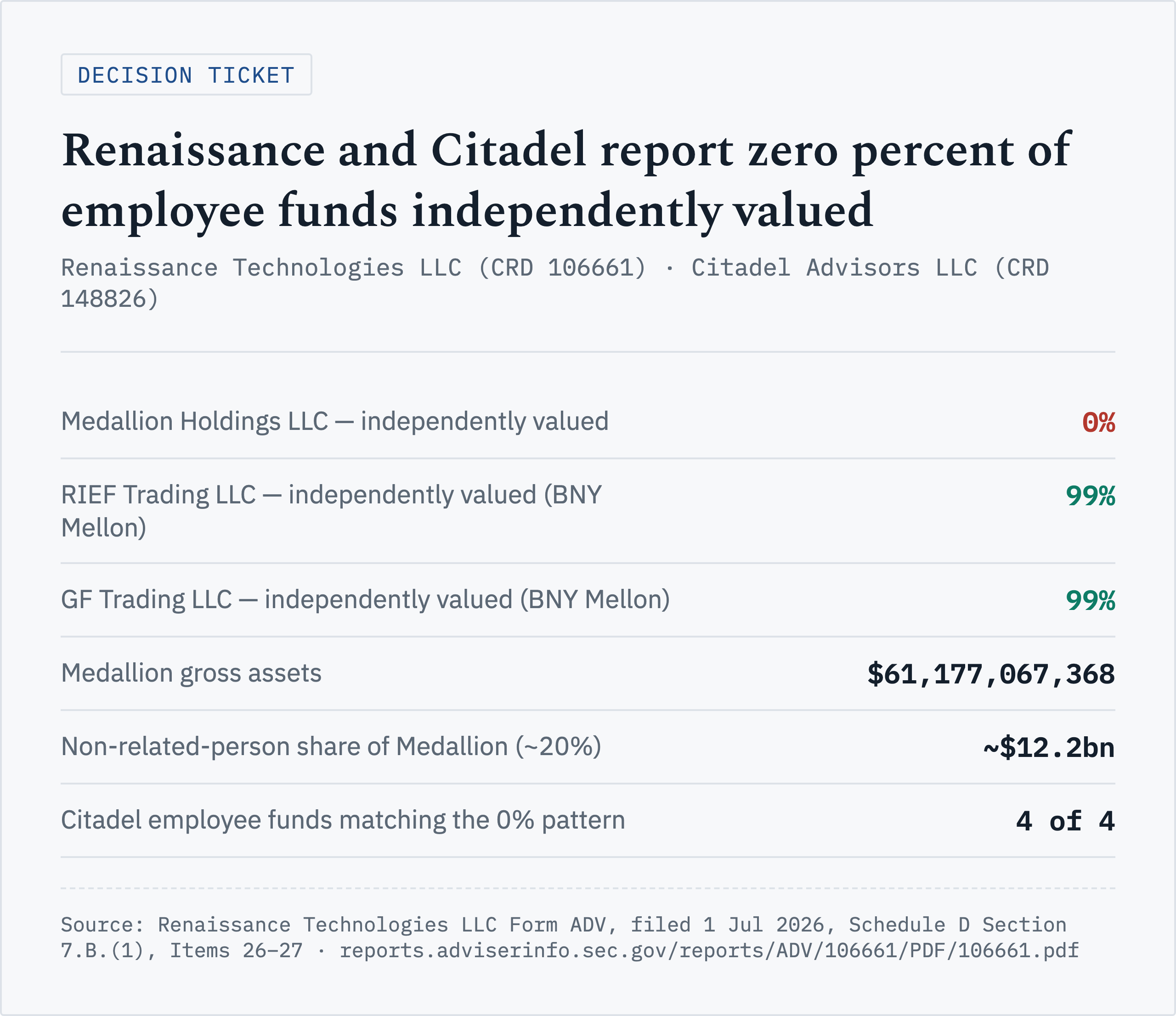
I think that argument is wrong on the facts, and the filing is what shows it. Medallion isn’t the roughly $10 billion fund most write-ups still describe. Renaissance’s July 2026 ADV puts its gross asset value at $61,177,067,368, spread across a master fund and four feeders: Medallion Associates L.P., Medallion Fund L.P., Medallion International Ltd., and Medallion USA L.P. All five are reported under a single Schedule D Section 7.B.(1) filing, exactly what the SEC’s own instructions permit for a master-feeder arrangement. And it isn’t run for roughly 300 people any more either. The same filing reports 549 beneficial owners, nearly double the 2016 headcount and more than five times the roughly one hundred qualified-purchaser employees Bloomberg reported a decade ago. Item 14 puts Renaissance and its related persons at 80% of that pool, by value. The remaining 20%, by my own arithmetic on the disclosed gross asset value, is roughly $12.2 billion ($61.177bn times 0.20) beneficially owned by people the filing doesn’t classify as related to the adviser.
The minimums Renaissance sets tell the same story a different way. Medallion’s own Item 12 answer lists a $25,000 minimum investment commitment. RIEF and GF each require $5 million. A fund priced two hundred times cheaper to enter than its institutional siblings is built for broad internal access. It isn’t a handful of founders parking bonus checks, and my read is that a $25,000 minimum only makes sense for a fund Renaissance expects hundreds of ordinary employees to actually use.
One filing, two numbers: 0% and 99%
Here is the part that does not fit the closed-fund story. Item 27 of Schedule D asks a specific question: what percentage of a fund’s assets, during the last fiscal year, was valued by “a person, such as an administrator, that is not your related person,” where that person’s valuation is the one actually used for subscriptions, redemptions, distributions, and fee calculations. For Medallion Holdings LLC, Renaissance’s answer is 0%. Item 26(a), a checkbox asking whether the fund uses an administrator other than Renaissance itself, is answered No. That answer did not come from a text scrape, which cannot reliably show which radio button is filled on a form like this. It was confirmed by pulling the filing and checking page 32 of Renaissance’s PDF directly.
Two entries later in the same document, Renaissance answers the identical pair of questions for RIEF Trading LLC, gross assets $21,767,779,497, and GF Trading LLC, gross assets $4,214,510,777. Both report an administrator, The Bank of New York Mellon, named and located in New York. Both report 99% of assets valued by that non-related administrator. RIEF’s owner count is 705, only 8% of it owned by Renaissance and related persons. GF Trading has 193 owners, 43% related-party. These are the Renaissance funds that raise money from pensions, endowments, and other institutional allocators. I checked whether this pattern is idiosyncratic to Renaissance’s paperwork or closer to a house style across the industry, because a single adviser’s quirk is a much weaker story than an industry pattern. It is not unique to Renaissance. Citadel Advisors’ own ADV, filed June 11, 2026, three weeks before Renaissance’s, shows the identical shape at smaller scale across its employee vehicles: CEIF Partners LLC at $1.83bn, 95% adviser-owned, 0% independently valued; CEIF International Ltd. at $1.42bn, 407 owners, 0%; CEIF Partners International Ltd. at $144m, 0%; and Citadel Voluntary Investment Fund Ltd. at $204m, 163 owners, 100% adviser-owned, 0%. Four employee-facing funds, four identical answers, at a firm with no public connection to Renaissance beyond filing the same form the same way.
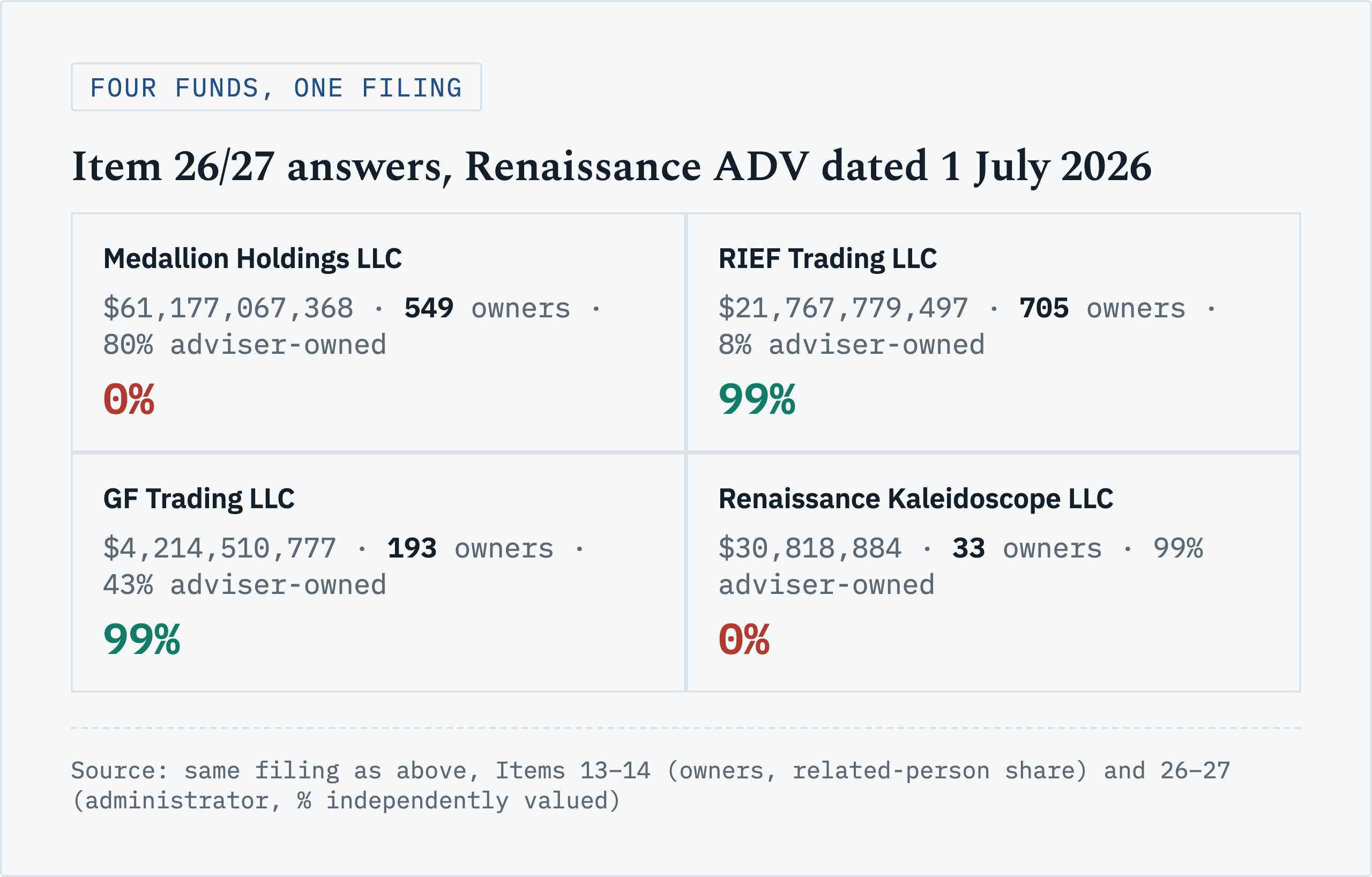
My leading read is that this is a genuine double standard, not a coincidence of fund type, though I lay out a real competing explanation later in this piece and I don’t think it’s fully resolved by what’s public. Renaissance can clearly run a fund with an outside administrator checking 99% of its book. It does exactly that for RIEF (Renaissance Institutional Equities Fund) and GF. It does not do it for the fund that is nearly three times RIEF’s size and pays its own people.
How a master-feeder filing turns into a single percentage
The SEC’s own instructions to Form ADV explain why one number can stand for a $61 billion complex spanning five separate legal entities. Under Instruction 6.d, an adviser filing a single Section 7.B.(1) for a master-feeder arrangement may report Items 13 through 16 by “aggregating all investors in the master-feeder arrangement,” and Item 11’s gross asset figure covers “the master-feeder arrangement as a whole.” That is not a loophole. It is the documented, intended mechanism, and it applies identically to Medallion, RIEF, and GF. The comparison is apples to apples: three master-feeder complexes, one adviser, one filing date, three different answers on who checks the number.
What does Item 27’s percentage actually certify? The SEC’s own standard is worth checking, because “administrator” can mean a rubber-stamp mailbox or a real check. Division of Investment Management staff guidance on the Form ADV FAQ addresses this directly: an adviser should report the full percentage of assets valued by an independent administrator on Item 27, even where the adviser still considers itself ultimately responsible for the valuation. This describes the substance of that guidance rather than quoting it verbatim, since a clean fetch of the SEC’s own FAQ page to check its exact wording was not obtainable this session (sec.gov blocks automated access). That guidance treats this field as a real measure of whether an outside party actually performed the valuation work behind what an investor’s stake is worth. It is not a formality Renaissance can satisfy just by retaining ultimate sign-off. Renaissance’s RIEF and GF answers of 99% mean BNY Mellon is doing that work on nearly the entire book. Medallion’s 0% means nobody outside the building is doing any of it.
