


Optiver’s shareholders, founder Johann Kaemingk among them, took €761 million in dividends in 2024. On 19 October 2026 a Bloomberg headline read “High Frequency Trader Optiver Seeks $900 Million Debt Package”. The Amsterdam market maker is seeking a debt package about the size of what it paid its owners in one year.
A reader of the headline might take a trader that borrows to be short of money, yet Optiver’s 2025 profit was a record and it calls its capital structure “conservative”. I read the package as Optiver borrowing to grow rather than paying its owners less, and its 2026 filed accounts will test that in the payout, the share of the year’s profit paid as dividends. That share sets how fast the equity behind Optiver’s quotes grows, and its lenders and clearing firms lean on that equity.
So why borrow at all? Optiver says in its Annual Review 2025 that it “trades on its own account, deploying its own capital across markets”. Quote, the Dutch magazine that reads its filed accounts, called the equity left after the 2024 dividend “zeer comfortabele” (very comfortable). Both describe a firm with money of its own, and neither says how the growth is paid for.
The owners take a large share of each profit, while the spending turns to computing power, a New York build out and an energy trader. Call the result pay and borrow, in which growth the owners could fund by taking less is borrowed and the owners’ share stays untouched. It breaks if the payout falls below 40% once the debt arrives.
Quote and FD, the Dutch financial daily, read the dividend from Optiver’s filed accounts in eight of the years since 2015; I set each against that year’s profit and cross checked them against its equity from 2020 to 2025. Both checks find about half of the profit going out. I also read both of its US arm’s audited balance sheets at the SEC.
The case runs in six steps, the last two behind the paywall:
Optiver’s profit has more than quadrupled since 2019, and its spending has turned to computing power.
At the end of 2025 its US arm’s hedged book ran on cash owed to its clearing firms.
About half of each profit goes out, Optiver’s own equity agrees, and part of 2025’s apparent dip can be the dollar.
Flow Traders, the listed Amsterdam market maker, stopped its dividend before taking private credit; Optiver’s record shows no such stop.
What Optiver really keeps of its profit, and what one lean year would cover.
Whether the owners take less once the debt arrives, and what would prove us wrong.
Source: Author’s calculation from Optiver’s filed annual accounts, years 2015 to 2024, as Quote and FD reported them · as of 31 December 2024
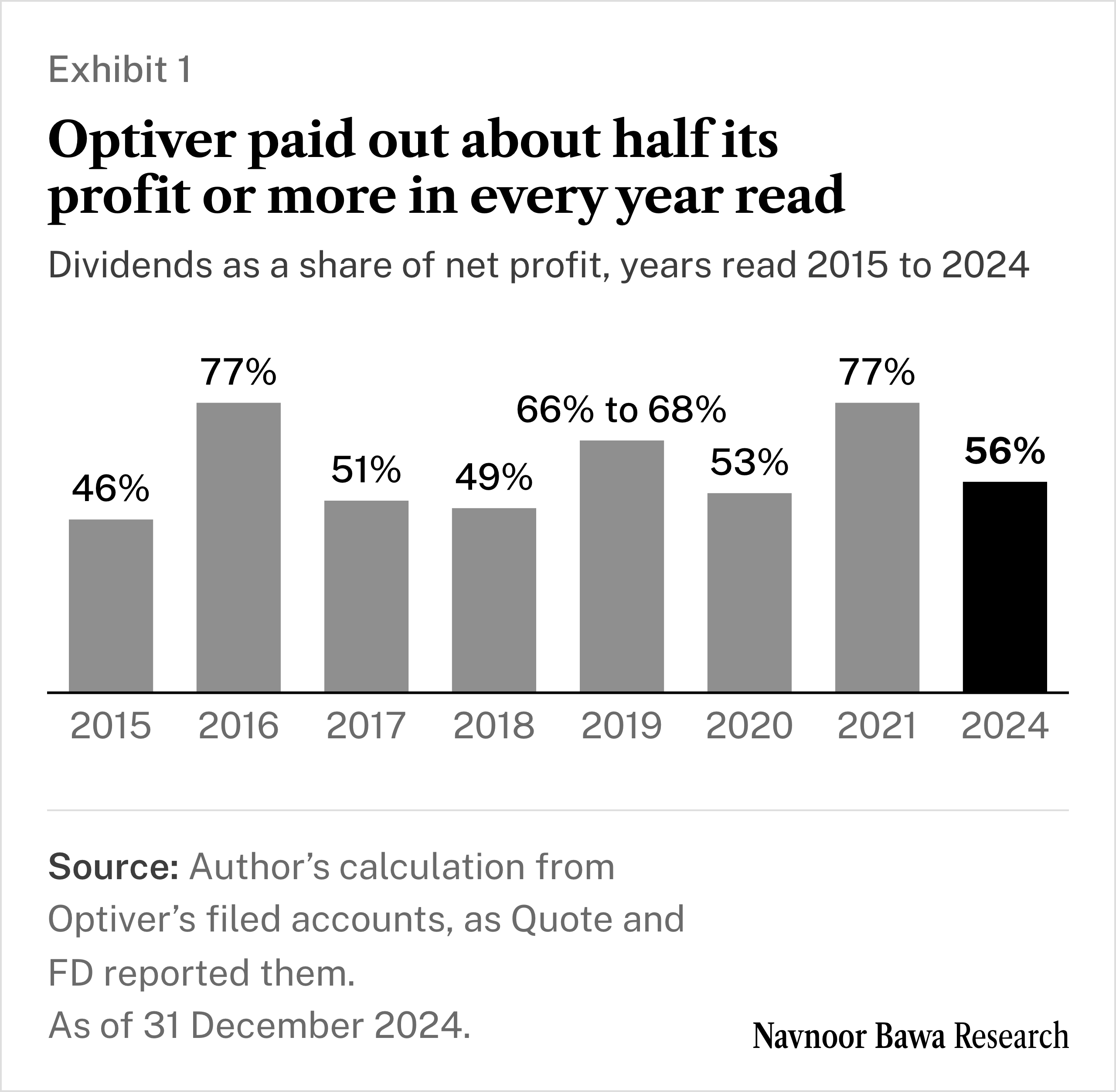
The payout stays at about half or more while profit rises from €279m to €1.37bn.
Each year keeps its source’s base: dividends for that year’s profit in 2015, 2018, 2019 and 2020, dividends paid during the year in 2024, and no base stated for 2016, 2017 and 2021. For 2019, the payout multiplies the €180 a share Quote reported by the 1.46 million to 1.5 million shares its figures imply. Each row is a press read of that year’s accounts, mostly published the next spring: Quote’s for 2015, 2016 and 2017, 2018, 2019, 2020 and 2024, and FD’s for 2021.
How Optiver makes its profit
Optiver quotes prices to buy and to sell, trades on those quotes and manages the inventory this leaves by hedging each position against others. What its trading income leaves after costs is the profit the owners divide, and the part they leave in adds to Optiver’s capital.
Profit was €397m in 2019 and more than tripled to €1.38bn in 2020. It fell back in 2021 and again in 2023, then rose to €1.77bn in 2025. If Optiver were borrowing because it is short of profit, its releases would show profit falling; they show a record, which Quote’s headline called “duizelingwekkende” (dizzying).
Jan Boomaars, the chief executive who signs Optiver’s annual reviews, wrote in the 2025 results release that “Our ambition is clear: to continue strengthening our position as a global liquidity provider, without compromising risk discipline.” The strengthening is where the money now goes.
The word that marks the turn in how Optiver describes its spending is “compute”, meaning computing power, which appears five times in the 2025 Annual Review and in none of the 2022, 2023 or 2024 reviews, which come no closer than “computer science” and, in 2022, “big data computing”. The build itself is older: on 7 May 2024 AMD quoted Alexander Itkin, Optiver’s US chief technology officer, on “building world-leading computational scale”, so the count dates the description; the spending began earlier.
Boomaars’s letter says “we are investing heavily in compute, data and global platforms”. The same review records “a new office in New York” and trading “in new asset classes”, U.S. credit among them, and in August 2026 Optiver agreed to buy a majority of Northpool, a Leiden power and gas trader.
Optiver prints no figure for any of these, and each is paid for before it earns. Under pay and borrow, that money comes from the profit the owners leave in or from lenders, and Optiver’s US arm already runs on one kind of lender.
Its US book runs on credit
Optiver US LLC, the group’s market making US broker dealer, has two statements online at the SEC, for 2018 and 2025, both audited by KPMG.
At the end of 2025 the arm owned $66.2bn of securities and had sold short 97% as much, most of both in options. Management writes that “market risk is substantially diminished when all financial instruments are aggregated” (note 7), so the gross figure, as in our Hudson River Trading piece, measures the size of a book largely hedged within itself and says little about its net exposure.
Note 4 shows the funding: at end-2025 the arm owed brokers, dealers and clearing organisations a net $916.1m, a line that holds $1.44bn of cash, partly offset by open trade equity (gains on positions still open). Call the cash the clearing credit, the cash the arm borrows from the firms that clear its trades, an affiliate among them (note 9). It is about 1.8 times the arm’s own equity of $803.4m.
The two year ends online differ in direction. At end-2018 the arm’s clearing firms owed it $138.6m, against $39.1m it owed them. At end-2025 they owed it $21.5m, against $916.1m. At those two dates the arm went from net creditor of its clearing firms to net debtor.
Optiver describes its trading as deploying its own capital, but at end-2025 its US book owed its clearing firms that clearing credit, so the package would add a second kind of lender, one that could term some of that credit out.
A capital squeeze is the other reading, and nothing Optiver publishes shows one. The US arm held $571m of net capital at end-2025, the liquid cushion the SEC’s Rule 15c3-1 counts, against a $250 thousand minimum. On 12 January 2026 it sent $40m of capital up to its parent, which fits no squeeze at the arm.
Optiver’s EU and UK investment firms publish their capital disclosures only “upon request”, its disclosures page says. Under the EU rules, a senior loan counts as funding, and only debt ranked below other creditors counts as capital. Bloomberg’s headline does not say how the package ranks, so it cannot be shown to add to those firms’ capital.
Half of each profit goes out
Optiver files its full annual accounts with the Dutch Chamber of Commerce, the KvK, and Quote and FD have reported the dividend from them in eight of the ten years from 2015 to 2024. For 2024 they show €761m paid in dividends against that year’s net profit, a payout of 56%.
Optiver kept paying a dividend even as capital rules tightened, FD’s headline on the 2017 results noted. Quote wrote in April 2019 that “Zoals gebruikelijk in beurshandelkringen wordt een flink gedeelte van de jaarwinst uitgekeerd aan de aandeelhouders” (as is customary among trading firms, a large part of the year’s profit is paid to shareholders).
Optiver has kept more before. Its 2013 accounts, as Quote quoted them in July 2014, said “In 2014 zullen we nieuwe kapitaalbuffers opbouwen die gebruikt kunnen worden wanneer verliezen worden geleden” (in 2014 we will build new capital buffers for use when losses are suffered), under a capital policy to be put to the Dutch central bank, and the dividend proposed out of 2015’s profit was “minder dan de helft” (less than half).
I found no report of the dividend for 2022, 2023 or 2025: for 2022 Quote saw only a shortened report, and in April 2026 it did not know the exact 2025 amounts. The KvK accounts carry each year’s dividend and were not read for this piece.
Boomaars runs the firm with Sandrine Teran, the chief financial officer, and Tadhg O’Shea, the chief risk officer, but the owners decide the payout. Quote wrote on 2 April 2026 of “de Quote 500-lieden die als aandeelhouders beslissen wat er met de winst gebeurt” (the people on Quote’s list of the 500 richest Dutch who, as shareholders, decide what happens to the profit), among them Kaemingk and a fellow shareholder, Chris Oomen.
Senior staff can also buy shares, which Optiver Holding, the group parent, must buy back from those still employed five years on, the US arm’s 2018 statement says. Many staff hold shares and share in the profit through the dividend, Quote noted in April 2023, so part of the payout reaches staff.
The equity bridge agrees
Optiver’s own releases cross check the missing years through an equity bridge, in which closing equity is opening equity plus profit, minus dividends and staff share buy backs, plus staff share issues, plus or minus currency on foreign subsidiaries. The rise in equity against profit, the share kept, mirrors the payout, blurred by share trades and currency. From 2020 to 2025 Optiver earned €7.92bn and its equity rose €3.96bn, from €1,532m at end-2019. It kept 50%, in line with Exhibit 1.
2025 alone looks different, because equity rose by only 33% of the year’s profit, which at face value says Optiver paid out two thirds. That is the pitfall: much of Optiver’s equity sits in subsidiaries outside the euro, its 2023 review says, and the dollar fell against the euro over 2025 on the ECB’s rates, so part of the gap can be currency.
The releases and Annual Reviews have described “a conservative capital structure” every year from 2019 to 2025, and the numbers it publishes agree. At a payout of about half, faster growth needs lenders or a smaller dividend, and pay and borrow takes the lenders.
Other market makers borrow too
Flow Traders took both. It measures its trading capital as net liquidity at clearing and prime brokers plus bank cash. In July 2024, a month after taking a small bank loan, its board announced a Trading Capital Expansion Plan, and its Annual Report 2025 says that “To expand the trading capital base, the Board suspended regular dividend payments until further notice”. In October 2025 a $200m private credit term loan, beside an undrawn $75m revolver, replaced the bank loan, at SOFR plus 500 basis points.
Trading capital rose by about a third in 2025, and the loan’s covenant keeps it at three times the loan or more, “on a daily basis”. The board wrote that “The use of external leverage has shown to be accretive to shareholders’ return on equity and is expected to continue to do so given the opportunities ahead.”
The bigger trading capital is on the record, much of it the loan itself; accretion is the board’s word, and the loan’s price is the bar each year’s trading must clear. Optiver’s record to 2024 shows no such stop, and it is now seeking the debt anyway.
Set against each firm’s own equity, with clearing firm credit left out, the borrowing differs in kind as well as size. Optiver’s package alone, leaving out any borrowing its KvK accounts may hold, is 14% to 15% of its end-2025 equity. Flow Traders’ two facilities came to about 27% at end-2025, 20% drawn.
Virtu Financial’s whole stock of long term borrowings was about 103% at end-2025. Jane Street’s one August issue, $14.6bn of senior secured notes raised to retire about $11.1bn of its debt, came to about 27% of the members’ equity S&P put at about $55bn for March 2026, and about 6.4% net of the debt it retires.
Set beside those, the package cuts against any reading of strain, and Optiver’s equity rose in each of the last six years.
In 2022 Moody’s wrote that Citadel Securities planned to use a term loan “to increase its trading capital”, the use Flow Traders put its own loan to. The payout decides how much of the growth the owners fund by taking less, and Flow Traders’ loan shows what the lenders’ share costs.
Once Optiver can borrow, does its 2026 payout fall, or do its owners keep taking their share of every good year?
Below the paid line:
What Optiver kept of last year’s profit, and how much of the gap currency can explain.
The package against a lean year’s profit, against what Optiver keeps, and against Flow Traders’ covenant.
The verdict on pay and borrow, our odds on the next payout, and what proves us wrong.
Four dated checks, from Northpool’s completion to the KvK filing that settles the bet.