


Coinbase’s September 1 filings to relaunch perpetual futures on individual US stocks read as a demand story, but a capital rule window and a live federal lawsuit sit underneath it.
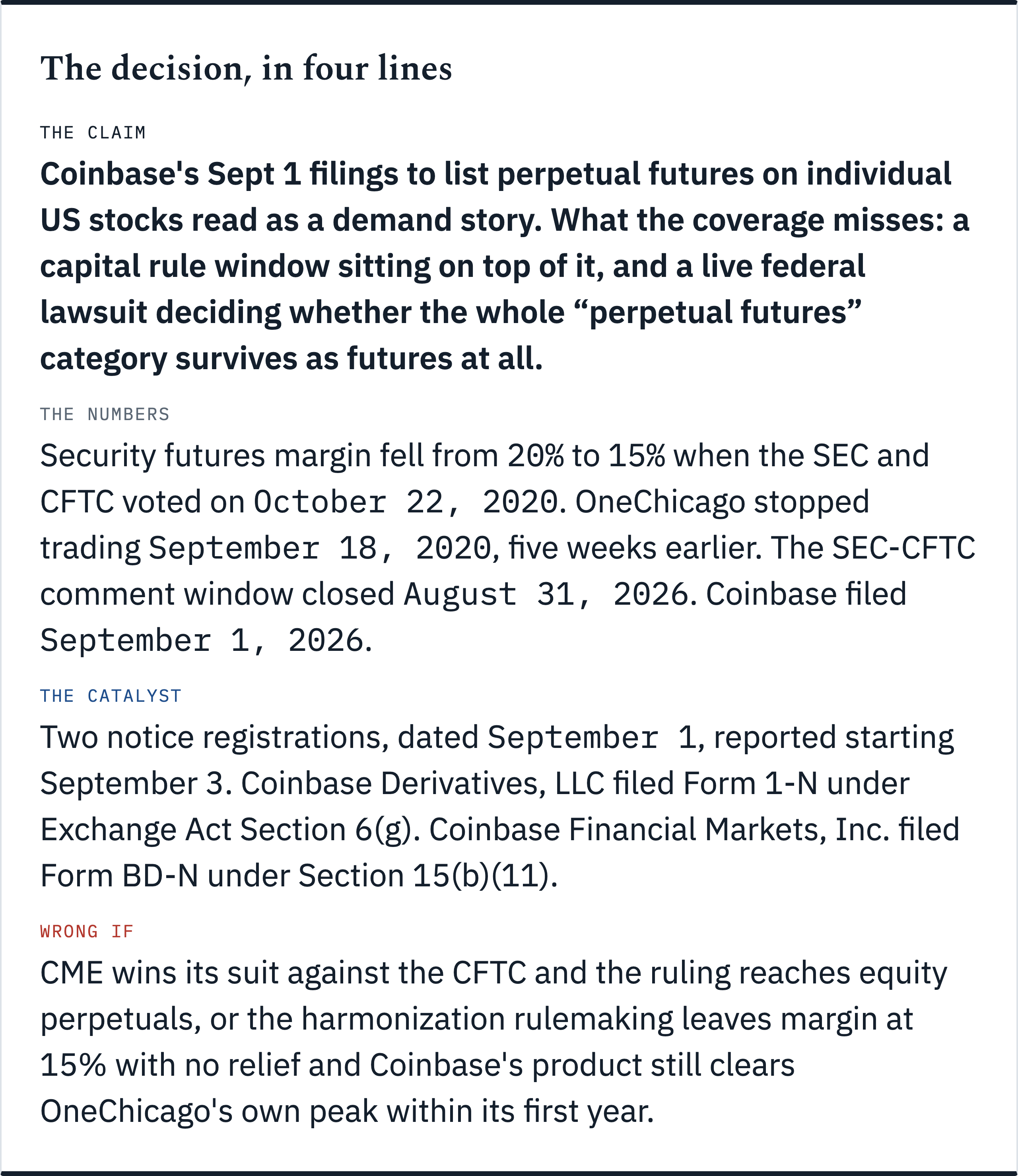
I’d size this as an open question, sitting on top of a demand story I’m not trying to argue away. I’ll show exactly where my own paper trail runs dry, and where a red team I ran against my own draft actually broke a claim.
The consensus, stated at its strongest
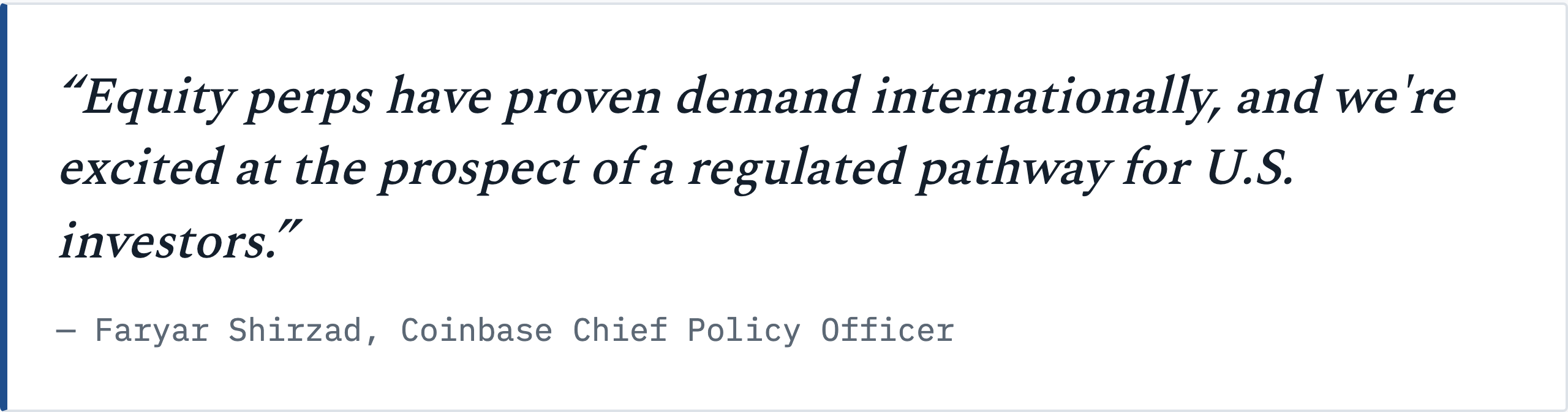
The trade press has the demand story right, and I want to give it its full weight before I complicate it. Coinbase’s chief policy officer, Faryar Shirzad, said it plainly: “Equity perps have proven demand internationally, and we’re excited at the prospect of a regulated pathway for U.S. investors.” That’s not spin. Combined crypto perpetual futures volume rose from $4.14 trillion in January 2024 to $7.24 trillion in January 2026, per CoinGecko Research. Perpetual swaps now carry roughly three quarters of all crypto derivatives flow. Coinbase itself isn’t new to this specific product: it launched single stock perpetuals for non-US customers in March 2026, building on the $2.9 billion Deribit acquisition that closed in August 2025. I take all of that as settled. The demand is real. Anyone claiming this is a paperwork stunt with no real user behind it is wrong, and I’m not that person.
The engineering case holds up too. A dated future converges to spot at expiry through cost of carry. That convergence is where a quarterly market bleeds liquidity: open interest fragments across contract months, and the front month thins as expiry nears. A perpetual swaps the roll for a funding rate, an interest rate plus a premium index, paid directly between longs and shorts on a fixed schedule. One instrument stays honest continuously. Four instruments used to stay honest four times a year, imperfectly. If the roll caused the friction, killing it should fix the friction. A CFA charterholder reading only the press coverage would land here and stop.
My variant view: what demand alone can’t explain
Here’s where I get off consensus. If proven demand alone explained this wave, it would explain why single stock leverage products exist in 2026. It would not explain why Coinbase’s specific notice registration landed on September 1 rather than August 15 or October 3, and the trade coverage doesn’t ask that narrower question at all.
Start with the history the demand story skips past. Single stock futures already existed in the US for nineteen years as a listed product, traded on OneChicago, an exchange CME and Cboe founded in 2001 with Interactive Brokers joining as a partner in 2006. They didn’t fail from indifference. The Commodity Futures Modernization Act of 2000 created the legal category “security futures product,” and the same statute ordered regulators to set its margin so it could never sit below the lowest margin on a comparable exchange traded option. Congress built that floor specifically to stop a future from becoming a cheap synthetic option. The SEC and CFTC implemented it in 2002 at a flat 20% of contract value.
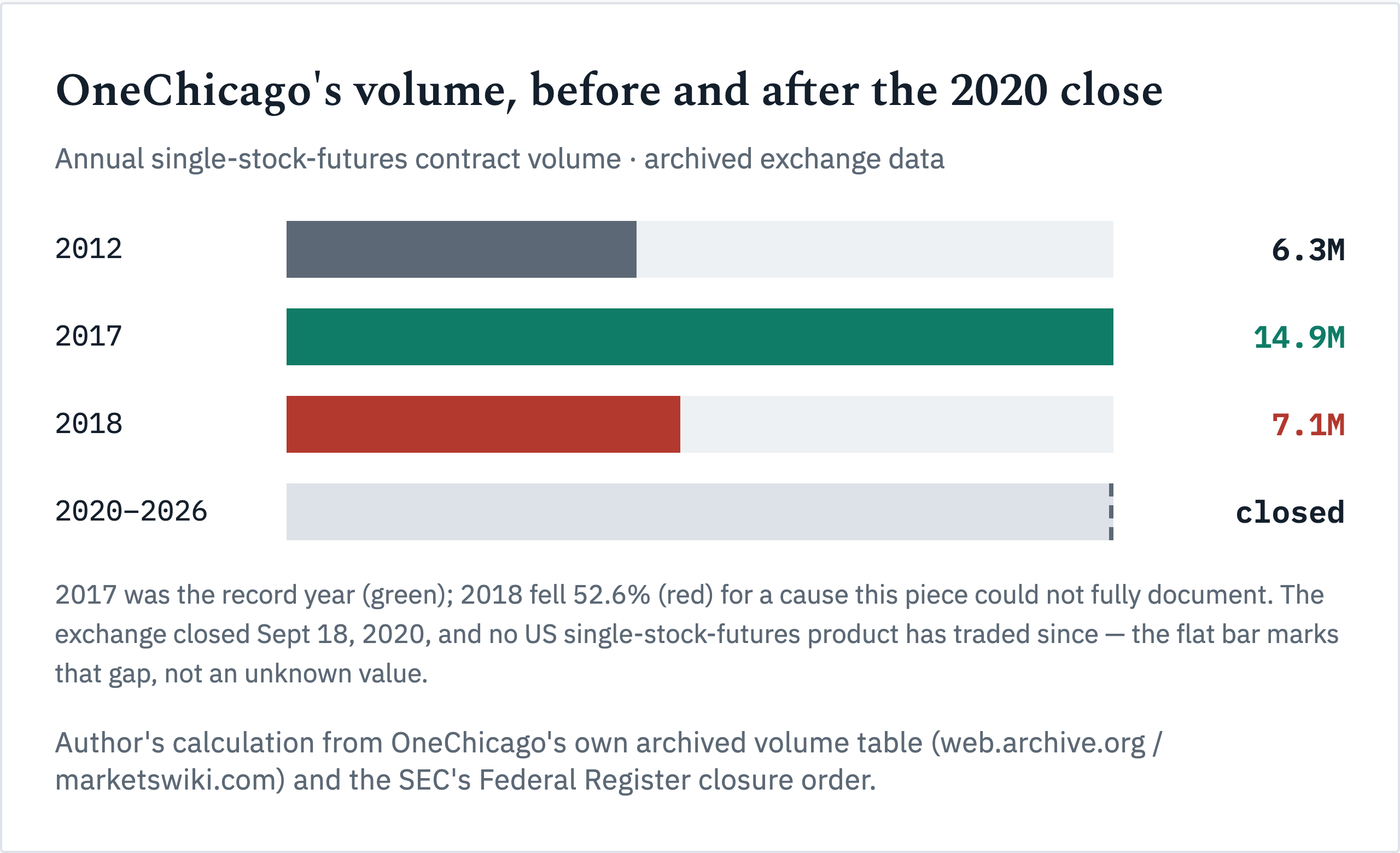
That statute didn’t stop OneChicago from building a real market. Annual volume climbed from roughly 6.3 million contracts in 2012 to 14.9 million in 2017, its record year, across five straight years of growth. This was working order flow. Real money, real size. Then volume fell 52.6% in 2018, to 7.1 million, and kept falling every year after. I haven’t found a single documented cause for that collapse, and I want to be direct about a second explanation I found while checking my own margin story.
Derivatives writer Jakub Rehor’s account of the period puts real weight on a distribution failure specific to security futures. A broker wanting to offer them had to also register as a CFTC futures commission merchant under a separate, contradictory compliance regime, and most securities broker dealers looked at dual registration and declined. Security futures also drew ordinary income tax treatment instead of the 60/40 capital gains treatment normal futures get, a second handicap margin alone doesn’t capture.
I’m not walking back the margin story. Congress’s floor is real, dated, and it removed the one advantage that would have made the product worth the distribution hassle. Margin was one blade of a pair of scissors. Not the whole cut. Two causes, not one.
It matters because Coinbase’s structure answers the other blade more precisely than it answers margin. Form 1-N registers the exchange. Form BD-N registers the broker dealer. One corporate family holds both, which is exactly the dual registration wall that made brokers walk away from OneChicago in the first place.
Two dates that make this filing worth a second look
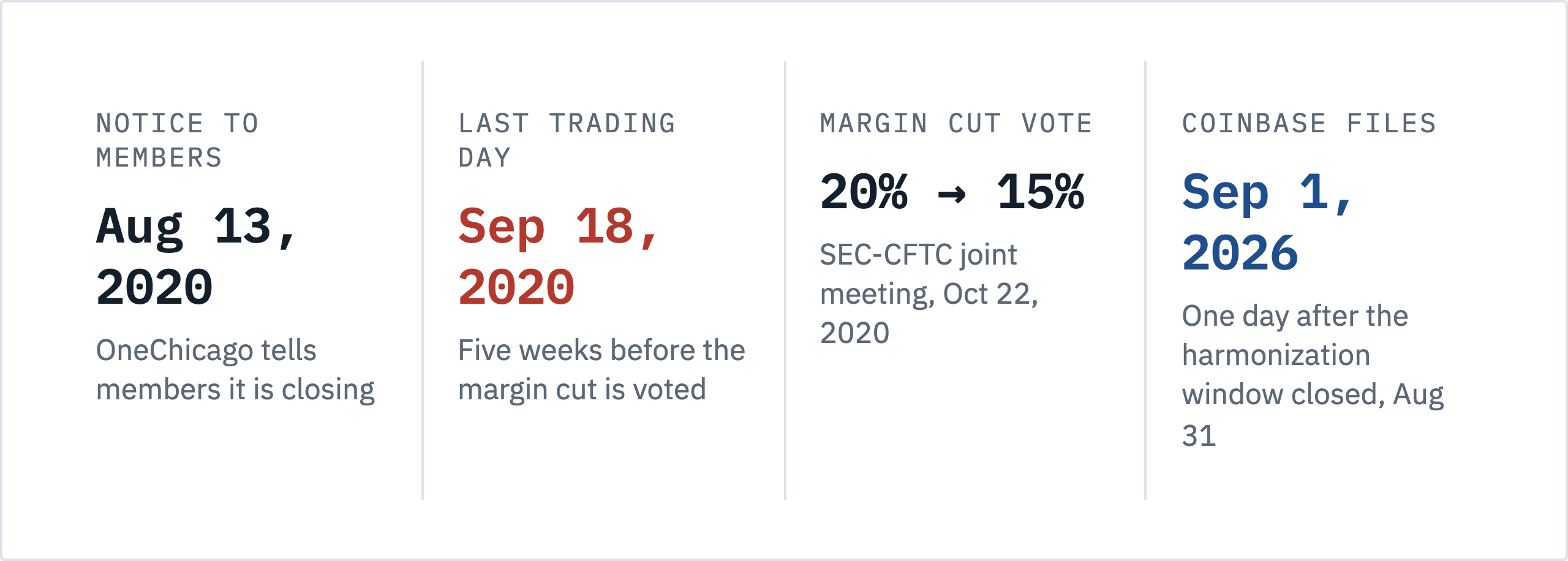
On October 22, 2020, at that first joint meeting, the SEC and CFTC voted to cut the margin floor to 15%. OneChicago had told members on August 13 it was closing. Its last trading day, September 18, landed five weeks before regulators voted to approve that cut, and the rule did not formally take effect until December 24, 2020, three months after OneChicago was gone. The one market that could have tested whether 15% was low enough closed before the number existed, and stayed closed for nearly six years. Six years of silence. I’ll say now, before the objection finds me later: CME relaunched a dated single stock future this July under this exact 15% floor, so the floor has been tested since. What it has not tested, not once, in nineteen years of the category’s existence, is a version with no expiry at all. That is the specific, narrower claim the rest of this piece needs, and it is the one I can actually defend.
Now the second half of the timing. On June 30, 2026, the SEC and CFTC jointly asked for comment on further implementation of portfolio margining and cross margining of securities and derivatives, an explicit continuation of the same 2020 project. SEC Chairman Paul Atkins called cross margining an opportunity to free up “liquidity that remains frozen in separate accounts.”
That project is older than the June date suggests. SEC Commissioner Hester Peirce was already commenting on this same harmonization push in a September 2025 statement, a full year before this specific window opened. The June 30 request is a discrete step inside a much longer running conversation. That window closed August 31, 2026, and Coinbase filed Form 1-N and Form BD-N the very next filing day.
I have not found a comment letter from Coinbase or any subsidiary in that docket, and I do not have Coinbase’s internal product calendar, so I’m holding this as a strong circumstantial marker, not a proven cause. The honest version: a company with an obvious, independent, demand driven reason to file in 2026 chose to file on the one business day when a related capital rules proceeding had just gone quiet for deliberation. That is worth noting. It is not proof of intent.
The mechanism: what actually changes, and what doesn’t
Start with what a perpetual actually fixes. Crypto exchanges settle funding every eight hours. Coinbase’s filings do not specify a cadence for the equity product, and that’s one of the real unknowns in the paper trail. The mechanism holds regardless of frequency, though. When the perpetual trades above spot, longs pay shorts. That pulls in fresh selling and drags price back down. Below spot, the payment flows the other way. Continuous funding does the job periodic rolling used to do, only without the calendar. That much is a real fix. Margin is a separate question entirely.
It does not touch the margin problem, and I have not seen this point made anywhere in the coverage. “Security futures product” is defined by what sits underneath the contract, a single security or a narrow based index. It says nothing about whether the contract expires. Exchange Act Section 3(a)(55) and CEA Section 1a(45) both define the category by the underlying instrument. Neither the 2002 rule nor the 2020 amendment carves out a no expiry structure. If that reading holds, a Coinbase single stock perpetual sits on identical legal footing to an OneChicago contract from 2019: same joint SEC-CFTC oversight, same 15% floor, unless the pending rulemaking moves it.
The forms Coinbase actually filed confirm which regime it walked into. Form 1-N is the specific notice registration a CFTC registered designated contract market files with the SEC to become “notice registered” under Section 6(g), a simplified path Congress built only for exchanges listing security futures products. Form BD-N is the parallel registration for a broker dealer trading exclusively in them, under Section 15(b)(11). Coinbase did not invent a fresh, unregulated crypto wrapper. It filed the two forms the 2000 era regime built for this exact job.
The entities behind the filing, and the doors they have already used
It filed them through entities with a live record in this kind of doorway. Coinbase Derivatives, LLC is the CFTC registered exchange Coinbase bought in 2022 as FairX, already running nano Bitcoin and Ethereum futures. Coinbase Financial Markets, Inc. separately holds a CFTC no action letter, granted May 29, 2026, letting it post customer crypto assets as margin at its affiliated foreign venue, Deribit FZE, for perpetual contracts the CFTC agreed to treat as foreign futures. That same May 29 letter cites a parallel CFTC order approving KalshiEX LLC’s BTCPERP futures contract, a second, independent perpetual futures approval moving through the Commission the same day, on an entirely different rail. I would read that as the whole apparatus around perpetual style products loosening at once. Not one filing. A pattern. Coinbase’s own move here is at least its second doorway in twelve months.
And here’s the part the margin story alone misses: one corporate family holding both the exchange registration and the broker dealer registration is the more precise fix for OneChicago’s actual, documented failure mode. The dual-FCM-and broker dealer wall that made securities firms decline to distribute security futures in the 2000s doesn’t exist inside Coinbase’s own structure the way it existed for an independent broker deciding whether OneChicago’s product was worth the compliance cost. That is real. It has nothing to do with margin.
Run the arithmetic on what 15% still costs you, margin fix or not. A trader who wants $10,000 of directional exposure to one stock puts down $1,500 under the security futures margin rule. The same trader buying a comparable option struck at the money typically pays somewhere in the range of 4% to 8% of notional in premium (a rough illustration using standard option pricing approximations, not a quoted market figure), depending on the stock’s implied volatility and the option’s tenor. That premium is the trader’s entire maximum loss, not a refundable deposit.
On volatility alone, options can beat the future on the same directional bet. Options still win here. And the option owner can’t be called into forced liquidation overnight the way a futures holder can. That’s the actual competition security futures have never won. Never once. Fifteen percent is progress against 20%. It’s not obvious progress against a four percent option premium on a volatile name, which is exactly the kind of single stock a retail trader wants leveraged exposure to in the first place.
One more door exists already, for accounts that can reach it. FINRA Rule 4210(g), the industry’s portfolio margin framework, names “a securities futures product” among the instruments eligible for portfolio margining, alongside listed options and unlisted equity derivatives. Portfolio margin prices a whole position’s net risk instead of a flat per contract percentage, and it can push effective margin on a hedged book well under 15%. That relief isn’t hypothetical. It exists today, for sophisticated or institutional accounts, not the retail trader Coinbase’s own marketing is aimed at. The open question I’d flag here is whether the current SEC-CFTC proceeding extends anything like portfolio margin economics down to an ordinary account. That’s the only version of this product that actually needs 24/7 access to justify itself.
I built a paid research note that goes further on exactly this question: the specific public query that tracks the margin docket in real time, plus the worked arithmetic for a portfolio margined book.
The clock this filing is actually racing
There’s a fourth date that belongs beside the other three, and it’s the one that already answers part of my own earlier claim. CME itself already re entered this market once this year: it relaunched cash settled, dated single stock futures on 55 US names, SpaceX and Nvidia among them, on July 27, 2026, five weeks before Coinbase’s filing, and CME’s own product notice sets the minimum margin at 15%, the identical floor this entire piece has been discussing.
That relaunch is exactly what Bloomberg reported CME is betting on: “the rise of retail trading and today’s market environment of hot IPOs with limited share availability,” with CME’s global head of equities, Tim McCourt, quoted separately calling it a way to “bring in a lot of new traders” to CME’s ecosystem. That’s a second, independent, on the record demand explanation I have to weigh rather than wave off. I’ll come back to what that does to my thesis in the next section.
CME’s own August volume release breaks out interest rate, equity index, energy, agricultural, metals, FX and cryptocurrency as named lines. Single stock futures don’t get one. I read the omission as informative on its own: the product exists, is trading under the exact floor this piece is built on, and isn’t yet large enough for CME to name in its headline numbers five weeks in.
CME is also, right now, suing the regulator that would have to bless Coinbase’s structure, though not over the question I first assumed. On June 18, 2026, CME filed suit against the CFTC in the DC district court, docketed as case 1:26-cv-02157 before Judge Colleen Kollar-Kotelly, arguing that the CFTC’s May 29 order classifying Kalshi’s Bitcoin perpetual as a future rather than a swap sidestepped the correct process. That fight is specifically about Bitcoin, a commodity under the CFTC’s own jurisdiction, under the Commodity Exchange Act’s swap versus future line. Both possible outcomes keep the product inside the CFTC’s rulebook.
It does not directly govern Coinbase’s equity product, which sits on a different statute entirely: the Exchange Act’s “security future” category Coinbase invoked with Form 1-N and BD-N, versus “security based swap” under Title VII of Dodd-Frank, which is SEC-exclusive jurisdiction with its own capital and clearing regime. That fork is separately, actively contested. The Hyperliquid Policy Center is lobbying regulators right now to have cash settled equity perpetuals classified as security futures rather than swept into the broader swap category, which only makes sense if that classification is still open.
The CFTC moved to dismiss CME’s suit on September 2, one day after Coinbase’s own filing, calling CME’s claim of competitive injury “much ado about nothing.” CME’s opposition is due October 2, 2026.
I’d treat the equity specific classification fork, not the Bitcoin lawsuit directly, as the real capacity constraint on this whole opportunity. The worst case for Coinbase isn’t that the margin floor stays at 15%. It’s that an equity perpetual gets pushed into the security based swap regime entirely, which the article’s margin discussion above doesn’t come close to describing and which would be a materially larger problem than anything in this piece’s numbers. The Bitcoin case still matters as a signal of which way the Commission is leaning on perpetual structures generally, and Judge Kollar-Kotelly’s eventual ruling is worth watching for that reason. It just isn’t the direct legal mechanism I originally read it as.
What separates my read from the simpler one
Here’s the strongest version of the objection, and I want to state it the way a sophisticated reader actually would: two different companies converged on the same product category in 2026 off the back of an obvious, already measured retail boom, so you don’t need a regulatory window story to explain why either of them showed up this year. Leveraged single stock ETFs grew from roughly $17 billion to somewhere in the $43 to $65 billion range in under two years.
CME’s own leadership put a name and a quote on record attributing its identically margined relaunch to retail demand and hot IPOs, not to any rulemaking. Coinbase has been running the same offshore product since March and telegraphing stock perpetuals as a roadmap item for over a year, off an acquisition that closed thirteen months before this filing.
I think that objection is right about the category. It is too narrow about the date. Proven demand explains why leveraged single stock products exist in 2026 at all. It doesn’t explain why Coinbase’s specific US notice registration landed on September 1 rather than any other business day that quarter, and the demand story has nothing to say about margin economics either way, because CME’s identically margined relaunch and Coinbase’s own filing are both still operating inside the same 15% floor whether or not a rulemaking ever moves it. OneChicago is the control case that keeps this distinction honest: 14.9 million contracts in one year is real, cleared demand, and the product still died because demand was never the binding constraint, capital cost and distribution structure were. A crypto native audience with proven appetite for perpetuals answers the demand question. It says nothing about whether the US-regulated version clears the capital hurdle that broke this exact legal product before, or survives the classification fork that’s live right now. Demand, capital economics, and legal classification are three separate conditions. This piece is about the second and third, not a rebuttal of the first.
Three things I can’t rule out
First, I haven’t located the text of Form 1-N or Form BD-N themselves. Coinbase disclosed them as images on its own account rather than through EDGAR. As of this writing, I could not confirm the phrase “equity perpetual” or “security futures” anywhere in Coinbase Global’s own EDGAR full text record, including what I could find of its most recent 8-K, filed September 2. I was not able to independently rule out a filing landing after my own search, so treat that specific negative as unconfirmed rather than settled.
Second, I haven’t found a comment letter from Coinbase or an affiliate in the SEC-CFTC harmonization docket. My “positioned to benefit” read is inference from a one day gap between two dated events, sitting inside a harmonization conversation that’s been running for at least a year. It isn’t a documented lobbying position I can point a reader to directly.
Third, and the one that matters most: no SEC or CFTC release I’ve found states outright whether a perpetual, no expiry structure gets margined identically to a dated one under the existing rule, or whether it risks being pushed into the security based swap category the Hyperliquid Policy Center is actively lobbying against. My reading follows from how the statute defines the product category by its underlying security rather than its settlement calendar. It’s never been tested by an actual ruling, because no perpetual security futures product has existed to test it on. I’m not hiding that hole. It’s the argument. The untested case is what makes this filing a bet instead of a formality.
What would change my view
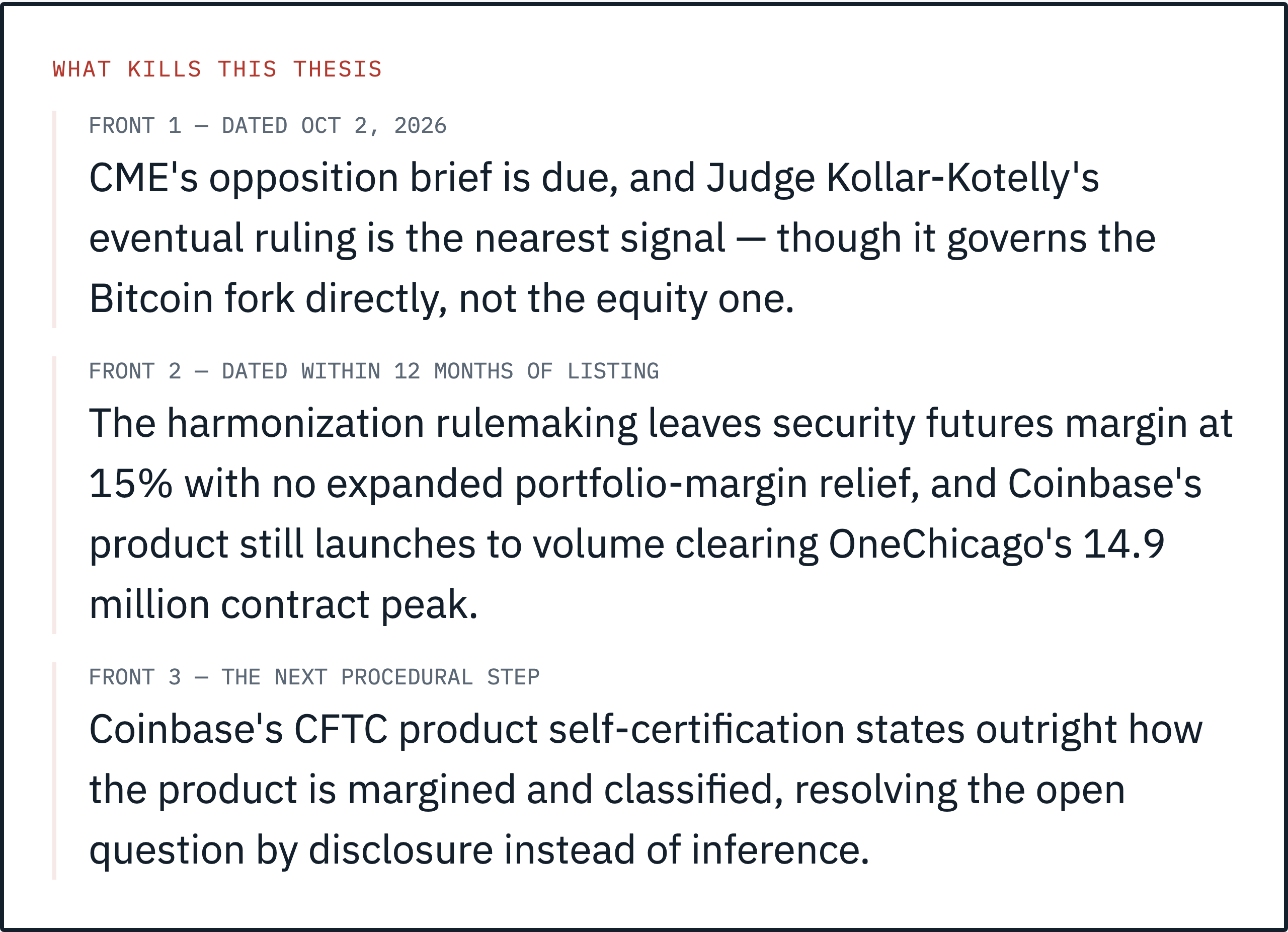
The claim above is falsifiable on purpose, and three dated, public checkpoints settle it, in order of how soon each one lands. CME’s opposition brief is due October 2, 2026, and Judge Kollar-Kotelly’s eventual ruling is the nearest signal, even though it governs the Bitcoin fork directly rather than the equity one. If the harmonization rulemaking produces a final rule, or an explicit decision not to act, that leaves security futures margin at 15% with no expanded portfolio margin path for ordinary accounts, and Coinbase’s product still launches to volume clearing OneChicago’s 14.9 million contract peak within its first twelve months of listing, then demand and crypto native distribution are doing the work I attributed to margin and classification timing. I’d be wrong about the mechanism even if right about the filing pattern. Separately, the actual next procedural step after a notice registration is a CFTC product self certification. If that filing states outright how the product is margined and classified, my open question resolves by disclosure instead of by inference.
What to watch instead of the launch date
OneChicago didn’t die of low demand. It built a real, growing market across five years, then lost most of it inside twelve months, carrying both a capital cost Congress wrote into the statute on purpose and a dual registration wall that kept most brokers away entirely. The one fix regulators made to the capital side arrived after the only market for it had already closed, and stayed untested for the no expiry version of the product for six years after that. Coinbase isn’t filing into settled ground, and it isn’t filing on demand alone either. It’s filing through a structure that solves OneChicago’s distribution problem more precisely than its margin problem, in the same month a related capital rules proceeding went quiet for deliberation, while a live lawsuit works out whether perpetual futures survive as futures at all.
That’s the actual trade sitting inside this filing. The funding rate engineering is real, and it solves a real problem. The demand is real too. Whether the capital and classification questions get answered in Coinbase’s favor is a question for regulators and a federal judge, not for engineers or for how big the crypto perpetuals market already is. A harmonization rule that hands security futures a genuine capital edge over listed options, combined with a classification ruling that keeps equity perpetuals out of the security based swap bucket, gives Coinbase a path OneChicago never had. Absent either one, a perpetual single stock future is a better built, better structured version of a product that already failed twice for reasons that have nothing to do with how often it rolls.
Watch the Federal Register and the D.C. district court docket. Don’t watch Coinbase’s app store listing. That’s where this actually gets decided.
The same pattern shows up elsewhere in market structure right now. The CFTC rejected a special call reporting plan from the futures industry in 2011 and adopted the same plan as a transitional bridge fifteen years later, in 2026, which is the same story as a margin rule cut five weeks after the market it was meant to save had already closed. And the clearinghouse side runs the identical asymmetry in the other direction: Kalshi’s clearing members can be assessed up to 550% of what they put in, while the exchange’s own default fund carries no matching obligation to refill. Capital rules built for one product rarely retire on the same schedule as the product itself.
I break down filings like this one on YouTube and post shorter research notes on LinkedIn.
The Decision-Grade Version
This piece is complete on its own. The thesis, the evidence, and what would kill the view are all above, and nothing was held back to sell you a next step.
The Patreon note is a separate piece of work rather than a deeper cut of this article. It takes one tool from inside this story, i.e. the exact public query that tracks the margin docket in real time, and writes out the worked arithmetic for what a portfolio margined book actually costs at 15% versus 20%. Written for people who want to watch this resolve as it happens rather than read about it after.