


The claim: The CFTC deleted the licence condition that made a shortfall at Kalshi’s clearinghouse arithmetically impossible, and the rulebook Kalshi wrote to replace it seven days later exempts the company from ever replenishing its own default capital while requiring members to restore theirs on demand.
The numbers: The book opened in June. The affiliated FCM’s customer segregated funds went $0 to $17,765,306 in one month while its capital rose 28.5 times, per the CFTC’s own FCM reports. Members are assessable to 550% of their deposit and must replenish it on demand; the company’s contribution replenishes never. Seven days separated the amended order from Kalshi’s own rulebook filing.
The catalyst: Two emergency orders under CEA section 8a(9), on 14 July and 11 August 2026, are what currently keep the exchange open. Kalshi told its regulator the emergency risked its compliance with Core Principle 21, Financial Resources, against a New York claim of $36bn at a company valued at $22bn.
Wrong if: Kalshi Klear amends Rule 12.5C to replenish the company contribution, or the Commission requires its futures margin methodology to arrive through a Regulation 40.5 approval instead of a 40.6 self-certification. Either would mean the constraint moved back to the regulator.
The half of the Kalshi story nobody has opened
Every piece I’ve read on the New York fight is about jurisdiction: federal preemption against state gambling law, one state reaching a national market, a regulator reviving a power untouched since the Carter grain embargo. I won’t retell it.
I went looking for the other half: what happens to money and open positions if the claim lands. The interesting change happened months before New York filed, in documents carrying no press coverage.
Full collateralization was a licence condition, and a regulatory exemption
I will start with what Kalshi Klear was. Its own application says it plainly.
When Kalshi applied to run its own clearinghouse, it told the Commission every product would be pre-funded and fully collateralized. Then it drew the consequence itself. That design was “negating the need to calculate variation margin levels or maintain a default fund, and making it easier to offer clearing services directly to participants” (Exhibit A-3).
Full collateralization is not a risk management style. It is an arithmetic property. A fully collateralized position, in the Commission’s definition, requires the clearinghouse to hold “at all times, funds in the form of the required payment sufficient to cover the maximum possible loss that a party or counterparty could incur upon liquidation or expiration of the contract.” Hold the maximum possible loss and a shortfall cannot arise. There is nothing left to mutualise.
Here is the part I had not appreciated before reading the regulations, and it makes the April change consequential. Full collateralization also switches off two of the Commission’s own requirements. Under Regulation 39.11, a clearinghouse must run monthly stress tests to size the resources it needs against its largest member default, and must hold liquid resources against a one-day settlement cycle. Both carve out the same thing: “The requirements of this paragraph (c) do not apply to fully collateralized positions,” and “A derivatives clearing organization is not subject to paragraph (e)(1)(ii) of this section for fully collateralized positions.”
Those words did two jobs: they described the book, and they exempted the clearinghouse from sizing a default package at all.
Both jobs were written into the licence. The original order of registration, 28 August 2024, condition (1): “Kalshi is permitted to clear, in its capacity as a registered DCO, fully collateralized positions in swaps.”
On 14 July 2025 Kalshi asked to widen that. On 13 April 2026 the Commission did. The amended order supersedes the original, and its condition (1) now reads, in full: “Kalshi is permitted to clear, in its capacity as a registered DCO, futures, options on futures, and swaps.”
I checked whether that is loose drafting, the obvious way for this to be nothing. It is not. Of the nineteen registered clearinghouses on the Commission’s filings registry, twelve carry the “fully collateralized” qualifier, and those twelve include every prediction market venue on the list: Polymarket Clearing, ForecastEx, ProphetX, Aristotle, Electron, Gemini Olympus. The six clearing without it are Eurex, LCH SA, ICE Clear Credit, ICE Clear Europe, ICE NGX and Nodal Clear.
One entry settles whether the drafting is careless. Nadex, now Crypto.com Derivatives North America, is the other retail event venue permitted to run margin, and the Commission wrote its remark out longhand: “permitted to clear margined futures, and fully collateralized futures, options on futures, and swaps.” When it means a split book it says which half is which. Kalshi Klear’s line splits nothing. Its permission now reads like Eurex’s, and not like Polymarket’s.
Seven days later, Kalshi wrote the replacement itself
This part matters more than the order.
On 20 April 2026, seven days after the amended order, Kalshi Klear self-certified a new rulebook under Regulation 40.6(a), effective after close of business on 27 April. Self-certification is the route that needs no approval. You file, the clock runs, the rule takes effect. Kalshi also requested confidential treatment of the substantive amendments until the effective date, so the redline was not public while the review period ran.
I would not call the changes housekeeping. Rulebook v1.3 contains the phrase “Guaranty Fund” zero times. Version 1.4 contains it seventy-five. The amendment introduces Margined Contracts as a defined class, Initial and Variation Margin, Futures Customer Collateral in its own segregated account, an expanded Risk Management Committee, and an entire new Chapter 12 establishing a default management framework where there had been none.
Note what those two documents are, because I think that swap is the whole finding. What constrained Kalshi Klear used to be an instrument the Commission controls, amendable only by the Commission, on the record, after a request that took nine months. What constrains it now is a rulebook Kalshi controls, amendable by Kalshi, effective seven days later, with confidentiality on request. The protection didn’t weaken in April. It changed custodian.
The obvious answer is the one I’d make myself. Self-certification is not a loophole. It is the ordinary route every clearinghouse uses, and the Commission keeps a stay power over it: Regulation 40.6(c)(1) lets it halt a certification for “novel or complex issues,” take 90 days to review, and run a 30-day comment period. That power is not theoretical here. The Commission used it against this exact registrant six weeks later, staying Kalshi’s Michigan emergency rule in the July order.
So the custodian point needs stating precisely. The Commission can stop a self-certified rule. What it no longer does is size the package in advance. An order condition is tested before anything happens and changeable only by the body that wrote it. A stay is reactive and needs somebody to notice. A state court unwinding trades is a loud trigger. A guaranty fund calibration is quiet.
The waterfall they built is good, and I want to say so plainly
I read Chapter 12 as a conventional, competently drafted loss waterfall of the kind a serious futures CCP runs. Calling it shoddy would be wrong.
Defaulter’s margin goes first, then its guaranty fund deposit, then the clearinghouse’s own capital, then the mutualised fund, then more of that capital, then assessments on survivors. Deposits are calibrated on stress loss, open interest and volume, with a $1,000,000 floor for a new member.
Its own layer is generous, too, and here I had to correct myself. Rule 12.5C defines a First and a Second Tranche Company Contribution, each “not to exceed the greater of $20 million or 10% of the total aggregate value of the Guaranty Fund.” That’s twenty percent across both tranches. Published comparisons put OCC near 0.5% of member contributions, LCH around 0.9%, CME about 2.8%, ICE Clear US about 10%. On the percentage, Kalshi Klear is not skimping.
The one layer that never replenishes
What I could not find in Chapter 12 is a replenishment obligation on the clearinghouse. I went looking because the peers I checked have one.
Rule 12.5C, immediately after defining the two tranches: “If the Company Contributions are so applied, the Company will have no obligation to provide additional funds to replenish such contribution or otherwise provide additional funds in respect thereof.”
Now hold that against what the same rulebook demands of everyone else. Rule 12.4H-2 says a member whose guaranty fund deposit is drawn down “shall restore the deficiency … on demand (a ‘Replenishment’).” Members are separately assessable up to 200% of their deposit for a single default and 550% across multiple defaults inside six months.
So after one bad day the mutualised layer refills and the owner’s layer does not. That is the asymmetry, it sits in one document, and it runs opposite to where the industry has moved: the OCC proposed rules for exactly how it replenishes its minimum corporate contribution after each chargeable loss.
Put a number on the member side, because the rulebook supplies one. A new member’s guaranty fund deposit may not be less than $1,000,000, and assessments run to 550% of it across multiple defaults inside six months. A member at the floor is exposed to its $1m deposit plus $5.5m of assessments, $6.5m against $1m posted, and then it replenishes and the meter restarts. The owner’s layer is capped at the greater of $40m or twenty percent of the fund, and spent once. Both numbers sit in the same chapter.
I ran that default through all six steps at the rulebook’s own floors in the trade note on Patreon.
There’s a second consequence I’d want priced before clearing anything there. Regulation 39.11(b) lets a clearinghouse count guaranty fund deposits and potential assessments toward the resources it must hold. The regulation sizes the package. The rulebook decides who provides it. Kalshi Klear can satisfy a growing requirement substantially with member money and member assessment capacity, while the parent’s exposure stays fixed and refills never.
The margined book is no longer hypothetical
I’d assumed the April filing was scaffolding for something distant. Kalshi’s certification letter encourages that: the changes “do not alter the economics, risk, or operation of any currently cleared Contract” and merely “create the definitional and structural framework” for “new products in future filings.”
Six weeks later the product arrived. On 29 May 2026 the Commission approved KalshiEX’s BTCPERP contract, a perpetual future on the spot price of bitcoin, cash settled, no expiry, with a periodic funding mechanism. A perpetual exists to be held on margin, and Kalshi Klear clears it.
Three weeks before the amended order, Kalshi’s affiliate Kinetic Markets LLC was registered as a futures commission merchant. That matters because of a representation inside the amended order: Kalshi represented that “only clearing members that are either futures commission merchants or eligible contract participants are permitted to clear margined contracts.” Retail traders aren’t eligible contract participants. An affiliated FCM is the piece that lets customer margin be carried at all.
Here the paper trail becomes a measurement, because the CFTC publishes every FCM’s capital monthly. Kinetic appears in no FCM financial report before the one dated 31 March 2026. Then it sits still for three months and moves at once:
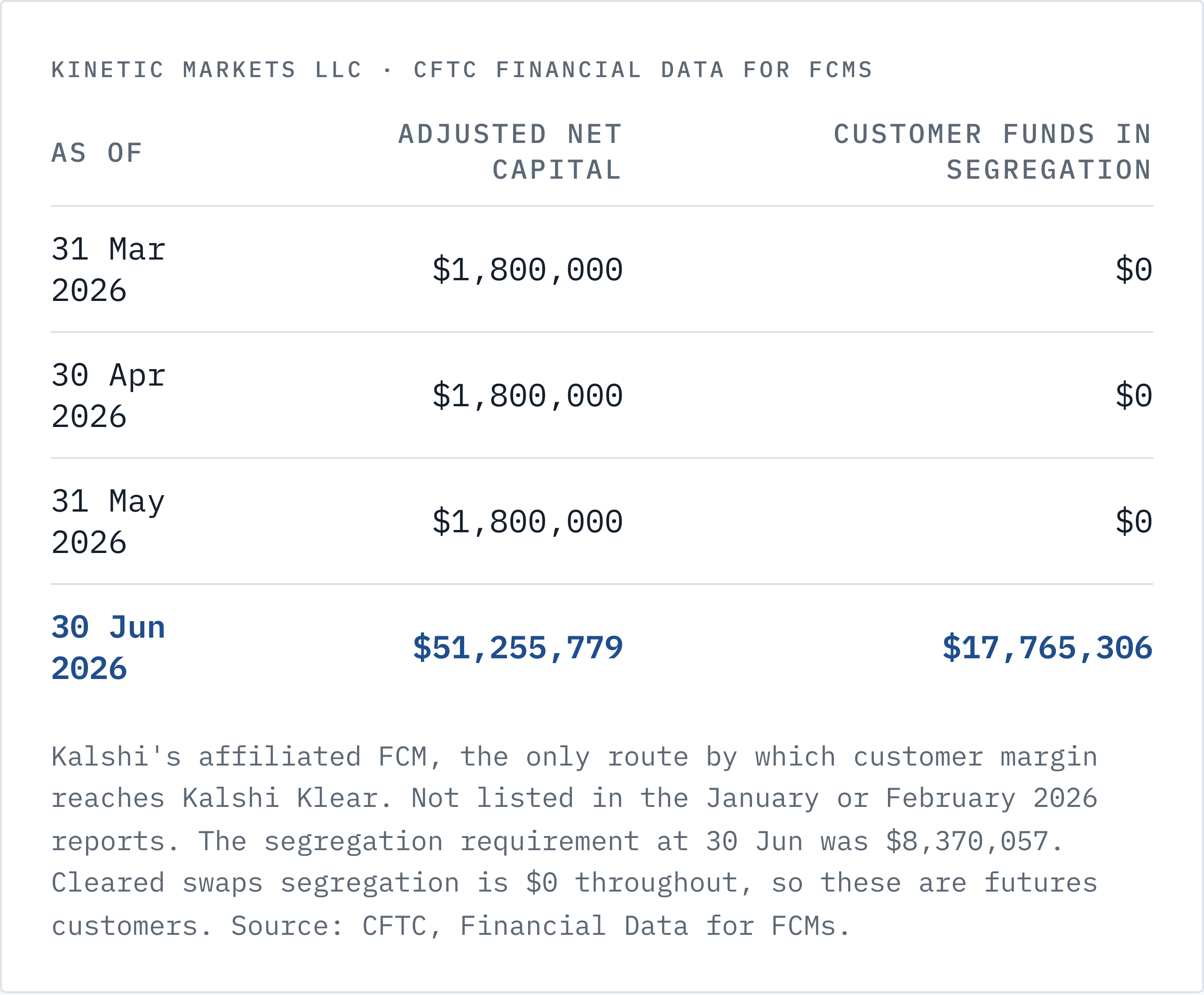
Three months at the regulatory minimum, no customer money at all. Then in June the capital goes up 28.5 times and $17.8m arrives against a requirement of $8,370,057. Cleared swaps segregation is still zero: these are futures customers.
I read that as the margined book opening.
End to end: ask to widen the licence (July 2025), register the affiliated broker (March 2026), get it widened (13 April), self-certify the margined rulebook seven days later, list the perpetual future (29 May). Then Michigan (29 June), then New York (31 July). The reconstruction finished a month before the state actions started. Kalshi owns the exchange, the clearinghouse and the broker.
Where the money sits, and why that part is fine
Here I part company with the alarmed reading, and the protective case deserves its strongest statement.
An ordinary Kalshi user’s event contract collateral is in good shape. Those contracts are still Fully Collateralized Contracts under Rule 7.5, and the clearinghouse “will not clear a position in a Fully Collateralized Contract that is not fully collateralized.” Cleared swaps collateral is segregated under Part 22, futures collateral under Regulation 1.20.
If Kalshi Klear itself ever failed, 11 U.S.C. 766(i) splits the estate into two pools, one for ordinary customers and one for clearing members, each distributed “in priority to all other claims.” I’d assumed Kalshi’s direct users, who are self-clearing members and not a broker’s customers, would sit in a junior class. They don’t. The Senate Report says section 766(i) gives member property “the same priority.” The real subtlety is that the pools are separate, each distributed only within itself, so a shortfall in one drops to a section 726 general claim instead of reaching the other.
Rule 12.6 then walls the old book off from the new one. On a margined default, “Members and the holders of Contracts shall have no recourse to any other funds or any other entity, including without limitation the Margin or Guaranty Funds that support clearing of other products (including, without limitation, the Margin held by the Company for Fully-Collateralized Contracts), the Company, Kalshi Exchange, or any of its affiliates.”
Read one way that’s a genuine protection: a blow up in bitcoin perpetuals can’t be paid out of the collateral behind somebody’s Fed decision contract. My read is that this one is right.
The exposure is the discretionary layer, and the rulebook disclaims it
Read the same sentence the other way, because it also disclaims recourse to the Company, Kalshi Exchange, or any of its affiliates.
We’ve got exactly one live test of what protects a Kalshi user when a court interferes with their trades, and it wasn’t the waterfall. When a Michigan court ordered trades “voided, cancelled and refunded” in June, Kalshi’s proposed remedy was to force liquidate the affected positions at market and then, in its own words to the Commission, “pay the difference to the affected user from Kalshi’s operational funds,” absorbing “the entire shortfall” (July order).
Operational funds. Unsegregated corporate money, paid at the company’s discretion, and the rulebook tells contract holders they have no right to it.
Kalshi also told the Commission why it could afford the gesture: it could “bear the cost of reimbursement” because “the total number of positions impacted by the specific order is limited.” That qualifier is the whole thing, and I’d underline it. My read: the remedy that made users whole in the only real test was scoped to a small population, funded from the balance sheet a $36bn claim attaches, at a company valued at $22bn.
One more note on how that exposure has been described. When the 11 August order relays a warning that a TRO “would expose traders to substantial losses exceeding the collateralized value of the contracts,” I read that as describing the value of open positions. It doesn’t describe a collateral shortfall. Note also where the sentence sits. It’s in the Background section, reciting what Kalshi told the Commission, and it is not among the Commission’s findings. The most alarming line in the public record about customer exposure is the company’s own characterisation of its own risk.
What is holding the doors open
Both emergency orders rest on CEA section 8a(9) and both assert near total insulation from review. The July order says “the merits of the Commission’s emergency determination are precluded from judicial review by operation of 5 U.S.C. 701(a)(2).” The August order notes review lies only in a court of appeals.
The power had been dormant since 1980. Reported counts of its total historical use differ, and no Commission source enumerates them, so treat the number as unconfirmed. The gap isn’t in doubt: nothing between 1980 and this summer.
The Commission that issued them “By the Commission” has one member. Its own page says the Commission “consists of five Commissioners” and lists Chairman Michael Selig, sworn in 22 December 2025, alone. Regulation 140.11 covers acting without colleagues and presumes they exist. Neither order was issued that way.
I’m not writing the one commissioner story, which is taken and overrated. I raise it for one reason. This venue stays open on a power nobody used in the forty six years before this summer, exercised by a Commission of one, asserted to be unreviewable.
Four things I cannot rule out
I can’t tell how much of that $17.8m is margined rather than fully collateralized. The FCM report gives segregated funds, not the collateralization basis of the positions behind them, and reporting says the margin feature is institutional-only with CFTC sign off outstanding. June proves the futures complex took real customer money. It doesn’t prove that money sits behind leverage today.
I couldn’t read the v1.4 redline as filed, because Kalshi requested confidential treatment. I’m working from the clean rulebook and the certification letter’s description of what changed.
The guaranty fund’s balance isn’t public, and neither are Kalshi Klear’s Regulation 39.11 filings. I can give you the formula and the floor, not the balance. At 30 June the customer money in the affiliated FCM’s segregation was $17.8m, so the $40m floor alone was about 2.25 times it. That ratio’s comfortable now, and it decays as the book grows, because the numerator is fixed and the denominator isn’t.
And the strongest objection: a judgment against KalshiEX LLC isn’t a judgment against Kalshi Klear LLC, and segregated collateral isn’t available to the exchange’s creditors. I think that’s correct, and it’s why I’ve put the exposure at the discretionary layer instead of claiming customer funds are at risk. They do share a parent and a balance sheet posture.
What would change my view
Three dated, public, resolvable things.
An amendment to Rule 12.5C obliging the company to replenish would remove the asymmetry this piece is built on, and I’d say so. Second, if the futures margin methodology arrives through a Regulation 40.5 approval instead of a 40.6 self-certification, the constraint has moved back to the regulator. I’d note that Kalshi’s representation to seek 40.5 approval names “swaps or options on futures“ and does not name futures, while BTCPERP is a future. I won’t assert that’s a loophole.
Third, if New York’s claim is dismissed or cut to a number that fits inside the balance sheet, the discretionary layer stops being interesting.
What I’d do with this
If you hold size on Kalshi as a trader, the question isn’t whether your collateral’s segregated, because it is. It’s which protections are structural and which are discretionary. The Michigan file answers that: what made users whole was a payment the rulebook says they couldn’t have demanded.
If you’re considering clearing there as a member, my question is sharper. You replenish on demand and you’re assessable to 550%. The owner’s layer is spent once. Price that before you price the fees.
I’d watch three filings, not the docket. The next Kalshi Klear rulebook and what it does to Rule 12.5C. Any filing carrying a futures margin methodology. And the first margined product open beyond the affiliated FCM’s institutional book, which is when Chapter 12 starts backing something real.
My transferable point: a clearinghouse’s safety can live in a licence condition or in a rulebook, and those degrade differently. A condition takes a Commission and nine months. A rulebook takes seven days. Kalshi’s protection didn’t disappear in April. It moved from the regulator to the regulated, and the layer that moved furthest is the one that never has to be put back.
So the question I’d put to anyone underwriting this venue: when a clearinghouse’s owner is exempt from replenishing its own default capital and its members are not, what is the right premium for clearing there, and is any level of bitcoin perpetual volume worth paying it?
📊 The Decision-Grade Version
This piece is complete on its own. The thesis, the evidence, the confounds and the filings that would kill the view are all above. Nothing was held back to sell a next step.
The Patreon note is a separate piece of work. It takes one decision from inside this story: what a clearing member at Kalshi Klear’s own minimum is exposed to, run through all six steps of the Chapter 12 waterfall with the arithmetic shown and the layers that refill separated from the one that does not. Written for people who put capital behind a view.
→ Read the Kalshi Klear waterfall trade note
→ Or join the Patreon community for every note
Elsewhere: YouTube and LinkedIn.
Cover: kalshi.com, screenshot taken 16 September 2026.