

In January 2026 Brevan Howard made Fash Golchin lead portfolio manager of its flagship fund and gave him its largest cash allocation, Hedgeweek reported. By August the ten largest allocations in that fund held 71% of its adjusted capital.
From the outside, Brevan Howard looks like a pod shop. Its website advertises “150+ Portfolio Managers“ and sells “multi-portfolio manager strategies.” We described it that way ourselves in January, when we wrote that it ran “20+ portfolio managers with individual mandates” and read its flat 2025 partly as those books netting each other out.
But the flagship’s own disclosure says otherwise. BH Macro Limited, the listed fund that puts nearly all its money into the Brevan Howard Master Fund, reports every month how that fund’s capital is spread. In August 2026 the three largest allocations held 41% of it, and three allocations each ran more than a tenth of the money. Brevan Howard is a 150-manager firm, but its flagship is a concentrated macro fund built on about ten allocations.
For anyone who owns BH Macro, that is the position: about ten books, three of them holding two fifths of its adjusted capital, and the largest run by Golchin’s team of eight. It was not always so. In early 2025 as much as 43% of the fund’s capital sat in temporary books outside any trader’s allocation. Those books have since shrunk to 7%. Six parts of the record show how the flagship got here:
The 2011 machine
The flagship shrinks inside the firm
Inside BH Macro’s monthly report
From temporary books to allocations
2025, the flat year
The December 2026 test
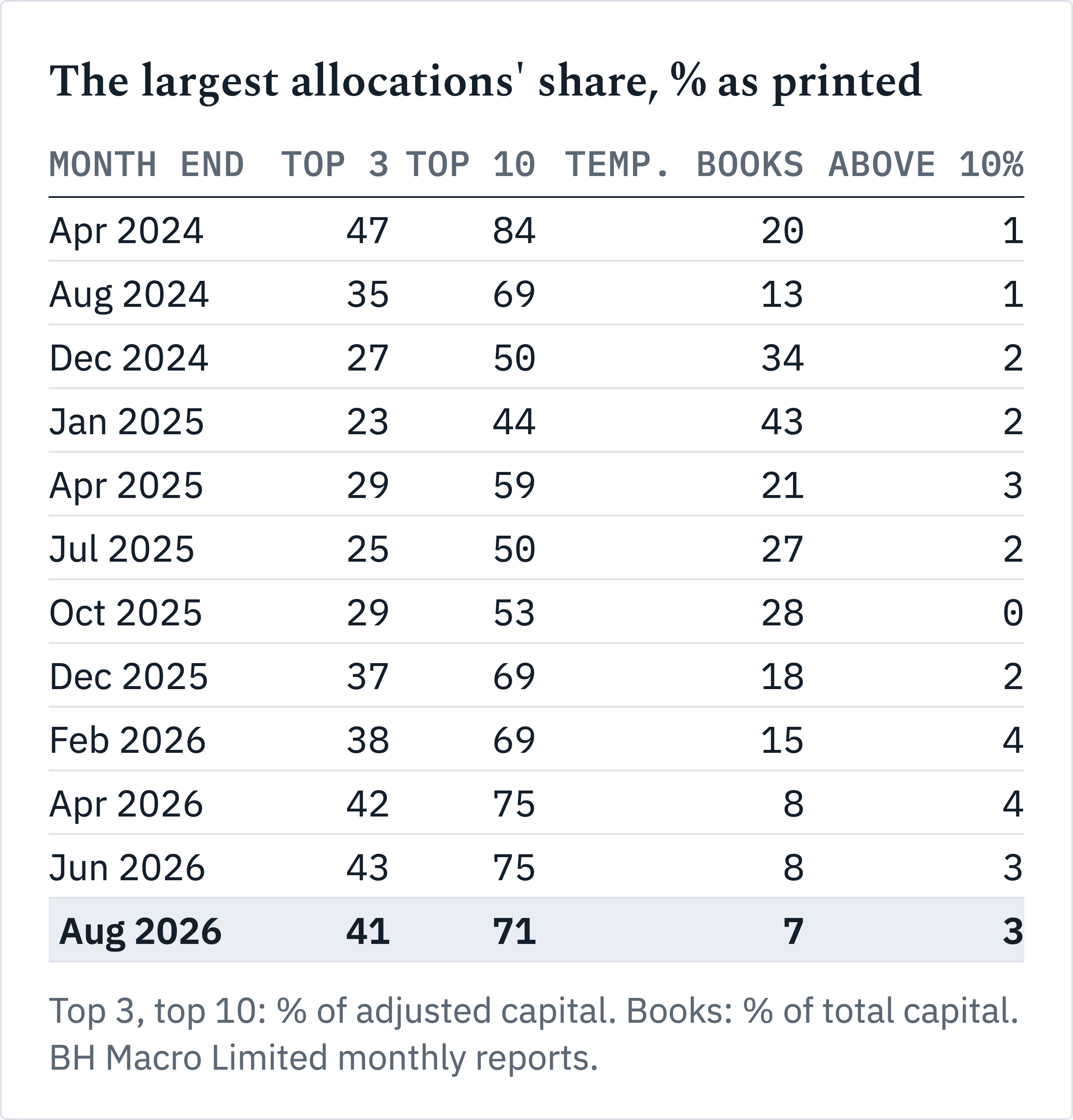
Source: BH Macro Limited monthly shareholder reports, as printed. The temporary books were called “strategic books” in April 2024 and “Risk Overlay Strategies” from August 2024.
How to read it. Adjusted capital is each allocation’s capital scaled by Brevan to the same severe loss risk, so a cautious book and a geared one can be compared; the weights are not published. The temporary books are tactical positions the fund opens and closes on its overall risk, outside any trader’s allocation. The report counts them in the total but not in the top three or top ten, so when they are large the printed shares understate how much of the traders’ own capital the biggest allocations run.
The 2011 machine
In April 2011 the consultant Cliffwater wrote a due diligence report on Brevan Howard for the Rhode Island Treasury, and a redacted copy is public. It is an early look from inside, with two limits: it is one allocator’s consultant writing at one date, and parts are blacked out.
Five partners had founded Brevan Howard in 2002, all from Credit Suisse First Boston: Alan Howard, Christopher Rokos, Trifon Natsis, James Vernon and Jean-Philippe Blochet. The Master Fund launched in April 2003 with $870 million. By 31 March 2011 it held $24.7bn of the firm’s $32.6bn, or 76%. In money terms, Brevan Howard was one fund.
The firm had 339 employees. Cliffwater counted “more than 85 investment professionals, including 45 traders, 14 economists, and 4 strategists”. The fund ran on those traders. “The fund is comprised of a group of approximately 45 different traders,” the report says, each with “a strict, unique written mandate that specifies the limits of the trading strategy including capital allocation, risk limits such as VAR and DV01”. VaR is value at risk. DV01 is the loss from a one basis point move in rates.
Each mandate came with a ladder of losses:
At a 4% loss, the trader reviews positions with the risk officer.
At 8%, the trader is “subject to a mandatory reduction in risk limits”.
At 12%, the trader “may be required to sharply reduce risk or take time off from trading”.
Cliffwater added a sentence that tells you how the ladder worked in life: “In practice, a trader’s capital will be cut sharply before they reach the 12% drawdown”. The top rung was a backstop. Capital was cut well before it.
Capital came from a committee. “The firm’s investment committee distributes capital among the individual traders,” the report says. It met monthly, reviewed every trader’s capital formally once a year, and could move capital away from a trader whenever it judged it necessary.
The risk function sat outside the star system. Aron Landy, then chief risk officer, reported to joint chief executive Nagi Kawkabani “rather than to Mr. Howard”. Even the founder was a line on the risk sheet: “Mr. Howard does not participate in these discussions and his book is specifically reviewed and discussed at the weekly meetings.”
Put those pieces together and you have the risk machine people now associate with the big platforms that split capital across many managers. Traders hold written mandates. A committee hands out capital, and losses are cut on a schedule. A risk chief who does not answer to the founder enforces it.
What differs is scale and scope. The 2011 machine had about 45 traders, and it governed one fund that held three quarters of the firm’s money. Today the firm advertises 150+ portfolio managers across many products, and Landy, the 2011 risk chief, runs it as chief executive. The machine kept growing. The flagship’s place inside it did not.
By 2011 Brevan Howard had built a pod shop’s risk machine and pointed it at a single macro fund.
The flagship shrinks inside the firm
The Master Fund grew fast before the firm grew around it. Its year end assets went from $2.65bn in 2003 to $15.3bn in 2007 and $24.7bn in 2010, per the same Cliffwater report.
Then the firm grew around it. Brevan Howard now reports “over 1000 team members” in nine hubs, from London and New York to Bengaluru and Austin. It sells “multi-portfolio manager strategies, single-portfolio manager strategies and thematic co-investment opportunities”. In October 2019 the firm said Alan Howard would step down as chief executive by the end of that year, with Landy taking over, and that “Alan will focus on his own trading activities,” Reuters reported.
The manager ran about $34bn at the end of 2025, according to BH Macro’s chair. The Master Fund’s net assets that day were $11.06bn. Divide one by the other and the flagship is roughly a third of the firm, against 76% in 2011. Firm assets barely moved over that span, from $32.6bn to about $34bn. The flagship’s share fell by more than half.
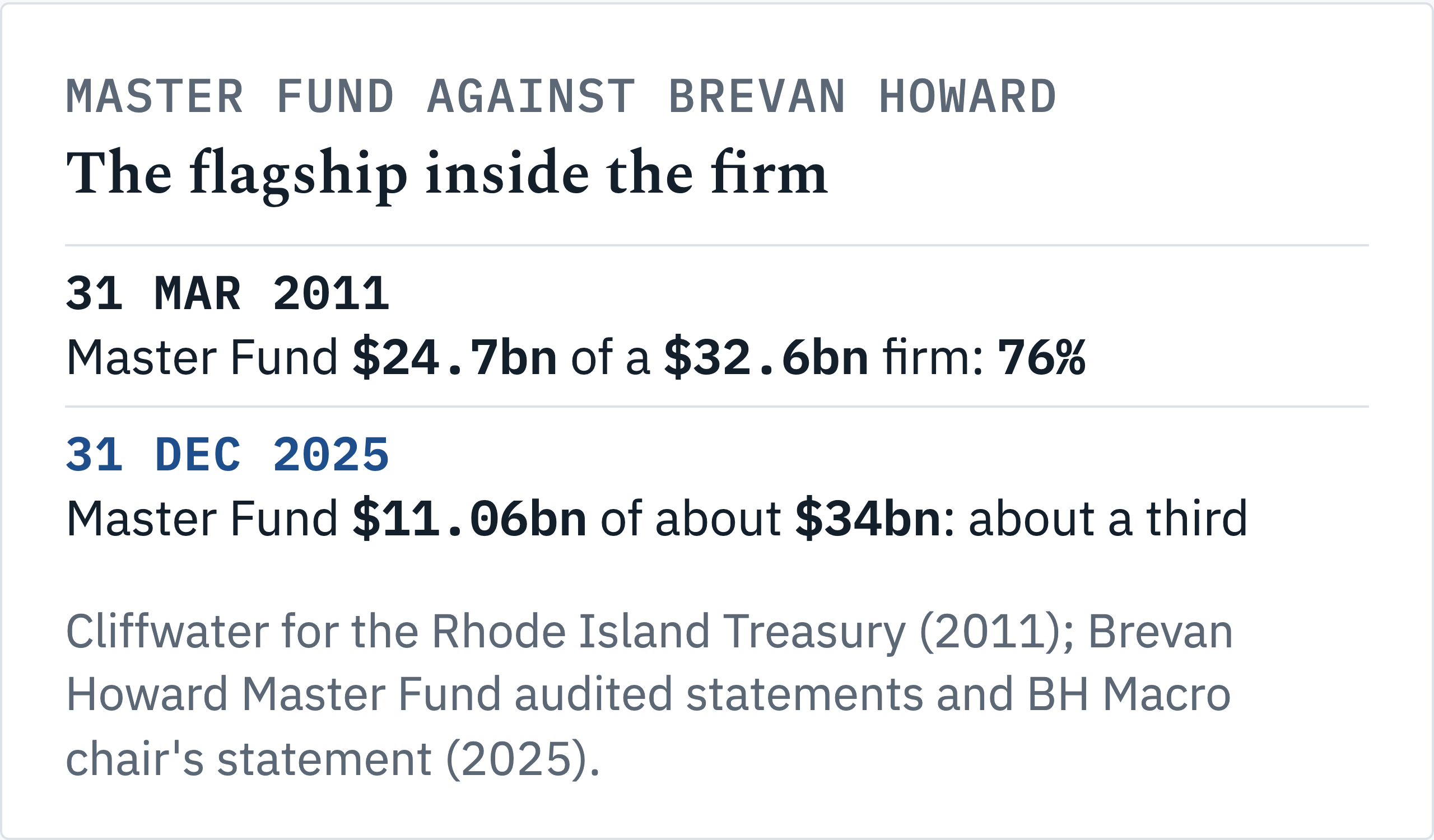
Source: Cliffwater for the Rhode Island Treasury (2011); Brevan Howard Master Fund audited statements and BH Macro chair’s statement (2025).
That correction applies to us too. Our January piece called Brevan a “$34B Master Fund” and built a scale argument on it. The $34bn is the whole firm; the Master Fund was about a third of that.
The shrinking continued in 2025. The Master Fund lost $1.59bn to net redemptions during the year, against $655m of investment gains before the fees its feeder funds charge, so it began the year near $12.0bn and ended it at $11.06bn. The interim statements published on 30 September put net assets at $11.39bn on 30 June 2026. Hedgeweek puts the Master Fund and its sister, Alpha Strategies, at roughly $11bn each. The flagship is now one of two equals.
The fund also changed how it holds its traders. In October 2023 BH Macro said the manager expected the Master Fund to redeem its stakes in three sister master funds, BH Alpha Strategies, AS Macro and FG Macro, by 2 January 2024. Direct allocations to the teams would replace them, and holdings in other Brevan funds would fall to about 17% of assets. In 2011 Cliffwater had put that share at about 7-8% of the fund’s net asset value.
The same report sorted “every portfolio manager (’PM’) trading on behalf of BHMF” into two styles. Alpha traders had “more narrowly defined trading mandates and smoother return profiles”, and the report’s table sums up their P&L as “Smoother - try to hit ‘singles’”. Macro traders were “Lumpier - try to hit ‘home runs’”. Alpha held 55.6% of the fund’s capital and Macro 44.4%, so in late 2023 the narrow mandates were the larger half.
The partnership that had employed Brevan’s London traders since 2002 changed shape as well. On 10 May 2025 its business moved into a new company, and on 31 May Companies House recorded Alan Howard, Landy and Natsis leaving it as members. The accounts say the partnership is to “remain inactive”.
The flagship went from three quarters of Brevan Howard to a third, and the business of many managers that the label describes is the firm that grew up around it.
Inside BH Macro’s monthly report
BH Macro’s report defines its own terms in a footnote. From the January 2025 report:
“Adjusted Capital applies weightings to the traders’ nominal capital in order to normalise the data to a consistent level of potential severe downside. Total Capital exceeds AUM, accounting for gearing. Core BHMF Trader Allocations excludes Risk Overlay Strategies (’non-core books’).”
The temporary books are “temporary tactical books that will open/close based on the aggregation of risk factors across the fund as well as investment opportunities at the time.” The top 3/5/10 calculation “excludes Risk Overlay Strategies from the numerator but includes them in the denominator.”
One detail limits how far the table can be pushed. The report gives the temporary books as a share of “total BHMF capital”, a different base from adjusted capital, so the two figures cannot simply be divided into each other. We read the printed top ten share as a floor on the traders’ share and go no further.
Now the case, end to end, for August 2026:
The ten largest allocations held 71% of adjusted capital, temporary books included in the total.
The temporary books held about 7% of total capital, so the floor sits close to the traders’ own figure.
Three allocations each held more than 10% of the fund’s capital, counted at nominal value.
On the printed figures, ten allocations hold at least seven tenths of the adjusted capital and three hold two fifths.
Sized roughly, a 10% loss across those three allocations would cost the fund about 4% of its adjusted capital: 41% times 10%. That is an order of magnitude, not a forecast, because adjusted capital is not net assets.
“Allocations” is the careful word. The report says traders manage capital “directly or indirectly”, and the largest allocation has a team behind it. Golchin’s appointment as lead portfolio manager came with a trading team of eight, and his own $1.4bn FG Fund was to stop running outside money at the end of June, Hedgeweek reported citing Bloomberg.
Compare that with the picture our January piece drew. Twenty books of equal size would put half the capital with the top ten, and less once the temporary books are counted in the total. The fund printed 71%. No firm that runs many managers publishes a comparable figure, so the flagship is measured here against that benchmark, its own past and its own sister fund.
For an allocator, the portfolio manager count answers a question about the firm. The question about the flagship is the top ten share, read beside the temporary books, and it sits in a free PDF every month.
In 2026, on the fund’s own reporting, the flagship’s capital sits with about ten allocations, and three of them hold about two fifths of it.
From temporary books to allocations
In April 2024 the top ten held 84% of adjusted capital and the top three 47%, with 20% of capital in what the report then called “strategic books”. After dipping to 13% in August, the temporary books rose to 34% by December 2024, when the top ten’s printed share was 50%. In January 2025 the temporary books reached 43% and the printed top ten 44%.
The table cannot say how much of that fall belongs to the traders. With nearly half the capital outside their allocations, their printed share had to fall, and the report’s two bases do not allow a clean adjustment. What moved without any arithmetic is the temporary books themselves. For 11 of the 12 months of 2025, more than a fifth of the fund was run that way, outside any named trader’s allocation.
2025 went badly early. In March, with the Master Fund down 5.4% for the year, Landy imposed stricter trading limits on some portfolio managers, Hedgeweek reported from an investor letter seen by Bloomberg. That is the 2011 machine’s tool, a cut in a trader’s limits, used at the top of the firm.
Through the middle of the year the fund looked most like the label. From March to November 2025 the printed top ten ran between 50% and 59%, and the temporary books held 27% to 28% of capital from June to November. In August, September and October 2025 no allocation held more than a tenth of the fund. Our January piece described the fund in exactly that window.
Then the books closed and the allocations grew, in this order:
By December 2025 the temporary books were down to 18% and the printed top ten up to 69%.
In January 2026 Golchin became lead portfolio manager, and his own fund was set to close.
From February 2026 four allocations held more than a tenth each, and four still did in April and May.
By July the temporary books were 7% of capital and three allocations were above a tenth.
The reports give the sequence, not the reasons. Read in order, they show capital leaving the books run on the fund’s overall risk and going to a small number of named allocations, one of them led by the trader Brevan had just promoted.
The fund’s worst month sits in that stretch. March 2026 cost BH Macro’s dollar shares 6.22%. In the 234 months of BH Macro’s published NAV table, which starts in March 2007, no other month fell by more than 4.11%. The March report puts the losses on “interest rate and equity trading”, with the equity losses from directional exposure to Asian indices, in a month when four allocations held more than a tenth each.
The flagship has moved its risk out of books run on the fund’s overall exposure and back into a few named hands.
2025, the flat year
Chris Rokos, one of the five founders in the 2011 report, left to build his own firm, and 2025 is where his record and Brevan’s part. Rokos Capital made about 21% last year, according to Hedgeweek citing Bloomberg, which put its assets at roughly $22bn in January 2026. Brevan’s flagship was flat for its shareholders. The Rokos figure is a reported estimate; Brevan’s below come from its own documents.
BH Macro’s net asset value (NAV) per share rose 0.8% in dollars and 1.4% in sterling after fees. Inside the Master Fund, before the feeder funds’ management and performance fees, the main dollar share class returned 2.91%. Hedgeweek reported an estimated 0.75% for the Master Fund and about 8% for Alpha Strategies.
The fund’s own attribution shows where the year went. Equities and commodities added about eight points to the sterling shares; FX, rates and digital assets took nearly eight back, with FX alone costing 4.87. Discount management, the buybacks, added 0.74, which is most of the 1.4% the sterling shareholder kept. Gains in one set of markets were spent covering losses in another, so on this attribution the netting reading in our January piece holds up.
BH Macro’s chair, Richard Horlick, called the year’s return “less than satisfactory whilst it is within expected bounds of return”. Among the reasons he gave for the shares’ discount was “a lack of returns from the two historically principal drivers of return, interest rate trading and FX trading”. He added that “the Board is encouraged by the changes to process which the Manager has implemented during the course of the year”. The January 2025 report had already put the year’s first losses “primarily from interest rate and FX trading”.
Shareholders stayed anyway. The sterling shares traded at a discount of 6.7% to 10.6% during 2025, and the company bought back £115m of stock, after £116m in 2024. In February 2026, votes to close the share classes failed, with 96.23% of sterling votes and 99.91% of dollar votes against closure.
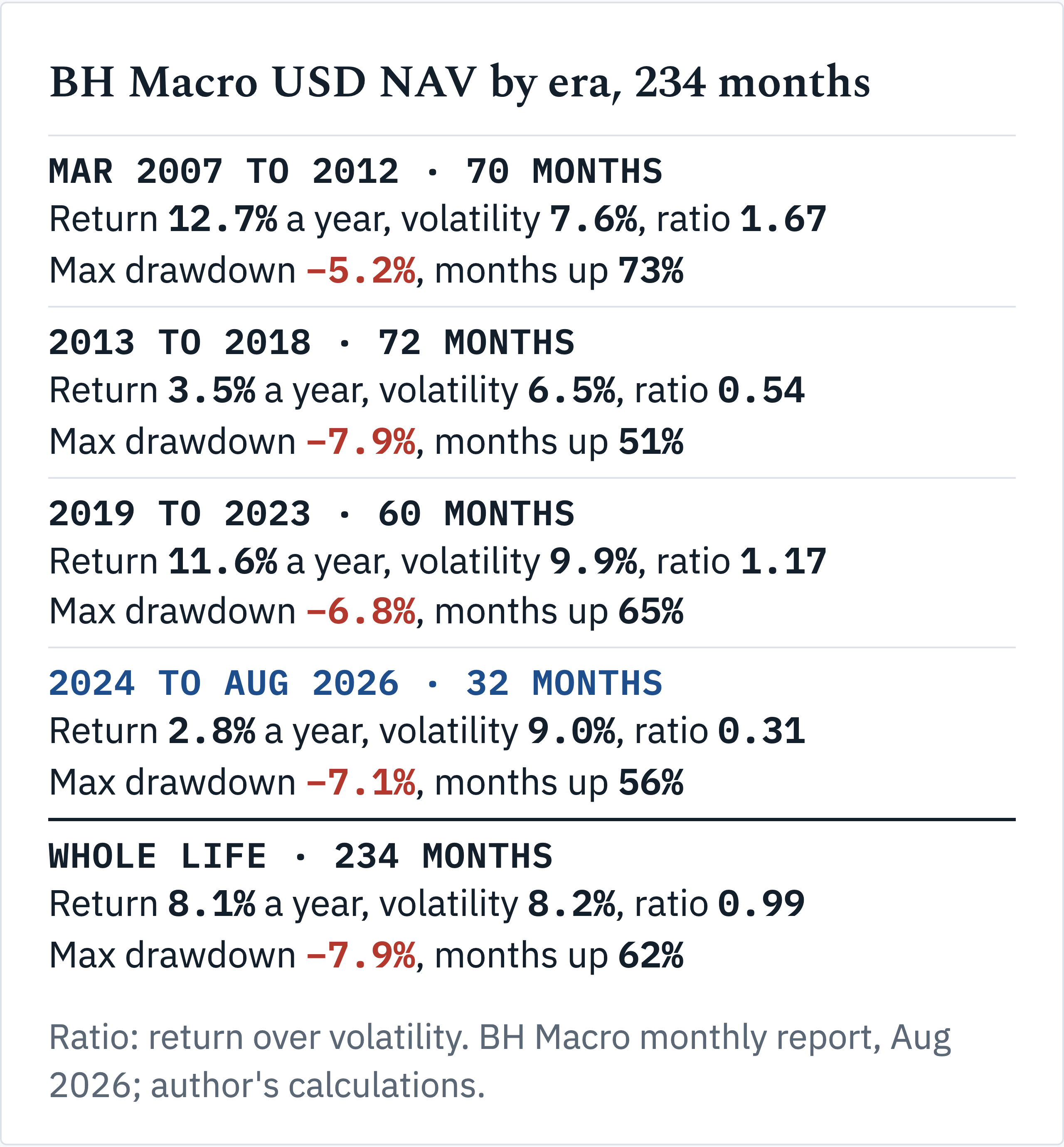
Source: BH Macro Limited monthly shareholder report, August 2026 (monthly USD NAV per share), author’s calculations.
Since 2024 the fund has returned 2.8% a year at 9.0% volatility, against 12.7% at 7.6% in its first era, so it now takes more risk for far less return. The pattern has turned before: the weak 2013 to 2018 stretch was followed by 28.89% in 2020 and 21.17% in 2022.
2025 was the year equity and commodity gains were spent covering losses in the fund’s two traditional engines, while the founder who left made 21%.
The December 2026 test
One claim is on trial: that the flagship is a concentrated fund, built on about ten allocations, and not a platform of many small books.
The firm’s portfolio manager count is not a test, because the Master Fund’s reports do not disclose how many managers trade for it. Neither is the printed top ten share on its own, because it falls whenever the temporary books grow. The test has to hold the temporary books low and then look at the allocations.
2025 shows why the temporary books matter. From March to November that year the printed top ten held 50% to 59%, and for three months no allocation held more than a tenth. But the temporary books never fell below 21% of capital in that stretch, too large for the printed shares to settle the question. In August 2026 the top ten held 71% and the temporary books 7%. If the temporary books come back above 15%, the printed shares stop being a clean test until they fall back.
We are not forecasting the fund’s return. It was up 1.78% in dollars through August 2026, after the 6.22% fall in March.
The limits, stated once. Adjusted capital is Brevan’s own weighting, and the weights are not published. The temporary books are reported against total capital, a different base from adjusted capital, so we read the printed shares as they stand. The concentration figures are the manager’s own month end estimates, and the definition of the temporary books changed during 2024. An allocation can be a team. The table shows twelve month ends; the other months cited are linked where they appear. The reports do not disclose the number of portfolio managers inside the Master Fund. Drawdowns from month end data understate losses inside a month. Concentration and returns sit side by side in this piece, never as cause and effect.
A 150-manager firm can still own a flagship that rests on ten allocations, and the monthly report is where that shows.
The argument is wrong if, by 31 January 2027, BH Macro’s monthly report for December 2026 shows the temporary books at 15% of total capital or less and the ten largest allocations below 60% of adjusted capital.
Further reading
How Millennium, Citadel & Point72 Structure Pods: Team Economics Behind $428B Multi-Manager Industry: how a true pod shop splits capital and pay across hundreds of teams, the structure this flagship turned out not to have
D.E. Shaw, Millennium and Citadel Lock Up Cash for Years. Rokos Chose the Opposite: the redemption terms behind the same funds, the other half of how a flagship’s capital stays put
Next Thursday: a named fund’s bet, read from its own filing, with the position.
→ The screen that reads BH Macro’s monthly report for concentration, with all 26 months in a sheet on Patreon, open to everyone.
Navnoor Bawa · YouTube · LinkedIn · Patreon
Cover: Brevan Howard logo · Public domain · via Wikimedia Commons
