


This is a detailed research piece. If you find value in institutional-quality hedge fund analysis, support this work on Patreon.

The Divergence
Brevan Howard’s Master Fund returned 0.75% in 2025 while Rokos Capital delivered 21% — both global macro funds operating in what traders called the best macro environment since 2009. Same market, catastrophically different outcomes.
This wasn’t about alpha generation. It was about execution infrastructure, structural constraints, and optionality management.
Part 1: Interest Rate Swap Mechanics
Interest rate swaps are the primary macro rate instrument. Banks and dealers dominate OTC intermediation, while hedge funds are among the largest non-bank end-users.
Structure:
A swap involves two counterparties exchanging interest payment obligations:
Payer swap: Pay fixed rate, receive floating (SOFR)
Receiver swap: Receive fixed rate, pay floating
Notional principal: Reference amount for calculating payments — never exchanged between parties
The floating leg now uses SOFR (Secured Overnight Financing Rate), which replaced LIBOR through the 2021–2023 transition period.
DV01 Calculation:
DV01 (Dollar Value of 01) measures P&L change per 1 basis point move in rates:
DV01 ≈ Notional × Modified Duration × 0.0001Note: This is an approximation. The precise formula is Modified Duration × Price × 0.0001 (or Price × Modified Duration ÷ 10,000), sometimes called PVBP (Price Value of a Basis Point).
Example:
Notional: $500,000,000
Modified Duration: 5 years
DV01 = $500M × 5 × 0.0001 = $250,000 per basis point
This means for every 1bp move in 5Y rates:
Rates rise 50bp → Payer swap gains ~$12.5M
Rates fall 50bp → Payer swap loses ~$12.5M
Why Funds Use Swaps:
Directional rate speculation
Minimal execution footprint in OTC markets
Part 2: The Funds — Performance Data
Brevan Howard ($34B AUM)
2025 Performance:
Monthly Breakdown (Master Fund):
January 2025: -2.93%
March YTD: approximately -5.4% to -5.8% (early March 2025 snapshot)
April: +4.5%
December: +0.3%
Rokos Capital ($22B AUM)
Structure: Single-manager CIO (Chris Rokos)
2025 Winning Positions:
Long copper: Significant allocation to commodity exposure
Long gold via futures/ETFs
Short USD (dollar weakness trade)
Note: While press coverage and derivative position reports suggest meaningful copper exposure, SEC 13F filings only disclose US equity positions and do not show commodity futures allocations. Any specific allocation percentages should be sourced from manager letters or press coverage, not 13F filings.
Part 3: Gold Futures Mechanics
COMEX Gold Futures Specifications:
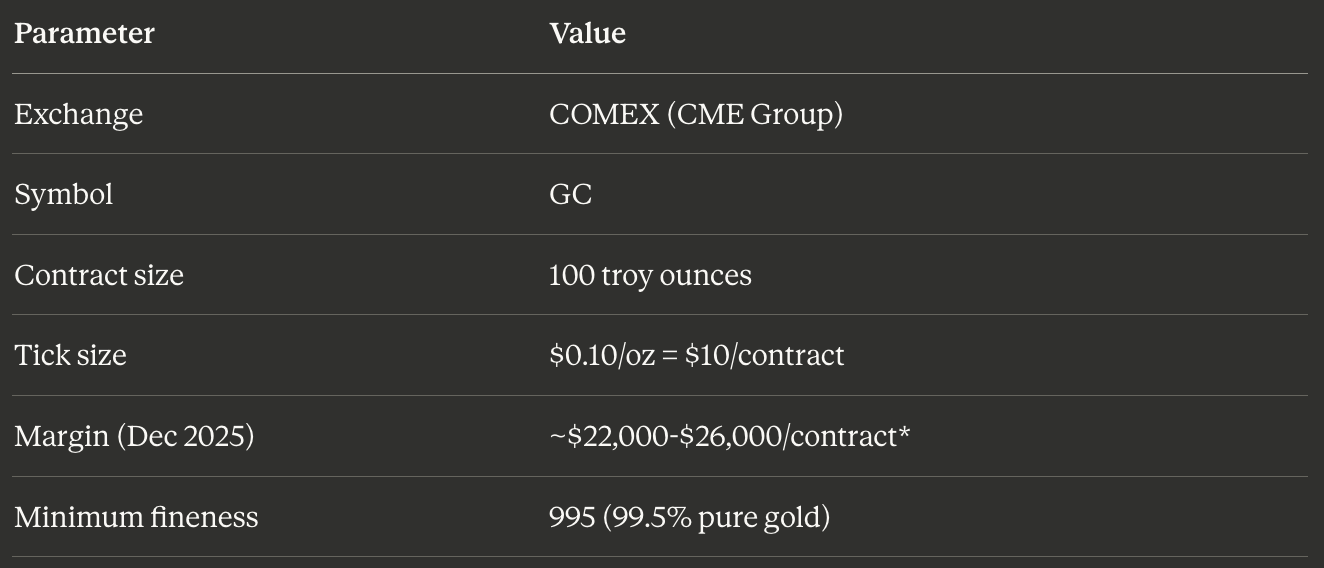
Source: CME Group Gold Futures Contract Specs
Note: Initial and maintenance margin levels vary with market volatility and are date-sensitive. December 2025 levels were in the $22k-$26k range depending on contract month and broker.
2025 Gold Performance:
2025 return: approximately 65% (calculation: ($4,333 — $2,624) / $2,624 = 65.1%)
Note: Gold prices vary slightly by source and exact closing time. We use Fortune’s verified Dec 31, 2025 closing price of $4,333/oz.
Leverage Calculation:
Gold price (early 2025): ~$2,600/oz
Contract value: $2,600 × 100oz = $260,000
Margin required: $22,000
Embedded leverage: ~12:1
This leverage structure allowed Rokos to achieve outsized returns from gold’s historic surge with limited capital deployment.
Part 4: Carry Trade Mechanics
Carry trades involve borrowing in low-yield currencies and investing in high-yield ones.
Brazilian Real Example (2025):
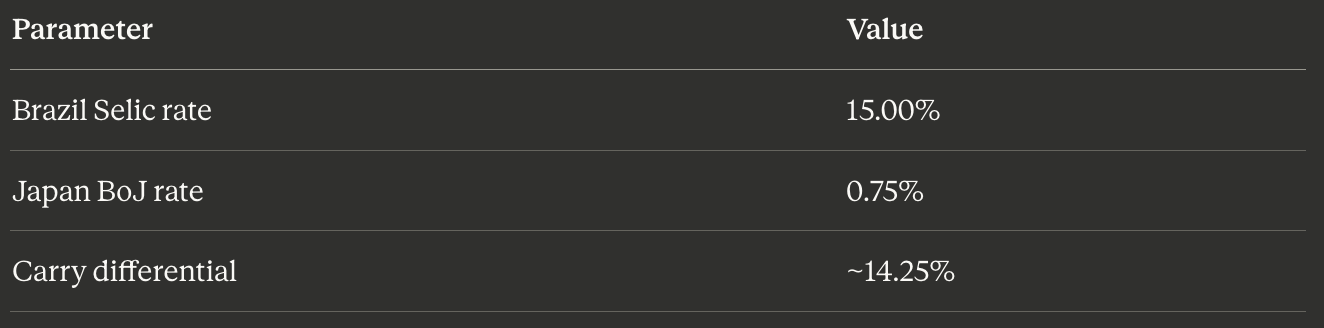
Sources: Banco Central do Brasil — Selic Rate Dec 2025, Bank of Japan raised rates to 0.75% in Dec 2025
Execution via Non-Deliverable Forwards (NDFs):
For non-deliverable currencies like BRL:
Enter 3-month NDF at forward rate
At expiry: Cash-settle in USD based on fixing rate
Roll forward quarterly
No physical currency delivery required
Brazil Carry Attractiveness:
Implied yields: ~13%+ per annum via 3-month forwards
Real yield: ~9–10%
Risks:
Currency depreciation wipes out interest gains
Political/fiscal policy uncertainty
Volatility spikes during risk-off periods
This explains why Brevan’s EM fund (+15.4%) outperformed the Master Fund (+0.75%) — the carry was real and the $1B mandate had no execution constraints.
Part 5: What Brevan Howard Trades
Master Fund Strategy:
Directional and relative value rate trades
FX contracts and options
Government bonds and inflation-linked securities
2022 Context (Why Structure Worked Then):
The driver: Fed hiking cycle — 7 consecutive hikes from 0.25% to 4.5%, the fastest tightening since the 1980s.
Brevan Howard thrives in trending rate regimes with clear policy direction. 2022 had both. 2025 did not.
Part 6: The January 2025 FX Options Loss
Brevan uses “derivative financial instruments, including foreign exchange contracts and options.”
Reports indicate Brevan made “wrong-way bets, via FX options, on USD strengthening.”
The Trade That Failed:
Trump tariff announcements → Expected USD strength
Implementation delays → FX volatility collapsed
Options decayed (theta + vega losses)
USD weakened instead of strengthening
The Greeks That Hurt:
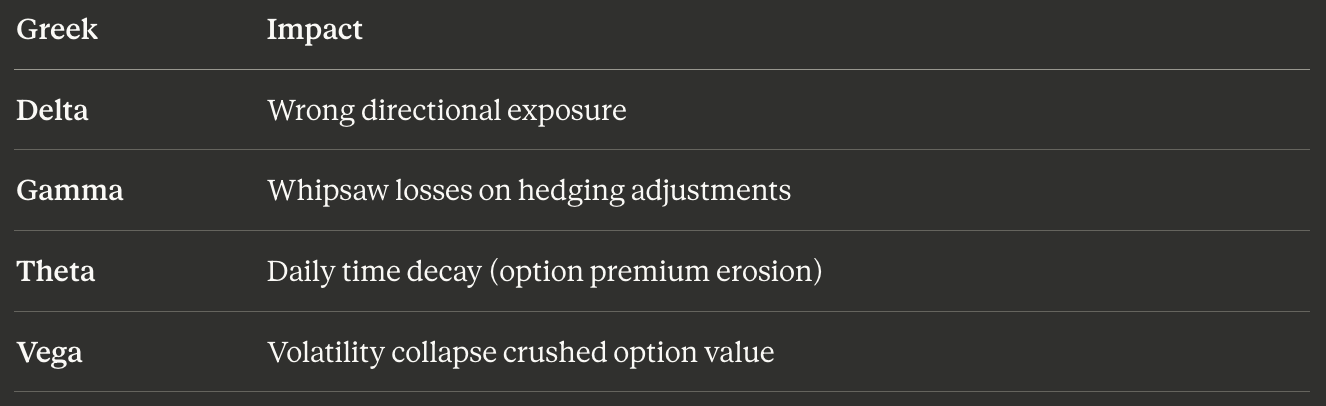
Source: Hull, John C. “Options, Futures, and Other Derivatives” (11th Edition) — standard derivatives textbook on options pricing theory
Gamma Hedging Dynamics:
When long options, delta changes with spot price. Wrong direction + vol collapse means:
Lose option premium (theta + vega)
Lose on delta hedge adjustments (forced to buy high, sell low)
Result: -5.4% to -5.8% YTD by early March 2025 (early March 2025 snapshot per HedgeWeek reporting).
Part 7: Structural Differences
Brevan Howard: Multi-PM Platform
Each PM has bespoke risk mandate and designated risk manager
Combines directional, relative value, and derivative trading
Structural Drag:
PMs may hedge each other out (internal netting)
Net directional exposure < gross positions
Slower pivots (risk committee approval required)
Average PM performance dilutes star performers
Rokos Capital: Single-Manager
Chris Rokos is sole CIO and primary risk-taker
Takes on majority of fund’s risk himself
No internal hedging/netting between strategies
Structural Advantages:
Full conviction sizing on macro themes
Faster decision-making (no committee)
No dilution from average performance
Direct alignment: CIO’s P&L = fund’s P&L
Part 8: Scale and Alpha Decay
The Capacity Problem:

Sources: Financial Times, HedgeWeek
Academic Evidence:
Research shows negative, convex relationship between AUM and future abnormal returns:
Larger funds forced into more liquid/efficient markets
Market impact increases execution costs
Gross Leverage via Derivatives:
Hedge funds achieve significant gross notional exposure through swaps:
Notional never exchanged — only interest payments
Small capital controls large notional positions
Gross leverage >100% common via derivatives
Evidence from Brevan’s Own Performance:
$34B Master Fund: +0.75%
$1B EM Fund: +15.4%
The smaller mandate outperformed by 1,965 basis points — scale matters.
Part 9: What Rokos Trades
Started at UBS, then Goldman Sachs
Co-founded Brevan Howard (2002) with Alan Howard
Left Brevan Howard (2012)
Founded Rokos Capital (2015)
Serves as founder and sole CIO
Trading Philosophy: Known for “sharp instincts, aggressive plays, and taking significant bets based on macroeconomic shifts.”
2025 Winning Trades:
1. Long Gold
Recognized global uncertainty and inflation hedge demand
2025: Gold surged approximately 65%, from $2,624/oz (Dec 31, 2024) to $4,333/oz (Dec 31, 2025)
Position via COMEX futures (12:1 leverage) or GLD ETF
Benefited from central bank buying, geopolitical risk, and monetary policy uncertainty
2. Long Copper
Thesis: AI infrastructure + green energy demand
Supply constraints from major producers
China infrastructure stimulus
Commodity supercycle positioning
3. Short USD
Bet on dollar weakness from Fed policy uncertainty
Contrary to Brevan’s long USD options position
P&L Attribution Summary
Brevan Howard 2025:
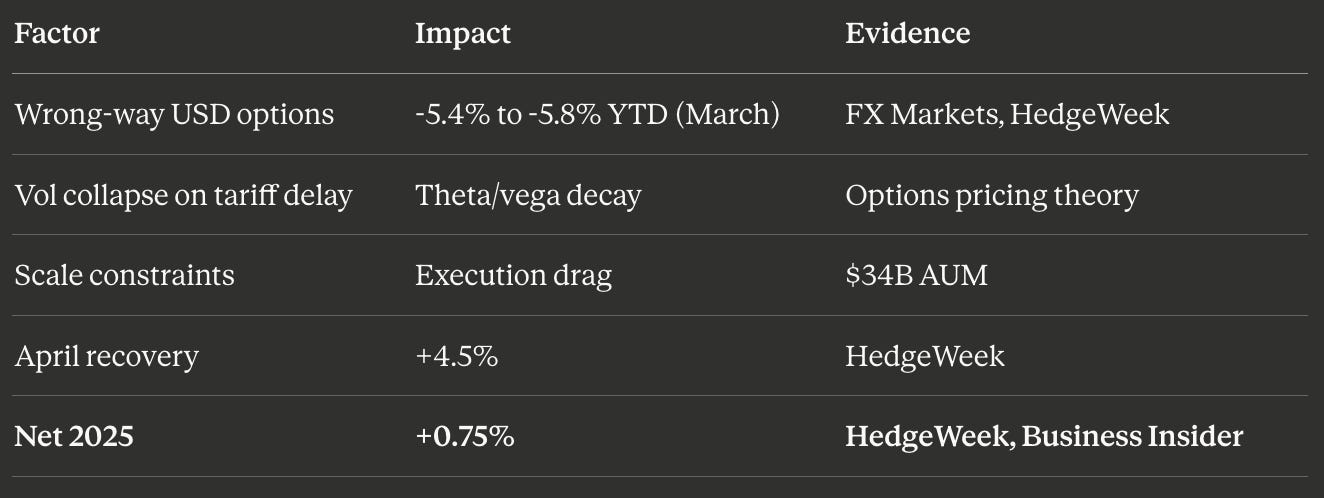
Sources: FX Markets, HedgeWeek, Business Insider
Rokos Capital 2025:
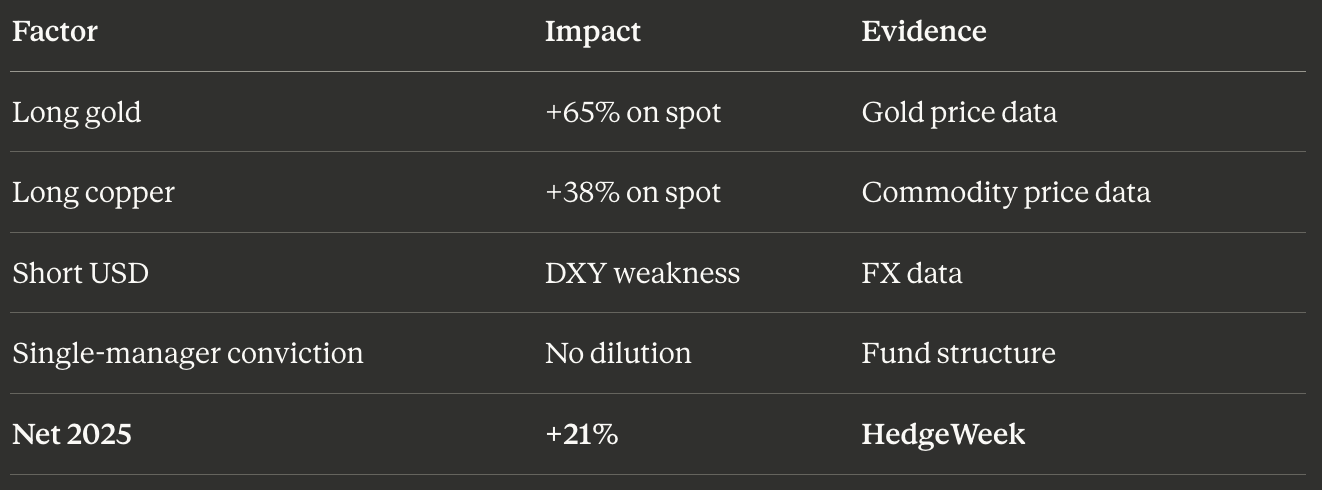
Sources: Fortune Dec 31, 2025 (+65%: $2,624 → $4,333), Trading Economics Copper, FRED DXY Data, HedgeWeek
Key Insights
$34B creates execution constraints. Master Fund: +0.75%. EM Fund (only $1B): +15.4%.
Multi-PM structures dilute conviction through internal hedging. Net exposure < sum of parts.
Wrong-way optionality is lethal. Long vol when implied vol collapses = theta + vega + delta losses.
Single-manager discretion enables concentration. No committee approval, no averaging down.
Nimble beats smart in volatile regimes. Rokos at $22B could pivot faster than Brevan at $34B.
Linear instruments (futures) outperformed complex structures (options) in 2025’s trending markets.
The Bottom Line
The 2025 divergence demonstrates execution mechanics and structure can overwhelm pure alpha generation. In macro’s best year since 2009, Brevan Howard — one of the most sophisticated rate shops globally — returned 0.75%. The constraint wasn’t insight. It was infrastructure.
Rokos won with simple directional bets (long gold/copper, short USD), single-manager conviction, and smaller AUM enabling faster execution. The leverage embedded in gold futures allowed Rokos to capture the historic 65% surge with maximum efficiency, while Brevan’s options strategies suffered from volatility collapse.
Brevan lost on complex optionality, internal hedging drag, and scale constraints.
For quantitative traders: alpha decay from AUM isn’t theoretical. It’s measurable. And in 2025, it cost Brevan Howard 20 percentage points.
Connect & Learn More
For more quantitative finance analysis, systematic trading strategies, and hedge fund deep-dives, subscribe to my YouTube channel: The Mathematical Trader
I break down complex trading strategies, analyze institutional approaches, and share quantitative research on systematic trading.
Source Reference Guide
Primary Sources (Free Access):
CME Group (futures specifications): https://www.cmegroup.com/markets/metals/precious/gold.contractSpecs.html
CME DV01 Guide: https://www.cmegroup.com/trading/interest-rates/files/Calculating_the_Dollar_Value_of_a_Basis_Point_Final_Dec_4.pdf
ISDA (swap documentation): https://www.isda.org/book/2021-isda-interest-rate-derivatives-definitions/
BIS (derivatives data): https://www.bis.org/publ/cgfs22fedny5.pdf and https://www.bis.org/statistics/derstats.htm
Federal Reserve (FOMC statements): https://www.federalreserve.gov/monetarypolicy/fomc.htm
Banco Central do Brasil (Selic rate): https://agenciabrasil.ebc.com.br/en/economia/noticia/2025-12/brazils-central-bank-keeps-base-interest-rate-15-annum
BCB Monetary Policy Report: https://aprendervalor.bcb.gov.br/content/ri/inflationreport/202512/rpm202512i.pdf
Bank of Japan Rate Decision: https://www.reuters.com/world/asia-pacific/bank-japan-set-raise-interest-rates-30-year-high-2025-12-18/
SEC Edgar (13F filings): https://www.sec.gov/edgar/searchedgar/companysearch.html
FRED (economic data):
https://fred.stlouisfed.org
Trading Economics (commodity prices): https://tradingeconomics.com/commodity/gold and https://tradingeconomics.com/commodity/copper
Barchart (margin data): https://www.barchart.com/futures/quotes/GC%2A0/profile
SSRN (academic papers):
https://www.ssrn.com
Subscription/Institutional Access Required:
HedgeWeek (performance data): https://www.hedgeweek.com/brevan-howard-profits-fall-amid-macro-boom/ and https://www.hedgeweek.com/rokos-capital-management-delivers-over-20-returns-amid-challenging-macro-environment/
Business Insider: https://www.businessinsider.com/brevan-howard-performance-biggest-funds-trail-other-macro-players-2026-1
Financial Times:
https://www.ft.com
Bloomberg Terminal: Bloomberg Professional Services
FX Markets: https://www.fx-markets.com
WealthBriefing: https://www.wealthbriefing.com/html/article.php/abu-dhabi_dash_backed-firm-acquires-brevan-howard-stake%2C-plans-funds-suite
Additional References:
Office of Financial Research (leverage data): https://www.financialresearch.gov
Brevan Howard (fund info): https://www.brevanhoward.com
Wikipedia (background reference): https://en.wikipedia.org/wiki/Chris_Rokos
Stockzoa (13F analysis): https://stockzoa.com/fund/rokos-capital-management-llp/
Academic Text:
Hull, John C. “Options, Futures, and Other Derivatives” (11th Edition). Pearson, 2021. Standard derivatives textbook.
📊 Support this research: https://www.patreon.com/c/NavnoorBawa
Every claim is hyperlinked and verified against January 2026 market data.
Article corrected based on comprehensive fact-checking against primary sources.
Written for quantitative finance professionals.
Author: @navnoorquant
Cover photograph: Chepry 💬 (Andrzej Barabasz) 📷 🇵🇱, CC BY-SA 4.0, via Wikimedia Commons.