


On 27 August 2026, AQR’s Form ADV listed 191 Flex hedge funds; 187 listed one beneficial owner. They are the newest part of the tax business Bloomberg credits with making AQR the world’s largest hedge fund manager. That business sells two things: deferral of gains, and ordinary losses that can offset wages, within a limit.
The IRS notice, open for comment until 28 October, describes the second: swaps, currency forwards and straddles. Bloomberg ties those losses to AQR’s commingled funds, Delphi Plus first; AQR’s materials for the separate Flex accounts list none. Guidance by 31 March 2027 tests whether the notice stops at the commingled funds.
A holder’s exposure turns on which product his fund sells, and AQR’s on how much of its growth those commingled funds carried.
I read four of AQR’s Form ADV filings, the SEC registration that lists every private fund, from November 2024 to August 2026. I matched the Flex funds on the May 2026 filing to their Form Ds, the notices a fund files after its first sale. In order, they show:
Taxes built AQR’s size: tax funds went from 10.6% to 43.5% of its private fund gross.
Three wrappers make one tax machine, the newest a hedge fund of one.
Clients buy deferral or ordinary losses; documents Bloomberg saw put Delphi Plus’s 2025 ordinary losses at 28% of capital.
Washington is reading one half: the notice’s three trades need a derivative or a currency election.
Below the wall, a split of AQR’s private fund growth, fund by fund, measures how much of it the notice describes.
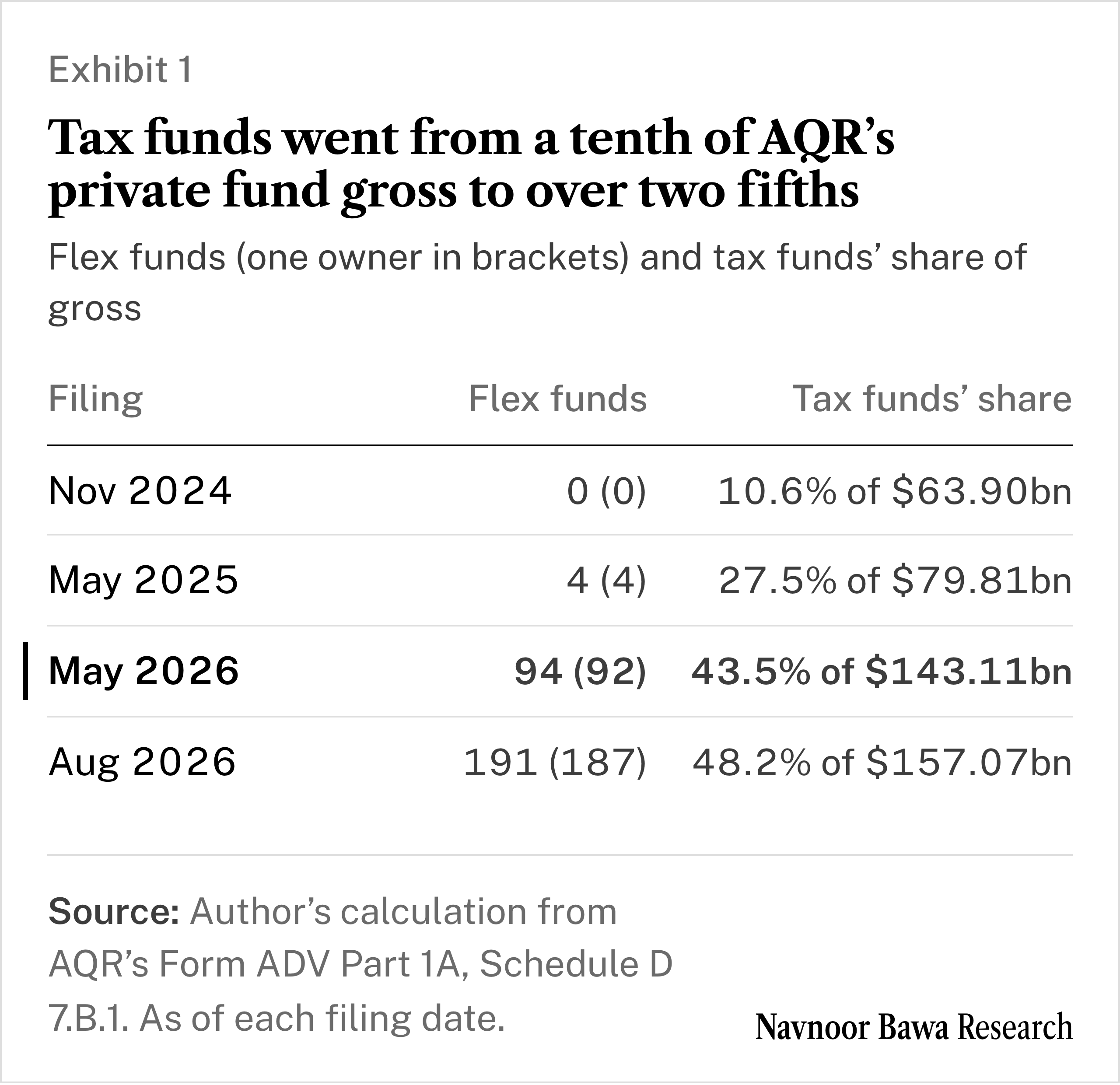
Source: Author’s calculation from AQR Capital Management, LLC Form ADV Part 1A, Schedule D 7.B.1 (Q11, Q13), filings of 27 Nov 2024, 30 May 2025, 29 May 2026 and 27 Aug 2026.
Read down the last column to May 2026. Tax funds are the Flex funds plus the commingled AQR TA (tax aware) funds; gross is each fund’s gross assets on its Form ADV row, never client money.
Taxes built AQR’s size
Alternative Fund Insight’s power list of 26 March 2026 had AQR’s hedge fund assets up 89% in 2025 to $109.1bn, “ahead of long-time leader Bridgewater Associates”. On 4 August, Hedgeweek, citing a Bloomberg report, called AQR “the world’s largest hedge fund manager”. Bloomberg’s headline named the cause: “A Tax Strategy for the Rich Built the World’s Largest Hedge Fund”.
None of the three says what it counts, so the rank stays theirs. A Bloomberg Law headline on the notice added the sequel, “Tax-Slashing ‘Holy Grail’ Popularized by AQR Dealt IRS Warning”. Read together, they say the strategy that built the rank is the one the IRS warned about.
The test is the fund row reading: Schedule D of Form ADV gives each private fund a row, with gross assets at Question 11 and beneficial owners at Question 13. Gross counts the long side of a levered book in full, which is why AQR’s $312bn of regulatory assets sits well above the $187.18bn of client net assets in its brochure at the end of 2025. I sorted every row into Flex funds, TA funds and the rest, leaving out AQR Arbitrage, a sister adviser with its own filing.
The trap is the date. All four filings are amendments between annual filings, which the SEC’s instructions do not require to refresh asset figures, so each mixes old values with new series, August most of all; its tax share reads 48.2%. I measure on the May 2026 filing: 43.5%, gross against gross.
On money, Institutional Investor reported that by the end of 2025 “more than a third of its total assets” sat in tax aware funds. On private fund gross or on money, tax is a third or more, and it is the part that grew. The label is right that taxes built AQR’s size; it does not say which tax.
Three wrappers, one tax machine
Cliff Asness, AQR’s cofounder and principal owner, gave the reason in a 2021 essay titled “Now There’s Nothing Certain But Death”. “For almost my entire career I’ve been vexed that investments for taxable investors didn’t focus enough on after-tax returns, and many taxable investors didn’t seem to care,” he wrote. AQR’s brochure calls the answer “tax-aware implementation of some of our strategies”: its systematic strategies, sold through three wrappers.
The first is the Flex accounts: separately managed accounts (SMAs) that advisers and wealth managers sell at “typically $1 million”, per AQR Flex’s Form CRS, its client relationship summary. The Flex accounts get no fund rows.
Loukia Gyftopoulou, a Bloomberg reporter, told NPR on 1 October that, in the few years since it began offering the strategy, AQR went “from having 3 billion in these accounts to having 70 billion”. That is about the size of the whole tax aware business, which Institutional Investor put at “about $68.8 billion” in June, so her “these accounts” may mean all of it.
The second is the TA funds, ten commingled private funds named “AQR TA” on the August filing, which added Delphi Long Short Equity Fund II beside the original Delphi Long Short Equity. Delphi Plus is the largest by gross, and Delphi Long Short Equity has more owners.
The third is the Flex funds: series of AQR Flex 1 Series LLC, each listed as its own private fund and managed by AQR Capital Management II. None was on the November 2024 filing. These are hedge funds of one: Form ADV’s instructions make any private fund that “may sell securities or other assets short” a hedge fund.
Series G1 is one. Its Form D, filed on 7 May 2026, records $100m sold to one investor; the August filing shows $311,342,000 of gross and one beneficial owner.
No document I read says why AQR puts one client’s book in a fund of its own. An AQR paper on funds of one in general, not on its own Flex funds, says such a fund “may technically qualify as a partnership, but in substance, it often resembles an SMA”. It adds: “A legal wrapper cannot be used to circumvent anti-abuse rules.” On that reading the wrapper changes the label, since an SMA gets no row on Schedule D, and should not change how the anti-abuse rules apply.
One machine, then, with three doors, and the newest opens onto a hedge fund with one beneficial owner.
Clients buy deferral, or ordinary losses
Bloomberg’s August story put the Flex pitch: “Invest $100 million in the most aggressive of AQR’s Flex strategies”. Over ten years, “it may generate over $580 million of losses that can be used to erase taxes from other investments.” Institutional Investor reports the reading of AQR’s Flex marketing presentations by Nate Koppikar, a short seller at Orso Partners, that “Flex SMA projects cumulative net capital losses of 723 percent of invested capital over ten years”. His figure names the Flex accounts; Bloomberg’s names no wrapper.
AQR answers that the losses are not the point: “most of the tax benefit of TA LS strategies, relative to their tax-agnostic counterparts, comes from the deferral of gains,” it wrote on 28 September. Deferral means postponing the realisation of gains, and the losses buy it:
The account holds long and short positions, with leverage.
It sells positions that have fallen, realising capital losses that can be used against gains elsewhere.
It keeps those that have risen, so the kept winners become unrealised gains, taxed only when sold.
The two figures and AQR’s answer describe one book. Each loss realised cuts the book’s tax basis by as much, so the unrealised gain grows with every one. What the losses are worth depends on the exit. A seller pays tax that may “offset some of the benefits accumulated along the way”, per AQR’s Not Locked Up. Heirs get “a basis step-up at death”, per its lifecycle paper, but shorts are not stepped up, leaving “a small remaining built-in gain of 19% of the current NAV” in its 150/50 case.
The second product
The second product changes a loss’s character, capital or ordinary, which decides what it can offset. Two Bloomberg figures rest on documents its reporters saw. Justina Lee wrote on 22 November 2024 that “An AQR presentation obtained by Bloomberg News shows” Delphi Plus “was able to generate ordinary losses amounting to 31% of capital invested in 2023”. On 29 September 2026, Sridhar Natarajan and Loukia Gyftopoulou wrote that the fund “recorded ordinary losses in 2025” equal to 28% of capital invested, “according to documents seen by Bloomberg”.
The rest comes from people familiar with the funds. One told Lee that Delphi Plus’s trades include “notional principal contracts, or NPCs”, the class of contract that includes swaps. Her story added: “AQR has at least two more, the people said, including the trend-following TA Helix Fund” and the multistrategy TA Legacy Fund.
Mark Stancato of VIP Wealth Advisors wrote on 10 August that “In Delphi Plus, swap and currency activity can generate separately stated ordinary income or expense”, while AQR Flex “may generate capital losses”. AQR, he added, “explicitly takes the position that its tax-aware funds are trader funds”, funds that trade as a business, so Delphi Plus’s ordinary losses “may potentially offset W-2 income”, within limits that include the cap on business losses.
Take one holder at Delphi Plus’s $5m minimum (its Form ADV row and Form D): at 2025’s 28% that is $1.4m of ordinary losses. The 2025 cap lets a joint filer set $626,000 of business losses against wages; at the 37% top federal rate, that is about $232,000 of tax that year, and the rest carries forward.
Daniel Hemel, a New York University law professor who specializes in taxation, told Institutional Investor: “The IRS could stop it because it is using derivatives to generate ordinary losses.” The same story added: “Hemel isn’t so sure the IRS would shut down the Flex SMA strategy.” His line runs where the swaps are: in Delphi Plus.
A fund’s name does not tell a holder what he owns: Delphi Long Short Equity shares Delphi Plus’s TA wrapper, and no document I read states its tax character. Every fund tied to ordinary losses is a commingled TA fund that AQR, by Stancato’s account, treats as a trader fund.
No Flex fund’s offering document is public. AQR Flex describes “long/short equity strategies” with no swaps or derivatives, but it describes the Flex accounts. I class the funds of one with them because AQR’s paper says such a fund resembles an SMA, and no document I read puts a derivative in either.
Washington is reading one half
Notice 2026-62, released at the end of September and printed in the Internal Revenue Bulletin of 19 October, names no manager. It asks for comments by 28 October on tax aware fund strategies that “create a pattern of generating capital gain and ordinary loss”. Section 3 describes three trades, held in “an investment partnership or a separately managed account”, and each lets a loss arrive as ordinary while the matching gain stays capital:
An identified straddle pairs a currency forward with a currency future, or an equity index swap with a future on the same index, and closes the future first, so a gain lands as capital and the matching loss as ordinary.
Currency forwards are bought and sold the same day, and an election chooses each forward’s character after the fact.
A fund that is “a trader for federal income tax purposes” ends its winning swaps just before a scheduled payment, so the gain is capital, and holds its losing swaps to the payment, so the loss arrives as ordinary expense.
A book that holds only stocks, long and short, has no currency contract or swap to elect or close, so none of the three fits it. Section 3 calls its one stock example, an index investor who sells losers and keeps winners at year end, “long-standing, well-established”: a long only book, with nothing said either way about a levered long and short one.
Section 4.01(4) keeps the door open, asking about “other investment fund strategies” that “may be viewed as producing unintended federal income tax results”. Guidance “could apply prospectively only or retroactively”, and a retroactive rule would reach losses already taken.
The platforms moved first, on new money. Fidelity restricted new client assets in long and short SMAs from February 2026, by Koppikar’s account, and Schwab lifted its minimum for some such accounts from $1m to $10m on 16 September, Bloomberg News reported.
Institutional Investor, which obtained his letter to Orso’s investors, quoted Koppikar: “if regulatory action forces custodians to reconsider the risks of facilitating these structures, the entire AQR Flex SMA growth engine seizes up overnight.” His engine is the Flex accounts, so no Schedule D row can test him.
When a manager’s growth is a tax product, the question is what its trades sell, deferral or character, and whether they run in a commingled trader fund. That question reaches every tax aware long and short manager, every league table that counts tax accounts as hedge fund assets, and Affiliated Managers Group (AMG), which holds an equity stake in AQR. Michelle Celarier of Institutional Investor reported that “AMG’s CFO has said that the company expects AQR to account for more than 20 percent of its earnings this year.”
So far the evidence points away from the funds of one: nothing I read ties one to the notice’s trades, though the Flex funds went from none in November 2024 to 94 in May 2026.
How much of AQR’s private fund growth sits in the funds tied to ordinary losses, and how much in its funds of one?
Below the paid line:
The table: the change in gross by fund and family, November 2024 to May 2026, graded by evidence, then Form D sales.
Delphi Plus’s owner curve; the largest fund of one; the Flex series first sold in the third quarter of 2026.
The verdict with its odds, the 31 March 2027 line that proves it wrong, and the dated checks.