


This is a detailed research piece. If you find value in institutional-quality hedge fund analysis, support this work on Patreon.

AQR Capital Management (≈$165–166 billion AUM as of end-September 2025) operationalizes peer-reviewed factor research into tradeable strategies across global markets. Founded in 1998 by Cliff Asness, David Kabiller, John Liew, and Robert Krail — three of whom studied under Eugene Fama at Chicago — the firm’s core thesis: diversified exposure to value, momentum, carry, and defensive factors generates superior risk-adjusted returns across market cycles.
2025 validates this approach. YTD performance through September 30, 2025: Apex +15.6%, Managed Futures +17.7%, Delphi +14.3% — all significantly outperforming the S&P 500.
The Four-Factor Framework
AQR systematically harvests returns from four academically-documented factor premia:
Value: Long cheap assets (low P/E, P/B), short expensive. Captures mean-reversion when prices diverge from fundamentals. Uses composite metrics: book-to-price, earnings yield, cash flow yield, intangible-adjusted measures.
Momentum: Long recent winners, short losers. Exploits behavioral under-reaction and delayed information incorporation. Implements 12-month lookback, typically excluding the most recent month to avoid microstructure noise.
Carry: Long high-yielding assets, short low-yielding across FX, bonds, and commodities. Harvests term premia and interest rate differentials.
Defensive/Quality: Long low-beta, high-profitability stocks; short high-beta, low-quality names. Captures the low-volatility anomaly documented in “Betting Against Beta” research.
Critical insight: These factors exhibit low correlation (~0.08 average pairwise). Value and momentum are negatively correlated both within and across asset classes — combining them produces a more efficient portfolio than either alone.
Time Series Momentum: Academic Foundation
AQR’s managed futures strategies implement Time Series Momentum (TSMOM) — distinct from cross-sectional momentum. The foundational research (Moskowitz, Ooi, and Pedersen, 2012, Journal of Financial Economics) documented significant return predictability across 58 liquid futures contracts.
Key empirical findings:
A security’s own past 12-month return predicts its future return
Return persistence: 1–12 months, followed by partial reversal at longer horizons
Effects robust across equity indices, currencies, commodities, and bonds
Diversified TSMOM portfolios deliver abnormal returns with little exposure to standard risk factors
TSMOM profits statistically significant in 52 of 58 contracts examined
Execution mechanics:
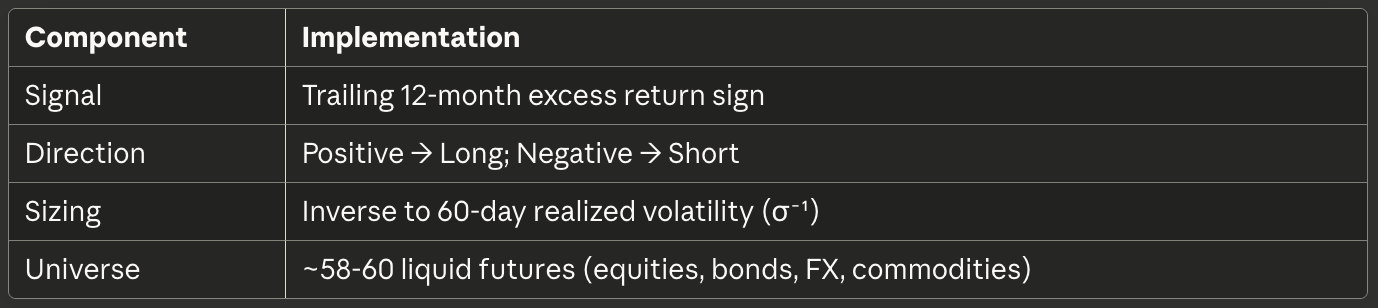
Behavioral explanation: Initial under-reaction creates trends; herding extends them; eventual mean-reversion generates the partial reversal pattern observed at longer horizons.
The 2018–2020 Value Crisis: Case Study
AQR experienced a defining stress test during the “quant winter” — with value as the primary culprit.
The damage:
Absolute Return fund: >30% peak-to-trough decline
AUM: $224B (December 2017 peak) → ~$140B (end-2020)
First six weeks of 2020: “zeroth percentile” event for value — worse than tech bubble or GFC
Performance accounted for ~1/3 of the 50% asset decline; outflows drove the rest
The spread-widening thesis:
Asness argued that value’s underperformance was not fundamental destruction (cheap companies failing) but spread widening — investors paying increasingly higher multiples for growth stocks while value multiples compressed. The valuation spread between cheapest and most expensive stocks exceeded 1999 tech bubble levels.
The contrarian response:
Rather than abandoning value, AQR increased allocation. Value’s weight in the Equity Market Neutral model was raised from ~25% to 33% (November 2019), eventually reaching 40% by early 2021. Asness called this a “venial sin” — modest factor timing at historic extremes.
The recovery:
2022: Absolute Return fund posted +43.5% — best year since 1998 inception
End-September 2025: AUM recovered to ≈$165–166B
The wealth transfer from 2020 capitulators to disciplined holders was substantial
Crisis Alpha: Why Managed Futures Matter
AQR’s managed futures strategies are designed for convex payoffs — moderate results in normal markets, substantial gains during market stress.
The mechanism:
During equity drawdowns, TSMOM strategies typically profit from:
Short equity index positions as markets decline
Long bond positions during flights to safety
Short commodity positions during demand destruction
Currency trends driven by risk-off flows
Correlation profile:
The AQR Managed Futures Strategy exhibits approximately -0.26 correlation to equities — contrasting with parts of the broader CTA industry that have shown positive equity correlation. AQR attributes industry-wide correlation contamination to carry overlays that juice returns in benign environments but compromise crisis hedging.
2022 validation:
When the 60/40 portfolio collapsed (stocks and bonds falling together), Managed Futures delivered: short bonds (riding the rate hike trend), short overvalued tech, long commodities. The strategy provided effective diversification when traditional fixed income failed.
2025 Performance Attribution (as of September 30, 2025)
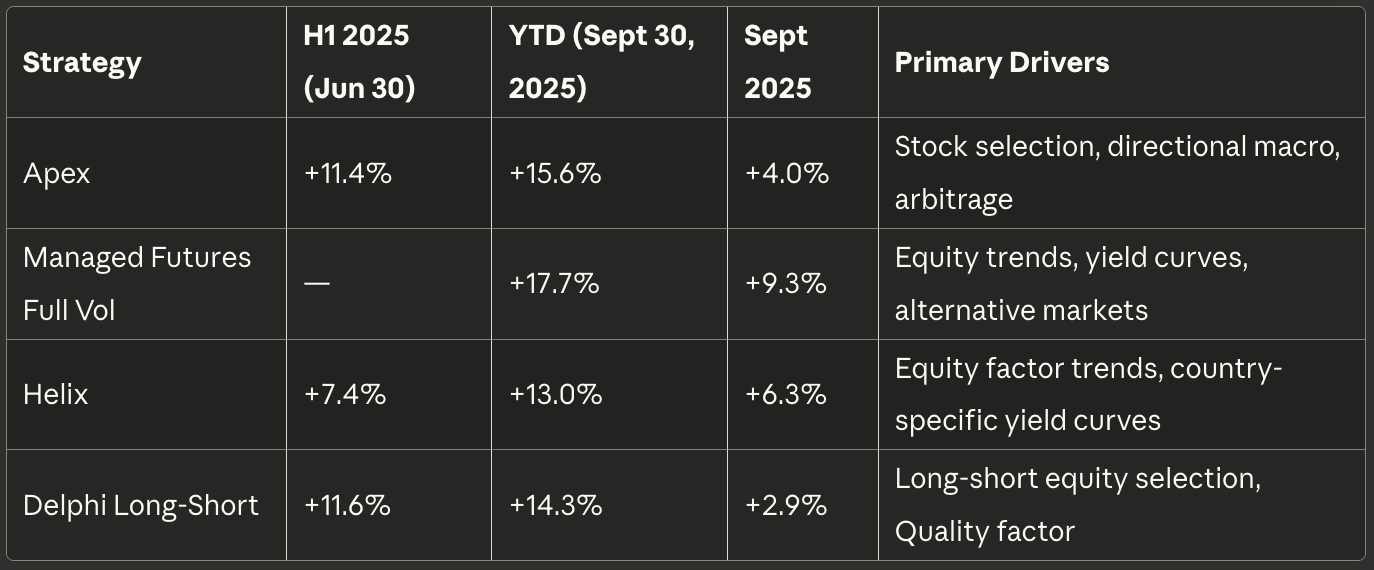
Key 2025 drivers:
Macro dispersion: End of ZIRP/QE restored fundamental differentiation — good companies rise, bad companies fall
Stock selection: Identified as largest contributor to Apex in 2025
Value recovery: Narrowing of historic spreads from 2020 extremes
Inflation trends: Sustained moves in rates and commodities benefited trend-following
P&L Mechanics: Risk Compensation Framework
Factor premia represent compensation for bearing systematic risks:
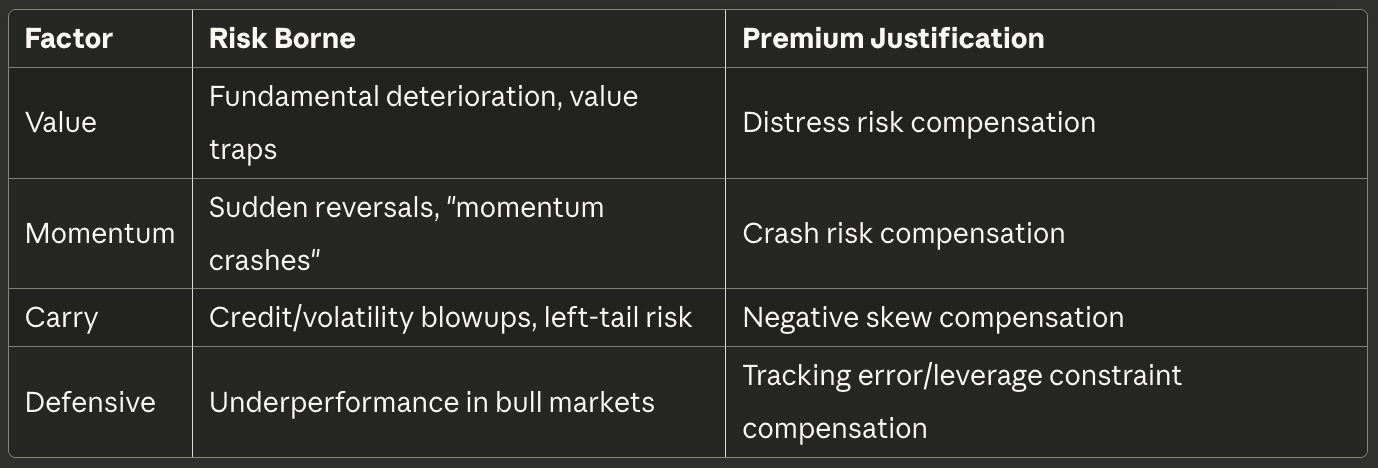
The diversification benefit (Asness, Moskowitz, Pedersen 2013):
Value and momentum are negatively correlated both within and across asset classes. This negative correlation — the “holy grail” of portfolio construction — means combining them produces higher Sharpe ratios than either factor alone.
Key Quantitative Insights
Drawdowns are structural: Factor strategies exhibit severe short-term underperformance as compensation for long-term premia. If they never lost money, arbitrage would eliminate the premium.
Timing is low Sharpe: Contrarian factor-timing tilts work over medium-to-long horizons but are statistically indistinguishable from noise short-term.
Spread dynamics ≠ fundamentals: Value’s 2018–2020 crash was ~90%+ spread widening, not fundamental destruction. Correctly diagnosing this distinction enabled the contrarian tilt.
Behavioral exits transfer wealth: Investors who capitulated in 2020 systematically transferred future returns to those who held.
Conclusion
AQR’s systematic approach demonstrates that factor premia are real, persistent, and exploitable — but extraction requires discipline through severe drawdowns. The behavioral difficulty of maintaining positions when factors underperform is precisely why the premium exists.
The firm’s survival through three quant crises (2007–2008, 2018–2020, 2022) validates a core principle: diversified factor exposure with full-cycle commitment generates superior risk-adjusted returns.
Sources
Academic Research
Moskowitz, T.J., Ooi, Y.H., and Pedersen, L.H. (2012). “Time Series Momentum.” Journal of Financial Economics, 104(2), 228–250.
2. Asness, C.S., Moskowitz, T.J., and Pedersen, L.H. (2013). “Value and Momentum Everywhere.” The Journal of Finance, 68(3), 929–985.
2025 Performance Data
3. Reuters (October 1, 2025). “Billionaire Asness’ AQR’s multi-strategy fund surges 15.6% so far in 2025.”
4. Reuters (July 1, 2025). “AQR Capital Management reaches mid-year with double digit returns.”
5. Hedgeweek (October 2025). “AQR’s multi-strategy Apex fund up 15.6% YTD.”
6. CNBC (July 1, 2025). “Cliff Asness’ AQR sees multiple hedge funds up double digits in 2025.”
Historical Context & Crisis Period
7. Institutional Investor (September 2024). “Cliff Asness Has Steered Hedge Fund AQR Through Not One, Not Two, But Three Quant Crises.”
8. Institutional Investor (October 2025). “AQR’s Big Year: Funds Climb on Stock Picks and Macro Moves.”
9. Pensions & Investments (June 2020). “Down market slamming AQR but firm keeps faith in future.”
10. Business Insider (April 2021). “Cliff Asness’ AQR Hit Hard by Redemptions Since 2018.”
AQR Primary Sources
7. Cliff Asness (February 2020). “Never Has a Venial Sin Been Punished This Quickly and Violently!”
8. AQR. “Understanding Style Premia.”
9. AQR Managed Futures Strategy Fund.
10. AQR. “Time Series Momentum: Original Paper Data.”
Company Information
11. Wikipedia. “AQR Capital.”
12. Wikipedia. “Cliff Asness.”
Disclaimer: Educational purposes only. Past performance does not guarantee future results. Factor strategies involve substantial risk of loss.
📊 Support this research: https://www.patreon.com/c/NavnoorBawa
Cover photograph: Mx. Granger, CC0, via Wikimedia Commons.