


Chris Rokos’s firm filed its US holdings for 30 September on Monday 16 November. He runs its money and, by the firm’s Form ADV, directly owns 50% to 75% of it. At 30 June the firm’s largest position was puts on QQQ, the Nasdaq-100 fund. They came back almost halved: $6.84bn of underlying, the value of the shares the options control, against $12.48bn. A June reader would say Rokos dropped its puts right before the selloff. But its QQQ shares halved too.
Netted at a middle put delta, how far a put’s value moves per dollar of QQQ, the Nasdaq leg of puts, calls and shares stayed near flat. That points the listed damage toward the chip stocks Rokos added, not the put cut. Read alone, a put line misstates a fund’s Nasdaq bet.
I priced every line of the filing I could tie to its own close, 94% of the value outside the QQQ lines, at October’s closes. First I checked each against the filing’s own prices: all 63 issuers closed 30 September within 0.29% of them.
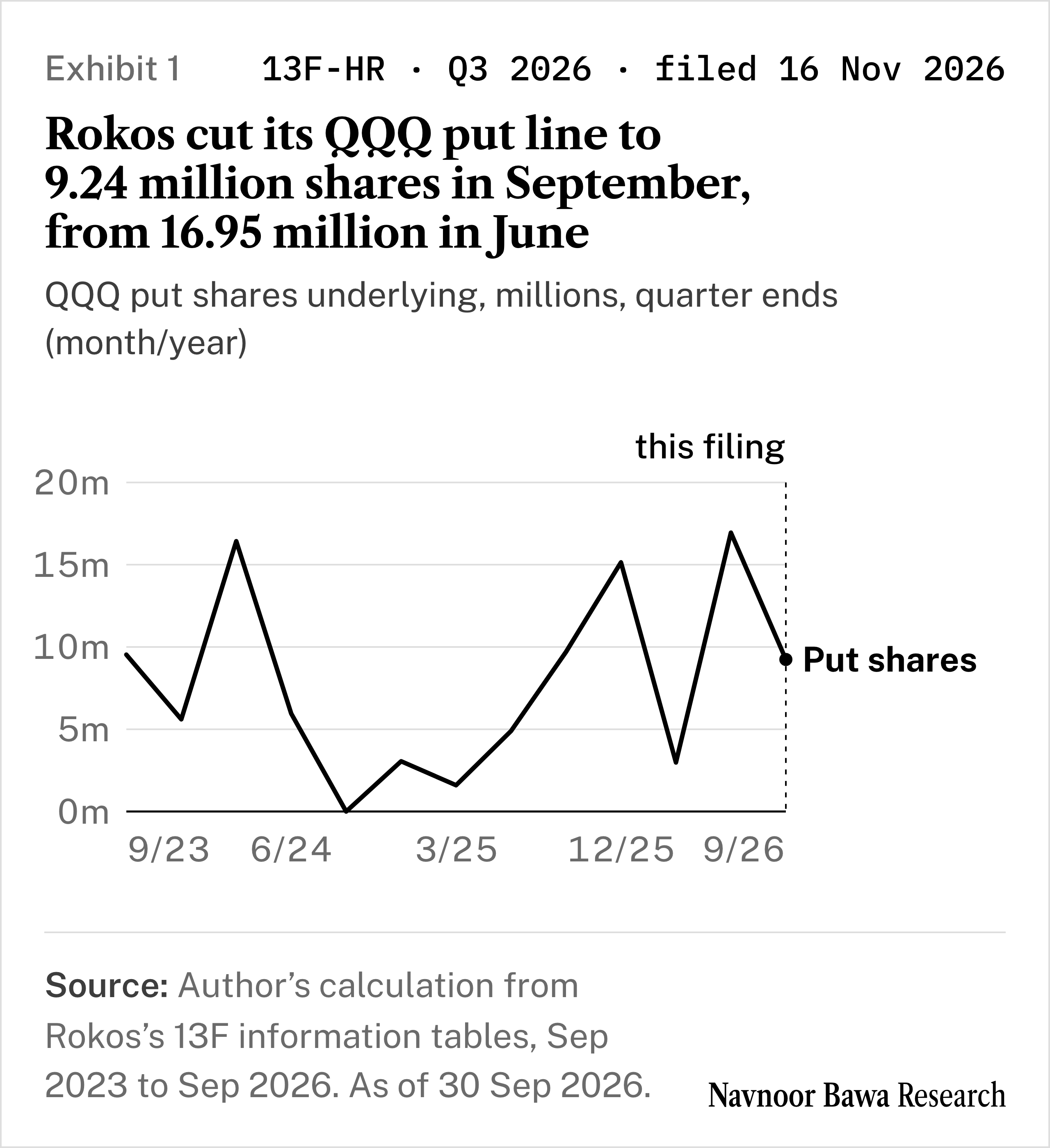
Source: Author’s calculation from Rokos Capital Management LLP Form 13F-HR information tables, the quarterly lists of its US-listed long positions, Sep 2023 to Sep 2026 · as of 30 September 2026
Rokos cut its QQQ puts almost in half
Rokos’s 30 September table lists QQQ puts in six lines on 9,240,000 shares. The June table listed them in 13 lines on 16,953,400.1 A 13F counts an option at the value of the shares beneath it, which is how the September line comes to $6.84bn. It omits shorts, swaps and futures, and it shows the book of 30 September, filed 47 days later.2
The 7.71 million put shares that went were cut, sold, left to expire or, in part, rolled at quarter end into a series the table does not show; a 13F cannot tell which. In the same quarter the QQQ share line fell to 2,897,997 shares from 5,719,724, keeping 50.67%, and QQQ calls fell to 200,000 shares from 558,400.
The figure I did not expect was 2.82 million: the QQQ shares Rokos cut in the same quarter it cut the puts, so at a middle delta its Nasdaq exposure barely moved. At a put delta of 0.35 the leg was about 0.27 million shares net short on 30 September. In June it was about 18,500 shares short.
The SEC’s guidance leaves out written options too: “You should not report put or call options that you write. This means that your short options positions like your short equity positions will not be reported on Form 13F or subtracted from a long position in the same issuer.” So every listed put is one Rokos owns, and it may be one leg of a spread whose other leg goes unlisted.
Why the put line was cut, and who decided it, is in no document I hold: the firm made no statement on October, and neither its Form ADV nor the press reports say how it uses index options.
As Hedgeweek reported, relaying Bloomberg, Rokos lost 4.9% in October and manages about $22bn, which may be one fund’s figure while the filing adds up every account the firm runs.3 No figure on the month came from the firm, and the report gives no other fund’s October figure.
The latest league is September’s, the last month of the quarter this book closes. Rokos gained 4.2% “as its macro strategy capitalised on volatile global bond markets” (Hedgeweek, relaying Bloomberg, 8 Oct), while the master fund of Brevan Howard, a macro manager whose listed book is $13.6bn, fell 2.2%.
Even cut, the line dwarfs Brevan Howard’s. Brevan’s 30 September table lists QQQ puts on 100,000 shares, $74m of underlying, so Rokos’s line is 92 times Brevan’s. Both of Rokos’s big QQQ lines lost about half, and we had made a call on one of them.
Our 43% call on the puts, scored
Our 11 November piece priced Rokos’s June book at October’s closes, five days before this filing existed. It made a call: “I put 43% on the 30 September table showing the put line held at half of June’s or more.”
The table printed 54.8% of June’s put value, and 54.5% of its put shares. The event happened, and 43% was the less confident side of it. Scored by the Brier rule, the squared gap between a forecast and what happened, where 0 is perfect, our 43% earns 0.325. The base rate our call was set against, 60%, six of the ten quarter changes to June that kept half or more of the put line in value, would have scored 0.16. The base rate beat us.
Exhibit 1 shows why the line is hard to call:4 15.14 million shares in December 2025, 2.98 million in March 2026, 16.95 million by June.
What the call got right is narrower: it named the September put line as the number to watch. It could not see from the June book that the share line would fall with the puts.
Read by the put line alone, the cut looks like a firm stepping back from a Nasdaq bet. Three other readings fit the same filing.
Rokos may have moved Nasdaq exposure into swaps or futures no 13F lists, which would make the share cut a hedge moved off the filing and leave the put cut a real cost. The chip longs may be one leg of pairs whose shorts the 13F omits, which would make the pairs lose less than the listed lines. No 13F can separate those two, because the swaps and the shorts both sit outside it.
Or the puts and shares may be one volatility position, its delta kept near zero on purpose, which predicts a flat leg at both quarter ends; June’s leg, near zero at the middle delta, fits it.
At a middle delta, listed Nasdaq exposure held
The filing gives the sizes of the three QQQ lines but not the number that joins them: the put delta, which depends on a strike and an expiry the 13F leaves out. So I set it at three values, 0.2, 0.35 and 0.5, as the November piece did.
Net exposure, in shares, is the QQQ shares, plus the call shares times the delta, minus the put shares times the delta. On 30 September, at a delta of 0.35:
The 9,240,000 put shares count as about 3.23 million shares short.
The 2,897,997 QQQ shares count as themselves, long.
The 200,000 call shares count as 70,000 long.
Together, the leg is about 0.27 million shares net short.
QQQ closed at 739.77 on 30 September and 690.49 on 30 October, a fall of 6.66%. A net short of 0.27 million shares made about $13m on that fall.
The filing cannot settle the delta. At 0.2 the leg was about 1.09 million shares net long and lost about $54m. At 0.5 it was about 1.62 million short and made about $79.9m. At the middle delta the leg moves about $1.97m for each 1% that QQQ moves.
One caution on that middle value: netted the same way, the June book was about 18,500 shares short at 0.35, close to zero, so at that delta both quarters look flat and part of the flatness comes from the delta itself. The outer deltas show the change: at 0.2 June was 2.44 million long and at 0.5 it was 2.48 million short, so September’s net long fell by more than half and its net short by a third.
That is the near flat Nasdaq leg: a large put line and a large share line that cancel at a middle delta, so cutting both by half moves little.
The rest of the book was priced the same way, the November method run on September’s sizes.5 The lines I could not tie are mostly option and share lines on index and sector funds.
At the middle delta, against QQQ’s own 6.66% fall, the near flat Nasdaq leg is a rounding error on Rokos’s capital. The listed damage came from lines that fell further than the index.
The chip stocks it added fell further than QQQ
Between June and September Rokos built its chip and storage lines, adding about $1.07bn of their shares at September’s prices. Its Nvidia shares went to $530m from $190m, and Nvidia fell 10.4% in October. Micron went to $325m from $62m and fell 16.9%. AMD went to $183m from $28m and fell 17.5%. Seagate went to $123m from $38m and fell 30.1%. Intel, which Rokos also added to, fell 45.3%.
The press account names three shocks: “a sharp technology sector selloff coincided with political upheaval in Brazil and violent protests in France” (Hedgeweek, relaying Bloomberg). The filing can test only the first. Weighted by their 30 September value, the twelve largest share lines after QQQ, $2.30bn of the book, fell 11.5% in October, against QQQ’s 6.7%. The Brazil lines it lists are far smaller than the chip lines, and most of what Brazil and France would move, currencies, government bonds and non-US listings, is outside any 13F.
Not every tech line fell. Microsoft, whose line Rokos took to $215m from $104m, rose 1.8%. Apple rose 3.5% and Tesla 12.7%. Alphabet fell 18.7% and Meta 15.2%, so the falls were not in chips alone; the chip lines held the most added size going into the worst of them.
Taken together, the listed chip longs lost the most of any group the filing shows. What the filing cannot show is the rest of the month.
Twelve lines are a rough guide to a book of 148. The paid half prices all of them, weighs the two QQQ cuts against the whole loss, says what the filing leaves unexplained, and puts our odds on December’s put line.
→ Rokos’s 2024 QQQ options book, rebuilt from its 13F filings, Trade File No. 19 on Patreon.
Once every line is priced at its own close, how much of Rokos’s October is left standing outside the filing?
Below the paid line:
How much of October the listed book explains, what sits outside it, and what the put cut cost.
Our odds on December’s put line, with the table of three outcomes behind them.
The base case table and a sensitivity table of four rows.
The book of record, a test for any filer, and three dated checks.