


The claim: The consensus is watching the wrong number. A basis book dies when its financing dies, never because the bond it holds fell in price, and financing is published every morning, free, at T+1.
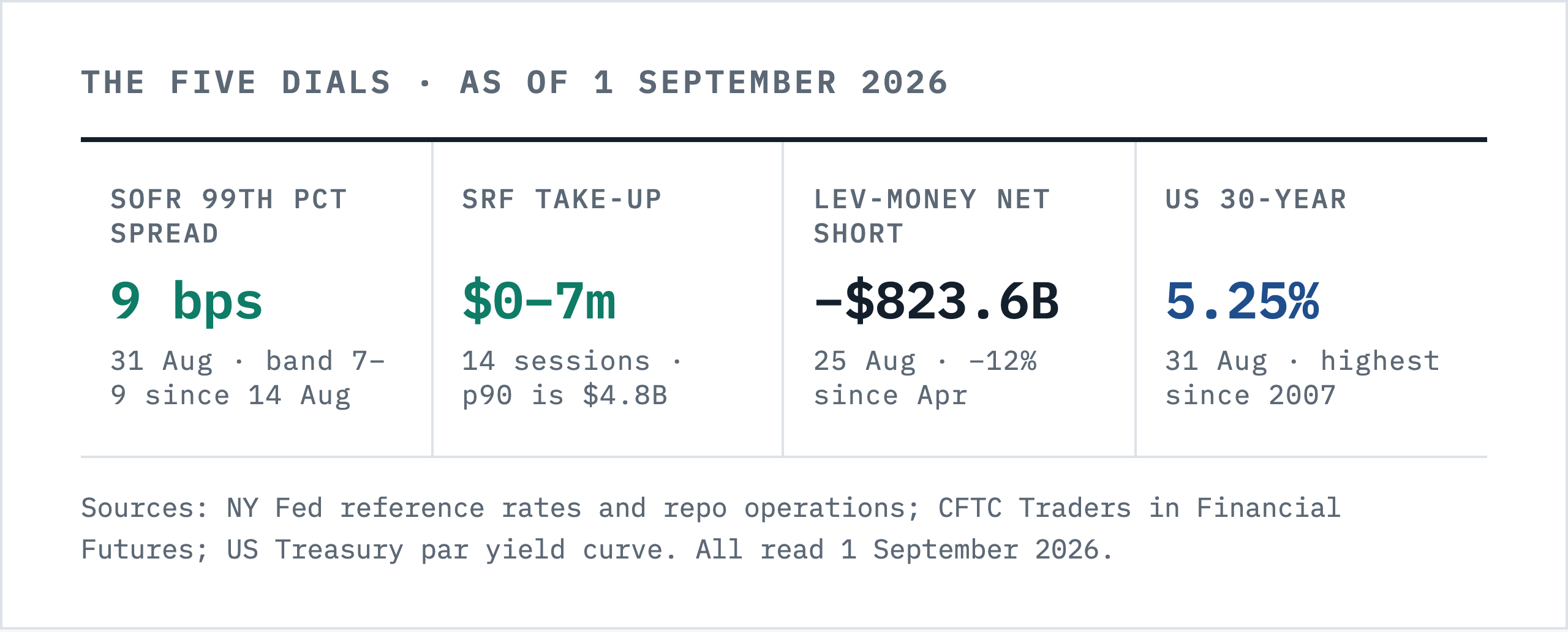
The numbers: Leveraged money is short $823.6 billion of Treasury futures notional (CFTC Traders in Financial Futures, 25 Aug 2026, my reconstruction from contract counts). SOFR’s 99th percentile spread has held a 7 to 9 basis point band since 14 August. On 16 March 2020, the one day this trade actually broke, that spread went from 12 basis points to 174 in a single session.
The catalyst: On 31 August 2026 the CFTC pushed the Form PF amendments to July 2027, a fourth extension, while the US 30-year printed 5.25% and Japan’s 10-year crossed 3% for the first time since 1996.
Wrong if: SOFR’s 99th percentile spread closes above 20 basis points for two consecutive sessions, or Standing Repo Facility take up clears $30 billion on a non quarter end day. Both are public and free, and neither has happened.
Below the paid line:
The full five dial monitor with every endpoint URL, the exact JSON field to read, and a threshold on each set against that dial’s own trailing distribution
The 16 March 2020 SOFR percentile table, the signature a real unwind leaves in the funding data
My contract by contract notional reconstruction: 7,003,041 contracts to $823.6 billion of net short, with the CME face values and the arithmetic shown
The haircut arithmetic: what a one point widening calls in cash across the whole book, and why fifty to one is defensible until it’s not
The four week direction of the leveraged net short, which the consensus never quotes
The bilateral repo blind spot, and the one condition under which this entire read fails
The consensus: a record 7,003,041-contract short into the worst rout since 2007
Here’s the view I’m departing from, in the strongest form I can write it.
Global yields are repricing hard. Japan’s 10-year crossed 3% for the first time since 1996, euro area inflation printed above 3%, and the September FOMC now carries a live hike under Kevin Warsh. Against that backdrop, hedge funds hold the largest leveraged Treasury futures position ever recorded. The precedent is documented and recent: in March 2020 the cash futures basis trade unwound into a Treasury market that stopped functioning, and the Federal Reserve had to buy the market to stop it. So the size of the leveraged position is the exposure that matters, and that exposure sits at a record.
I want to be clear that I find this argument coherent, and that serious people hold it. It’s also old. Back in November 2023 Ken Griffin was already arguing that regulators worried about basis trade risk should look at bank balance sheets instead of at the funds, and the SEC’s scrutiny of the trade was public enough by then to draw that response. Three years on, the size number is the figure this market has worked hardest in this market. The consensus has the size right. My disagreement is about what size does.
The variant view: the position is quarterly and stale, the financing is daily and free
My claim is narrow and I’d rather state it narrowly than oversell it.
A leveraged Treasury book doesn’t liquidate because the asset it holds fell in price. It liquidates when somebody stops lending against that asset, or lends at a haircut it can no longer meet. Price and financing are different variables. They correlate in a crisis, which is exactly why people conflate them, and that conflation is the whole mistake.
Here’s what turns my disagreement into an edge instead of a debating point. The position is observable quarterly, two quarters late. The financing is observable daily, one day late, at no cost. Everybody is watching the slow one. It gets worse for the slow one. On 31 August 2026 the CFTC and the SEC published a joint final rule (PR 9290-26) moving the compliance date for the Form PF amendments from 1 October 2026 to 1 July 2027. Read that carefully, because the detail is the story: those amendments were adopted on 8 February 2024. They are not a proposal anybody is still arguing about. They are settled law whose start date has now been pushed out again, and the trade press counts this as the fourth such push. The OFR’s Hedge Fund Monitor, which is built on Form PF, currently runs to 31 March 2026. Five months stale. And the upgrade everyone has been waiting two and a half years for just slid another nine months.
So the profession is underwriting a number that’s five months old and won’t improve until 2027, while ignoring a number that refreshed at eight o’clock this morning. I think that asymmetry is the trade.
The mechanism: three ways a basis book actually dies
You know the trade: long the cash bond, short the future, earn the spread, lever it through repo because the spread is thin. Fifty to one is ordinary, and on its own terms defensible, because the spread carries very little risk if you can hold to convergence. If you can hold. That conditional is the entire risk, and it is the part the coverage skips.
Three things stop the position being holdable. None of them is “the bond fell.”
One: the repo lender raises the haircut. The fund borrowed 99 cents against a dollar of collateral. The lender now wants to lend 97. Two cents per dollar, across the whole book, in cash, today. Nothing about the bond’s yield caused that.
Two: the futures leg calls variation margin faster than the cash leg pays. The legs offset economically. They do not offset operationally. The short future is marked daily through the clearing house and settles in cash, while the long bond gains value on paper. A fund can sit perfectly hedged and still run out of money on a Tuesday.
Three: repo stops clearing at a single price. This one matters most and gets skipped most. Repo is a distribution, and the tail of that distribution is where a borrower who has lost the market’s confidence actually funds. Somebody being forced out pays up in the tail well before the average moves. So the tail moves first, and it moves violently. That third channel is why I watch a percentile instead of a rate.
Sizing the book from contract counts, because nobody hands you the number
The consensus quotes 7,003,041 contracts as though a contract count were a position. It is not one. Converting it is worth doing yourself, because the conversion is where the risk actually lives.
CME Treasury futures carry fixed face values. The 2-year note contract is $200,000 of face. The 5-year, 10-year, Ultra 10-year, classic bond and Ultra bond contracts are $100,000 apiece. I multiplied the leveraged money positions from 25 August by those face values:
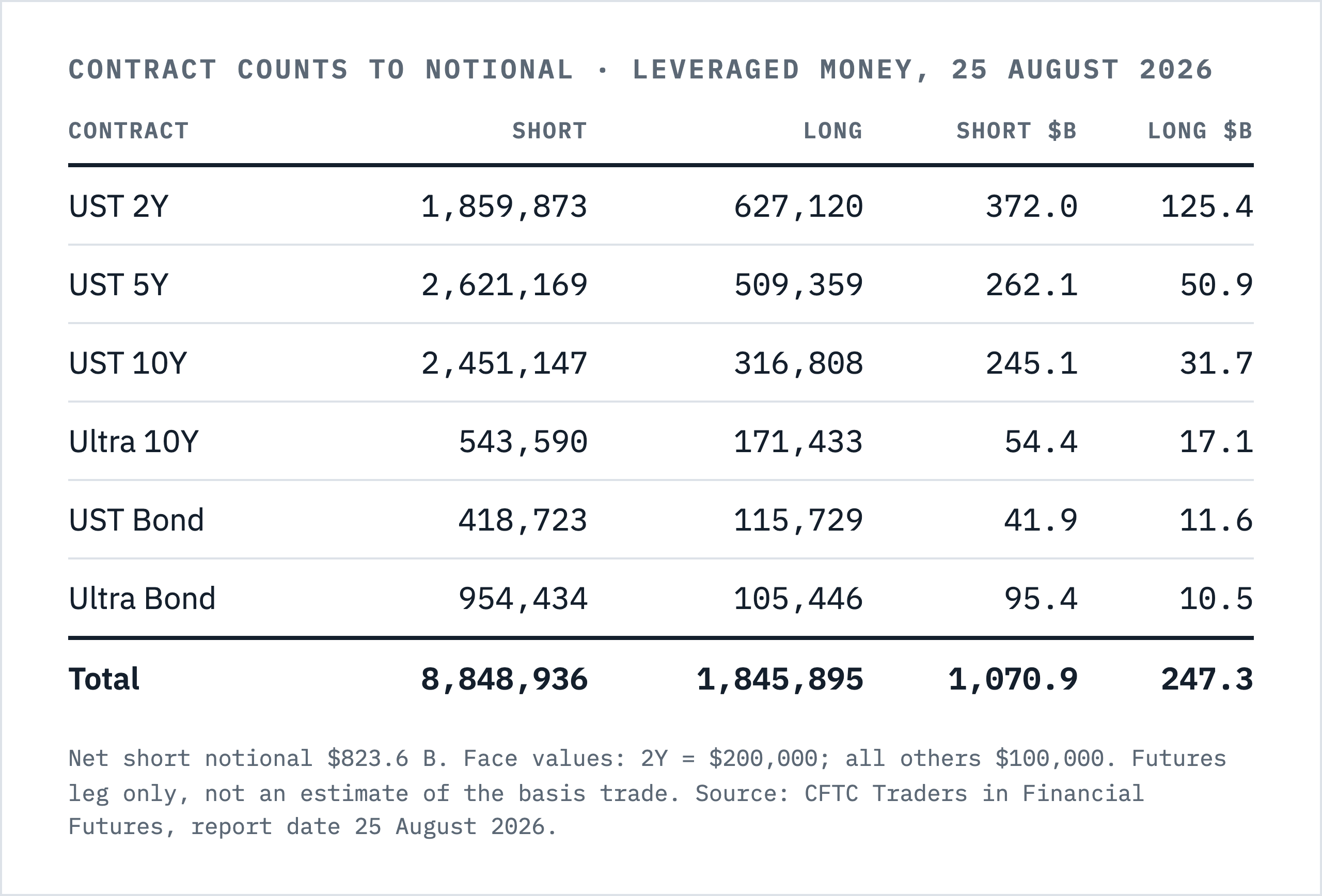
Gross short notional of $1,070.9 billion against gross long of $247.3 billion, for a net short of $823.6 billion. Before that number does any work in your head, take the concession that governs it: the CFTC’s “leveraged money” bucket holds CTAs, macro funds and anybody trading with leverage, so this is an upper bound on basis positioning and not a measurement of it. Some unknown share of that short is trend followers who have never touched a cash bond. I use it anyway because its DIRECTION is informative even when its composition is not, and I flag below where that reasoning could fail. Now the second caveat. This is the FUTURES leg only, reconstructed from contract counts and published face values, with no proprietary feed anywhere in the chain. It is not an estimate of the basis trade, and I want to be exact about that, because published estimates of the trade itself range widely by method and vintage. Work built on OFR data put the cash futures basis near $830 billion as of September 2025, a figure I walked through in detail when Citadel’s own SEC filing came in at $570 billion against the $71 billion everyone prints; press estimates circulating in January 2026 ran closer to $1.5 trillion. Those are different measures of different things, and I have not reconciled them here. What my $823.6 billion gives you is something none of them do: a number you can rebuild yourself, from one free file, every Friday at 15:30. Reproducibility is the property I’m buying here, not precision.
Now put the haircut mechanic against that number, because this is where leverage becomes arithmetic instead of an adjective. Take a clean $1 billion of cash Treasuries financed in repo at a 2% haircut. The fund posts $20 million of equity and borrows $980 million. Fifty to one. Move the haircut to 3%. Required equity goes to $30 million, so the fund owes $10 million per billion, in cash, that day. The bond did not change. No yield moved. A lender revised a percentage. Scale that across $823.6 billion and a one point haircut widening calls $8.2 billion of cash into existence overnight. That is the mechanism in full, and it is why I keep insisting the financing dial outranks the price dial. The haircut is the trigger. The yield is weather.
One more link in the chain makes it monitorable. A lender who is widening haircuts is also repricing in repo, and repo reprices in the tail before the average. Which brings me back to a percentile.
