


Leopold Aschenbrenner’s fund is offering its own clients a stake in Fluidstack, the company building data centres for Anthropic. Hedgeweek, relaying Bloomberg, reported on 29 October that the fund’s clients may “co-invest alongside it in Fluidstack” at a valuation of $40bn. Situational Awareness led Fluidstack’s January round at $7.5bn.
In other words, the fund’s new money goes where its old money already sits. Its biggest position is one bet on Anthropic’s data centre buildout, held three ways: the Anthropic shares TechCrunch counted in July as a cushion against its public losses, its January Fluidstack shares and this round. A client taking the offer adds to that bet; the 30 September 13F tests whether the fund rebuilt a public book beside it.
I read every Form D from Fluidstack and the fund, the fund’s 13Fs, every landlord 8-K on Fluidstack and Anthropic’s S-1 with its drafts, then summed the leases to $27.0bn across four campuses.
Read in order, they show four things, and the paid chapters a fifth:
Citadel took most of the public book in July; the private stakes stayed, Anthropic’s at about half the fund.
The fund led Fluidstack’s January round, and an outside fund had nearly doubled its Fluidstack mark by June.
Fluidstack’s lease book, the base rent it owes three listed landlords at four campuses, sits inside Anthropic’s buildout, with Google guaranteeing part of it.
Anthropic’s prospectus prices no commitment to Fluidstack, yet a delay in Fluidstack’s halls could cost Anthropic too.
The paid chapters settle what a buyer of the round owns: the equity behind the rent, Google’s share and the rent against Anthropic’s.
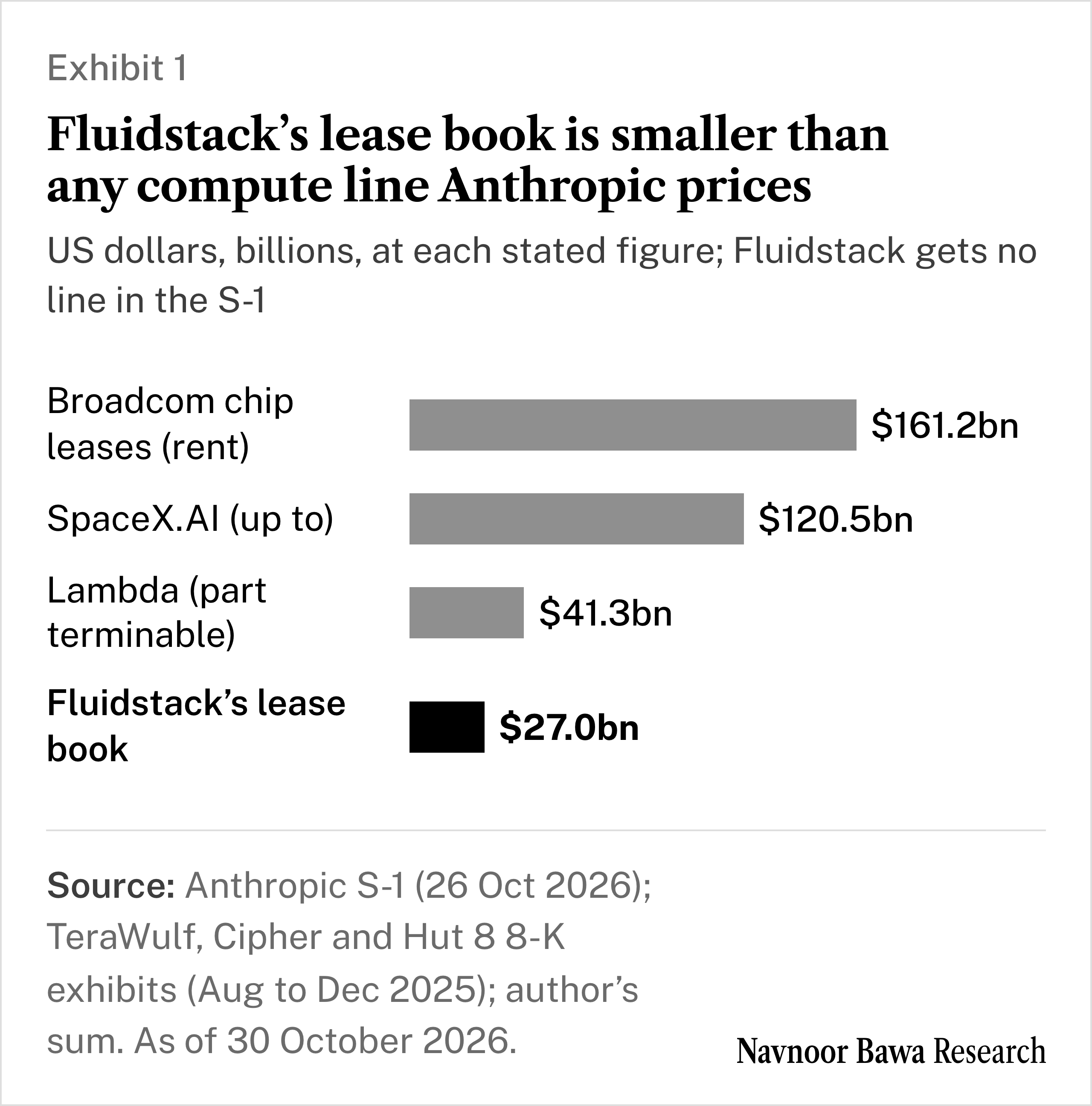
Source: Anthropic’s S-1 (26 Oct 2026); TeraWulf, Cipher and Hut 8 8-K exhibits (Aug to Dec 2025); author’s sum · as of 30 Oct 2026
What Situational Awareness kept
Citadel bought most of the fund’s public book on 30 July, after the losses in it. Bloomberg then put the fund’s assets at about $10bn and its Anthropic stake at $5bn, as TechCrunch relayed: one source for both figures. Bradley Saacks of Business Insider reported on 14 October that the fund still holds the stake; its size since July is not public.
The last public snapshot, the fund’s 13F for 30 June, a month before the sale, showed $20.24bn. A 13F lists only long US listed securities at a quarter end, options at the underlying’s value, so it never shows a private stake.
Since the sale the fund has filed on two public stakes. A 13D/A of 4 August showed 4.4% of Core Scientific, after sales took it under 5%. A 21.1% block of SharonAI Holdings, a Nasdaq company, bought under a purchase agreement of 17 June, was still held in September.
Its private stakes reach beyond Anthropic and Fluidstack. Bloomberg reported, as Investing.com relayed on 8 August, a $500m investment in Source Foundry, a chip manufacturing startup, and Hedgeweek names a stake in MatX, another private company.
The clients are investors in two funds, Situational Awareness Partners LP in Delaware and Situational Awareness Offshore LP in the Cayman Islands. Their Form Ds report “amount sold”: cumulative capital sold since each fund’s first sale, never what it is worth and never net of redemptions. By 11 September they had sold $9.53bn to 187 investors, about a fifth of it by 10 March.
On July’s reports, about half of every dollar those clients had in the fund sat in Anthropic shares. Marina Temkin of TechCrunch wrote that many would view the stake as “an asset that continues to appreciate” and that a windfall from it “could offset some of the hedge fund’s public-market losses”. That cushion and the round are one exposure, because Fluidstack’s campuses are Anthropic’s buildout.
The fund led Fluidstack’s January round
The fund’s Form ADV of 11 June 2026 lists Aschenbrenner, the founder, as chief investment officer since May 2024 and Carl Shulman as director of research since October 2024, at a firm of eight employees. In June 2024 Aschenbrenner set out the thesis in an essay: “Behind the scenes, there’s a fierce scramble to secure every power contract still available for the rest of the decade, every voltage transformer that can possibly be procured”. Fluidstack signs for that capacity on a lab’s behalf.
Its Form D for the round, first sold on 10 January, shows $842.5m sold to 30 investors by May and names none of them. In July Fluidstack announced an “$830M Series A” at a “$7.5B valuation”, “Led by Situational Awareness”.
The price climbed from January’s. On 14 April Bloomberg reported, as TheNextWeb relayed, that Fluidstack was in talks to raise $1bn at an $18bn valuation. A June Form D shows $730m sold to seven investors; a Form D files no price.
An outside fund marked the rise: Capital Group’s SmallCap World Fund carried its Fluidstack preferred shares, a Level 3 holding with no market price, at $74.09 each on 31 March and at $144.11 on 30 June. On 29 October Bloomberg put the new round at $40bn, “roughly double” the valuation of a few months earlier and “more than five times” January’s.
The managers have a stake in that price: the fund’s SharonAI 13D says its general partner “is entitled to allocations based on assets under management and realized and unrealized gains”, so a higher mark counts before anything is sold. No filing says that shaped the offer, and an outside fund’s marks nearly doubled first.
Nor does any filing say whether clients would buy new Fluidstack shares or some of the fund’s own; Hedgeweek, relaying Bloomberg, reports the fund considered selling stakes in Anthropic, MatX and Fluidstack during July’s margin calls. The fund declined to comment and a Fluidstack cofounder disputed Bloomberg’s report without details. Until a Fluidstack filing shows what was sold, the $40bn rests on one outlet’s sources.
Fluidstack’s leases are Anthropic’s buildout
Fluidstack’s own filings say nothing about its leases; its landlords’ do. TeraWulf, Cipher and Hut 8, all listed, each disclosed its Fluidstack leases in an 8-K exhibit giving the term and the base term contracted revenue, the rent due before any renewal. Summed, those figures are Fluidstack’s lease book.
Barber Lake, Cipher’s site in Colorado City, Texas, is the cleanest case. Fluidstack leased it for ten years in two leases, announced on 25 September and 20 November 2025, for about $3.8bn of base term contracted revenue. Google’s backstop, its guarantee of Fluidstack’s lease payments, covers $1.73bn, under half of it. Cipher’s deck of 4 August describes that backstop as one “determined by rent payments made by Fluidstack”. At the first signing César Maklary, Fluidstack’s cofounder and president, said that “Fluidstack understands what it takes to deliver the compute this moment requires”.
On 25 September 2026 Cipher amended the lease with Fluidstack and signed “a binding commitment with a leading AI lab to lease the facility for an additional 10-year term following the conclusion of the Barber Lake Lease”. That is “a separate lease”, worth about $5.2bn.
One building holds the whole structure: Fluidstack in the middle for ten years, a lab signing for itself after, and Google’s guarantee tied to Fluidstack’s rent. Gary Wu, Fluidstack’s cofounder and chief executive, said when Anthropic announced its $50bn buildout with Fluidstack that “Fluidstack was built for this moment”; the moment both founders invoke lasts ten years, and the decade after it is the lab’s.
Exhibit 2 sums Barber Lake with the other three campuses. Counting the lab’s separate lease as Fluidstack’s would put the book at $32.2bn instead of $27.0bn.
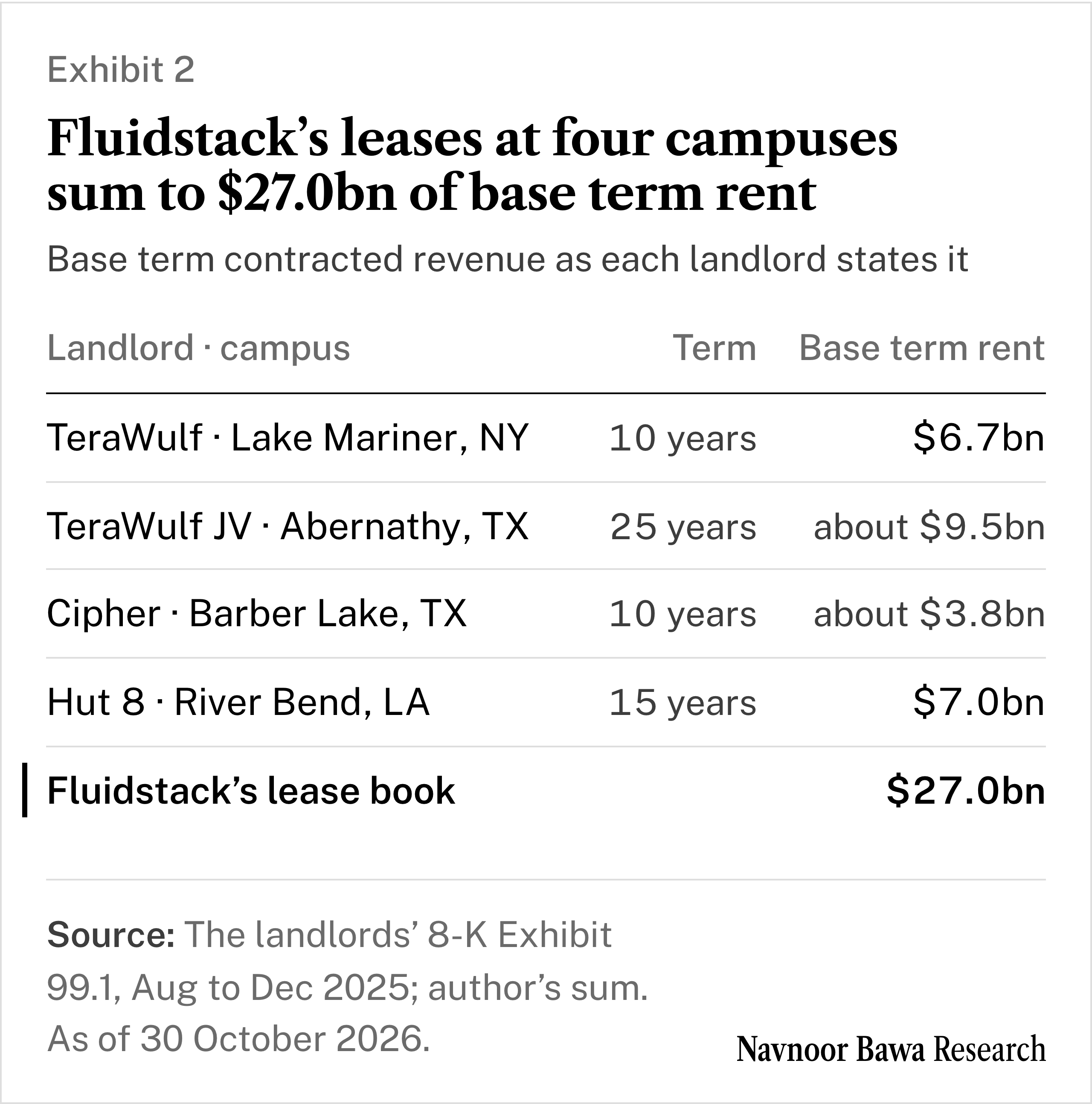
Source: the landlords’ 8-K Exhibit 99.1, Aug to Dec 2025; author’s sum · as of 30 Oct 2026. Base terms only, Lake Mariner as signed; Abernathy’s landlord is a TeraWulf joint venture with Fluidstack, and its term may be cut to 20 or 15 years by option. River Bend is triple net, the rest modified gross.
The filings behind the rows: TeraWulf · Lake Mariner, New York, $6.7bn · TeraWulf joint venture · Abernathy, Texas, about $9.5bn · Cipher · Barber Lake, Texas (two leases), about $3.8bn · Hut 8 · River Bend, Louisiana, $7.0bn.
Three of the four campuses sit in Texas and New York, the states Anthropic named for its buildout with Fluidstack. Hut 8 reports a partnership with Anthropic and Fluidstack for at least 245 megawatts (MW), the size of its River Bend lease.
Google is tied to these halls by its chips and by its guarantee: it sells TPU8i chips to Broadcom, which leases them to Anthropic under a lease of 31 March 2026. The lease even names “the Fluidstack Property”: where Google gives credit support, Broadcom may not unreasonably refuse a site agreement there modelled on Hut 8’s. And Google backstops the rent at all four campuses, taking warrants in two landlords: about 8%, then 14%, of TeraWulf and about 5.4% of Cipher.
No listed landlord has filed a new Fluidstack campus lease in 2026. The 2026 filings naming Fluidstack show amendments, one raising two Lake Mariner leases from 162 to 168 MW, and a group led by Fluidstack agreeing to buy TeraWulf’s 50.1% of the Abernathy joint venture. No landlord filing ties Fluidstack’s other clients, Meta and Mistral among them, as TheNextWeb reported in April, or the cloud capacity it buys from IREN to a campus lease.
One new build sits outside the landlords’ filings: in April Meridian Arc HoldCo, “a joint venture owned by Next Frontier and Fluidstack”, sold $5.7bn of notes. They fund “two new data centers in Sullivan County, Indiana, which will be leased to Fluidstack”, about 430 MW “with obligations supported by Google”. No filing names the end user, and the halls sit outside the $27.0bn lease book.
Anthropic names it once
On 12 November 2025 Anthropic announced a “$50 billion investment in American computing infrastructure, building data centers with Fluidstack in Texas and New York”. Dario Amodei, its chief executive, gave the reason: “Realizing that potential requires infrastructure that can support continued development at the frontier”.
The S-1 of 26 October gives that partner one sentence. It says Anthropic has “entered into a colocation and services agreement with Fluidstack USA I Inc. (’Fluidstack’), under which Fluidstack provides data center development and operations services to us”. The next sentence is the one Fluidstack’s price turns on: “We have also executed data center leases directly and expect to do so increasingly over time”. Fluidstack builds and runs sites for Anthropic, and Anthropic means to sign more sites itself.
The wording moved across seven filings: the partner was a blank in the 1 June draft and Fluidstack by 13 July. From 9 October the sentence sat inside “Anthropic Direct”, Anthropic’s name for leasing chips itself and hosting them “in dedicated data center facilities leased and operated on our behalf”.
The S-1 prices six compute service commitments by supplier, from up to $120.5bn of compute on Nvidia chips from SpaceX.AI to the AI cloud Lambda’s about $41.3bn over terms into 2034, each larger, at its stated figure, than Fluidstack’s whole $27.0bn lease book. Its Broadcom chip leases, about $161.2bn of rent, are priced apart. Fluidstack, the partner named in the $50bn plan, gets no figure.
Anthropic already signs with Fluidstack’s landlords directly: on 6 July 2026 TeraWulf signed Anthropic for 20 years at its Justified Data site in Hawesville, Kentucky, for about $19bn, twice Fluidstack’s largest lease. Paul Prager, TeraWulf’s chief executive, said: “Our strategy is centered on owning and operating critical infrastructure assets, maintaining direct relationships with our customers, and controlling the long-term evolution of our campuses”. The release names no operator for the site.
That lease has not cut Fluidstack out so far: Fluidstack amended its leases at TeraWulf in July and at Cipher in September, and the S-1 keeps it inside Anthropic Direct. The risk is the S-1’s own “increasingly over time”.
One counter would keep the Anthropic stake a cushion: Anthropic gains when it pays Fluidstack less, so the two stakes should move apart. The S-1 points the other way: in March 2026, under an amended colocation and services agreement, Anthropic guaranteed up to $500m of a data centre provider’s power purchase obligations. The S-1 names no provider, and the only such agreement it names is Fluidstack’s.
The S-1 says rent on Anthropic’s Broadcom chip leases “may commence earlier … when the readiness of a data center facility is delayed”. So a delay at a Fluidstack site can start Anthropic’s chip rent early, while what Fluidstack owes Anthropic for a delay is not filed; if the buildout slows, both stakes fall.
The same holds for any neocloud, a company renting out AI computing capacity, whose campuses are one lab’s buildout: Nscale and Lambda, priced in the same S-1, or CoreWeave with its labs. Owning a lab and its supplier is one position, not two, when the supplier’s book is the lab’s buildout.
→ Citadel’s 2006 takeover of Amaranth’s energy book, rebuilt from the Senate record, Trade File No. 2 on Patreon.
Should a client treat the $40bn round as a bet separate from the fund’s Anthropic stake before 31 December’s filings?
Below the paid line:
Exhibit 3: Google’s guarantee campus by campus, and the equity behind Fluidstack’s rent.
Exhibit 4: rent per megawatt year on five rows, Fluidstack’s four campuses against Anthropic’s own lease.
The January Series A marked at the headline price, beside the SharonAI block from the fund’s 13D/A.
The verdict with our odds, the line that proves it wrong, and four dated checks.