

Griffin’s own letter proves the market misread the July 30 trade. My read: distributing the risk was the plan from day one. Citadel says so itself. The receipt is public: more than 80% of the risk gone in three weeks, while the stocks Citadel exited kept rallying without it.
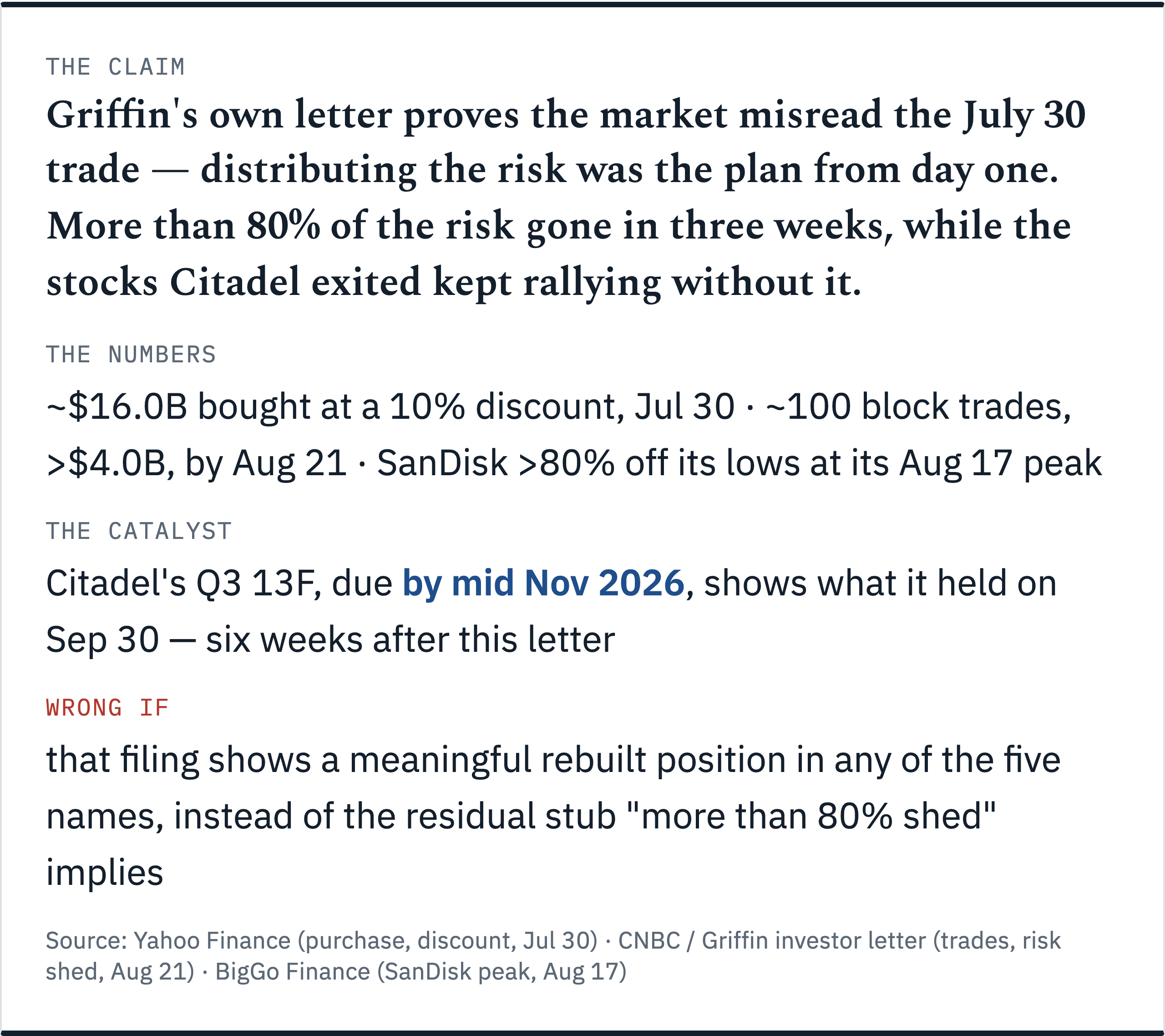
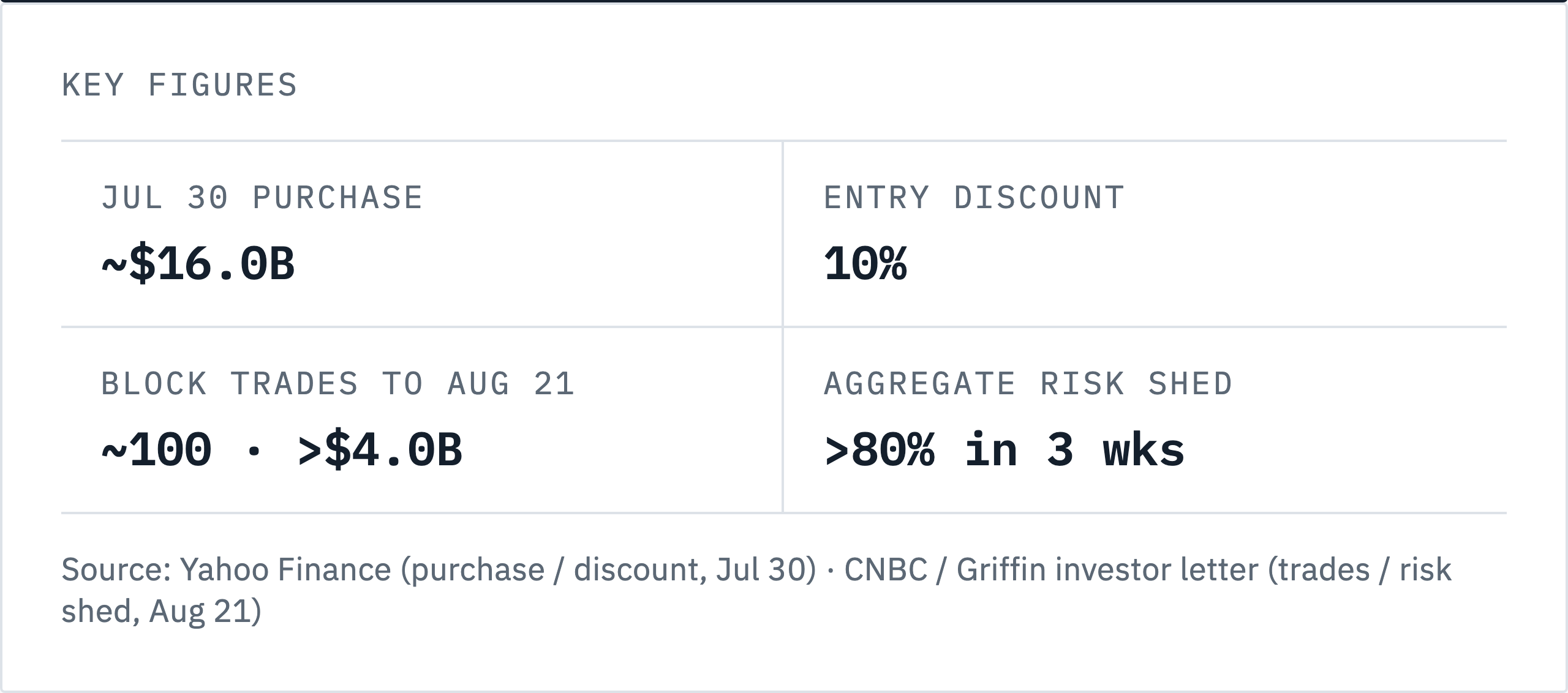
Photo: Federal Reserve Board · Public domain, adapted · via Wikimedia Commons
This piece is also a film: sixteen minutes working Griffin’s own letter against the block trade tape, the capital base arithmetic worked on screen against both of Citadel’s measures, and the Q3 falsifier stated on camera with its date.
The consensus, stated at its strongest
On July 30, four names in Leopold Aschenbrenner’s forced sale book ripped 21 to 28% in a single session. The market read that as Citadel underwriting the AI infrastructure trade. I wrote about the mechanics of that day three weeks ago, and one detail from it still holds up: a name that never appeared in Situational Awareness’s disclosed holdings rallied just as hard as the ones that did. That argued for an overhang clearing. A fresh conviction call reads differently, and I trust the cross section over the headline. Still, I want to steelman the confidence reading properly here. It deserved a hearing then, and it deserves one now.
The backdrop makes it easy to believe. Situational Awareness had returned 439% through the first half of 2026 on leveraged AI infrastructure bets, then lost roughly 67% in July alone, as SanDisk fell as much as 56% and Nebius dropped about 48% from its peak. Assets went from as much as $45 billion at the start of July to roughly $10 billion after the sale, half of that a private Anthropic stake the fund never sold. Its three prime brokers, Goldman, JPMorgan, and Bank of America, had issued margin calls, and the book was being shopped with nobody stepping up. Then, the morning after the Federal Reserve held rates at 3.50 to 3.75% on a 9-3 vote, Citadel bought the whole thing in a single block. A firm managing hundreds of billions in regulatory assets paid real size for a book three of the largest banks on the Street could not place. That is not commentary. That is capital at risk, and reasonable investors updated on it. The story was clean. Almost too clean, in hindsight.
Griffin’s own words at the time reinforced the reading. ZeroHedge’s account of the same letter has Citadel describing itself as front footed over its nearly thirty six year history, arithmetic that checks out against a firm founded in 1990. A firm that wants credit for a fundamental call talks like that. It does not usually talk that way about a service it planned to resell inside three weeks. I take that phrasing seriously as a data point, even though I think the letter three weeks later reads differently.
I am not going to argue that reading was foolish. My claim is narrower: it was incomplete. Griffin’s own words on August 21 are the evidence that closes the gap.
What the letter actually says
Line up the dates first. July 29: the Fed holds. July 30: the block trade. August 14: the Q2 13F confirms the book. August 21: Griffin’s letter names the exit. Four dates, three weeks, one story. Consider the sentence that matters, from Griffin’s letter dated Friday, August 21, reproduced identically across CNBC, Yahoo Finance, and two further wire renderings: “Our ability to distribute this risk was central to our investment thesis. These moments highlight our ability to quickly evaluate complex risks, deploy capital with speed and conviction, and execute with precision.”
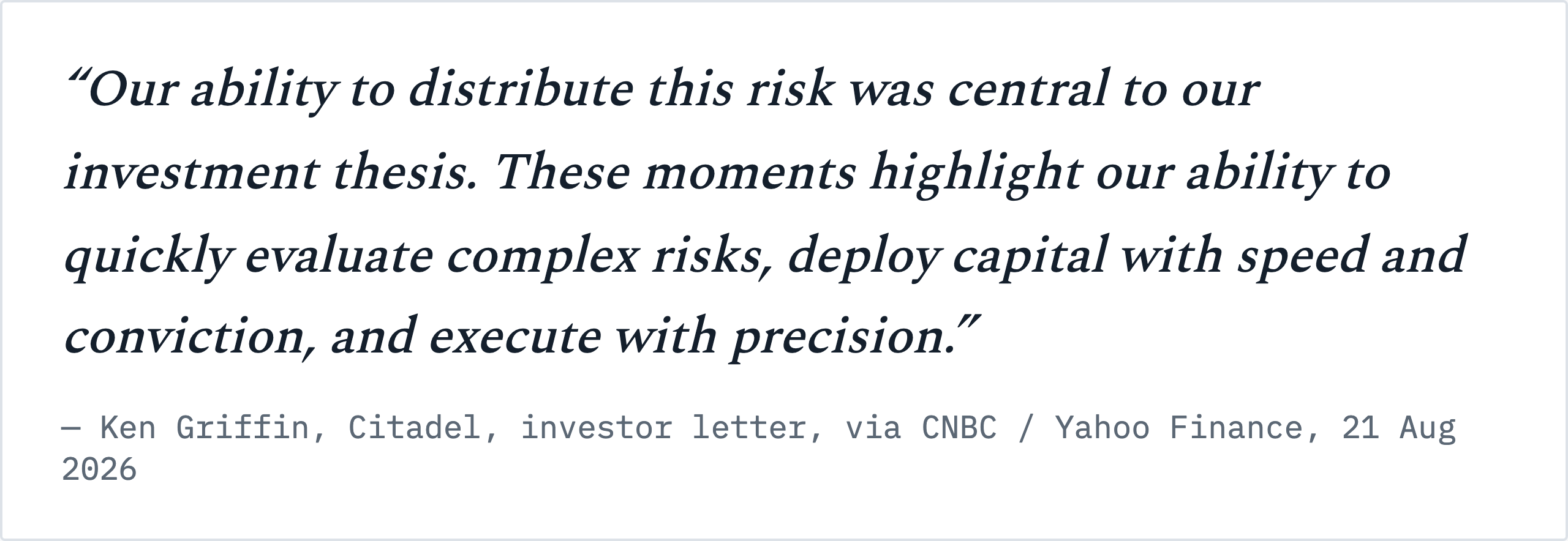
The word doing the work is “distribute.” Not “hold.” One verb. That is the whole disclosure. Citadel is not telling its limited partners it bought conviction in memory chips, data center capacity, or power generation. It is telling them the thesis was the transaction itself: buy a forced sale book at a discount nobody else could underwrite in the window available, then sell it back into a market that had time to normalize. The asset was never the point. The interval was.
The receipts back the letter. The July headlines do not hold up next to them. Griffin says Citadel completed nearly 100 block trades worth more than $4 billion in market value, including the largest intraday block trades of the year in 10 separate names, and shed more than 80% of the aggregate risk it took on. Those two figures describe different things and the letter never reconciles them: $4 billion transacted, 80% of risk, and Citadel does not publish how it weighs the second, so I cannot recompute one from the other. That is a full public turn on the risk, in three weeks, on a position the market spent a week in late July calling a conviction bet. I do not think a firm distributes 80% of a genuine long term fundamental call that fast. I think it distributes a warehoused position exactly that fast, because every day it holds one is a day of uncompensated exposure to a name it never wanted to own past the point where somebody else would.
What makes this checkable, beyond merely plausible, is what Situational Awareness’s own Q2 13F shows. Filed August 14 for the June 30 snapshot, the same filing that reported its total value twice on the same day, a separate reporting problem I covered on its own. Its five largest disclosed positions were SanDisk, Micron, Bloom Energy, Taiwan Semiconductor, and Nebius: a $20.2 billion book across 25 names. Five of those are the same names multiple outlets report Citadel bought, out of the 10 total names Griffin’s letter says the block trades spanned. The forced seller’s own filing and the forced buyer’s own trades line up. Same five names. Same order of size. I do not read that as a coincidence worth a footnote. I read it as confirmation that the book everyone is discussing is the actual book, which is why I trust the block trade figures in the August letter enough to build an argument on them.
The mechanism: why “distribute” beats “hold” here
Grossman and Miller’s 1988 result in the Journal of Finance is the right starting frame, and I am reaching for it again for the reason I reached for it three weeks ago. Market liquidity is the demand and supply of immediacy. A market maker gets paid for bearing risk during the interval between a seller who must transact now and a buyer who has not shown up yet. He is not paid for being right about the asset. He is paid for standing in the gap.
Citadel stood in that gap on July 30. Situational Awareness needed to sell an entire book, longs and shorts together, before the next margin call. The natural buyers of levered AI infrastructure equity were the other funds running the exact same trade, nursing the identical July drawdown. The bid did not disappear because the stocks were bad. It disappeared because everyone who would normally set the price was impaired at once. That is Shleifer and Vishny’s 1992 mechanism, and it is why a 10% discount to already depressed prices was available to whoever showed up with clean capital. The empirical literature on so called upstairs block markets backs the shape of this: large negotiated blocks executed away from the open order book routinely carry a temporary discount that reverses once the immediacy premium is paid off, distinct from a permanent repricing.
Here’s the part I think most coverage missed. The August letter and the July trade explain each other; each one alone tells half the story. A pure liquidity trade has a specific, falsifiable signature: a short holding period, uncorrelated with the asset’s own catalysts, ending when the forced sale discount closes rather than when the story plays out. Compare that against what actually happened. Bloom Energy posted a strong earnings quarter two days before the block trade. Microsoft’s July 30 earnings, a 43% cloud revenue growth print that added roughly $480 billion of market value in a single session, landed the same morning as Citadel’s block. None of that is Citadel’s research edge. It’s the market’s own catalyst calendar, arriving on schedule. Citadel supplied none of it. Citadel got to sell into every bit of it.

