



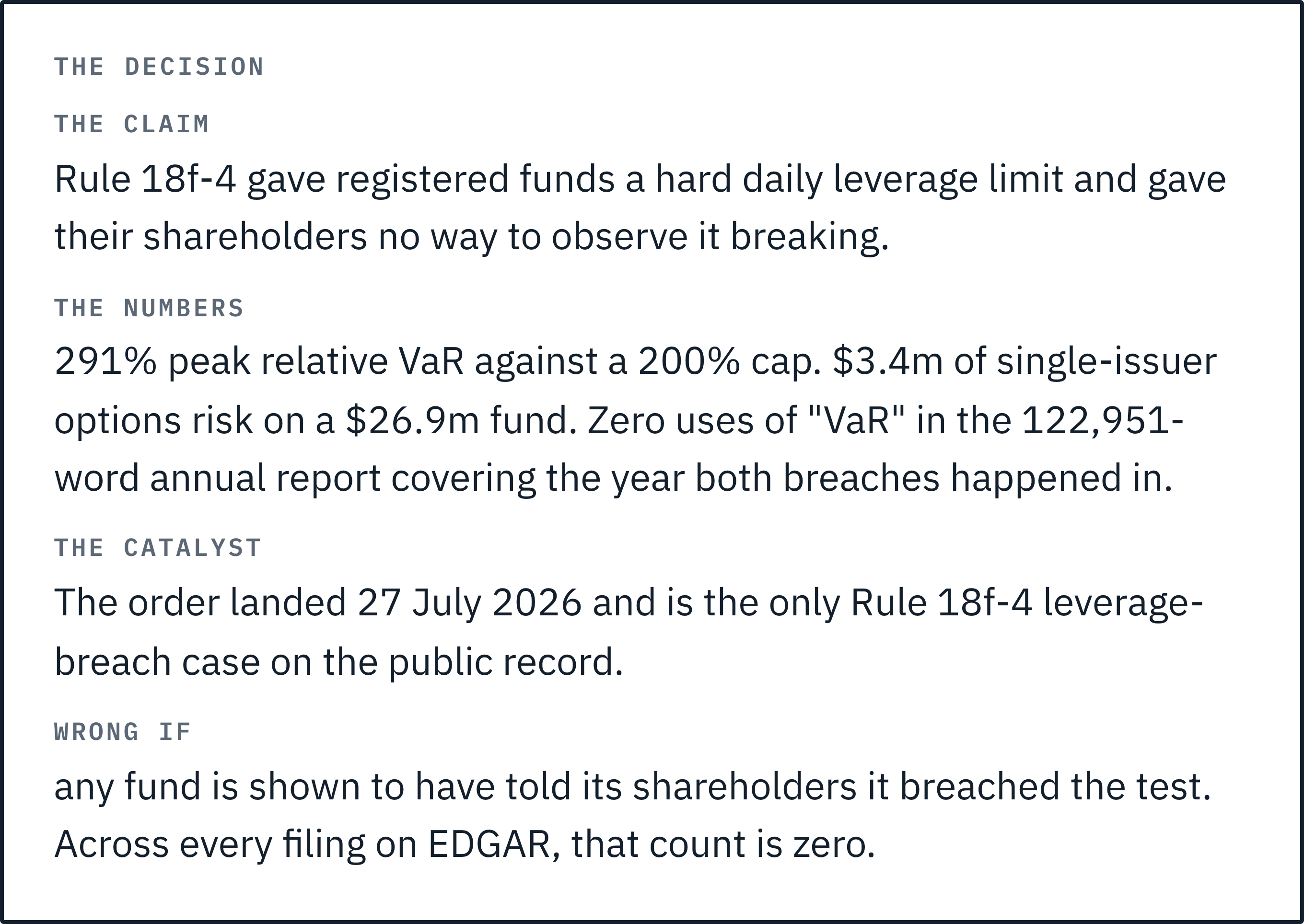
Simplify’s Macro Strategy ETF ran a 291% relative value-at-risk reading against a 200% regulatory cap across two episodes in 2024, and the only reason any of us can read about it is that an enforcement action arrived twenty seven months later.
What the Commission found, and the one word it withheld
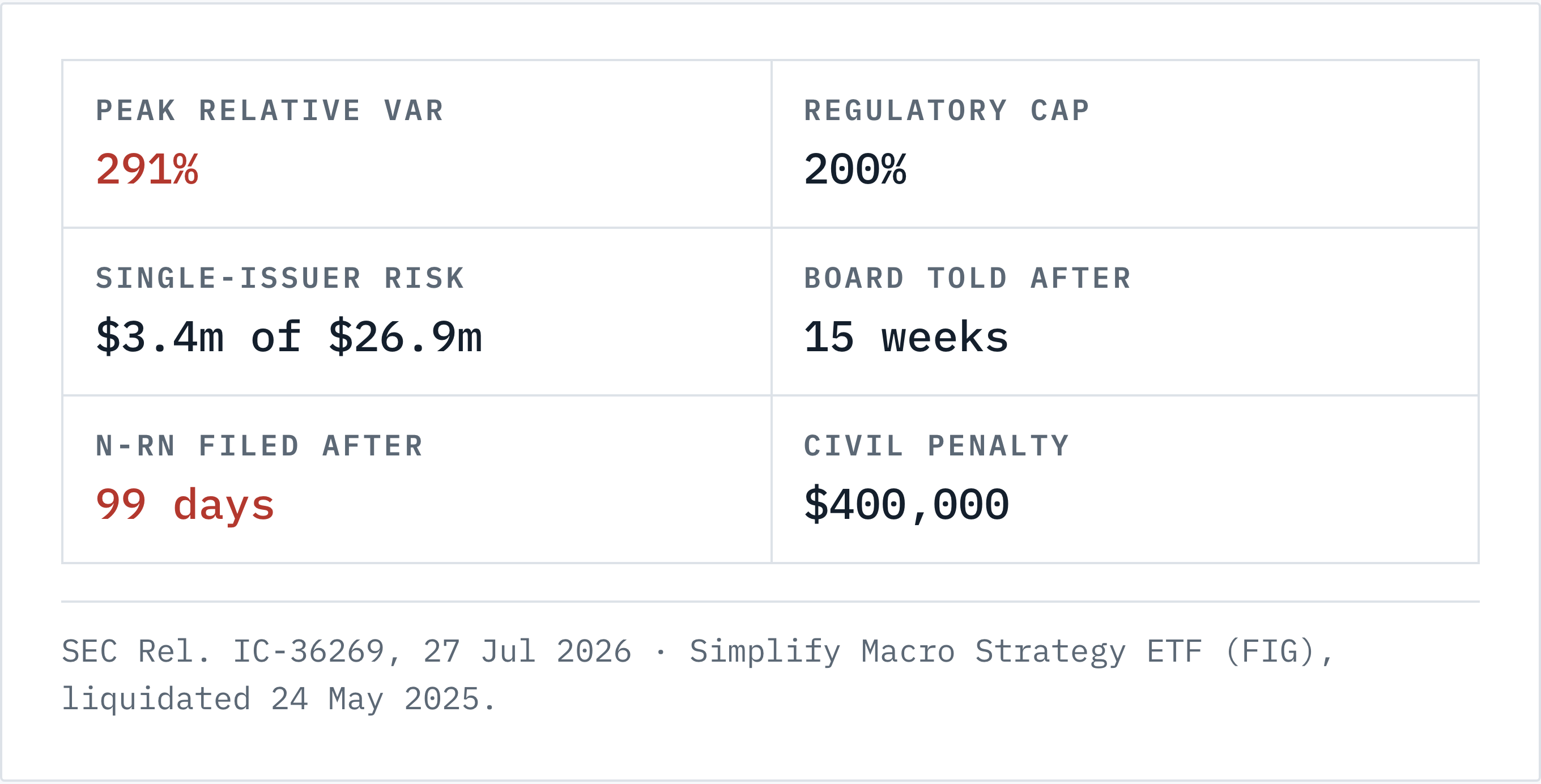
The SEC’s order against Simplify Asset Management is a settled cease and desist under Section 9(f), with a $400,000 penalty and no admissions. It charges four groups of conduct; my interest is the second.
Simplify’s Macro Strategy ETF, ticker FIG, held $26.9m in net assets at 31 March 2024 and was sold as “a long bias cross-asset portfolio.” On 11 April 2024 the portfolio manager put on an options position in a single issuer the order calls Company D, structured to pay if that issuer’s stock fell. Risk exposure was $3.4m, which the order puts at more than 13% of the fund that day.
The stock went up. From 26 April through 2 May the fund’s relative VaR breached its 200% threshold, reaching 253% on 26 April and a peak of 291%. Simplify’s chief risk officer, also FIG’s derivatives risk manager, “urged the portfolio manager to reduce the position to address this risk on a daily basis during this period.” On 2 May the fund lost over 8%, which the order attributes “primarily” to the partial unwind. A second breach ran 6 May to 16 May at 224% to 251%.
Fifteen weeks later, on 8 August 2024, the board found out. I read that twice. The Forms N-RN went in on 9 August, ninety nine days after that episode closed, against a one-business-day deadline. FIG was liquidated on 24 May 2025, fourteen months before the order describing it.
The order makes no finding on FIG’s prospectus, which said the fund “may invest up to 20% of the Fund’s portfolio in derivatives.” I couldn’t settle that from the document anyway, since it never states how the 20% is measured. What the cap plainly does not do is speak to concentration: it’s an aggregate, silent on how much of a derivative book may sit on one ticker.
All of that is public today. None of it was in May 2024, and the reason has little to do with Simplify.
The consensus is right about what 18f-4 fixed
State it at its strongest. Before 2020, derivatives leverage was governed by asset segregation, an accounting convention with no economics in it. Rule 18f-4 replaced that with a live quantitative constraint: a relative VaR test against a designated reference portfolio, computed every business day, capped at 200%, with a named human accountable and a board told when it breaks.
The natural reading is that the machinery worked, and I’d concede most of it. The VaR test was calculated daily and caught the breach on day one. The risk manager escalated, repeatedly, in writing. The Commission later found the breach, charged it, and fined it. For a rule whose critics said VaR limits would prove unenforceable in a 40 Act wrapper, that’s a decent showing, and Pensions & Investments reported it as what it was, a $400,000 fine over the derivatives rule.
Where I part company is one step down. That reading treats the enforcement as proof the regime protects investors. My read is that it proves the regime informs the Commission, and that the shareholder’s position hasn’t moved since 2019. The SEC built a rule you can’t watch, and I can show you it was a choice, because another regulator made the opposite one.
Company D is Carvana, and Simplify named it in September 2024
The Commission anonymised the issuer. The adviser didn’t.
FIG’s own annual shareholder report for the year ended 30 June 2024, filed on 9 September 2024, contains this sentence in Management’s Discussion of Fund Performance: “An aggressive short on Carvana (CVNA) resulted in a 7.8% NAV loss on May 2, 2024, and a -10.24% impact overall.” Same date as the order’s 2 May loss, same cause, same direction, comparable magnitude. The order says the fund lost “over 8%” that day while Simplify says 7.8%. I am carrying both figures instead of picking one, because they are two primary sources on one event and I cannot reconcile them from the public file.
Holdings corroborate my read. I pulled FIG’s full public N-PORT series looking for single-name corporate equity, which a “cross-asset” macro fund should not be carrying. At 29 September 2023, shortly after the order’s 9 August 2023 start date for the Company D trades, Carvana appears with a written call and a purchased put at the same $55 strike. It is then absent at 29 December 2023 and at 28 March 2024, exactly what the order implies in dating a new position to 11 April. And at 28 June 2024, out of ninety three holdings, Carvana is the only single-name corporate equity in the fund.
Two rivals sit in that September 2023 filing and neither survives. AutoNation appears as a single purchased put, NVIDIA as two purchased-put lots at $300, and NVIDIA is the tempting one because it also rose hard through April and May 2024. Both fail the same test: Company D involved “purchasing and selling put and call options,” four kinds of leg, and each rival carries one direction and one type. Carvana carries both directions and both types in 2023, five legs by June 2024, and both rivals are gone by then.
The adviser’s own 13F closes it. Simplify’s Form 13F-HR for the quarter ended 30 June 2024 reports CARVANA CO puts on 175,000 shares and calls on 10,000 shares. FIG’s purchased legs that day were 1,250 and 500 put contracts and 100 calls, which at the standard multiplier is exactly 175,000 and 10,000 shares. Different filer, different form, same position.
Dating the catalyst came last. Carvana filed Q1 2024 results on an 8-K exhibit dated 1 May 2024 announcing “our best financial results in company history” and a record 7.7% adjusted EBITDA margin. The stock rose roughly a third the next day, the day FIG lost its 8%. That percentage is my own calculation from a split-adjusted series, the one figure here with no public source. The order gives the direction independently: Company D’s stock “rose in late April 2024 and continued to rise throughout May 2024.”
The mechanism: performance is disclosed in detail, compliance is disclosed to one address
Start with what Simplify told its shareholders, because I expected an adviser covering its tracks and didn’t find one. The FY2024 report names the ticker, dates the loss, and puts the total drag at -10.24%. It concedes that “the Fund’s net short US equity position drove underperformance,” unflattering for a fund sold as long bias, and books the year at -7.19% against a benchmark at 15.69%. The schedule of investments carries every Carvana leg with strikes and notionals. That is candid, and more than I expected.
Now search the same document for the breach.
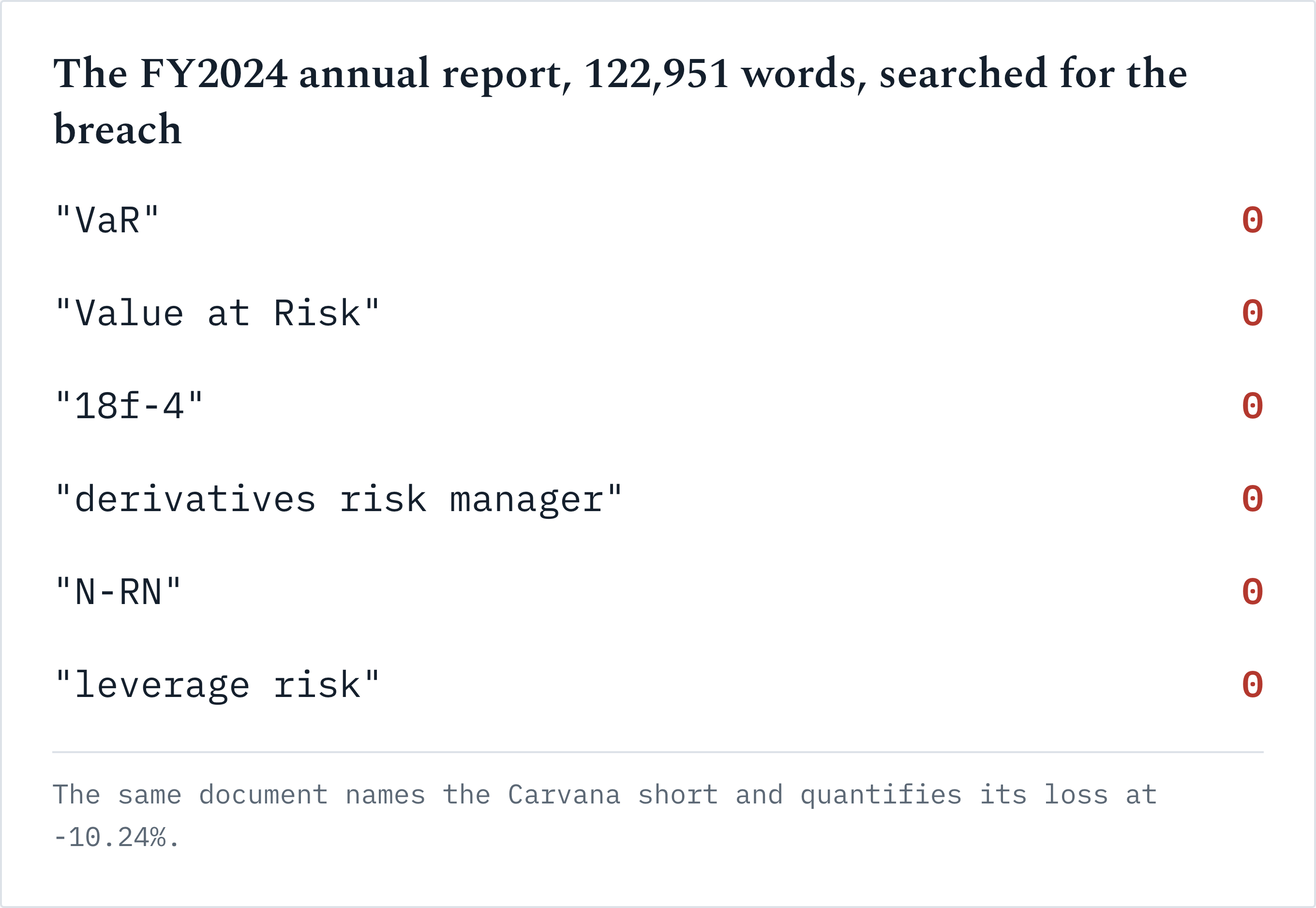
The next year’s report mentions Rule 18f-4 six times, all boilerplate under a reverse-repurchase heading, and says “VaR” zero times too.
The order shows the shape twice. Seven Simplify ETFs paid distributions partly out of investor capital and sent none of the notices Section 19(a) requires, which I took apart separately. Paragraph 49 is the part that matters here: Simplify did file audited statements showing those returns of capital. The annual report had it. The notice meant to arrive with the cash was never sent. In both halves of this order the slow retrospective document carries the information and the timely instrument does not.
