


Renaissance’s Institutional Equities Fund, RIEF, which takes outside money, made 6% in October, Bloomberg reported, as most hedge funds lost. The reports gave no specific cause; the obvious guess is that its stocks dodged the chip selloff.
Renaissance’s 13F, its quarterly list of stock holdings, for the end of June showed $72.6bn of US stocks. Did they make the gain? The lines I could price, nearly nine tenths of the value, lost about half a percent at October’s closes, so a copy of that book would not have made RIEF’s 6%. An allocator who credits those stocks credits a book that, priced where it could be, lost money.
A free index twin, the S&P 500 with every stock counted alike less the S&P 500 counted by size, fits October but missed two estimated stretches of this year.
The paid half puts odds, from every book change on file, on whether the September filing, due by 16 November, explains half of RIEF’s October, naming the S&P spread that breaks them. The deciding number is the June book’s share of RIEF’s month.
The filed book lost money
Hedgeweek relayed the 6% from people familiar with the results, and Bloomberg’s headline called Renaissance a “rare hedge fund winner”. To test the obvious guess, I priced the share lines Renaissance filed for June from their 30 September closes to their 30 October closes, nearly nine tenths of the filing’s value. I ran the same arithmetic, and the twin, on every RIEF period the press has reported that I could store.
Priced at the 30 September and 30 October closes, the lines I could price lost 0.52%. The S&P 500 lost 0.91% over the same days. The book’s chip and memory names, among them Nvidia, AMD, Broadcom, Micron and Intel, fell 17.2% and cost $907m. The VanEck semiconductor ETF, SMH, fell 14.2%. The rest of the book made money, which is why the whole lost so little.
The book Renaissance last showed us lost money in October, and the twin missed two stretches of 2026; RIEF’s 6% was most likely made where no outside reader sees.
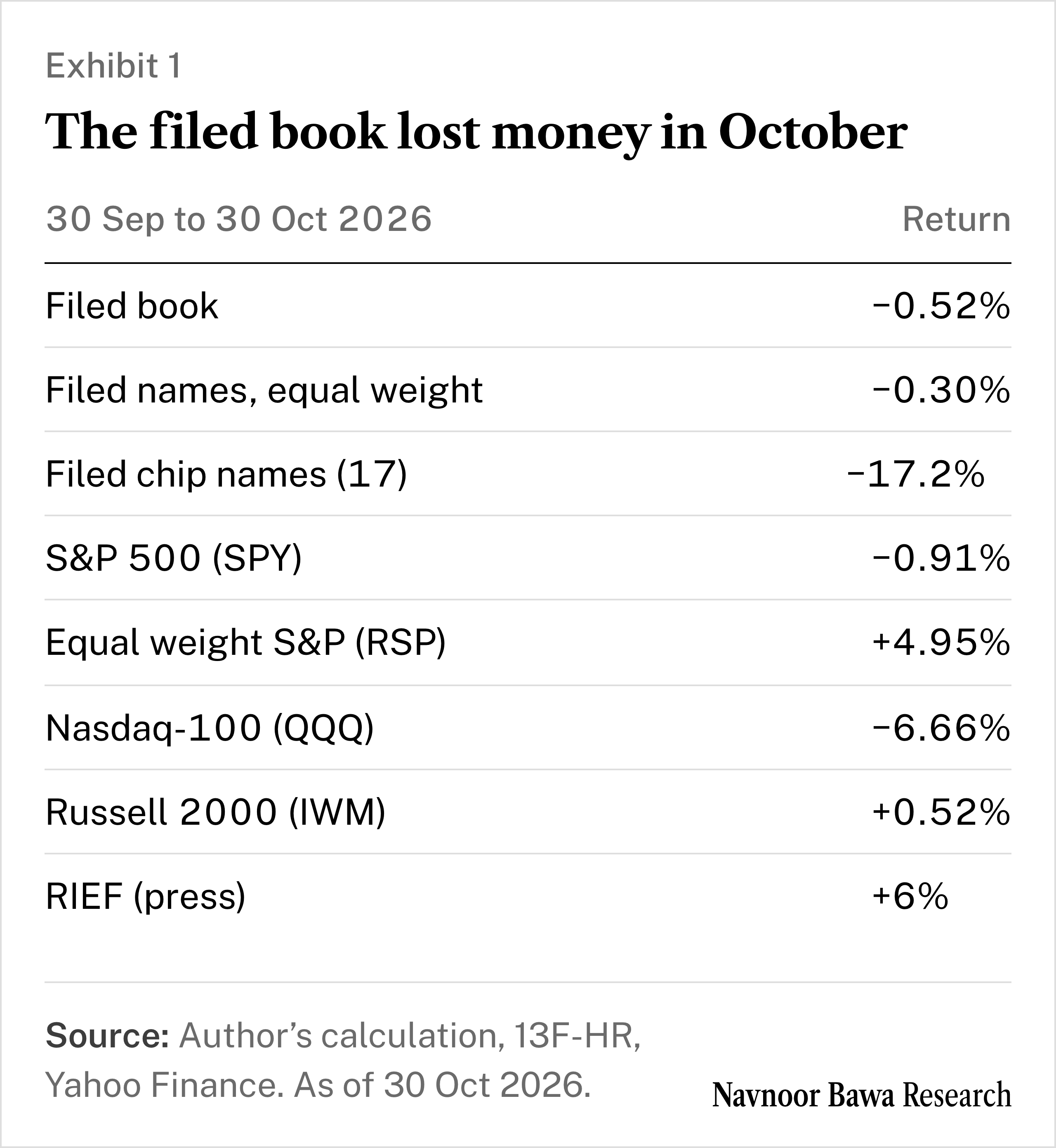
Exhibit 1 · The filed book lost money in October
Source: Author’s calculation from Renaissance Technologies LLC 13F-HR for 30 Jun 2026 and Yahoo Finance closes, RIEF as reported by Bloomberg via Hedgeweek · as of 30 Oct 2026
Both filed book totals sit near the S&P, the chip names far below it, and only the equal weight index sits near RIEF.
The method is the one our Rokos piece taught: price the manager’s last 13F at the month’s closes. A 13F shows long positions at a quarter end. The SEC’s Form 13F FAQ says short positions and the options a manager writes aren’t reported, and futures and swaps never appear in it. So the October figure is the June book held still, and Renaissance may have traded every line since.
It isn’t RIEF’s book either. Co-CEOs Peter Brown, also chairman, and David Lippe run Renaissance Technologies, the firm Jim Simons founded. One adviser manages RIEF, Medallion, the employees’ fund, and RIDA, Renaissance Institutional Diversified Alpha, another of the firm’s outside funds. It files one 13F for all of them, signed by Tiffany Michel, the chief compliance officer, so the filing doesn’t say which fund holds which share.
Medallion alone reports $61.2bn of gross assets in the Form ADV, the adviser’s regulatory filing, nearly three times the $21.8bn of RIEF’s master, the pooled fund (RIEF Trading LLC) it invests through. RIDA has the same claim on these stocks as RIEF, so RIEF holds only part of this filing and the filing cannot say which part. Some lines probably aren’t RIEF’s: the ADV says RIEF Trading LLC “does not invest in open-end investment companies”, which leaves out many of the filing’s ETF lines.
A copy of the filed book, the one trade a 13F lets an outsider put on, made almost nothing in the month RIEF made 6%.
Intel lost more than the book
Intel, the filing’s third largest line after Nvidia and Meta, shows where the money went. It held 7,321,928 shares, worth $1.02bn at the June close of $139.63. The March filing held slightly more shares, worth about a third as much.
On the June count, the line was worth $880m at the end of September. Intel closed October down 45.3%. The worst of it came in one session: Intel lost 28.6% on 30 October, the “29% single-session decline” Hedgeweek reported.
The June count is a photograph. Renaissance may have sold Intel after June and missed the fall, and only the next filings will say. It does show where the June book’s dollars sat, in a few large names. After Intel, the largest dollar losers were Meta, Corcept, Nvidia and both Alphabet lines, with AMD also among the ten; six of the ten are chip or megacap platform names. The largest winner, the drug maker Exelixis, made $147m, less than half what Intel lost; Etsy and Chevron were among the other winners.
Breadth wasn’t the problem. More than half the priced names rose in October, and so did the median name. The book lost because a few large lines fell hard, and the filing’s three largest lines, Nvidia, Meta and Intel, were among them, down 10.4%, 15.2% and 45.3%. A follower who copied the June filing owned Renaissance’s breadth and Intel’s fall at once.
The twin fits October, then breaks
The twin is the equal weight S&P 500 (RSP) less the cap weight S&P 500 (SPY) over the same days. It gained 5.85 points in October, against the 6% Bloomberg reported for RIEF. The selloff hit the giants, which is what that spread measures: Hedgeweek reported the Nasdaq-100 down about 10% from its peak earlier in the month. I picked the twin after seeing October, so its fit is a description, not a test.
The twin isn’t what Renaissance filed. The filed names at equal weight lost 0.30% and beat the S&P by only 0.61 point. If RIEF ran an equal weight tilt in October, it didn’t run it through the names the filing shows for June.
Beta, a fund’s sensitivity to the market, doesn’t explain the month either. RIEF is, in InvestmentNews’s profile, a “long-biased equity strategy that aims to beat the S&P 500”. InvestmentNews described its design in 2009 as “going 175% long, versus 75% short”, with “a beta of 0.4”. With the S&P down in October, any positive beta cost RIEF money, so the 6% came on top of a small market loss.
The peers had a harder month. Hedgeweek reported that many quant funds lost “approximately 1%”, Marshall Wace’s Eureka lost 5.4% and its systematic fund TOPS 3.6%, Rokos lost 4.9%, Millennium lost 2.3%, and RIDA made 4.6%. Among the funds Hedgeweek reported, only Quantedge, the hedge fund up 7.2% whose September 13F is the next firm below, did better than RIEF. A relay on Yahoo Finance credited “Renaissance’s systematic models” across “strategy lines”, a firm wide gloss rather than a cause.
Those funds lost in the market the filed book lost in, and the filed book’s month looks far more like theirs than like RIEF’s. The twin fits October almost to the point; the question is whether it fits any other month.
It fit for a long time: in every full month the press reported, the twin had RIEF’s sign, as Exhibit 2 shows. In October 2025, when RIEF lost 14.39%, as InvestmentNews reported (the loss we read in January), the twin lost 3.32 points. When Institutional Investor reported RIEF “climbed 12.65 percent” the next month, the twin gained 1.72.
Then it broke, in two stretches of 2026 derived from the press’s year to date figures. Business Insider reported, citing a person close to the firm, that RIEF made 9.2% in July for 4.5% on the year. That implies a first half loss of about 4.3%, while the twin gained 1.89 points.
The second break is recent. Hedgeweek’s 12.3% for the year after a 6% October implies about 5.9% at the end of September. Against July’s 4.5%, that leaves RIEF a gain of about 1.4% in August and September, while equal weight lagged cap weight by 5.23 points. These figures come from unnamed sources and the reports don’t say whether they are net of fees, so the two derived periods are estimates.
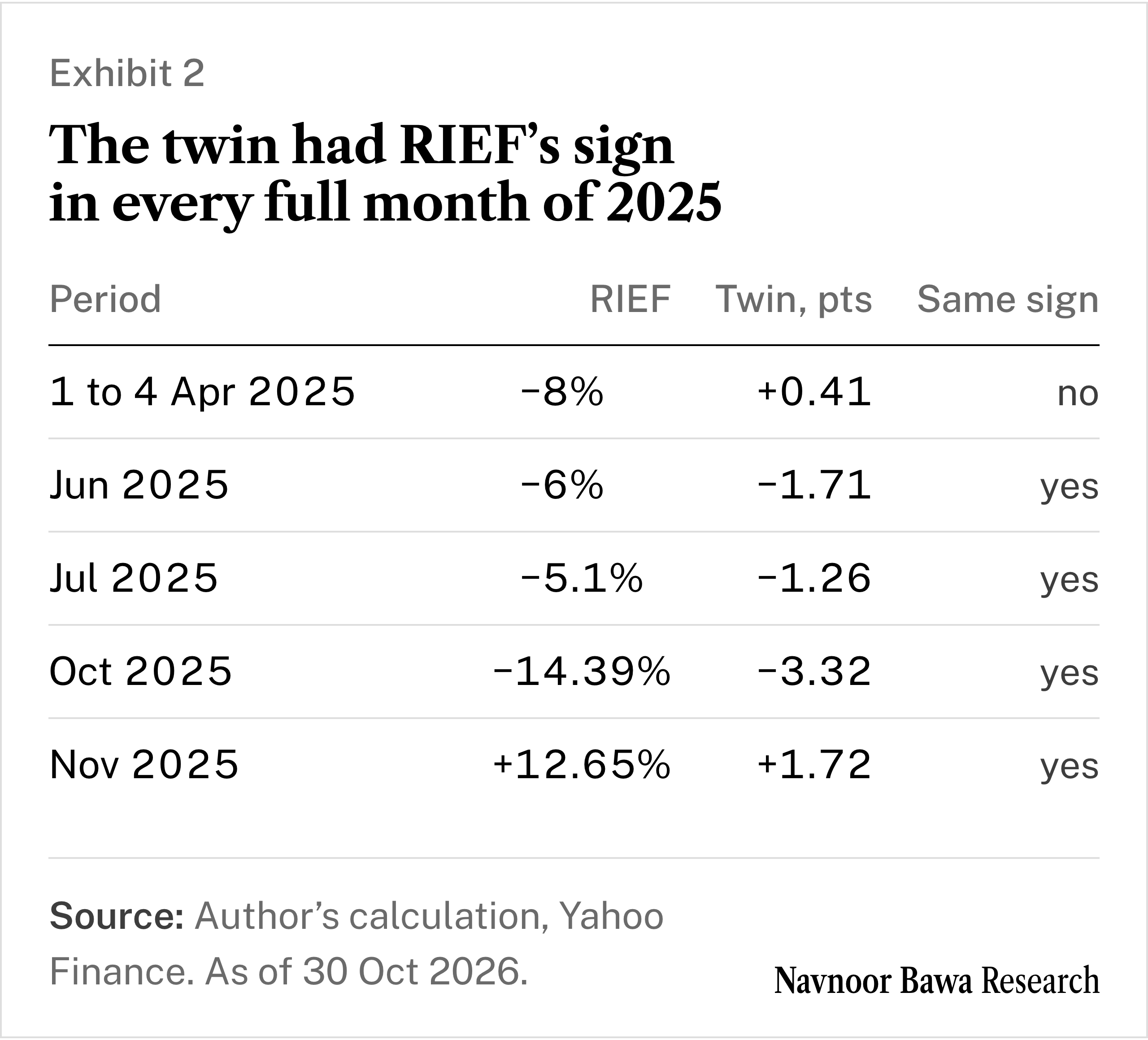
Exhibit 2 · The twin had RIEF’s sign in every full month of 2025
Source: Author’s calculation from Yahoo Finance closes, RIEF returns as the press reported them · as of 30 Oct 2026
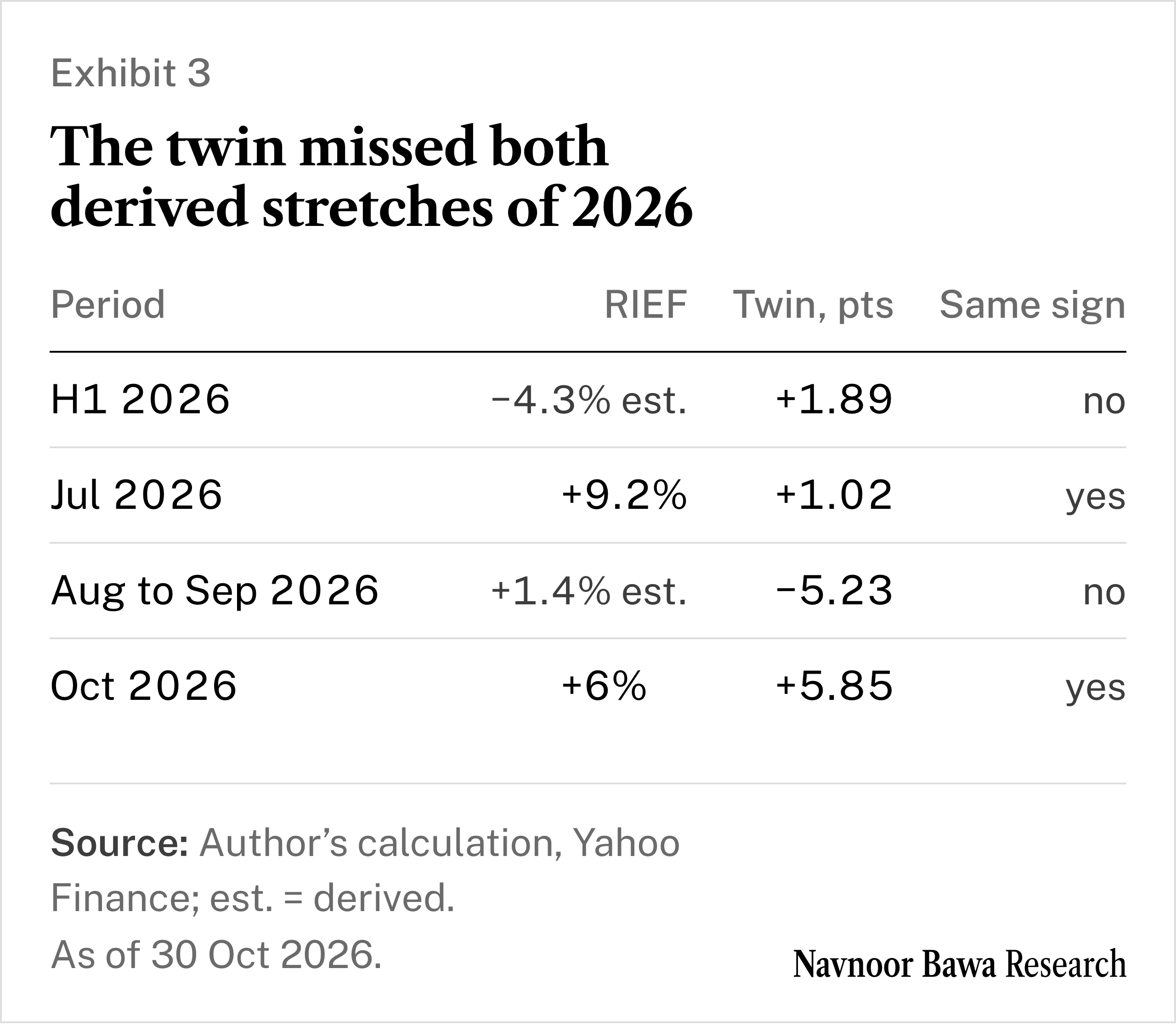
Exhibit 3 · The twin missed both derived stretches of 2026
Source: Author’s calculation from Yahoo Finance closes, RIEF returns as the press reported them · as of 30 Oct 2026
Only the April 2025 stub of four days and the two derived stretches of 2026 broke the pattern. Sign is not size: a match means only that the twin and RIEF both rose or both fell. October is the one month where the twin’s 5.85 points matched RIEF’s 6%, a ratio of about 1. In the five earlier full months RIEF moved 3.5 to 9.0 times as far as the twin. Two misses in one year are reason enough not to treat the twin as the explanation of RIEF’s.
The objection that matters most is that the book changed after June; it was three months old by October. The September book, due on EDGAR by Monday 16 November, is the first filing that could show stocks that made the month. Shorts, futures and swaps won’t appear in it at all, and the SEC’s short position report, Form SHO, is deferred to January 2028 and will publish certain information on an aggregated basis for each stock.
Anyone can price the September filing the day it reaches EDGAR, with the method above. The part that has to be fixed before the filing exists is behind the wall, so that its number tests the call and cannot rescue it. That is the odds, set from five book changes each priced for the month after it, and a test of how far the unpriced tenth of the filing can move the answer.
→ Renaissance’s 2000 to 2013 basket options, rebuilt from a Senate staff report, Trade File No. 14 on Patreon.
Will the book Renaissance files by 16 November beat the S&P by enough in October to carry half of RIEF’s gain?
Below the paid line:
The call, its odds on the September filing, the S&P spread that breaks it, and the deciding number.
The five book changes behind the odds, a sensitivity table, and the filed book’s sign period by period.
The lines OpenFIGI could not price, the five largest among them, and how far they can move the answer.
What this changes, a test any reader can run on another fund, and the dates to watch.