

The consensus: a platform staffs where the money is
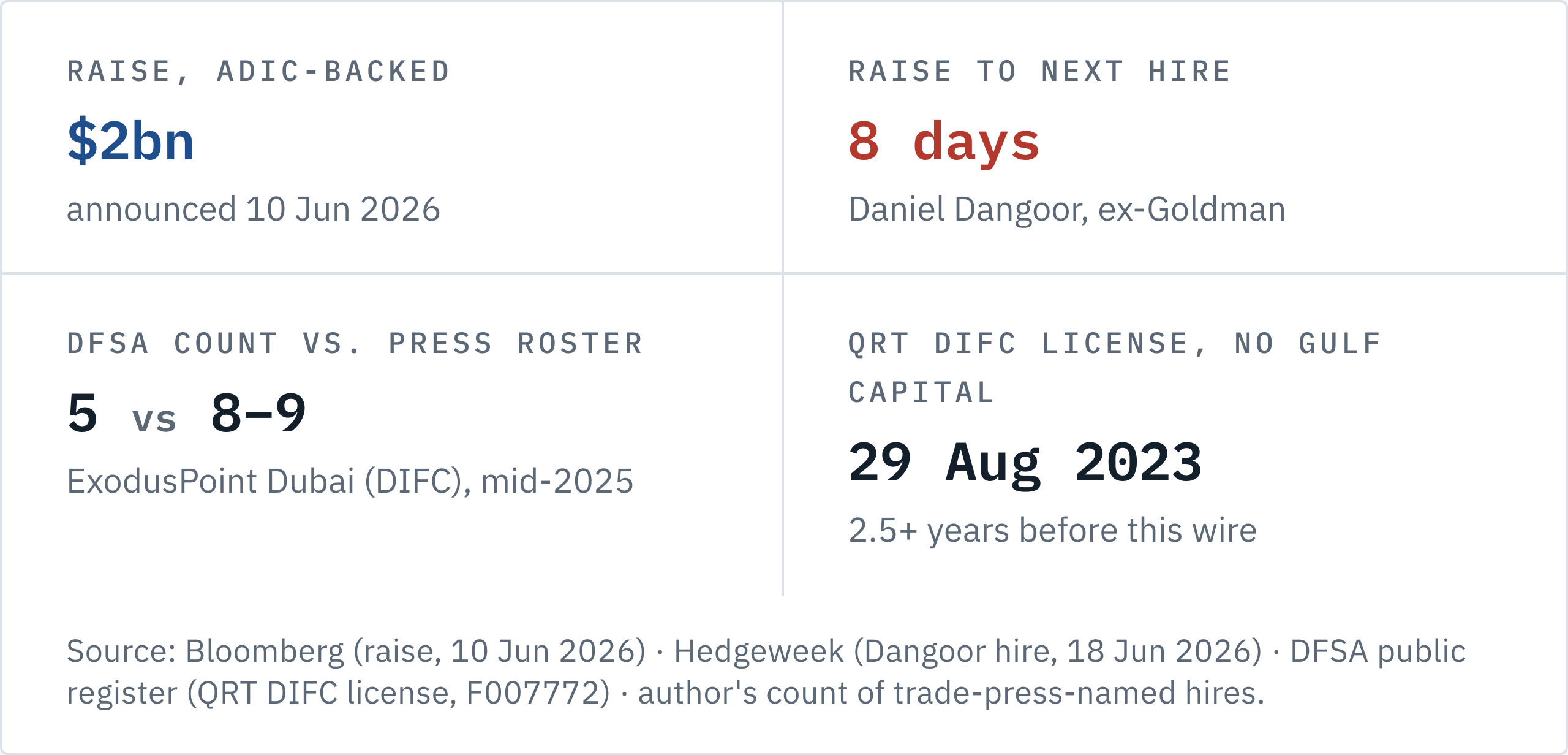
Here is the story that writes itself. ExodusPoint just pulled in $2 billion, its biggest capital raise ever, with Abu Dhabi’s sovereign money in the mix. A real number. A real backer. Weeks later, it hires a senior portfolio manager and points him at Dubai to run a ten figure global rates book. The firm manages $14.9 billion by the wire’s own count ($14.5 billion by Bloomberg’s June coverage of the raise, a gap I’ll come back to, the same kind of headline-AUM wedge that shows up at a much larger scale in Citadel’s own SEC filings), and it just took a fresh check from Abu Dhabi Investment Council, a unit of Mubadala. It plants a $1 billion pod in the same city its new backer calls home. It isn’t even the first addition since the raise closed. A Goldman Sachs macro managing director, Daniel Dangoor, joined the same desk eight days after the $2 billion landed. A sophisticated reader spots the shape immediately: a platform following the capital.
The backdrop makes the story easy to believe. Dubai’s hedge fund population isn’t merely growing. It’s compounding. The DIFC counted 102 hedge fund managers as of mid December 2025, more than double the count from the start of 2025, with roughly 80% of them running over $1 billion. Six of the eight largest US multistrategy platforms, Millennium, Point72, Balyasny, Schonfeld, ExodusPoint and Hudson Bay, now keep an office there. A crowded map. Abu Dhabi alone is deploying part of an estimated $1.8 trillion of sovereign wealth into the hedge fund industry. ADIC is separately reported to be building its own hedge fund portfolio worth around $15 billion. Put a $2 billion Gulf backed raise beside a Gulf based hire, made days apart from a second one, and the causal arrow all but draws itself: sovereign money in, sovereign linked pods out. It’s the cleanest version of a story hedge fund reporters have told about Dubai for three years running.
Scale it against the market leader and the pull looks even stronger. Millennium Management, the first of the major multistrats into Dubai, licensed its DIFC entity in 2020 and by September 2024 had grown its local headcount to roughly 100 people, on top of $68.8 billion firmwide. A four year head start. ExodusPoint just cashed the largest check of its own history from the same region.
I don’t think the reciprocity story survives the paper trail as written. But a clean “agglomeration, case closed” rebuttal doesn’t survive it either. I expected, going back through every dated hire one at a time, to find the timeline break cleanly one way or the other. It doesn’t. It does something worse for a tidy thesis: it accelerates, and it accelerates toward the money.
The variant: the office came first, but the pace didn’t stay flat
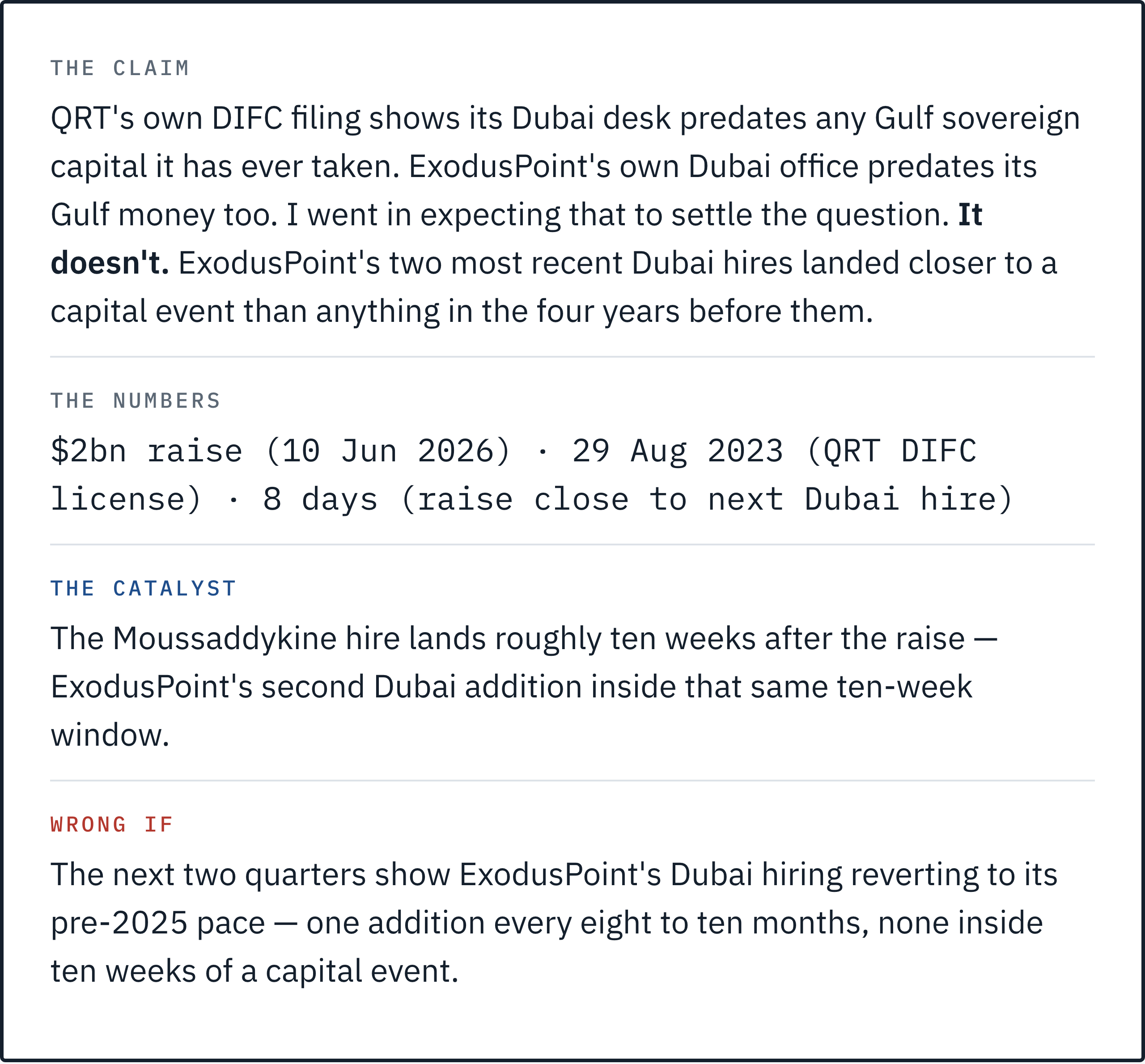
Here is what actually happened, in order, and it does not sort as neatly as either story wants. ExodusPoint set up its Dubai operations in 2022, years before Abu Dhabi Investment Council wrote a check. Adrian Ahmadi arrived from Point72 at some point after that, undated in the trade coverage I could find. By April 2024 the desk had three more portfolio managers. Valery Ivanov came from Point72, running consumer long/short equity. Omar Soomro came from Garda Capital and Moore Capital, trading emerging markets. Rob Kitchen came from Amia Capital and, before that, BlueCrest, running macro. 2025 added two more. Berhe Tesfayohannes, an FX options specialist out of PIMCO, joined in June. Chris Wheeler followed later that year, though he wasn’t new to the city: he had already been running BlueCrest’s own Dubai desk since 2022, after leaving Citadel for it. Then the pace changed. Daniel Dangoor, a Goldman Sachs macro managing director, joined the Dubai desk on 18 June 2026, eight days after the $2 billion raise closed. Now, roughly ten weeks after that same raise, the addition is Moussaddykine. Two hires inside ten weeks of the largest capital event in the firm’s history. Nothing in the four years before it landed anywhere near that close to a check clearing.
Here is the fact that still complicates the reciprocity story, even with that timeline in hand. Qube Research & Technologies, the systematic shop Moussaddykine is leaving, has no reported Gulf sovereign LP capital of its own. Its disclosed AUM has moved from roughly $23 billion in early 2025 to $38 billion by January 2026, a trajectory the trade press credits to returns, with no capital raise anywhere in the story. Its LP base isn’t public. A closed book. And it still opened a licensed DIFC subsidiary, Qube Research & Technologies (DIFC) Ltd, on 29 August 2023, just under three years before this wire, with nothing in the record to explain it. That date comes from the DFSA’s own public register: license date 29 August 2023, reference F007772, Index Tower, Unit 1801, Level 18, DIFC, Dubai. The register blocks automated access on direct request. An access wall, nothing more. The same address and entity are independently confirmed inside QRT’s own SEC Form ADV, CRD 304552, last amended 31 March 2026, in its books and records disclosure, though not in the filing’s list of disclosed advisory offices. A regulatory record from the firm Moussaddykine is exiting confirms QRT built the same Gulf infrastructure ExodusPoint is now paying him to staff, and no sovereign allocation explains why.
That is still the tell, for the origin question. A firm with zero documented Gulf capital events built the identical Dubai infrastructure a firm with a very large one just built. Same building. Opposite balance sheets. Origin and tempo are two different questions. The tempo is the one Dangoor and Moussaddykine answer differently than the six hires before them did.
The mechanism: two things happening at once, and a third that doesn’t fit either
Two mechanisms explain most of the Dubai buildout, and neither one runs through a single LP’s check. A third pattern, visible only in the last two hires, is the one that actually complicates the story.
The first is agglomeration. Once a critical mass of pods exists in one city, hiring inside that city gets cheaper for everyone, because a recruiting pool already exists and has already been screened by a competitor. Chris Wheeler is the cleanest example of it: he was already running BlueCrest’s own Dubai desk, having left Citadel for it back in 2022, before ExodusPoint hired him across town three years later. Ahmadi and Ivanov both arrived from Point72, Soomro from Garda and Moore. Those are lateral moves inside a set of firms already competing for the same regional bench, nothing to do with anyone’s fundraising calendar. The centre’s hedge fund headcount crossed 1,000 employees by September 2024, against a broader DIFC workforce that had grown 66% since 2019. That’s regional scale.
The second mechanism is personal, and it’s the one the trade press cites most often when it actually asks departing PMs why they moved. Dubai charges zero personal income tax. A senior portfolio manager clearing seven figures keeps meaningfully more of it in Dubai than in London or New York, whether or not his employer ever took a dirham of Gulf sovereign capital. Investment Monitor’s survey data, pulled from a May 2024 HFM Middle East Summit poll of 120-plus hedge funds, lists ease of doing business, visa processing, talent access, timezone coverage, and quality of life among the reasons funds gave for building a regional presence. Tax free comp is a PM level draw on its own, whatever a platform’s investor relations desk is telling Abu Dhabi. Tax beats optics.
Neither mechanism explains Dangoor cleanly. That’s the honest gap. He didn’t come from inside the regional bench the way Wheeler did. He came straight from Goldman Sachs in London, the same path Tesfayohannes took the year before, except Tesfayohannes’ hire sat inside an otherwise quiet stretch of the cadence and Dangoor’s landed eight days after a $2 billion raise. A cold relocation from outside the region proves nothing by itself. Landing one eight days after the largest capital event in the firm’s history is closer to the shape the reciprocity story predicts than to either mechanism above.
