



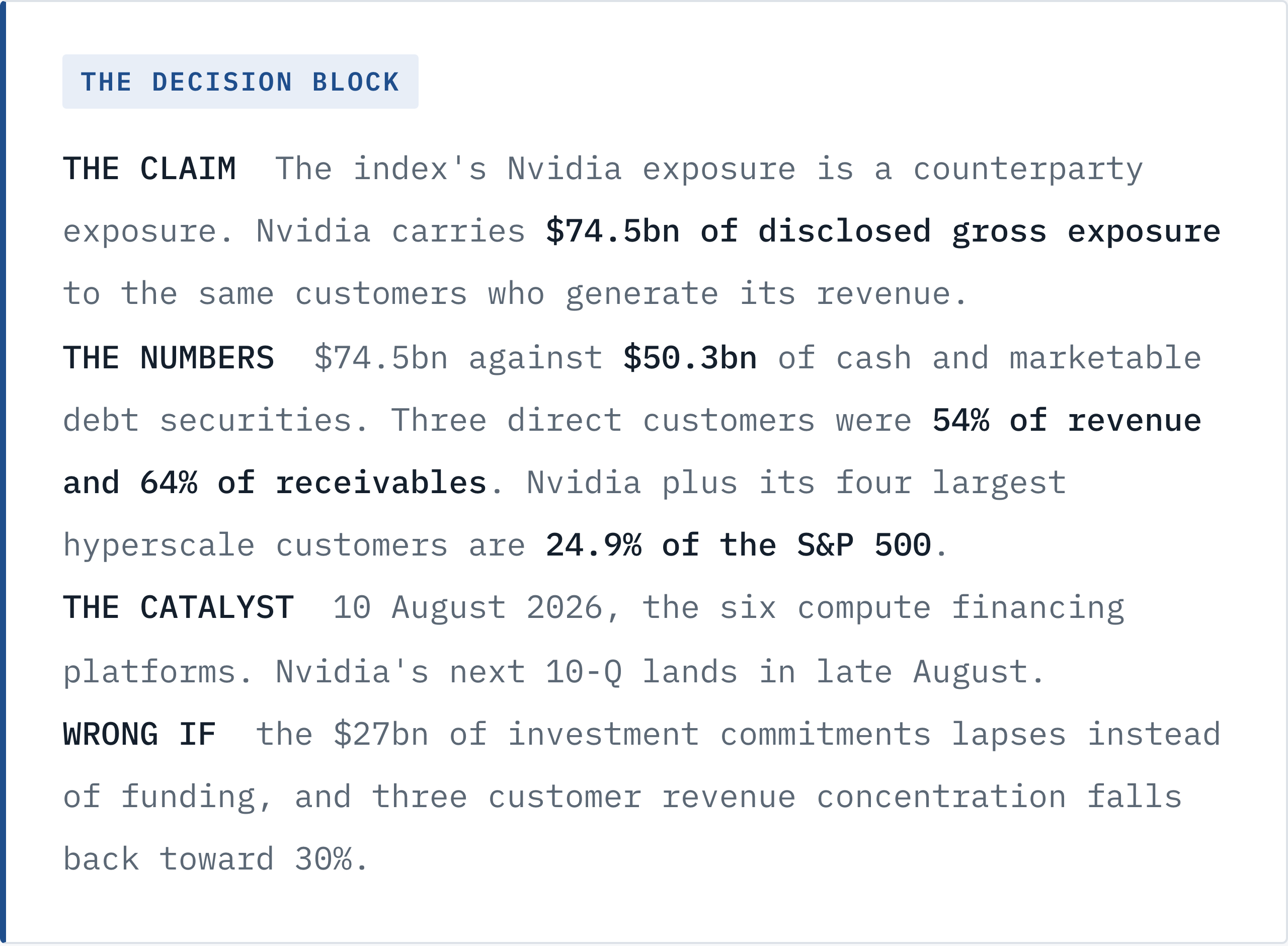
The last vendor to run this playbook wrote the tell into its own filing. Lucent, in 1999, justified calling its customer receivables collectible “based on various factors among which is the ability of Lucent to sell these loans and commitments”. Collectability rested on the existence of a buyer for the paper. On 10 August, Nvidia went looking for six.
The consensus is a weight argument, and it’s a good one
The figure moving around desks this month: Nvidia contributed more than 10 percentage points to the S&P 500’s roughly 84% five year total return, about 12% of the entire gain, against Apple at 5 and Microsoft, Broadcom and Alphabet at 3, 3 and 2. Five names, 30% of the rise.
I want to be careful with that number, because I cannot reproduce it and I could not trace it to a source I can open. No index provider publishes it, the attribution method is nowhere stated, and a chained contribution calculation on a stock whose weight rose this far over the window is extremely sensitive to whether you use beginning weights, ending weights or daily chaining. So I’m not resting anything on it.
What I can verify is the weight. In the SPDR S&P 500 ETF Trust’s daily holdings file dated 13 August 2026, Nvidia is 8.13% of the index, Apple 6.68%, Microsoft 5.50%, Amazon 3.87%, Alphabet 5.45% across both classes, Broadcom 2.95%, Meta 1.95%. Those are one fund’s weights on one date standing in for the index’s own, so I checked them against Vanguard’s at 31 July: Nvidia 7.55%, the fortnight between the reads being a rally rather than a disagreement.
The consensus built on those numbers deserves its strongest form before I depart from it. Passive vehicles hold the index as given, and American retirement savings sit disproportionately in them: $9.9tn in 401(k) plans alone at 31 March 2026, 58% of it in mutual funds, per the Investment Company Institute. A saver who chose an index fund to avoid single stock risk holds an 8% position in one semiconductor company, sized by a rule nobody debated. If AI capex slows, the index falls inside accounts whose owners never made the bet.
I think every part of that is true. It describes price risk, which is the part the market already prices.
What the filing shows that the weight doesn’t
Here is what I did not expect to find when I opened the 10-Q.
Nvidia now runs a credit book against its own customers, and it’s large. At 26 April 2026, on unaudited quarterly statements covering $81.6bn of revenue, the balance sheet shows $43.4bn of non-marketable securities, up from $22.3bn three months earlier. The equity component, stakes in privately held companies, went from $3.24bn to $42.34bn in twelve months. That’s a 13.1x increase. $17.9bn of it landed in one quarter.
These are what they sound like: positions in companies with no public market, carried at cost less impairment and marked only when a transaction forces it. No daily price. No bid.
Three items underneath it matter more. Investment commitments were $27bn, contracted capital Nvidia expects to fund through the rest of fiscal 2027. Equity method investments in infrastructure funds were $1.0bn, with maximum loss exposure including commitments of $2.3bn. Then the one that changed how I read the filing. During fiscal 2026 Nvidia entered agreements to guarantee partners’ facility lease obligations on default, in exchange for warrants. Maximum gross exposure is $3.5bn, declining as partners pay lessors over terms of five to seven years, with $712m placed in escrow against it. The filing classifies these as credit derivatives, with fair value changes running through other income.
Read that again. Nvidia is selling default protection on data centre leases and taking equity upside as the premium. That’s a bank’s trade. A bank writing it would report it as a credit exposure with an allowance against it; Nvidia reports it in four sentences of a note, at a fair value the filing calls not material.
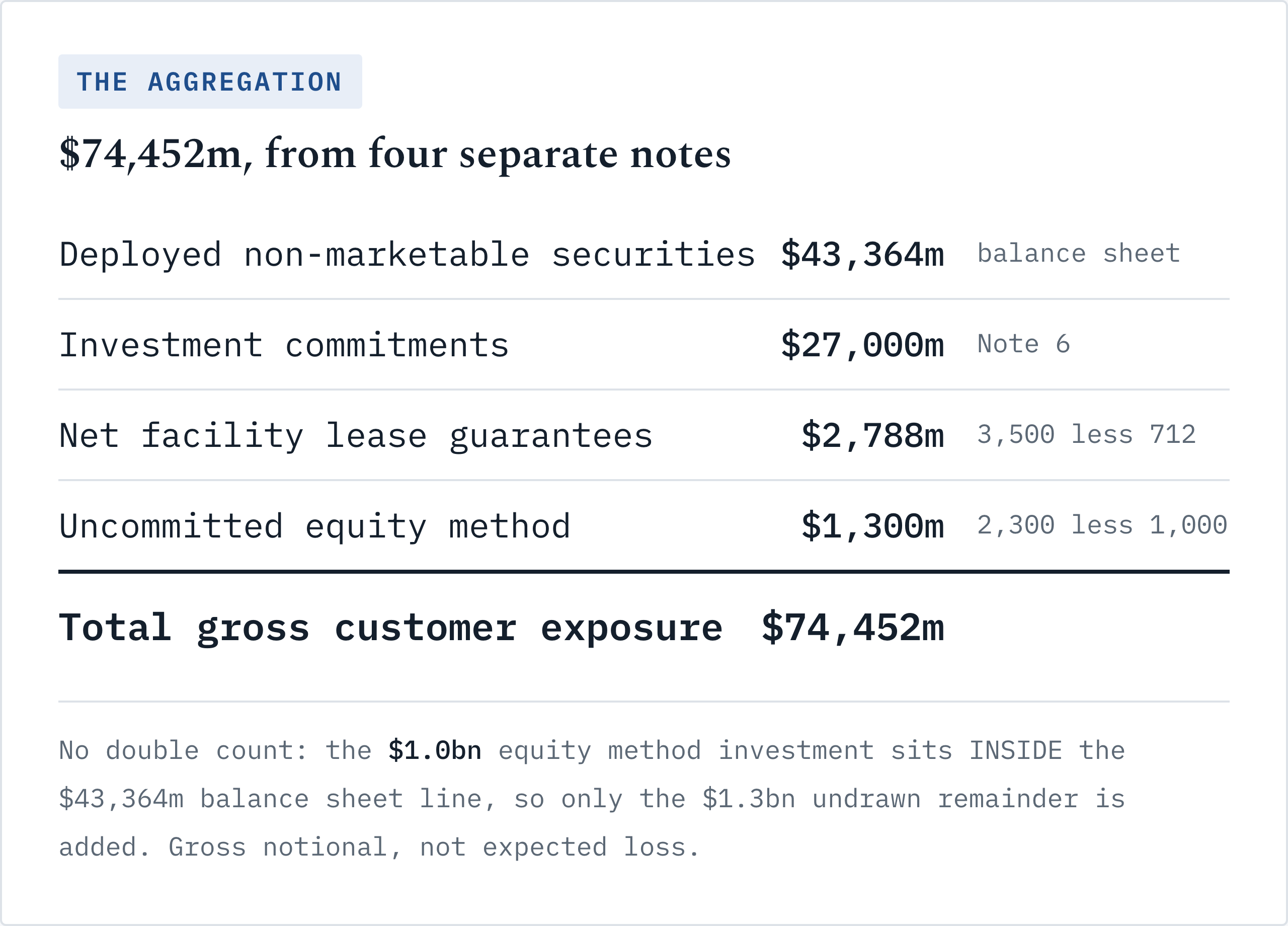
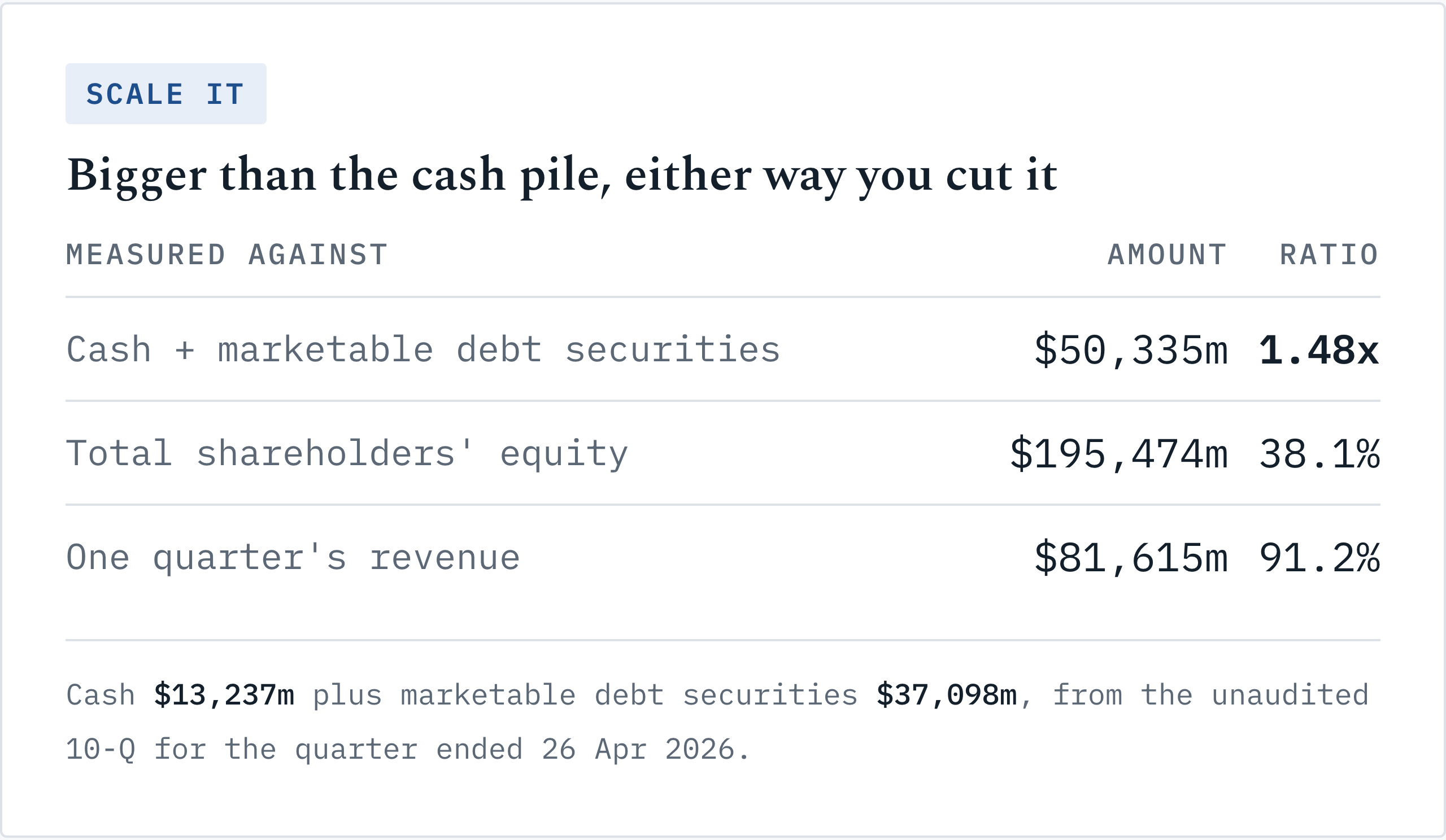
$74.5bn, gross and before recovery. A notional, not an expected loss, and I come back to what it’s worth in the limits. Against $13.2bn of cash plus $37.1bn of marketable debt securities, the book is 1.48 times liquid reserves, 38% of shareholders’ equity and 91% of a quarter’s revenue. None of it appears in an index fund factsheet, which reports a weight.
A quarter of pre-tax income now comes from below the operating line
For anyone reading the private book as a rounding error, this is the part I’d put in front of them.
In the quarter to 26 April 2026, Nvidia reported operating income of $53,536m and income before tax of $69,903m. The gap is $16,367m of non-operating income, of which $15,929m sits in the single line “Other income (expense), net”. A year earlier that same line was negative $180m, and total non-operating income was $272m against $21,910m of pre-tax income.
The share of pre-tax income arriving from below the operating line went from 1.2% to 23.4%. In twelve months.
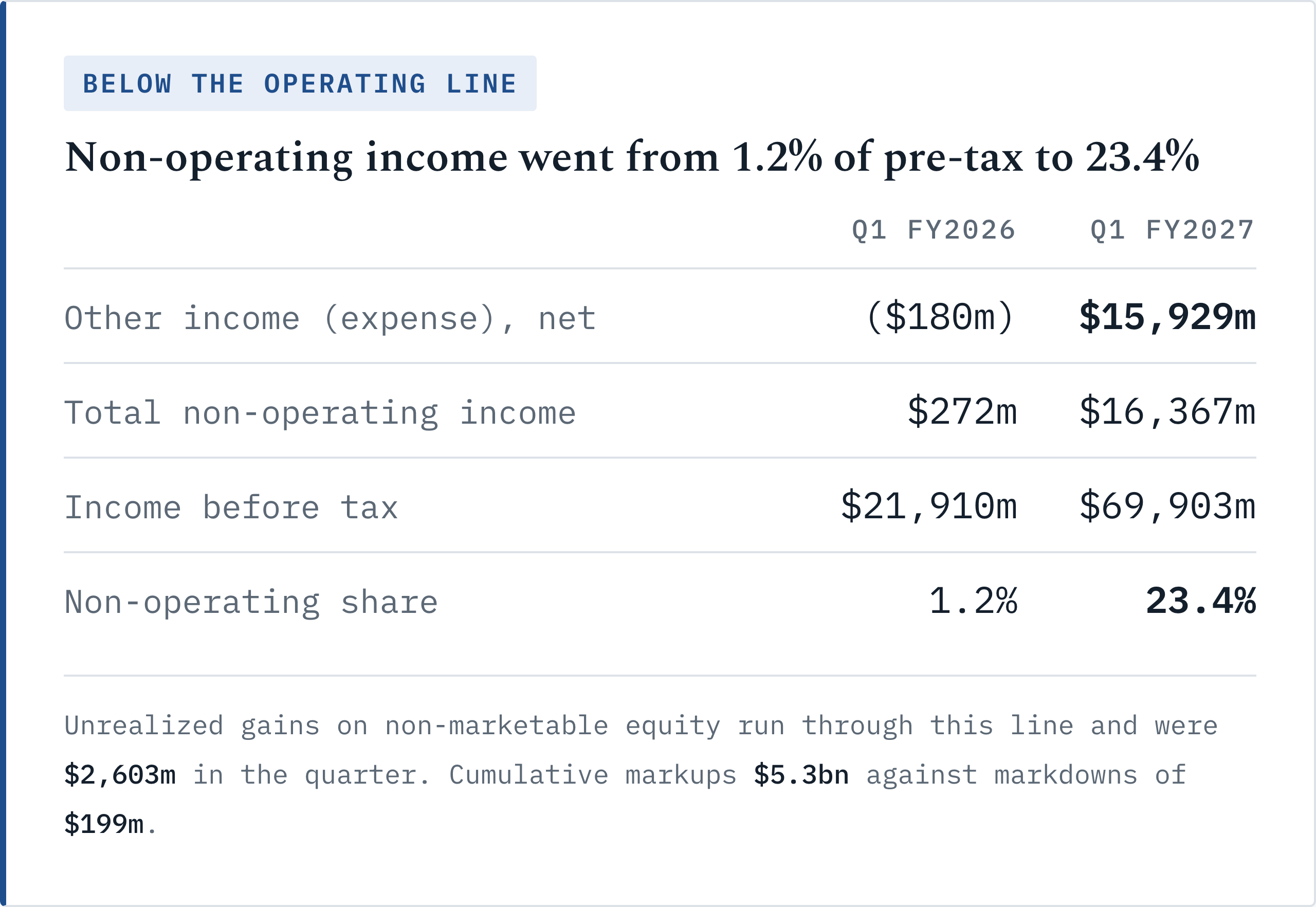
The filing says what feeds it. Unrealized gains on non-marketable equity securities run through Other income (expense), net, and were $2,603m in the quarter. Marketable equity securities, which include positions that graduated out of the private book when their issuers listed, rose from $12,886m to $30,237m over the same three months, marked through the same line. Net income was $58,321m against $18,775m, and a meaningful slice of the increase is Nvidia marking up its holdings in companies that buy its chips.
One more number frames how untested those marks are. Cumulative gross unrealized gains on the non-marketable equity book stood at $5.3bn, against cumulative gross unrealized losses and impairments of $199m. That is a 27-to-1 ratio of markups to markdowns on a portfolio of illiquid private positions built almost entirely within one year. Every venture book I’ve seen looks like that early. None stays like it.
The receivables point at the same corner of the market as the equity stakes
Concentration in the revenue line moved hard. In the first quarter of fiscal 2027, three direct customers represented 21%, 17% and 16% of total revenue. A year earlier, two direct customers represented 16% and 14%. Thirty percent across two names became 54% across three. In a year.
The receivables say the same thing one step further along. Three direct customers accounted for 30%, 18% and 16% of the accounts receivable balance, a combined 64%, against 25%, 18% and 13% at the January quarter end. Accounts receivable net stood at $40.7bn.
Nvidia doesn’t identify its direct customers and doesn’t itemise the private equity book, so I can’t prove the two lists are the same names. What the filing establishes is that both narrowed sharply and simultaneously while the private stakes grew 13x. Where they overlap the exposure compounds rather than adds: funding the buyer, booking the revenue, holding the receivable against a name whose ability to pay depends partly on capital Nvidia supplied, then marking the stake in that name up through the income statement.
For the public half I don’t have to infer, because Nvidia files it. Its 13F for the quarter ended 30 June, filed 14 August, lists eight positions worth $63.4bn, two of them its own AI cloud customers: CoreWeave at $4.70bn and Nebius at $0.33bn. A 13F is long only, US equities, quarter end and lagged, so it says nothing about the private book or the guarantees. Within its limits it names counterparties, which is more than the 10-Q manages.
And the 10-Q describes the wider loop in its own words, in a passage that gets far less attention than the customer-concentration line: “We estimate that one AI research and deployment company contributed to a meaningful amount of our revenue by purchasing cloud services from our customers in the first quarter of fiscal year 2027.” Nvidia’s telling you a company it doesn’t sell to is driving a meaningful share of what it books, through companies it does sell to. And in some cases funds.
What 10 August actually changed
The press release is short and worth reading in its own words. Six strategic partnerships, “the first compute financing platforms of their kind at global scale,” designed to create “dedicated pools of capital at significant scale at attractive rates for NVIDIA customers.” Over $500bn of third party capital, mobilised over time, and the whole arrangement “subject to execution of the final agreements.”
The framing everywhere is that this cuts circular financing, because the money is third party. On direction of travel that’s right. It also does something nobody has priced, and it follows from where the disclosure lives.
Today every dollar of it shows up where an index fund holder can open it. The $42.3bn, the $27bn of commitments, the $3.5bn of guarantees, the $712m escrow, the $2.6bn of marks: a handful of paragraphs in a public 10-Q. The exposure is ugly. It is also visible.
Move the next $500bn into six privately managed platforms and that changes. Be exact about how, because the loose version of the claim is wrong: some private credit sits in BDCs, which are SEC reporting companies filing schedules of investments that name each borrower at fair value. Nothing stops getting filed. It’s that nothing aggregates. No filing will tell an S&P 500 holder the total leverage written against Nvidia hardware across six platforms, at what advance rates, on what collateral schedules. Today that is one line in one 10-Q. Afterwards it is a quantity nobody computes, and the platforms’ legal form is still unannounced.
There is a size problem underneath the disclosure one. In its May 2026 Financial Stability Report the Fed puts the entire US private credit market at about $1.4 trillion, roughly 10% of US nonfinancial corporate debt, so a $500bn target is 36% of the whole asset class being asked to fund it. Treat that as an order of magnitude rather than an estimate: the $1.4tn is data from the second half of 2025 so the denominator has grown, and $500bn is cumulative with no stated horizon. It’s still an unusual amount of one asset class to point at one manufacturer’s hardware.
The obvious reply is that I have this backwards, and it deserves full strength. If the $500bn genuinely comes from third parties with no Nvidia recourse, Nvidia’s exposure falls and an index holder’s falls with it, because that exposure runs through NVDA’s equity. On that reading the platforms are the de-risking they were announced as, and I’m mistaking a vanishing disclosure for an appearing risk.
My answer: the risk changes address inside the index rather than leaving it. The lender isn’t outside the portfolio, five of the six sponsors are constituents, and the fastest growing private credit vehicles are sold to individuals through funds those same households hold. What leaves is Nvidia’s balance sheet, where the exposure was consolidated, dated and readable on one line. Where it lands it is none of those. For a diversified holder that’s a transfer into worse instrumentation.
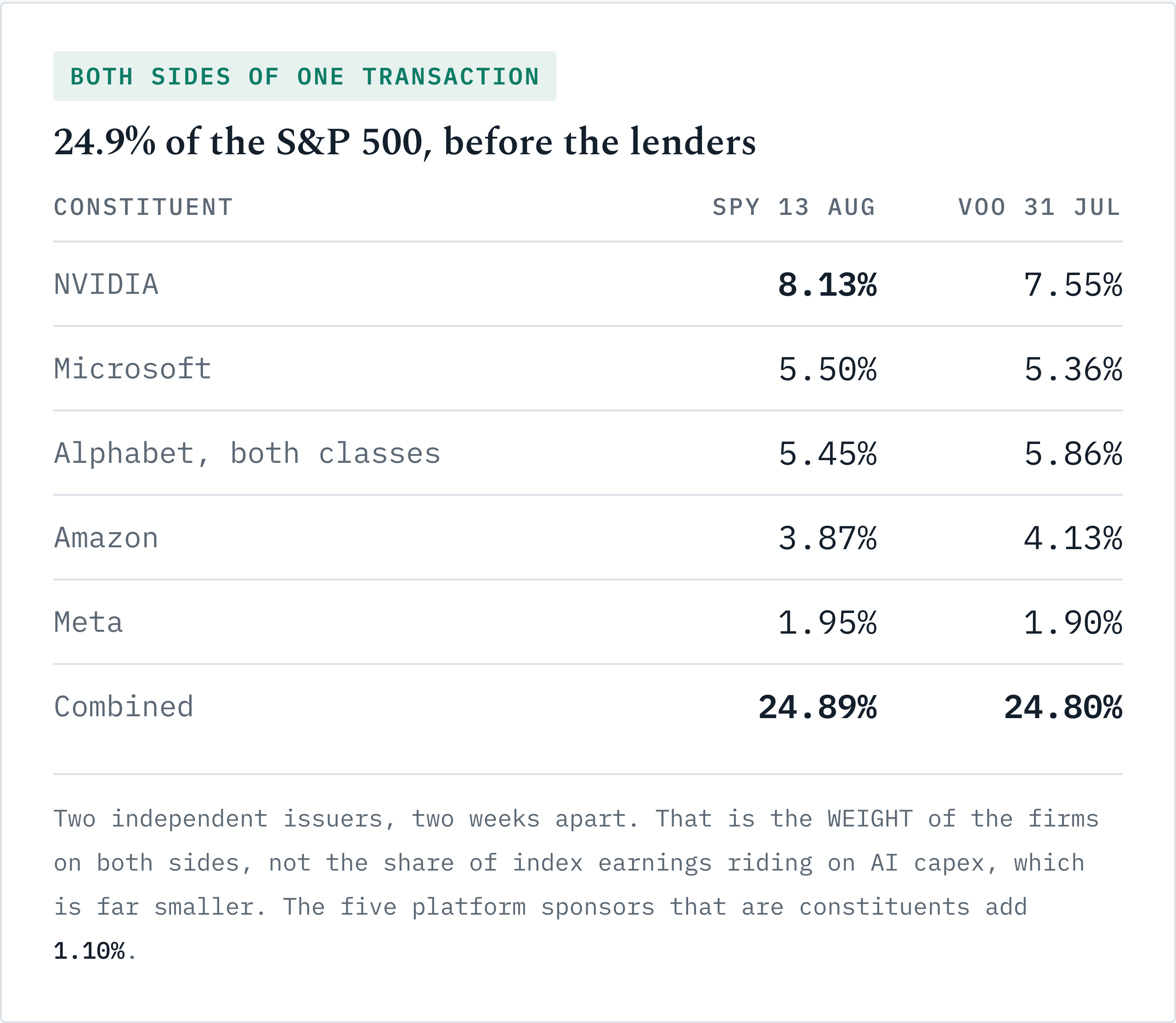
Checking each against the SPDR holdings file, five of the six sponsors are S&P 500 constituents: Goldman Sachs 0.458%, BlackRock 0.254%, Blackstone 0.165%, KKR 0.119%, Apollo 0.099%, combined 1.10%. Only Brookfield sits outside. That’s small, under a seventh of Nvidia alone, and I won’t inflate it. What matters is that the index holds the supplier, the buyers and the lenders, so one portfolio absorbs the loss on whichever leg breaks first.
Run the whole complex: Nvidia 8.13%, Microsoft 5.50%, Amazon 3.87%, Alphabet 5.45%, Meta 1.95%. That’s 24.9% of the S&P 500 in companies sitting on both sides of one transaction, before the lenders. Read it precisely: that’s the weight of the firms on both sides, not the share of index earnings riding on AI capex, which is far smaller because those four earn most of their money elsewhere. Every broad index owns suppliers and their customers. What isn’t ordinary is the speed and concentration, one capex cycle running through a handful of names in about three years.
The collateral is a chip, and the seller sets its useful life
Two sentences from the announcement do more work than the $500bn headline.
David Solomon, for Goldman Sachs: “...we’re excited for the new opportunity to create a market for credit backed by NVIDIA compute.”
Jensen Huang, in the same release: NVIDIA compute “is broadly adopted, flexible across models and workloads, fungible and transferable across customers and operators, and continuously improved through CUDA software [...] extending its useful life and improving its economics over time.”
The structure’s explicit. No ambiguity in it. The collateral behind this credit market is GPUs, and the claim that it holds value comes from the party selling it. Put the terms against each other: Nvidia’s own lease guarantees run five to seven years, and a GPU generation has been turning over in roughly two. A lender’s being asked to hold collateral across two to three product cycles on a residual value the manufacturer supplies. I don’t think Huang is wrong about CUDA, and the fungibility argument is stronger for Nvidia hardware than for most capital equipment. A lender underwriting a term loan against depreciating semiconductors is still taking a residual value view, and the residual value view on offer here is the vendor’s.
That’s what I’d want independently modelled before underwriting a dollar of it. I have no number that contradicts Huang. I want to be clear about that. My concern is structural: a market where the manufacturer supplies the collateral, the demand forecast and the useful life assumption has exactly one input nobody at the table is short.
What separates this from Intel Capital and GV
The obvious rebuttal, and the one I’d raise first: every cash-rich technology company runs strategic investments. Alphabet has GV, Intel ran Intel Capital for decades, and a $42bn private book at a company earning $58.3bn a quarter is unusual in size and ordinary in kind.
Two specifics separate it, both disclosed facts before they are interpretations. A venture arm doesn’t write credit derivatives on its portfolio companies’ lease obligations; Nvidia does, for warrants, on five to seven year terms. And a venture arm’s investments aren’t a precondition for its parent’s revenue line: hyperscale revenue was $37.9bn of $75.2bn total data centre revenue, so roughly half of data centre sales go to buyers outside the four biggest hyperscalers, and that cohort is the one needing financing to buy.
Nvidia’s own answer is stronger than either of those, and it is on the record. In a seven page memo sent to analysts in late November 2025 and obtained by Yahoo Finance, the company wrote that it “does not resemble historical accounting frauds because NVIDIA’s underlying business is economically sound, our reporting is complete and transparent”, and noted that its customers pay within 53 days rather than over years. The receivables in the filing agree with the company: $40.7bn against $81.6bn of quarterly revenue implies about 45 days, faster than it claims.
I think that rebuttal is sound and I think it answers a different claim than mine. Vendor financing, in the sense Nvidia denies, means lending a customer the cash to buy your product and waiting years to be repaid. Nothing here alleges that. What the filing discloses is equity in customers, $27bn committed to more of it, and credit derivatives written on customers’ leases. None of those is a loan to buy a chip. All of them are Nvidia’s own words.
The counter I can’t dismiss is that this is simply what supplying a capital intensive buildout looks like, and that vendor financing in semiconductors, telecom equipment and aircraft has always worked this way. That’s fair, and it’s why the last vendor to run this playbook at scale is worth reading in its own words.
Lucent said the same thing in 1999, and the sentence to read is about selling the loans
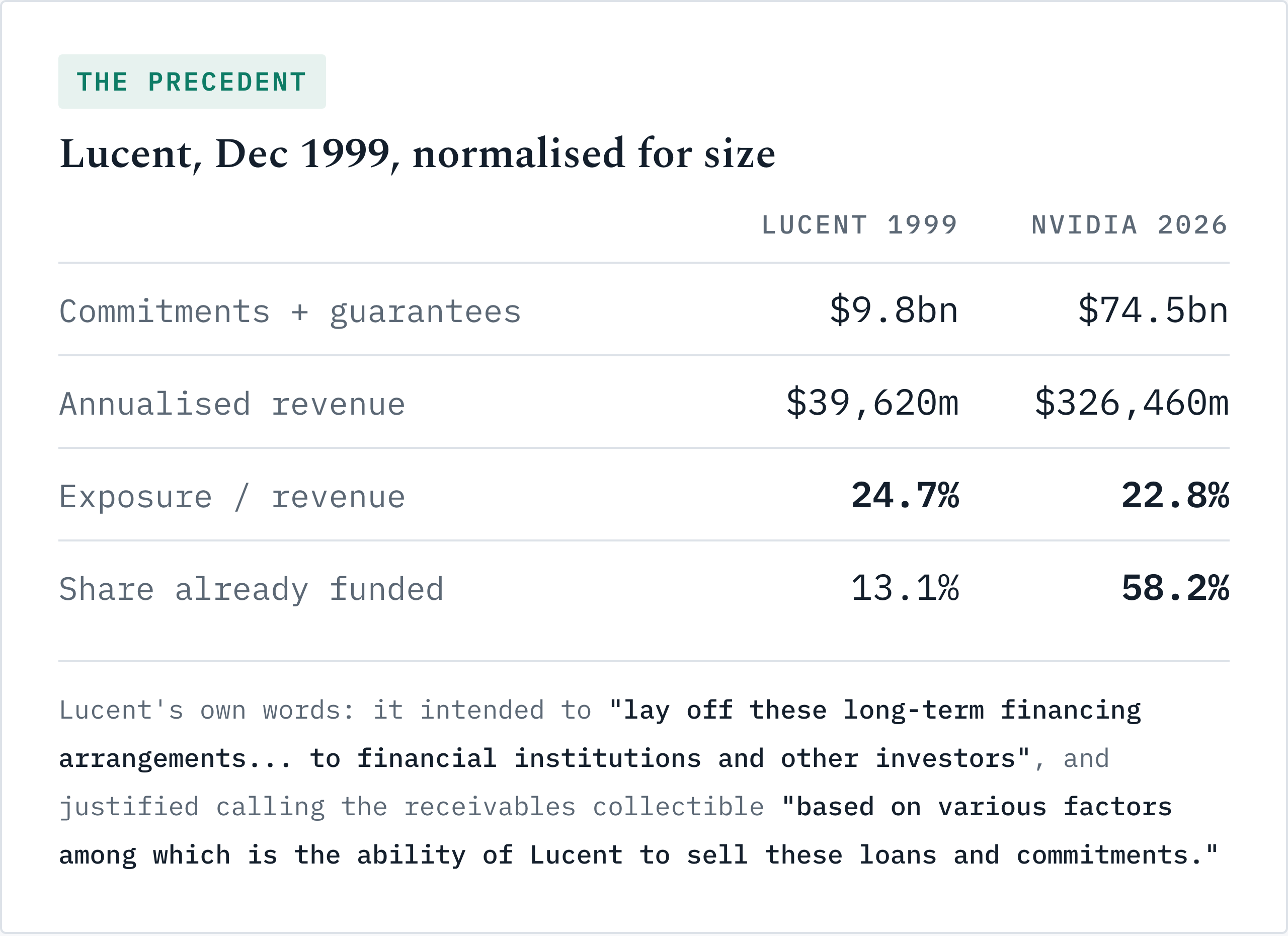
The closest documented precedent is in a filing. Lucent’s Form 10-Q for the quarter ended 31 December 1999 opens its management discussion this way: “Network operators worldwide are requiring their suppliers to arrange or provide long-term financing for them as a condition of obtaining or bidding on infrastructure projects.” It then discloses commitments to extend credit to customers of about $8.4bn, of which $1.1bn had actually been advanced, plus guarantees of customer debt of about $1.4bn.
Two sentences are why I’m using it. First: “As market conditions permit, Lucent’s intention is to lay off these long-term financing arrangements... to financial institutions and other investors. This enables Lucent to reduce the amount of its commitments and free up additional financing capacity.” That’s the 10 August announcement, written by a different vendor twenty six years earlier.
The second is the one I’d frame: “Lucent has determined that the receivables under these contracts are reasonably assured of collection based on various factors among which is the ability of Lucent to sell these loans and commitments.” Collectability rested on the existence of a buyer. The buyers left. Both halves went at once.
Scale it, because the raw sizes mislead. Lucent booked $9,905m that quarter, so its $9.8bn of commitments and guarantees was 24.7% of annualised revenue. Nvidia’s $74.5bn against $326bn annualised is 22.8%. Within two points, which surprised me and is the honest version of this comparison. One difference runs against Nvidia: Lucent had advanced $1.1bn of $8.4bn, 13% funded, while Nvidia has deployed $43.4bn of $74.5bn, 58% funded. That book was promises. This one is money.
Nvidia has answered this comparison by name. In the same November 2025 memo: “[U]nlike Lucent, NVIDIA does not rely on vendor financing arrangements to grow revenue.” True, and not my claim. The parallel is the EXIT ROUTE, not the reliance. Lucent’s filing says it intends to sell the paper to institutions to free up capacity; eight and a half months after telling analysts it was nothing like Lucent, Nvidia announced six platforms to do that at a $500bn scale. Both can be true. I think they are.
The difference that genuinely weakens the comparison is one Nvidia did not make, so I’ll make it. Lucent lent to capital starved CLECs with little revenue and no investment grade access. Nvidia’s disclosed base is led by four of the most creditworthy companies on earth, funding capex from operating cash flow. Matching the books on a revenue ratio while ignoring who owes the money is the sloppiness this piece is complaining about. So the comparison holds for the half of data centre revenue coming from buyers outside those four, which is the half being financed, and not for the hyperscalers.
To be precise about what I’m not claiming: the SEC charged Lucent in May 2004 over revenue recognition in fiscal 2000, and Lucent settled without admitting or denying. I draw no inference of that kind. The analogy is structural: same industry position, same disclosed instrument, same stated exit route.
Three things I cannot rule out
The exposures may not fully overlap. I infer compounding from two separately disclosed concentrations, and the 13F only names the public half. If the funded companies and the top three customers are largely disjoint, the risk is additive and my framing overstates it.
The guarantees may be small. Nvidia states the credit derivatives’ fair value “was not material.” I quote maximum gross exposure of $3.5bn because that’s the number a stress case uses. Treat my $74.5bn as a gross notional. Expected loss is a smaller and unknowable number.
The $27bn is contingent. The filing says investment commitments are “subject to certain contingencies.” Some portion may never fund. I’ve counted it at full value because it’s contracted, and a reader can reasonably disagree.
And the $500bn is a mobilisation target attached to partnerships that are not yet definitive. Nothing has closed yet.
What would change this view
Nvidia reports its second fiscal quarter in late August, on a period that ended before the platform announcement. That filing settles three things, and here is what each would mean, written before I see it.
If non-marketable securities keep compounding near $17.9bn a quarter while commitments stay near $27bn, the book is growing faster than the platforms can absorb, and the announcement is an addition rather than a replacement. If commitments fall sharply without a matching rise in the non-marketable balance, they were contingencies that lapsed, which is the cleanest kill of this thesis and checkable in one table. If three customer revenue concentration falls back toward 30%, the buyer base is broadening and the argument weakens on its own terms.
A fourth marker resolves more slowly, and I’ve had to sharpen it. Watch whether anything ends up publishing an AGGREGATE: total committed capital across the six platforms, advance rates against GPU cost, collateral schedules. A single BDC filing its schedule of investments would not settle it, because position rows in six vehicles are not a number. If an aggregate does get published, whether by the sponsors, a regulator or an index provider, the second half of this argument is wrong and I’d retract it.
What I’d actually do with this
I wouldn’t trade the index weight. That’s the crowded expression, and 8.13% is a number every allocator already has. The re-underwriting worth doing is on the disclosure surface: your largest single position runs a credit book you can read today and probably cannot read next year, and Notes 6 and 8 of the last 10-Q take ten minutes. For anyone underwriting the platform paper when it comes to market, I’d put the residual value question ahead of the coupon. Ask who set the useful life assumption in the collateral schedule, and whether that party is selling the collateral.
Then watch the vehicles that grew fastest, because they close the loop back to the household. The Fed’s report puts perpetual-life BDCs at $161bn of net assets and interval funds at $80bn, and notes most perpetual BDCs cap redemptions at 5% of NAV per quarter, some already exercising those limits amid “concerns about the quality of underlying assets.” The Fed’s own spring survey of market contacts most frequently cited geopolitical risks, an oil shock, artificial intelligence, private credit and persistent inflation. This structure sits on two of those five at once, which is where the saver ends up holding Nvidia through the index and the paper financing Nvidia’s customers through a semi-liquid fund, with a redemption gate on one and none on the other.
So here’s the question I’d put to anyone who has underwritten equipment backed paper before: at what advance rate against GPU cost would you lend on a five year term, given that the useful life assumption is the manufacturer’s? I’d start around 50%, and I suspect that’s too generous.
Two related pieces, if the disclosure angle is the part you want more of: Alphabet’s $20bn bond offering and the AI-vendor financing it guarantees, where the guarantor discloses quarterly what everyone else calls opaque, and SpaceX’s $1,146m AI profit and the share-release schedule underneath it.
The Patreon note is a separate piece of work rather than a deeper cut of this article. It takes the one thing a desk would actually use, the four-note aggregation itself, and writes it the way you would carry it: every line with its filing location, the Lucent book normalised for size, the three limitations I will not argue past, and the single line in the Q2 10-Q that settles it.
→ Read the vendor-credit note
→ Or join the Patreon community for every note
More of this work: YouTube · LinkedIn
Cover photograph: Rhododendrites, CC BY-SA 4.0, via Wikimedia Commons.