


What MSCI said on 23 June, and the part of it that has not moved
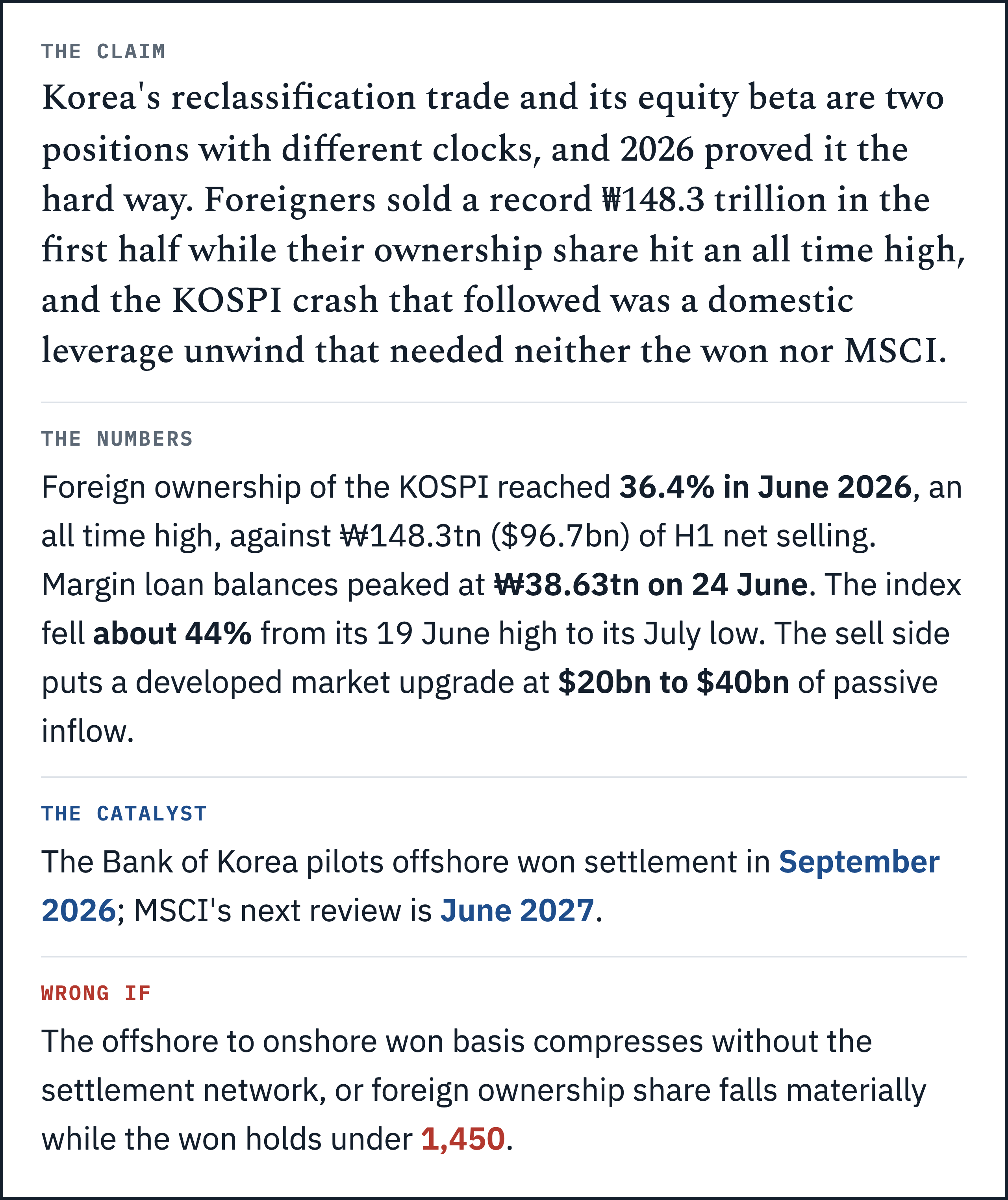
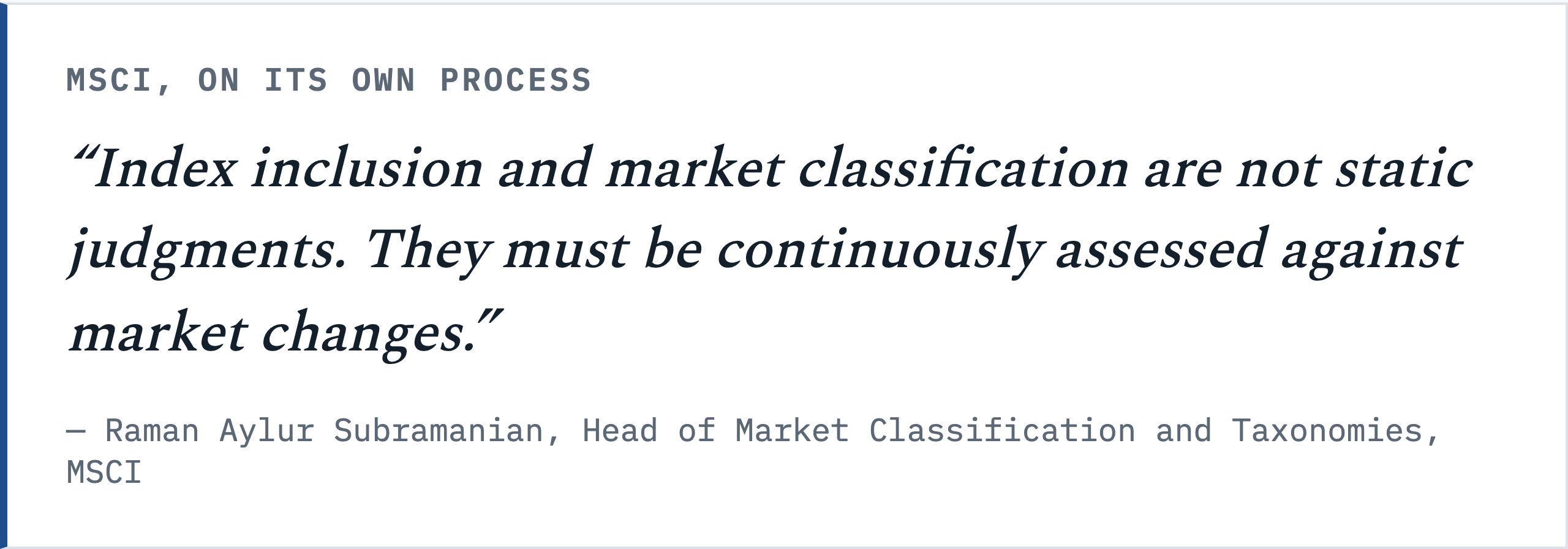
On 23 June 2026 MSCI published its annual market classification review and Korea was not added to the developed market watch list. A market has to sit in that antechamber before reclassification can be consulted on, so missing it pushes a realistic upgrade out several years.
The first substantive barrier MSCI named sits in the currency, ahead of disclosure quality and ahead of board composition. The won is not deliverable offshore. Korea entered the Emerging Markets index in 1992, joined the developed watch list in 2008 and was struck off it in 2014, that time over won convertibility and restrictions on the use of exchange data. On that first item, twelve years have changed nothing.
I want to be careful about how far that observation reaches, because I initially took it too far. The rest of MSCI’s 2026 list is new: insufficient onshore liquidity during the extended FX hours, thin operational adoption of omnibus accounts, the compliance burden of the reinstated short selling regime, presettlement funding. Those are complaints about how post-2014 reforms are working. Extended hours did not exist in 2014. Neither did omnibus accounts. So MSCI is grading a decade of implementation, and only the currency clause is frozen. My earlier framing, that the paragraph had barely moved, overstated it
.
The bull case at full strength, because the weak version is not what got underwritten
Korea traded below its own fundamentals for two decades for reasons everyone could name: chaebol cross holdings, treasury shares parked to entrench control, boards that owed nothing to minority holders. The Corporate Value-Up Program launched in February 2024 to attack exactly that, and Korea followed it with real law. Directors’ duties were extended to shareholders in July 2025, audit committees reformed in August 2025, and mandatory treasury share cancellation passed in February 2026.
One number in that case gets quoted wrong constantly, and I flag it because I quoted it wrong myself. The Korea Economic Institute reports that firms in the Korea Value-Up Index “outperformed the KOSPI 200 by 17 percent” since the October 2024 launch. Read it closely and that is the shareholder return of the hundred constituent companies, i.e. payout and buyback behaviour. The index’s own price performance is a separate series. Quoting the 17% as index against index outperformance misstates the source. Given how Korea traded through 2025 and the first half of 2026, it also understates the case it is being used to make.
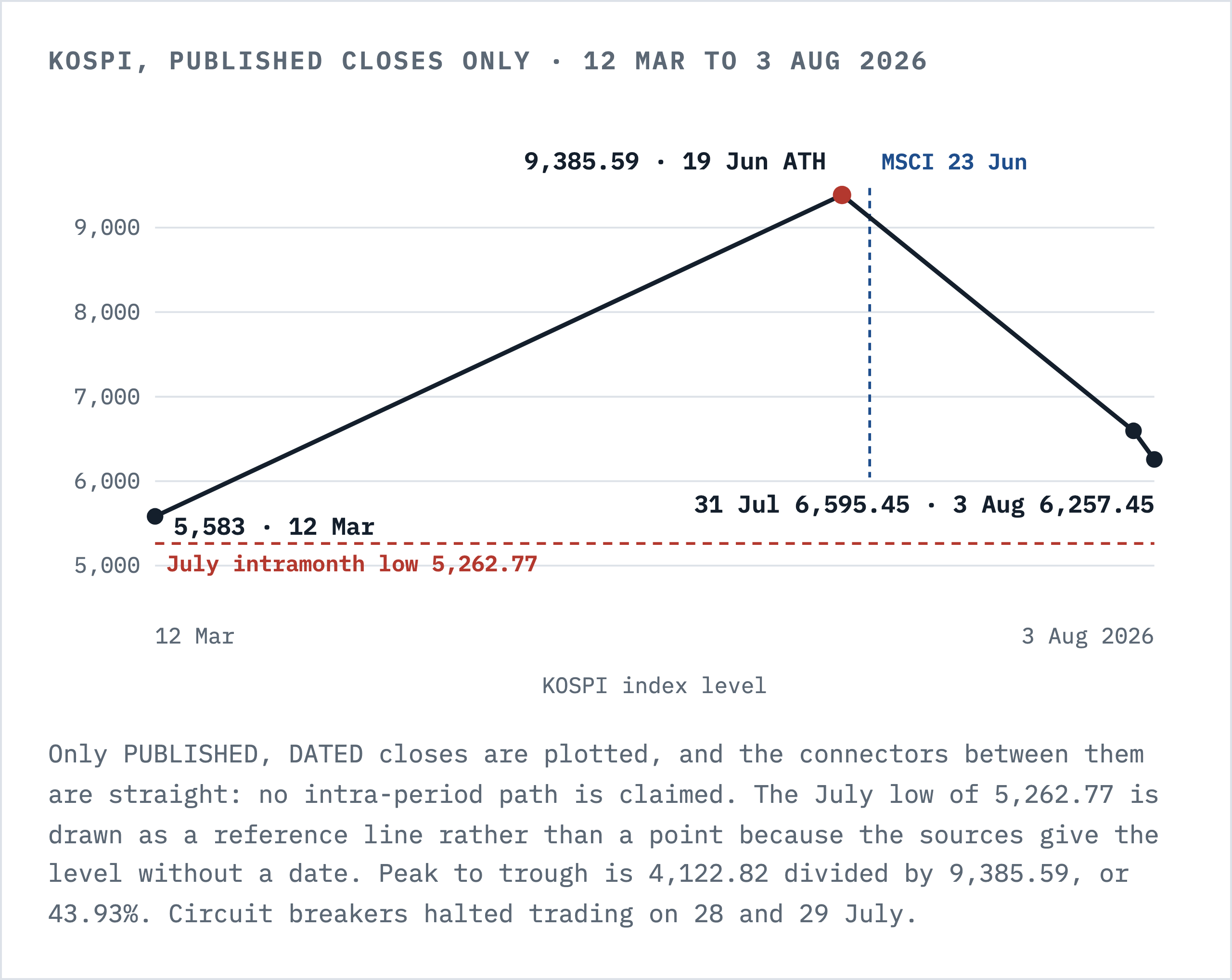
Then the earnings arrived. Goldman Sachs raised its 2026 KOSPI target to 7,000 from 6,400 on 13 March with the index at 5,583, and lifted its 2026 earnings growth forecast to 130% from 120%, on a record supply shortfall in DRAM and NAND. The index traded on 8.8 times forward earnings the day before that note. Worth flagging what I let slide past me: the target raise was about 9.4% against an earnings raise of 4.6%, so more than half of Goldman’s move was multiple expansion. And 8.8 times was a March number. Roll the index to its 19 June peak of 9,385.59 and hold that forward earnings figure still. Then 8.8 x (9,385.59 / 5,583) gives 14.8 times. “Still cheap” stopped being true nine weeks before the crash.
So the bull case is coherent and it isn’t naive. Governance defect identified, legislated against, partly priced. A genuine memory cycle behind the earnings. What it does not contain is a funded mechanism for the reclassification leg, and that is the only part I’d still argue with.
Taiwan is the control case, and it breaks the easy version of this argument
Here is the objection I’d raise first if someone handed me this piece, and it took a hostile read of my own draft to find it.
The new Taiwan dollar is also not deliverable offshore. MSCI raises against Taipei substantially the same list: no offshore market for the currency, prefunding practices, difficulty executing in kind and off exchange transactions. Taiwan is also stuck in emerging markets. And the multiple runs the wrong way for the story. In early March 2026, the week Goldman was calling Korea cheap at 8.8 times forward, Taiwan traded at 17 to 20 times forward against Korea’s 9.5. Two providers, two methods, and Korea lands in the same place on both.
Same currency barrier, same index status, roughly double the multiple. A variable present in both cases cannot explain the difference between them. So the tidy version of this thesis, that the Korea discount is really an FX convertibility discount, is wrong, so I’m dropping it.
What survives is narrower and I think more useful. Non-deliverability is the binding constraint on reclassification timing. It is demonstrably not the thing that sets Korea’s multiple, because Taiwan carries the identical constraint and trades at roughly double the multiple. Those are different questions and the market conflates them constantly, which is where the actual mispricing lives.
Foreigners did not leave. They trimmed five percent of a position that doubled
This is the correction that most changed what I think, so I’ll show the working.
Foreign investors sold a record net ₩148.3 trillion, about $96.7 billion, of Korean equities in the first half of 2026. That figure is real and it is a first half record. It also means much less than the headline suggests.
Over the same window foreign holdings of Korean stocks went from ₩1,326.8tn, roughly $919 billion and 30.8% of market capitalisation at end-December 2025, to ₩2,908.6tn at the end of June, with the ownership ratio at an all time high of 36.4%. June by itself carried ₩49.3tn of net selling and the balance still rose more than ₩56tn, because the mark on what they held beat the proceeds of what they sold.
So the arithmetic is this. ₩148.3tn of selling against ₩2,908.6tn held is 5.1%, a trim executed by a cohort that more than doubled its position and took its highest ever share of the market. Investors being taxed out of an asset do not double their holding of it.
I had this wrong in an earlier draft, where I wrote that the marginal foreign buyer left. He didn’t. He rebalanced, which is a much more ordinary thing, and Reuters said as much at the time: foreigners withdrew from Korean equities “primarily to rebalance portfolio weightings as the market soared.” That is the wire explanation, and I’m conceding it. Dressing that up as a variant view would fool nobody who reads the wires.
What actually broke Korea in July was domestic leverage
The KOSPI peaked at 9,385.59 on 19 June and traded as low as 5,262.77 in July. That is 4,122.82 points, or about 44%. Circuit breakers halted trading on 28 and 29 July, the first time they had ever fired on consecutive sessions.
One word on the superlative, because it moved ten points in a single session. Written before the last trading day of July, the month was down more than 33%, and it was called the worst in the index’s history, past the 27% of October 1997 and the 23% of October 2008. Then 31 July added 17.91%. July closed nearer 23%, which ties October 2008 and leaves October 1997 standing. So I quote the drawdown and leave the calendar month alone. A position experiences the drawdown.
Korean retail flow has broadcast its own position before. I wrote up the $170 billion retail wave in February, when that cohort was building rather than being margined out.
That is not a story about MSCI, and it is not a story about hedging. Margin loan balances peaked at ₩38.6328 trillion on 24 June before easing back. Single stock leveraged ETFs, listed only on 27 May, concentrated retail exposure into the two names that are half the index. The regulator halted new listings of those products and tripled the cash deposit requirement from ₩10 million to ₩30 million, effective 31 July. Citi put the retail loss on the leveraged ETFs at $38.7 billion, roughly ₩58 trillion.
That is a complete account of the round trip, and it requires neither the currency nor the index provider. Domestic leverage bubble, regulatory prick, forced unwind. I think it is the correct first order explanation of 2026 in Korean equities, and any piece that reaches for a structural story without disposing of it first is selling something.
The 31 July session shows the machinery plainly. The index rose 17.91%, gaining 1,001.89 points to close at 6,595.45, its largest one day gain on record. Foreign investors bought a record ₩8.7709 trillion while domestic retail sold a record ₩10.3834 trillion into their bid, with SK Hynix limit up at ₩1,718,000. The retail side was mechanical, driven by the deposit rule that took effect that morning. The foreign side was a view, triggered by Amazon and Microsoft cloud earnings overnight.
I called that a controlled experiment once. It wasn’t. Four things moved at once, and the very next session the whole thing inverted: on 3 August the index closed at 6,257.45, down 5.12%, with foreigners net selling about ₩2.8 trillion and retail absorbing more than ₩4.6 trillion. One session with four simultaneous shocks identifies nothing, and the session that reversed it had the same cast in opposite seats.
