



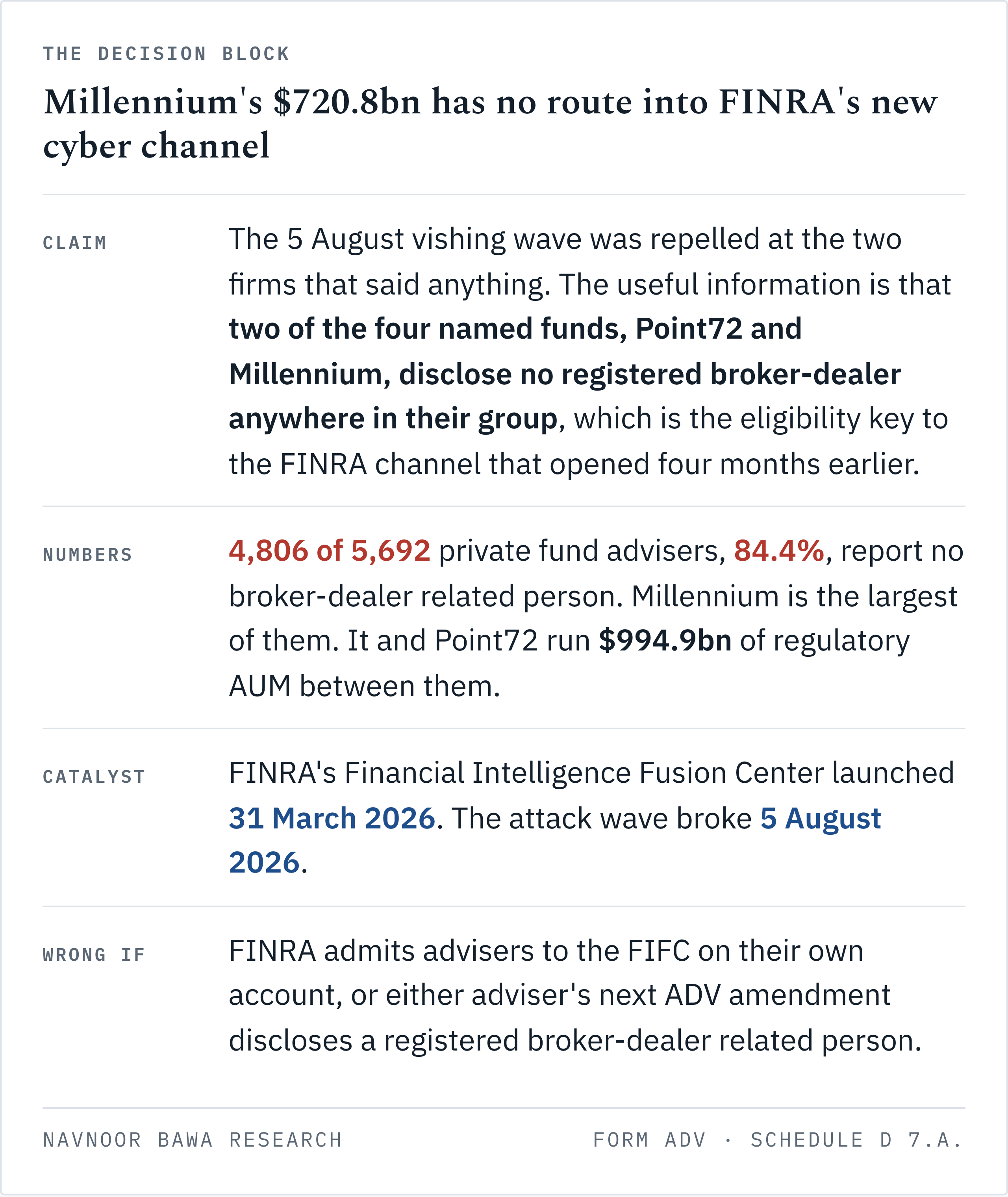
This piece is also a film. It puts Millennium’s Schedule D 7.A. on screen with the broker-dealer field unticked, and draws the ladder from 84.4% down to 19.4% so you can watch where it narrows.
What happened on 5 August, and what did not
Attackers ran cloned voices at the help desks of Point72, Citadel, Millennium and Two Sigma, plus several private equity firms. Vishing arrives as a phone call instead of an email: the caller impersonates internal IT or a colleague, then pressures a service desk agent into resetting a credential. Why that move gets chosen matters later. A help desk reset doesn’t break multi-factor authentication. It walks around it, by convincing a person to issue new factors to the wrong caller.
The outcomes I can stand behind are thin. Point72 said an initial review found no client information taken. Two Sigma said its “security team responded quickly to an attempted vishing campaign targeting Two Sigma and other investment managers.” Citadel and Millennium declined to comment. FINRA contacted member firms. On the public record this is a near miss, and I don’t want to inflate it.
Near misses are the cheapest information a risk process gets, and they get thrown away almost every time, because nobody lost money so nobody writes it up. I think that’s the error here. The interesting variable isn’t whether the calls worked. It’s which firms were positioned to hear about them first.
A sourcing caveat, up front. The event traces to Bloomberg on 5 August, carried onward by InvestmentNews and others. Those carriers are one wire counted twice, and I won’t pretend otherwise. Everything structural below rests on filings I pulled myself, so the argument holds even if the reporting proves incomplete.
The consensus is right about the attack and silent about the exposure
Take the prevailing view at its strongest, because it’s strong. Generative audio has collapsed the cost of a convincing impersonation: what needed a skilled social engineer and a rehearsed script now needs a voice sample and a subscription. Vinod Paul of Align put the scaling plainly: “Before they could attack 50 entities in a targeted attack, now they can do 1,000.” Harden the help desk, stop trusting a voice. That conclusion is correct.
I’ve no argument with it. My argument is that it describes the attack completely and the exposure not at all. Every firm named here can buy world class security. What spending can’t buy is early sight of a campaign already running against your peer group this week. That’s a coordination good, and coordination goods get distributed by membership rules.
So the question I went looking to answer wasn’t how good these funds’ defences are. It was narrower and far more checkable. When the industry’s shared warning system lit up in August, who was wired into it?
Two of the four named funds have no broker-dealer anywhere in the group
FINRA launched the Financial Intelligence Fusion Center on 31 March 2026, under its FINRA Forward programme. It runs both ways: firms submit what they see, FINRA anonymises and aggregates, and members get intelligence no single firm could assemble alone. Against one pretext run across a peer group in a week, I struggle to design a better instrument.
Its scope is one sentence on FINRA’s own page: “The FIFC is available to FINRA member firms and their affiliates.” Access runs through a firm’s Super Account Administrator in FINRA Gateway, so entitlement descends from a member registration. No membership in the group, no entitlement, as far as I can establish from what FINRA publishes.
One qualifier belongs here, in the body, because it cuts at my own argument. Enrolment is voluntary. FINRA’s release “encourages member firms to opt into the FIFC,” so eligibility is necessary and not sufficient, and I can’t see who actually joined. I can see who is structurally barred from joining. That sets a floor on the problem.
Not one of the four named funds is a FINRA member. All four are SEC registered investment advisers, so eligibility runs through an affiliate or it doesn’t exist. Form ADV Schedule D Section 7.A. is where an adviser lists its financial-industry related persons, and it’s public. I pulled all four.
Regulatory AUM below is each adviser’s own Item 5.F figure, matching the SEC’s 3 August 2026 file to the dollar.
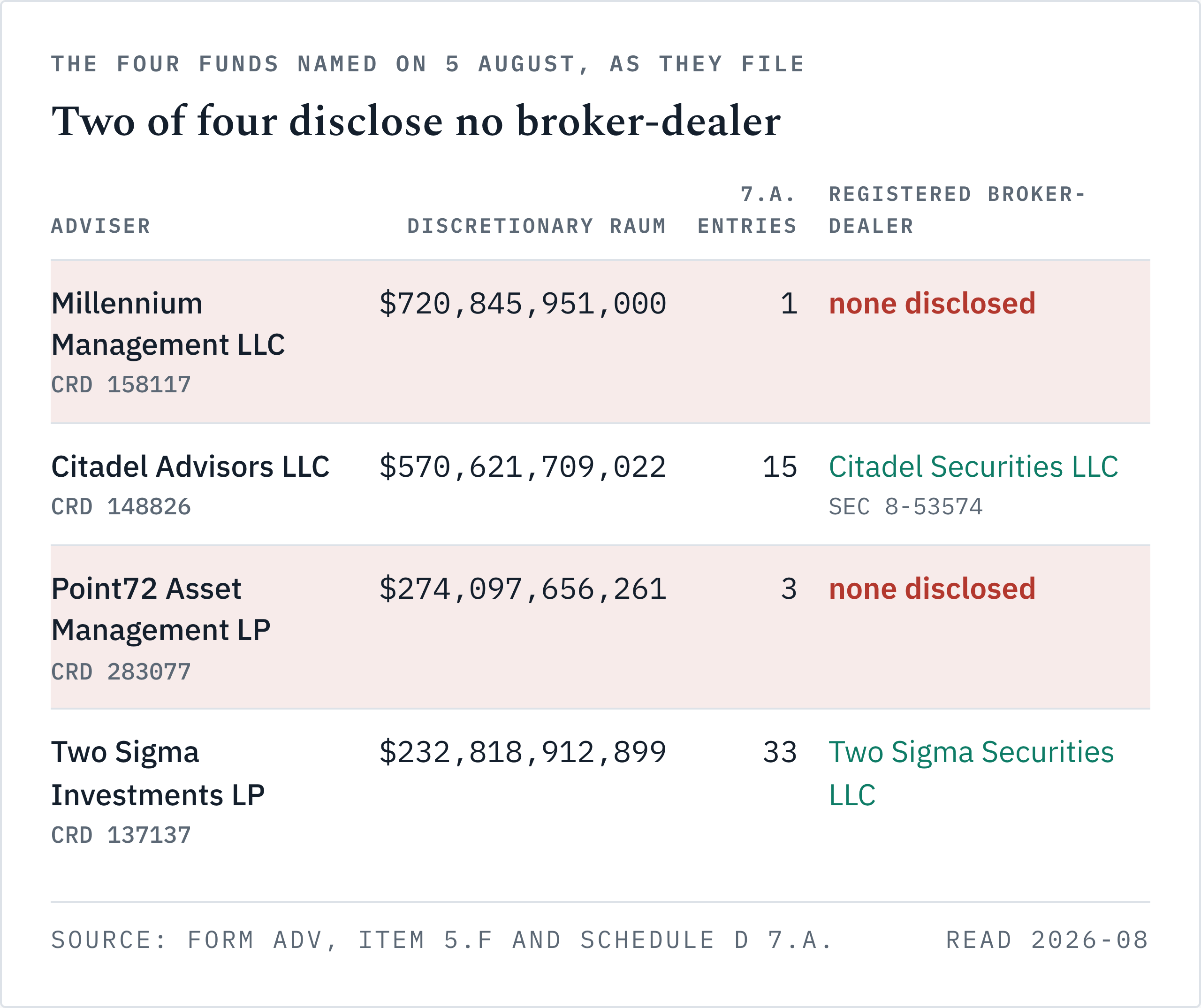
Millennium’s single entry is MFI Funding LLC. Point72’s three are Point72 Hyperscale GP, Point72 Capital Management and Point72 Turion GP, none carrying an SEC file number or a CRD. Citadel and Two Sigma are built around a registered dealer, confirmable on BrokerCheck.
I did not expect the line to fall straight through the middle of the four names. On one side, $994.9bn at Point72 and Millennium. On the other, two firms with a dealer in the family.
One number needs an honest label. Regulatory AUM is gross and includes leverage, so it sits well above investor capital and I’m not passing it off as that. It stays the right measure here, because what’s protected is the manager’s operating footprint.
84.4% of private fund advisers report no broker-dealer, and the share falls as size rises
Four firms is an anecdote, so I pulled the population: the SEC’s Form ADV bulk roster, dated 3 August 2026, two days before the attack. It carries 17,018 registered advisers and a structured field for Item 7A(1), the same broker-dealer question Schedule D answers in prose.
That field reproduces my reading of all four filings exactly: Citadel Y, Two Sigma Y, Millennium N, Point72 N. Two independent reads of the same disclosure, one by hand and one from the Commission’s own feed.
Narrowing to advisers that run at least one private fund and report discretionary assets, the population I care about, leaves 5,692 firms.
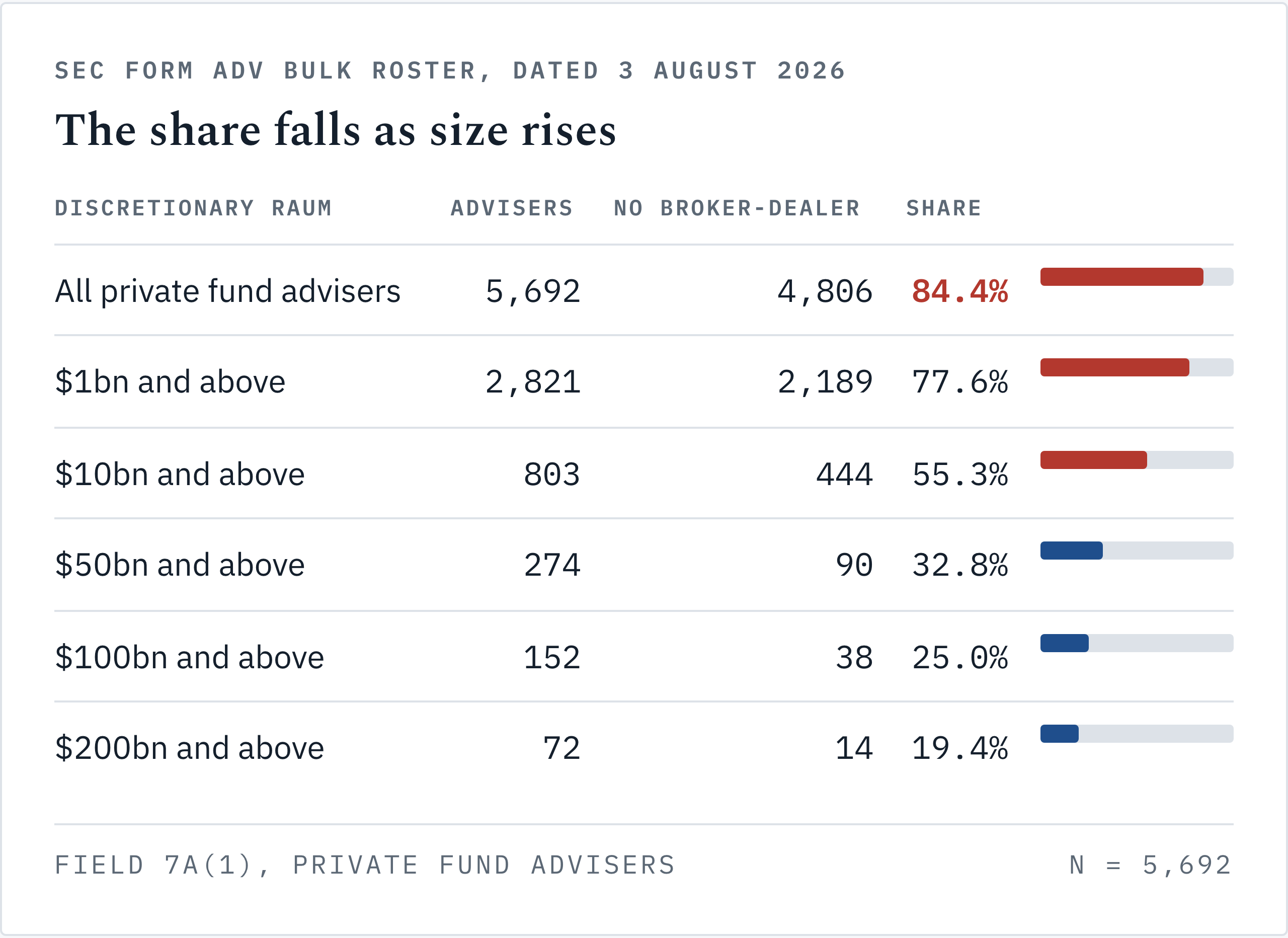
Two things fall out, and the second surprised me. 4,806 private fund advisers sit outside the FIFC’s structural eligibility. That makes it a feature of the industry. It also narrows sharply as size rises, from 84.4% down to 19.4% above $200bn. So this is not a story about large managers being uncovered. Most very large managers do run a dealer, for execution reasons unrelated to any of this, and their FINRA coverage is a side effect of that choice. I looked at how these same three platforms are built when Hindenburg wound down and the multi-strats delivered 15 to 19%, and the execution stack is the reason a dealer is there at all.
Which is what makes Millennium worth the headline. Sorted by discretionary RAUM, it ranks 14th of all private fund advisers in the file, and it is the largest of any reporting no broker-dealer related person. Every one of the thirteen filed adviser entities above it answers Y: Fidelity, PIMCO, J.P. Morgan, Goldman Sachs Asset Management, T. Rowe Price, BlackRock Financial Management, SSGA Funds Management, Wellington, Northern Trust, PGIM, Dimensional, AllianceBernstein, Invesco. That is thirteen straight names at the top of the industry before it breaks, once, at $720.8bn.
