



When Hindenburg Research targeted Carl Icahn in May 2023, alleging a “Ponzi-like structure,” IEP shares plunged 20% on day one and eventually dropped 50% within months. Icahn’s net worth fell $10 billion. Meanwhile, Citadel’s Wellington fund returned 15.2% in 2024, Millennium gained 15% across 330+ pods, and Point72 delivered 19%. These opposing strategies — forensic investigation versus systematic diversification — represent capitalism’s contrasting approaches to extracting returns.
The Fundamental Distinction
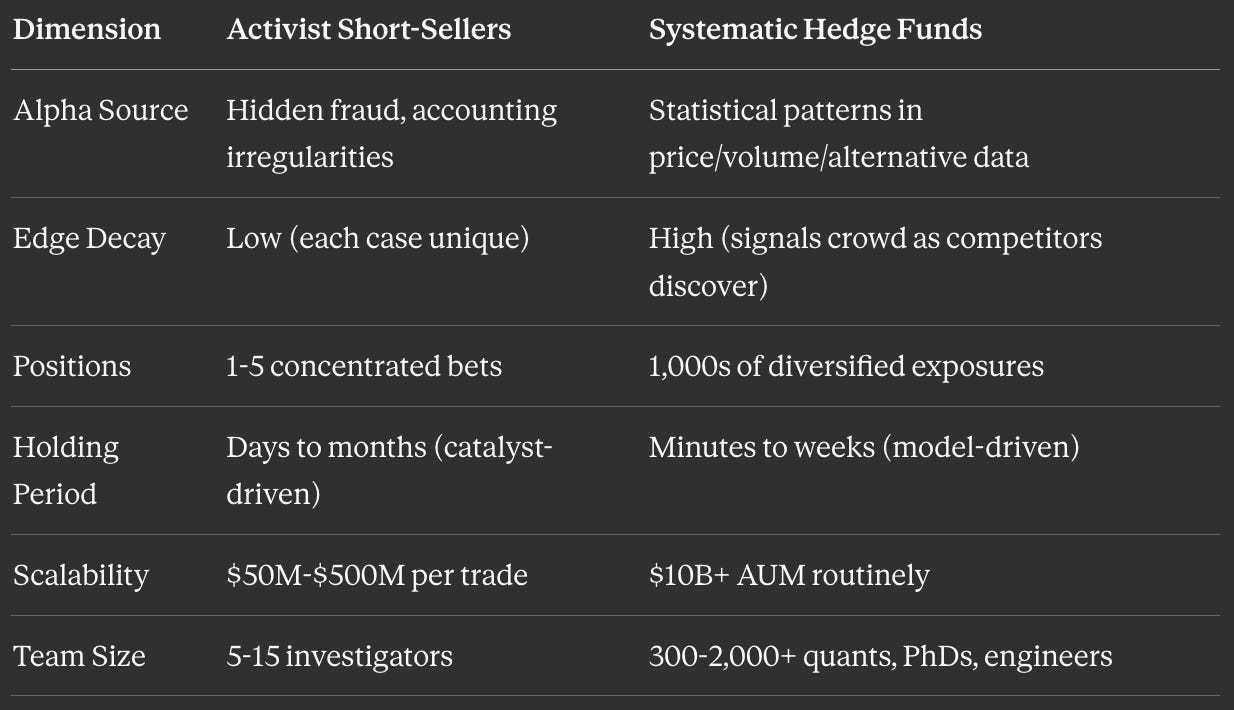
Activist short-sellers (Hindenburg, Muddy Waters, Spruce Point) monetize information asymmetry through forensic investigations of SEC filings, whistleblower interviews, and offshore structures. They take concentrated short positions before publishing catalytic reports.
Systematic multi-managers (Citadel, Millennium, Point72) monetize statistical edge through quantitative models across thousands of instruments. They exploit factor premia, mean-reversion, and alternative data signals with no public thesis required.
Structural comparison:
Part 1: The Investigative Model
The Icahn Case: When Legends Become Targets
Hindenburg’s May 2023 report alleged IEP traded at 218% premium to NAV with Icahn pledging 65% of shares as margin collateral. Stock dropped 20% day one, 19% day two, and continued falling. By August, IEP cut its dividend 50% (from $2 to $1 quarterly), erasing $10+ billion from Icahn’s net worth.
Track Records
Spruce Point Capital: 50+ CEO/CFO resignations from target companies, 100+ forensic reports published
Wolfpack Research: $15B Chinese fraud exposed, B. Riley short validated with 50% single-day drop
Carson Block (Muddy Waters): $14M SEC whistleblower bounty
Industry Shutdown
In January 2025, Hindenburg Research disbanded, founder Nate Anderson citing burnout after campaigns against Adani, Nikola, Block, and Icahn. The firm claimed responsibility for nearly 100 individuals charged civilly or criminally.
Part 2: The Systematic Model
2024 Multi-Manager Performance
Citadel Wellington: +15.2% — All five strategies positive (commodities, equities, fixed income, credit, quant). Since inception (1990): 19.46% annualized. LCH Investments ranks Citadel as most profitable hedge fund of all time.
Millennium: +15% — Israel Englander earned $4B (highest-earning hedge fund manager 2024). The firm operates 330+ independent pods with strict drawdown limits: 5% = capital halved, 7.5% = terminated.
Point72: +19% — Outperformed Citadel and Millennium. Returned $3–5B to investors in early 2025. Cubist Systematic Strategies manages ~17% of firm’s $41.5B AUM.
Two Sigma: Absolute Return Enhanced +14.3%, Spectrum +10.9% — Processes massive datasets from 10,000+ sources using machine learning and AI.
Balyasny Atlas Enhanced: +13.6% — Rebounded from <5% in 2023. Manages ~$29B across 170+ portfolio teams.
The Pod Model Economics
Millennium’s February 2025 $900M loss across 2 pods = only 1.3% firm-wide drawdown. The model contains individual failures through strict risk limits and 15–20% annual PM turnover.
Risk Profiles
Short-Seller Risks:
Short squeezes: Citron Research suffered catastrophic losses during GameStop squeeze (January 2021)
Criminal charges: Andrew Left charged by SEC/DOJ (July 2024)
Burnout: Hindenburg shutdown (January 2025)
Systematic Fund Risks:
Pod blowups: Millennium’s $900M February 2025 loss
Alpha decay: Signals crowd as competitors discover patterns
Model failure: August 2007 quant meltdown
Economic Models
Revenue Structure:
Activist short-sellers: 100% from own P&L + SEC whistleblower awards
Systematic funds: 2/20 fees on $30B-$80B+ AUM
Capital Efficiency:
Short-sellers: No external AUM (proprietary trading)
Multi-managers: Massive scale enables infrastructure investment (250+ PhDs at Two Sigma, petabyte-scale data systems)
The Convergence Thesis
Activist short-sellers create asymmetric payoffs through concentrated information bets. Systematic funds sacrifice drama for durability — small edges repeated millions of times across diversified exposures. Both models monetize market inefficiencies, but through fundamentally different mechanisms: one through investigative journalism applied to capital markets, the other through statistical physics applied to price dynamics.
The 2024 performance differential (systematic funds averaging 10–19% vs. S&P 500’s 25%) raises questions about systematic alpha sustainability in bull markets. Meanwhile, Hindenburg’s shutdown suggests investigative short-selling faces unique operational constraints — burnout, legal risk, and limited scalability — that systematic models avoid through institutional infrastructure.
Neither model dominates universally. The choice between them reflects different views on market efficiency: are the largest profits in uncovering discrete frauds, or in harvesting micro-inefficiencies at scale?
For more quantitative finance analysis and hedge fund strategy breakdowns, subscribe to my YouTube channel: The Mathematical Trader
Cover photograph: Gus Pasquarella, public domain, via Wikimedia Commons.
Great article man