



In July 2026, Steve Cohen’s Point72 flagship lost 3.3% while Turion, his firm’s AI fund, lost 11.4%. The flagship, like Millennium’s and Balyasny’s, spreads its capital across many traders’ teams, called pods.
The book shared by many traders lost far less than the book run on one theme, so the question is how, and who paid. My answer is the drawdown ladder: the staged cuts a pod shop makes to a losing trader’s capital. It can keep the firm’s loss small by moving it onto the traders it cuts and, regulators warn, onto anyone holding the names they sell. Millennium’s, Point72’s and Balyasny’s October returns, printed by 10 November, test it.
The same trade, two outcomes
Business Insider’s July scorecard lists 13 platforms besides Citadel, and their median July loss was 1.5%. The four AI funds in Hedgeweek’s report on July’s biggest losers lost a median 16.6%. That is about eleven times as much.
I read the three firms’ Form ADV filings (the registration a US investment adviser files, brochures included) and Cambridge Associates’ 2014 toolkit for allocators, which prints one unnamed manager’s ladder. I also set the two newsrooms’ July returns side by side: where both name a platform (Point72, Millennium, Balyasny, Verition, ExodusPoint and Citadel), the figures agree. Point72’s brochure ties Turion to businesses “believed to be impacted by artificial intelligence.”
Each figure is a return reported in the press. A platform that held less AI, or ran low net exposure with its longs nearly offset by shorts, would show part of the same gap before any trader was cut. The AI funds were picked as the month’s biggest losers, so eleven times is an upper bound.
The firms’ own 13F filings for 30 June measure the first of those (Millennium, Point72, Balyasny). Their AI-chip baskets were about 3% to 4% of their long books. Held through July, they cost under 1% of capital, about a fifth to a quarter of each firm’s July loss. Less AI explains much of the gap to the AI funds. It does not explain what the platforms lost. No July 2026 pod closure for losses has been reported.
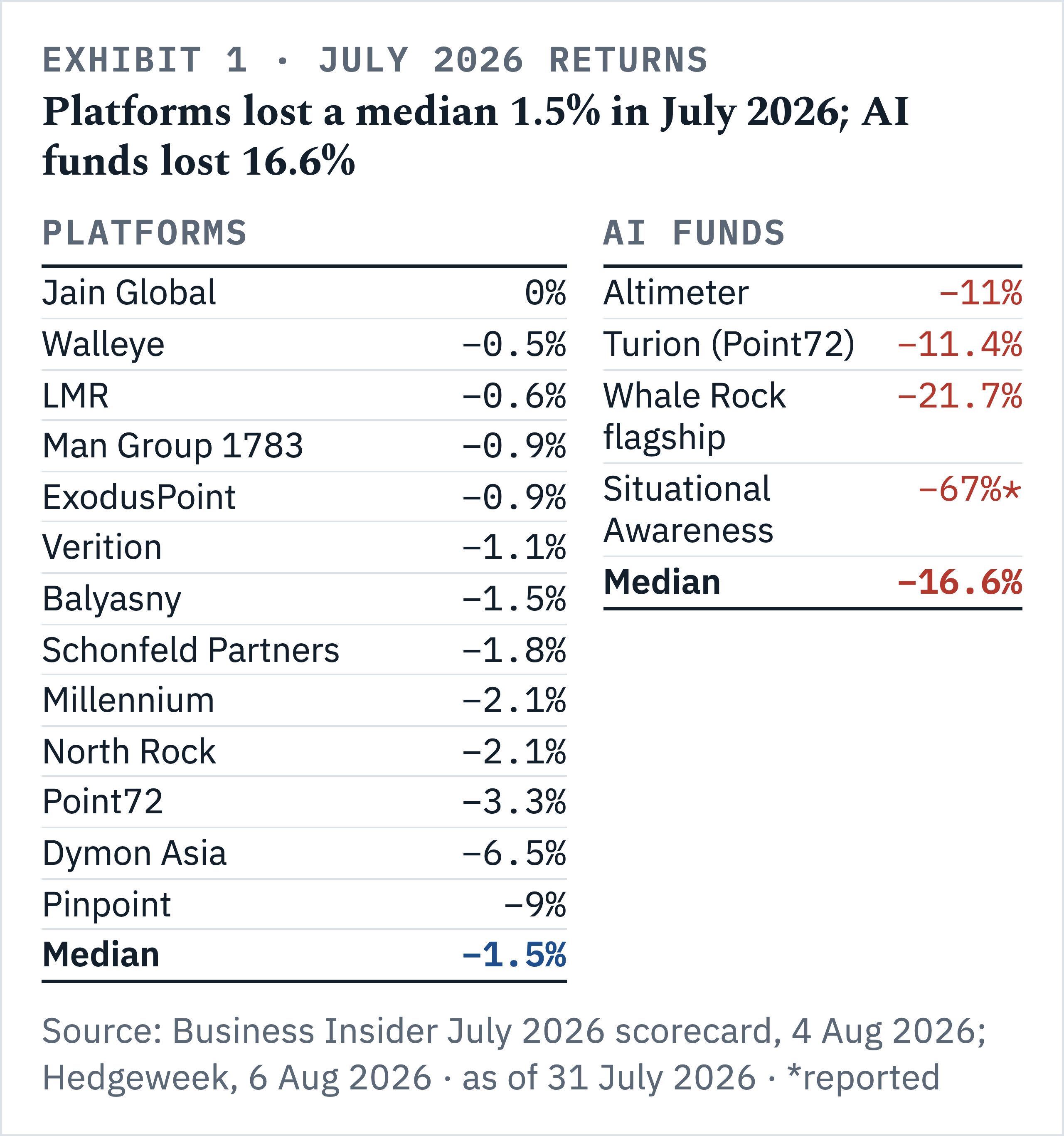
Read it from the top: every AI fund listed lost more than every platform, and the two platforms that lost more than 5% both trade Asia.
Those two are the leak. Dymon Asia and Pinpoint fell amid “stock market jitters in Korea and Japanese economic woes,” by Business Insider’s account. A platform whose books share one region can lose like a concentrated fund, and a ladder that cuts one pod at a time does least for a firm whose pods lose together.
Citadel is set apart because it stood on the other side.1 Wellington, its flagship fund, gained 5.9% in July. That month Situational Awareness, an AI fund, reportedly lost 67% and sold most of its public equity book to Citadel to meet margin calls. Those calls worked as a stop with one step, set by its lenders, which takes away two things a ladder spreads out: the size of the cut and its timing.
The firm halves a losing book
Diversification is the usual explanation for the platforms’ steadiness. The USCA All Terrain Fund, an allocator to them, wrote in its annual report filed in June 2025: “We view these allocations as intended to be ‘market neutral’.” The managers’ own filings are less sure. Point72’s brochure: “even a well-diversified, multi-strategy approach may not protect a Point72 Fund from significant losses.” Millennium’s adds that “strategies that are largely uncorrelated under normal market conditions may become more correlated at times of market stress.”
If diversification can fail under stress, something else holds the number, and the firm decides it. Millennium’s August 2026 brochure describes its job as “selecting, monitoring and evaluating Portfolio Managers and allocating and reallocating the Millennium Partners Funds’ invested capital among them.” Balyasny’s March 2026 brochure says the firm “regularly reassesses the allocation of the Investment Funds’ assets for possible reallocation among other Portfolio Managers.”
Millennium’s brochure states no thresholds; the numbers come from reporting. A portfolio manager running $1bn who loses 5% has his trading capital “slashed in half, to $500 million.” Once losses reach 7.5% of the original, “they will likely be fired,” with exceptions. Bloomberg’s reporting on the industry, as Hedgeweek carried it, says pods are typically dismissed after a 7% decline, so the second rung sits at 7% to 7.5%.
On that $1bn book, a loss of $70m to $75m makes it closable.
Cambridge Associates’ 2014 toolkit, written for allocators, prints one unnamed platform’s ladder. A 2.5% loss, half Millennium’s reported first rung, halves capital, a cumulative 5% halves it again, and a cumulative 7.5% brings a stop out, “an immediate sale of the assets in the portfolio to prevent further losses.” The same paragraph, on multi-manager (”MM”) firms, carries its own caveat: “most MM firms maintain soft drawdown limits or often grant exceptions to hard limits.”
Here is the reported ladder, one step at a time:
A pod’s book loses 5% of its allocation.
The firm halves the allocation, so the pod sells longs and covers shorts, which locks in the loss and halves the next one.
At 7% to 7.5% the firm can close the book, and the stop out sells what is left.
The firm’s number takes that pod’s realised loss, capped by the rungs.
August 2024: losses, then exits
The unwind of the yen carry trade, in which investors borrow cheaply in yen to buy assets that pay more, gives a case with names in it. Early losses in August 2024 prompted Millennium, Balyasny and BlueCrest, another firm that runs its traders in pods, “to halt the operation of at least six traders and their investment pods,” Bloomberg reported, as Hedgeweek carried it on 2 September.
Early August: books lose money as the yen carry trade unwinds.
The report ties two exits to those losses. Ryan Fitzgibbon, who traded industrial and energy stocks for Millennium in Houston, “left the firm following losses.” BlueCrest shut Chiga Murayama’s Japanese government bond pod after losses, and he and team member Yosuke Motegi left.
Others leave, with no loss tied to them by name. Shao Ying and Zachary Corones, index rebalancing in Asia for Millennium, “also exited,” and Mark Cox left Balyasny in Hong Kong. The report puts the exits down to the firms’ “stringent risk management approach.”
The firm’s number: Millennium was up 0.7% through 23 August.
The loss landed on named traders, their books left, and the firm stood in profit with a week of the month left. That is the order the ladder predicts, though it shows the order, not the effect.
The cuts took out books that were losing, and a rebound in the market did the rest; nothing public says how the 0.7% splits between the two.
Two books carry the firm’s risk
The rule bends at the top, and the record shows where the firm’s own risk then sits. Glen Scheinberg and Pratik Madhvani run index rebalancing pods at Millennium, trading around changes to stock indices. By early March 2025 their two books had lost about $900m, the losses behind Millennium’s 1.3% February, its worst month in more than six years.
Millennium ran about $75bn across more than 340 teams at the time. The two books’ $900m was about 1.2% of that capital, as large as the firm’s whole February loss on its own. The comparison is loose: the $900m runs to early March and counts the two books gross, before anything the other teams made.
Both stayed. The reports I read name no cut to the index rebalancing teams after February 2025, and Millennium kept running the trade. No report gives the pods’ capital, so whether the $900m crossed their rung cannot be known.
In November 2025 the same teams were reportedly down hundreds of millions of dollars at one point, “although some losses were recovered toward month-end,” and Millennium finished the month up about 0.5%.
In June 2026 the same two pods made about $3.7bn, more than half of Millennium’s roughly $6.6bn of profit before fees, as Bloomberg reported. Millennium returned 4.1% that month.
So two books carried the firm’s worst month in more than six years and more than half of its June 2026 profit. Keeping them reads as a choice the firm made, and its reported rule allows one: “sometimes exceptions are made.” Cambridge’s file describes the same bend in plainer words: platforms widen limits “for an unusually profitable or long-tenured trader,” and its one printed ladder stretches for traders on an unusual “winning streak.”
The ladder is hard for most books and soft for the books that earn most, so the firm’s own exposure gathers in its biggest books. That also settles one rival reading, that a bad month’s losses scatter across hundreds of teams and cancel: in February 2025 they sat largely in two.
The market pays, regulators warn
When a crowded long breaks, the platforms cut their losing books in the same days, so anyone still holding those names meets the sales as the price. A pod shop does not avoid the loss; it can hand it to whoever buys what its traders are forced to sell.
Two of the firms’ brochures warn about crowding:
Millennium’s, in a risk factor on managers who trade by model, warns of what happens “to the extent that such Portfolio Managers’ models come to resemble those employed by other managers.” A disruption then “could accelerate reductions in liquidity or rapid repricing due to simultaneous trading across a number of managers in the marketplace.”
Point72’s warns that growth in competing firms may bring more “investors that are attempting to purchase or sell similar positions simultaneously.”
Both describe many firms trading the same positions at the same time. Neither names its own ladder as a cause.
Andrew Bailey, governor of the Bank of England, named the pods’ part in a February 2025 speech: “where risk management results in pods de-risking aggressively in a shock, this could result in these funds amplifying market moves.” The IMF’s April 2025 report cites that speech, and its October 2026 report widens the warning to hedge funds in general.
Goldman Sachs’s prime brokerage counts the selling among the funds it finances. Its notes on October’s AI sell-off, as Reuters reported, track de-grossing, “long selling and short covering combined,” which is what a cut book does.
From COVID through the end of 2025, the three broad strategies Goldman tracks never all fell more than 80bp on the same day. In 2026 they did so three times, on 4 February, 28 July and 15 October. Funds with no ladder sold AI stocks too, so the count shows how hard the losses came, not the ladder’s share of them.
Leverage sets how much a cut book must sell. Multi-strategy funds’ gross assets averaged 9.51 times their net assets on 30 September 2023 and 12.29 times on 30 June 2026, each fund weighted by its size, in Office of Financial Research data from the larger funds’ Form PF filings, rates and repo books included. The average fund carries more assets per dollar of capital than in 2023; the data do not say how much of the rise sits in the books a ladder cuts.
Bruno Schneller of Erlen Capital, which invests in hedge funds, read October as “less a fundamental rejection of AI and more a classic, high-velocity unwind of a crowded trade meeting a macro reality check.” He pointed to “how much of the hedge fund industry has effectively been trading the same underlying theme, even when portfolios look very different on paper.” Exhibit 1 shows July’s version: twelve of thirteen platforms lost in the same month, which fits a shared trade without proving one.
The IMF’s October report puts a size on crowding by all hedge funds. In quarters of market stress, the stocks most crowded relative to their daily trading volume ran about 10 percentage points more volatile and fell about 4 points further than the least crowded. Nothing I read separates the ladders’ share of that cost, so the market’s part of the bill stays the regulators’ warning.
The trader carries the cut
A Millennium pod is paid on its own performance. Millennium’s brochure says what a losing year costs its manager: “If a Portfolio Manager suffers net losses during the year, generally the losses are carried forward and past losses must be made up before performance-based compensation becomes payable in subsequent years.”
A manager down on the year generally earns no performance pay until he wins the loss back. That gives a trader with a losing year reason to move to a firm where the count starts again.
Exits alone prove little. Business Insider put Millennium’s turnover at about 15%-20% of all staff each year in 2024 and tied it to the stop-loss rule itself; no report gives the rate for portfolio managers.
Stress months show the cut landing. In March 2025, Balyasny was “forced to stop out several portfolio managers.” The same report had Millennium down about 1.4% through the first week of March. It was liquidating a $1bn financials book run by Jonathan Philpot and an energy pod run by Justin Grant, and the reports give no reason for either closure.
Neither belonged to the index desks that lost the $900m. So the firm kept its two losing index books and closed two others in the same weeks.
Antoine Iskandar, a senior Millennium portfolio manager in Zug, shows the other exit. He managed “more than $600m” in equities, relative value and equity derivatives. His team “reportedly incurred losses running into tens of millions of dollars in 2026” after cumulative profits over the three prior years, Hedgeweek reported, citing Bloomberg. Balyasny is “set to hire” him. Iskandar, Millennium and Balyasny declined to comment.
He had also discussed a spinout with Millennium, a second reason to move. Bloomberg, reporting the move, framed what such a switch offers: it “benefits traders by allowing them to start making money for themselves again, instead of focusing on recouping losses at their previous employer.” The record shows a manager moving after losses; it shows no stop out.
October’s returns test the ladder
This is wrong if Millennium’s, Point72’s or Balyasny’s flagship fund reports an October 2026 loss larger than 5% in the monthly figures the trade press prints by 10 November 2026. That is more than Millennium’s reported first rung lets a single pod lose before its capital is halved; Point72’s and Balyasny’s rungs are not reported. The line tests whether the ladder bounds a firm’s month at all; it cannot show that the ladder caused July’s gap.
The mechanism has its own check. Watch for reports of pods closed or traders cut at the three firms in October, tied to losses. Bloomberg’s report of November 2021 is the model: Balyasny, BlueCrest and ExodusPoint each “curtailed the betting of two to four traders after they hit maximum loss levels.”
The line can lose, and it has. Point72 slid 10% in January 2021, the month it and Citadel put close to $3bn into Melvin Capital. It lost about 5% in November 2018, when Millennium’s 2.8% loss was its third worst month on record. Balyasny’s worst flagship month I found is a 4.3% loss in March 2026.
I would bet, at 90%, that none of the three crosses the line in October. The record, in unaudited press reports, holds one flagship crossing and one touch in the months I found, both at Point72, and the reports give no count of all months. I keep 10% on a breach because the first half of October brought this year’s third day of broad same day losses, and Asia stock pickers lost 6.8% in that fortnight.
A breach could come three ways the pods’ ladder does not reach. The firm can keep a losing desk, as Millennium kept its two index rebalancing desks in 2025. A gap beats any stop, because a stop out sells after the move. And the firm’s own direct trading outside the pods, Millennium’s brochure says, “may exacerbate any losses” when it adds exposure.
If all three report October inside 5%, the numbers held; reported cuts tied to losses would show the ladder operating, not that it was the reason. If one reports more, the ladder did not hold that firm’s month, whether the loss came through the pods or around them.
Further reading
The Bank of England warned about this crowding. Citadel and Millennium’s size tier took $6.5 billion anyway: the same Bailey warning on pods de-risking together, set against where the money went
When Hedge Funds Lost Money While Markets Hit All-Time Highs: The October 2025 Crowding Crisis: an earlier crowded unwind, and who sold into it
Next Thursday: a named fund’s bet, read from its own filing, with the position.
→ The three platforms’ June chip books marked through July, with the arithmetic and the 13F screen a reader can rerun on Patreon, open to everyone.
Navnoor Bawa · YouTube · LinkedIn · Patreon · Corrections: reply or comment.
Image: Millennium Management LLC · Trademark, the firm’s own mark, editorial use · via mlp.com
Wellington is a platform too; including it in Exhibit 1 would make the median platform loss smaller still.