


Big Tech’s off balance sheet AI obligations are not one undifferentiated $3 trillion risk. Credit markets are already pricing them on a single variable the aggregate number hides, and Oracle’s July 2026 downgrade is the receipt.
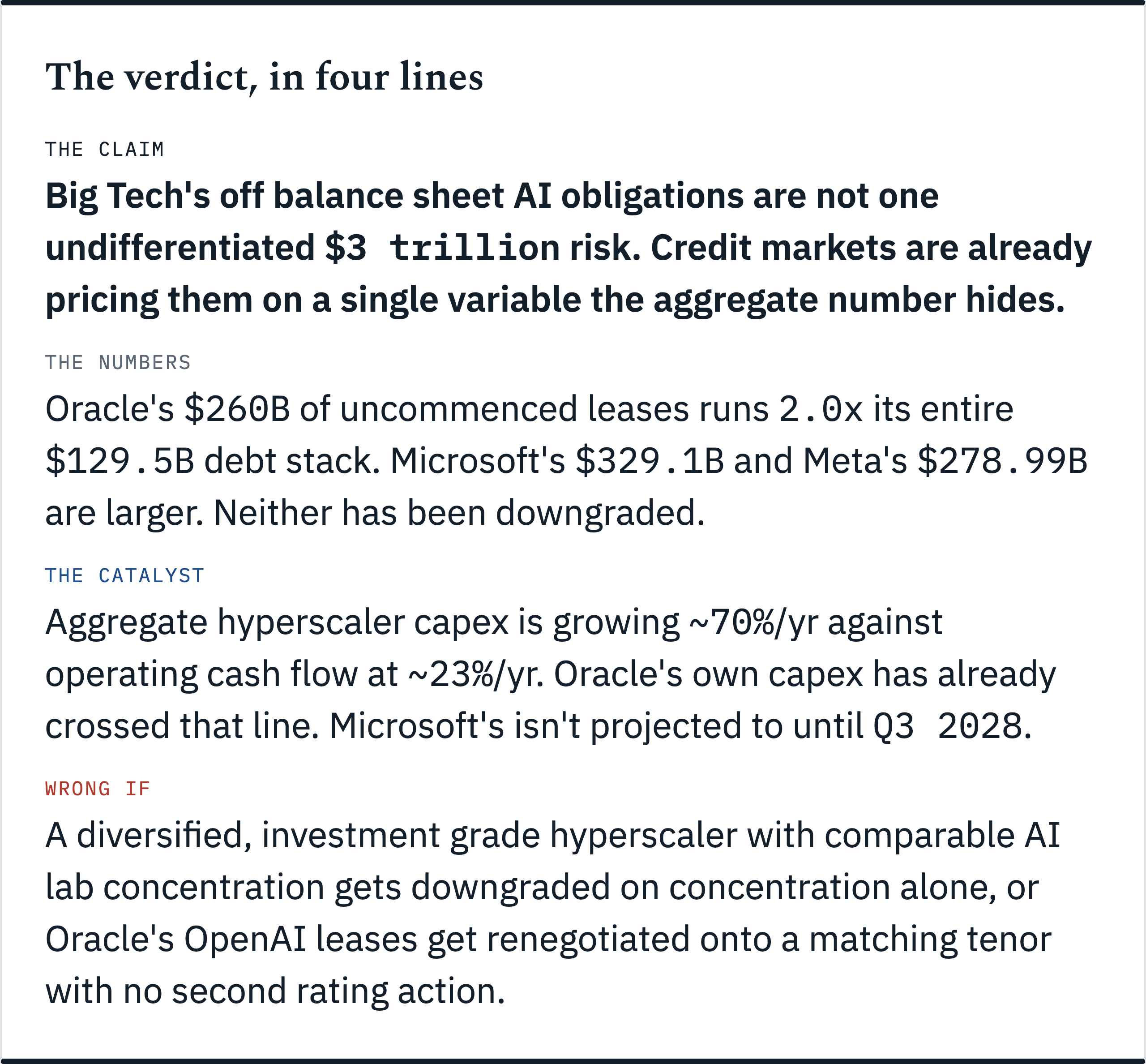
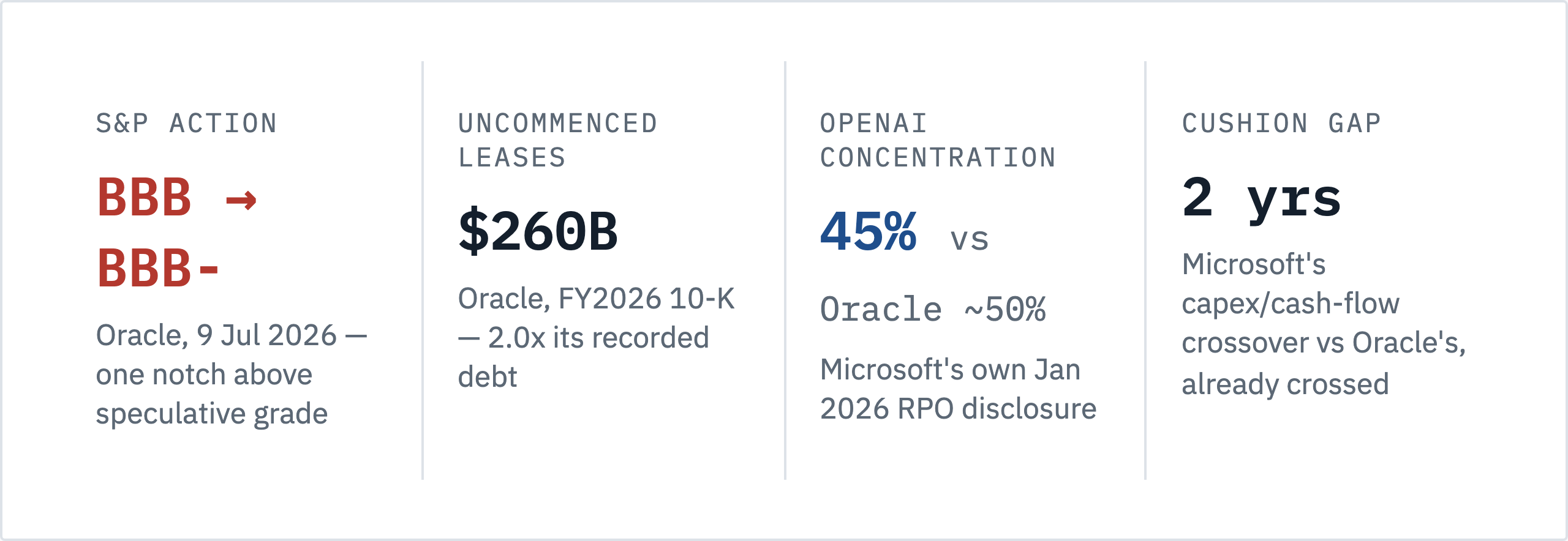
Photo: Håkan Dahlström · CC BY 2.0, resized · via Wikimedia Commons
I’ve spent several days inside five sets of SEC filings, plus a full adversarial pass trying to break my own read. My read is that most of the coverage of this week’s Wall Street Journal analysis missed the actionable part. The $3 trillion figure is real. It dwarfs the roughly $248 billion in leases and $356 billion in debt these firms report on their balance sheets today. Strip out Oracle’s own $260 billion, already downgraded slice, and roughly $2.7 trillion of this is still sitting in footnotes, being treated by the market as one undifferentiated pile. But treating it as one number, one risk, one story, is exactly the mistake a sophisticated credit desk isn’t making. They’re already discriminating inside it, on a narrower variable than “AI lab concentration” alone. The discriminator sits in a footnote most equity analysts skip past on the way to the capex guidance.
The consensus treats these as footnotes
The prevailing view, stated in a form its own believers would sign, goes like this. Purchase commitments and leases that haven’t commenced are executory contracts, not liabilities. Under ASC 842, a lease doesn’t hit the balance sheet until the space is delivered and the term begins. Alphabet, Microsoft, Meta and Amazon are, by every conventional metric, among the strongest balance sheets on the planet. Microsoft carries an AAA adjacent rating. Alphabet and Meta are barely levered against their operating income. The balance sheets are real.
These four companies generated more free cash flow last year than most G20 sovereigns raise in annual tax revenue. Analysts already model AI capex through the capex line and the depreciation schedule that follows it, both of which sit in every DCF on the Street already. The footnote disclosure exists precisely so nobody has to guess: it’s all there, filed quarterly, audited annually. A commitment isn’t a debt until you draw it.
Comparing $3 trillion in largely conditional, multi year forward obligations to $356 billion in funded debt, as several of this week’s viral posts did, is comparing a ten year grocery list to a mortgage. Moody’s own July report put the sharpest number on this: $1.2 trillion in total lease commitments across six companies, more than $820 billion of it from leases not yet commenced. And Moody’s still concluded that Microsoft, Alphabet, Amazon and Meta retain among the strongest corporate balance sheets in the world. Their investment grade ratings, in Moody’s own view, are unlikely to be under imminent threat. Moody's isn't worried. If the rating agency that ran the numbers isn’t worried about the big four, why should anyone else be?
The variant view: the market already split the $3 trillion in two
Here’s what that consensus reading misses. S&P already acted on it. On July 9, 2026, S&P Global Ratings cut Oracle’s long term issuer rating from BBB to BBB-, one notch above junk. It cited almost the identical mechanism the WSJ just described in aggregate: leases that haven’t commenced, running years into the future, invisible to a standard leverage ratio. S&P was watching anyway.
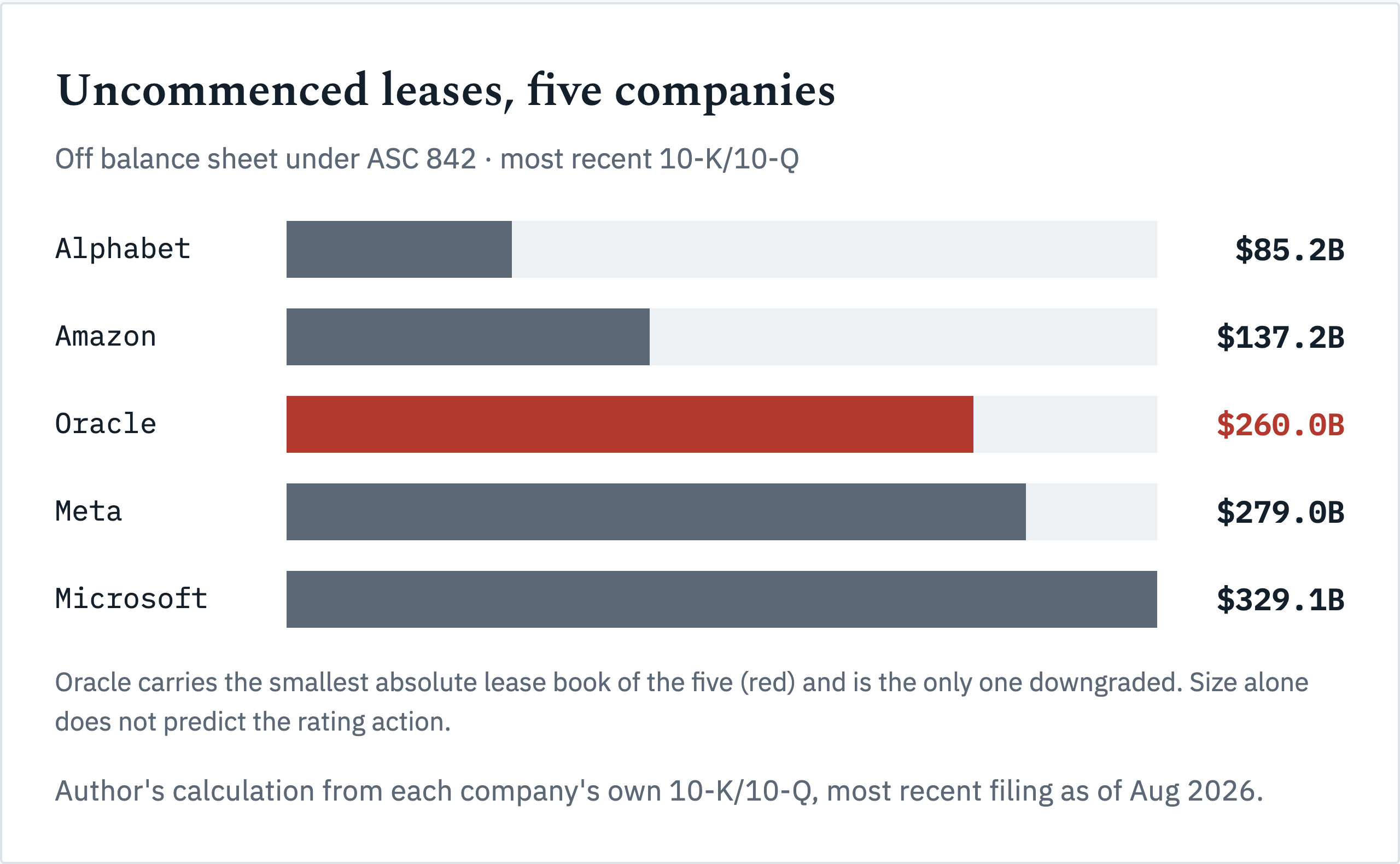
Oracle’s $260 billion in uncommenced data center leases is smaller in absolute terms than Microsoft’s $329.1 billion or Meta’s $278.99 billion (Microsoft 10-K; Meta 10-Q). Same accounting treatment. Same asset class. Same AI buildout. Only one company got downgraded.
That’s the fact the aggregate $3 trillion number cannot explain. It’s also the fact that makes this actionable instead of merely alarming. Moody’s report, the source of the $1.2 trillion figure, drew the same line I’m drawing here: it grouped Oracle with CoreWeave as the two names it did not extend its safety reassurance to, while naming Microsoft, Alphabet, Amazon and Meta specifically as the four that were fine. That’s not commentary. A rating agency, in the same document that produced the scary aggregate number, told you exactly which pieces of it it’s actually worried about. My read is that the $3 trillion headline does the opposite of what good research should do. It flattens a real, discriminating credit signal into one terrifying total, and that makes for a better hook on a feed than a basis for a position.
The demand side is just as concentrated as the supply side
Before the mechanism, it’s worth pausing on why a counterparty concentration story is even plausible here. The demand side of this buildout is exactly as narrow as the risk I’m describing on the supply side. Ramp’s own AI Index, as reported, puts the top 1% of AI spending US businesses at a median $7,400 per employee per month as of July 2026. The top 10% spend $650. The median firm spends $11.95. A steep drop-off. I read that as a whales first market, concentrated at the very top of the distribution.
The hyperscalers know it: a handful of frontier labs and enterprise whales account for a disproportionate share of the incremental demand supposed to fill $3 trillion of new capacity.
Nvidia’s own financing choices show it treats that concentration as a real risk to manage. Nvidia is reportedly finalizing roughly $100 billion in credit support for OpenAI’s planned 10 gigawatt Ohio data center campus, a figure still moving as I write this and sourced to a paywalled report, same limitation as the WSJ piece this article responds to. That guarantee was under discussion at up to $250 billion before being scaled back, and other reporting this week puts the settled number closer to $120 billion. Still nine figures. The company selling the chips is choosing to underwrite OpenAI’s credit directly, instead of letting OpenAI raise that debt on its own standalone signature. If Nvidia doesn’t think OpenAI’s own name is enough to raise nine figures cheaply, that’s a market priced signal about counterparty risk. It’s the same risk sitting inside both Oracle’s downgrade and Microsoft’s much larger, so far unpenalized, RPO. I found the same gap one layer down the stack when I compared how Google and its own lessees price the identical AI data center guarantee: the counterparty writing the contract and the counterparty relying on it can value the same piece of paper wildly differently, and that gap is where the real risk hides.
The mechanism: tenor mismatch is what gets priced
This section is the analytical core, and I am going to walk through it in full, because size is not the variable, and this is where almost every hot take on this topic goes wrong.
Start with the accounting. A lease that has not commenced sits outside the balance sheet under ASC 842 because the right of use asset and the corresponding liability are not recognized until the lessor actually delivers the space and the lease term begins. I checked this against all five companies’ own filings, and the treatment is identical every time. It is the standard, applied uniformly, not a loophole one lessor found and the others missed. Alphabet discloses $85.2 billion in uncommenced leases. Meta discloses $278.99 billion, plus another $68 billion signed in July, per its 10-Q’s subsequent events disclosure. Microsoft discloses $329.1 billion. Amazon discloses $137.2 billion in its own commitments table. Oracle discloses $260 billion, tagged explicitly in its own XBRL data as LesseeOperatingLeaseLeaseNotYetCommencedLeaseCommitments. All five sit in the identical accounting no man’s land. Same rules, every time. If accounting treatment were the discriminator, all five would carry the same incremental risk premium per dollar. They do not.
What S&P actually named was a mix of factors, and I want to be precise about the weighting rather than overstate one piece of it. The primary, quantified trigger is leverage. S&P’s own downgrade trigger is adjusted debt to EBITDA sustained above 4.5x, against a base case that peaks near 4.4x. The capex guide behind this downgrade jumped from roughly $60 billion to $90-95 billion inside one review cycle. Layered on top of that leverage story, on the record, is the structural piece I am arguing matters more than the headlines gave it credit for. Andrew Chang, the S&P credit analyst who led the Oracle downgrade, called the mismatch between 15 to 19 year data center leases and up to five year customer contracts an “absolutely key risk.” Oracle has to assume, in his words, that AI demand holds or improves “multiple years out.” Only then does the ecosystem underwriting those lease payments stay viable. A real, dated risk.

Then layer on the third piece. Reported estimates put Oracle’s OpenAI exposure at almost half of its $638 billion revenue backlog, a single, currently loss making counterparty. Oracle has not published a customer level RPO breakdown, so treat that as a closely sourced estimate, not an audited disclosure. If OpenAI’s revenue trajectory falls short of what its five year Oracle contract commits it to, Oracle remains obligated to a data center lease running three to four times longer than the contract paying for it. That gap is the risk.

