

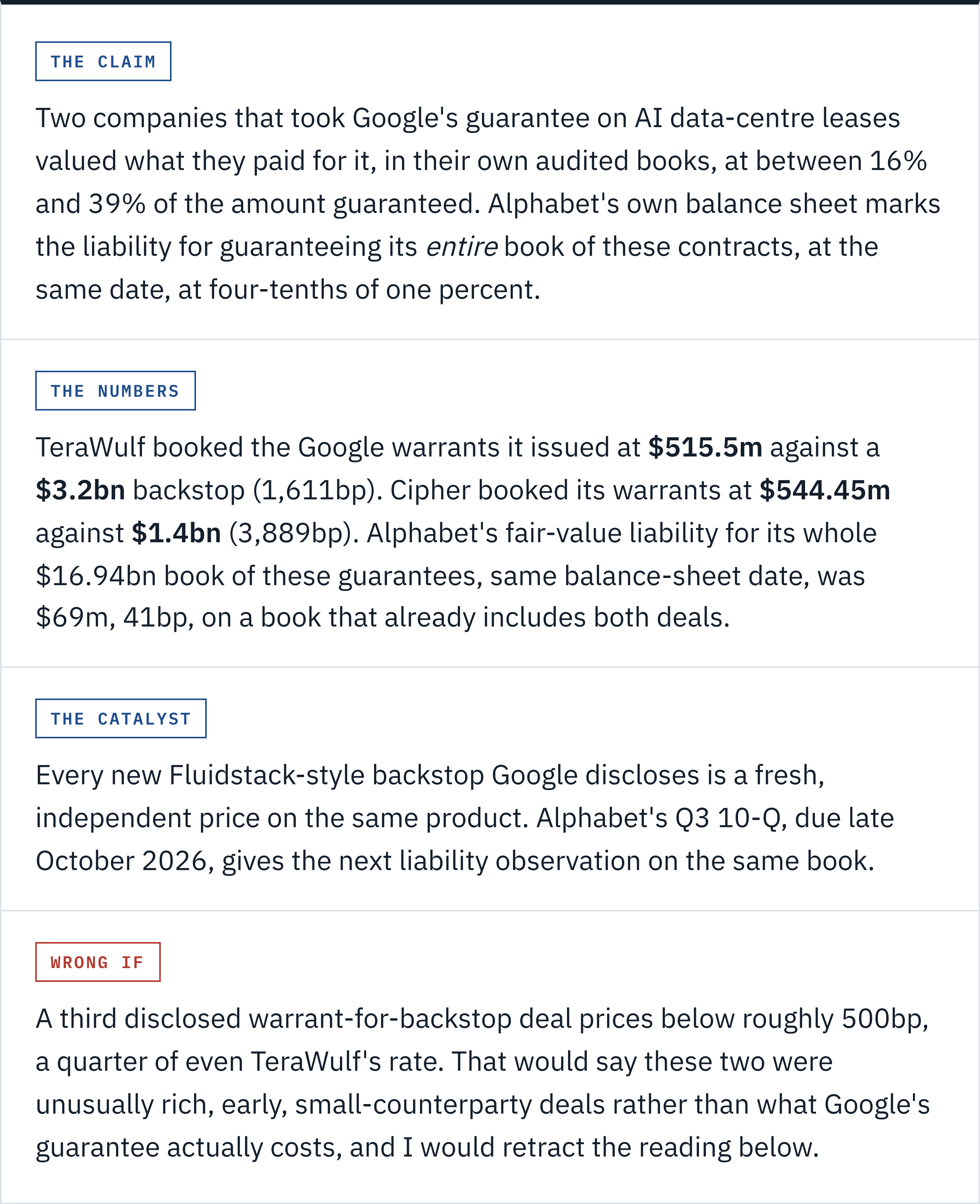
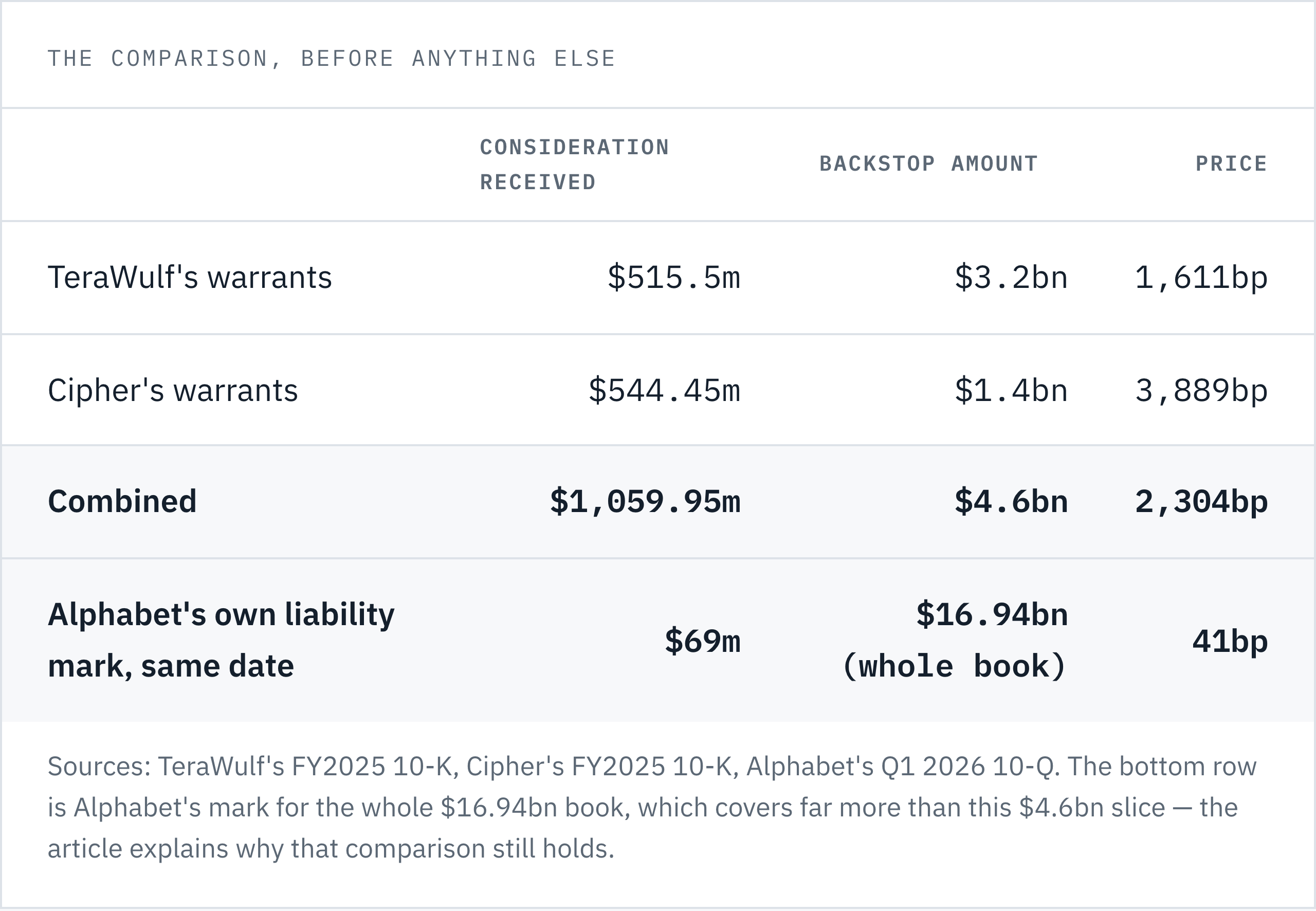
Two companies that took Google’s guarantee on AI data-centre leases valued what they paid for it, in their own audited books, at between 16% and 39% of the amount guaranteed, while Alphabet’s own balance sheet marks the liability for guaranteeing its entire book of these contracts, at the same date, at four-tenths of one percent.
The consensus I’m departing from, stated the way its believers would state it
The prevailing reading of Google’s roughly $200bn of interlocking commitments around Anthropic is that it’s vendor financing, and that the danger lies in what can’t be seen. Google sells the tensor processing units, funds the buyer, and guarantees the landlord who houses the machines. Revenue arrives on one side of the ledger while the obligation that produced it sits in a footnote on the other. The structure runs through Broadcom, Apollo, Blackstone, Morgan Stanley and a set of former bitcoin miners, and the sceptical conclusion is that the exposure sits in vehicles nobody consolidates, so no outsider can size it.
That’s a serious argument. Circular financing did inflate the 1999 telecom build, and the mechanism was identical in shape. But the people making it are missing something better than “opaque.” This exposure isn’t unsized. It’s priced twice, by four different parties, and the two prices disagree by a factor of nearly sixty.
I’ve covered the public-market side of this same financing complex before, Alphabet’s own $20 billion bond issuance and the $400 billion AI bond wave it sits inside. Neither piece touched the contingent side: guarantees, priced by an accounting entry instead of a coupon, which is what this one is about.
What I actually found, and why the piece changed under me
I started this thinking Alphabet’s rising guarantee mark, 41 to 186 basis points of notional over six months, was evidence AI vendor credit is deteriorating. I checked that against Alphabet’s own disclosures and it doesn’t hold up cleanly. The Q1 10-Q had already flagged $15.3bn of new backstops signed in April 2026. Q2’s notional grew $15,349m over the same quarter. A 100.3% match. Almost the entire six-month rise in the book is new paper. Existing risk barely moved. Alphabet even disaggregates the earnings effect: the credit-derivative P&L line ran -$147m in Q1, then +$70m in Q2: a gain, in the exact quarter the ratio kept climbing. A book that was mostly zero eighteen months earlier, growing mostly from new contracts, isn’t a clean deterioration series. I’m saying so directly rather than shipping the weaker version of this piece.
What replaced it doesn’t depend on reading a trend. It’s two audited numbers, already public, that nobody has put next to each other.
TeraWulf’s 10-K: “The Company recorded an asset of $515.5 million based on the fair value of the Google Warrants at issuance.” That’s against a combined $3.2bn of Google backstop: the original $1.8bn from August 14, 2025, plus a $1.4bn expansion four days later for a new lease at the same campus. Cipher’s 10-K does the same in a table: “Fair value of warrants as of issuance date 544,450” (in thousands), against its own $1.4bn backstop. Both used Black-Scholes. Cipher says it engaged a third-party valuation firm to run it.
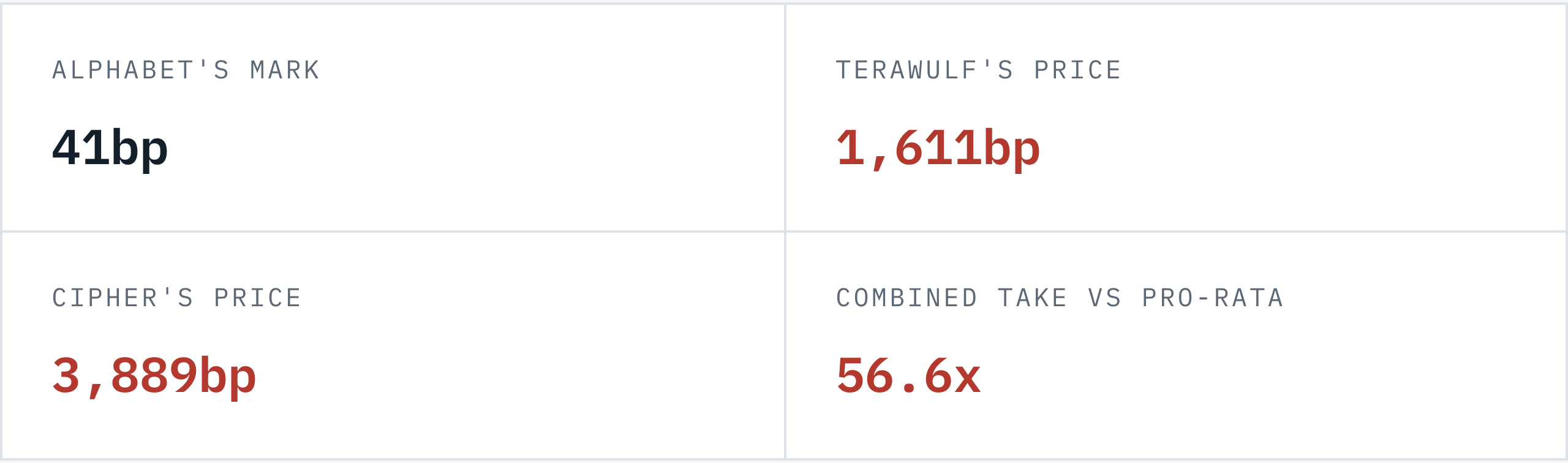
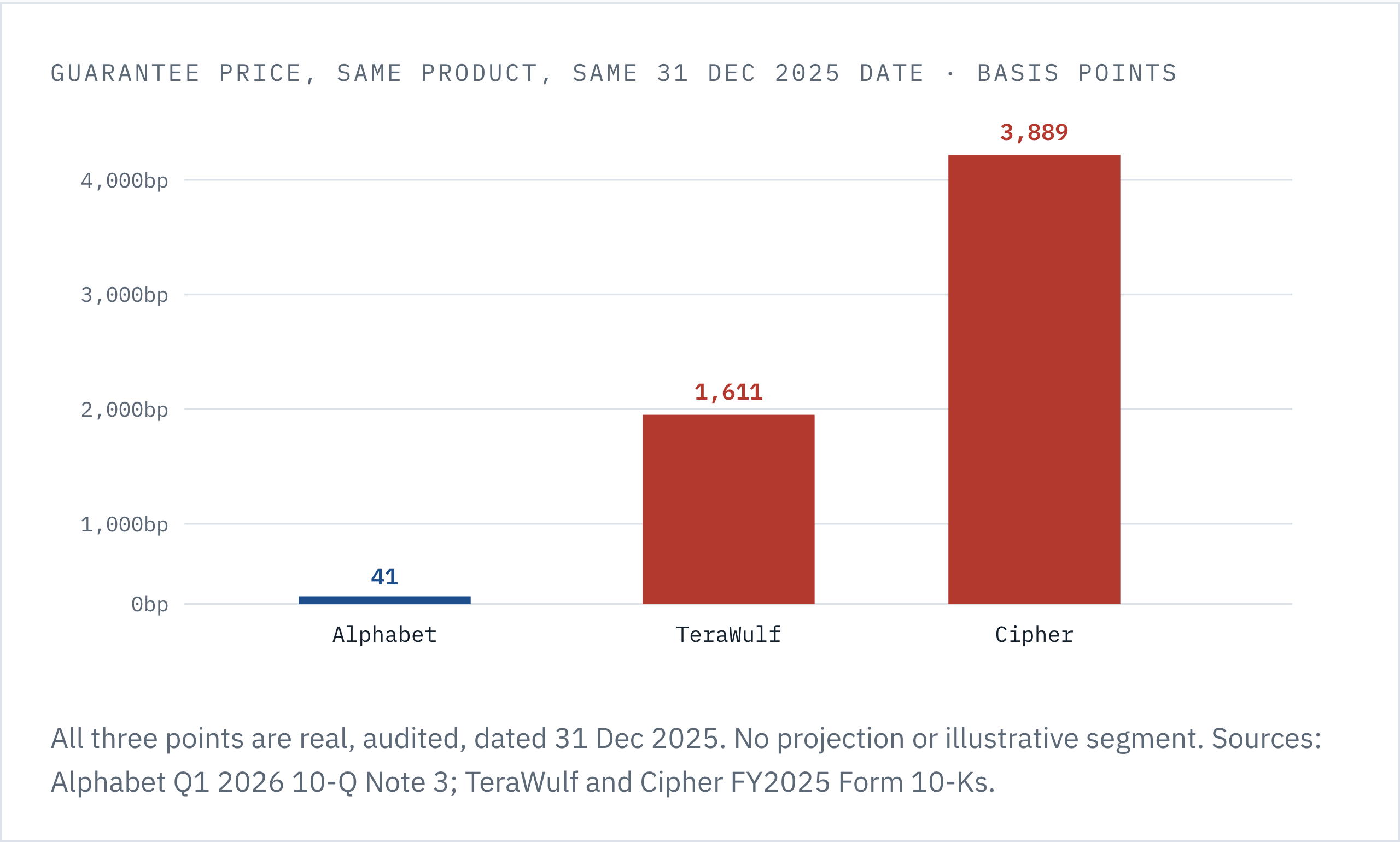
Divide it out. TeraWulf’s price for the guarantee was 1,611 basis points. Cipher’s was 3,889. Alphabet’s own mark for the liability side of its entire book of these guarantees, at the same 31 December 2025 date both 10-Ks report from, was 41 basis points.
The mechanism: two firms pricing one transaction from opposite sides
Here’s why this isn’t an apples-to-oranges trick.
A backstop is one transaction with two sides. Google promises to cover a lessee’s payments on default; in exchange, Google receives warrants. TeraWulf and Cipher record what they gave up, the warrants, as an asset, at fair value, because GAAP requires it: it’s the cost of the benefit they received. Alphabet records what it’s on the hook for, the guarantee, as a liability, also at fair value, under ASC 815 as a credit derivative. Same transaction. Same date. Two audited fair-value measurements, from the two parties who negotiated the price, of the two halves of one contract.
They should track each other. I’d expect that going in. A guarantee worth $515.5m to the party paying for it is, roughly, a guarantee that costs something in that neighbourhood to write. Instead Alphabet’s own mark for guaranteeing its whole $16.94bn book, which contains both of these deals, is $69m. Pro-rate that down to just the $4.6bn these two deals represent (27.2% of the book) and the implied share is $18.7m. The two counterparties’ own books say Google took $1.06 billion. That’s 56.6 times the pro-rata share of what Alphabet’s own model says the liability is worth.
I checked whether Alphabet’s credit-derivative assets line absorbs any of this. It doesn’t. Zero. Nothing. It reads $0 in every period reported. The warrant consideration isn’t netted against the liability anywhere in Note 3. It sits somewhere else entirely, most likely folded into non-marketable securities, disconnected from the number a reader would take as “what Google thinks this guarantee costs.”
I wrote this exact comparison up separately too, as a standalone trade note with the worked arithmetic and the position-level detail carried further than a Substack piece should: Google’s AI Guarantee Book: A 39x-96x Gap Between the Disclosed Mark and the Disclosed Price.
Two readings of the gap, and I can’t fully separate them
A sophisticated reader’s first objection: warrants aren’t a clean insurance premium. That deserves its own section. Not a caveat.
Reading one: the liability mark is too low. If $1.06bn is close to a fair price for $4.6bn of guarantee exposure, Alphabet’s Level 3 model is understating the expected cost of the guarantees it writes, possibly across the whole book, and the reported $69m-to-$815m series understates what should be on the balance sheet.
Reading two: the warrant price isn’t pure insurance premium. Google wasn’t only selling protection. It was helping two bitcoin miners re-rate into AI infrastructure operators, a transformation their own stock prices show real value in beyond the lease guarantee itself. I think some share of that $1.06bn plausibly compensates for things a pure credit spread wouldn’t: standing up project financing for young, single-purpose entities; an equity-like reward for enabling a risky pivot; maybe favourable terms elsewhere in the TPU relationship that never surface as their own line item.
I can’t cleanly apportion the $1.06bn between the two from public filings, and I won’t pretend I can. But even a generous, deliberately favourable allocation to reading two still leaves a large number sitting in reading one. If only a third of the warrant value is priced credit protection in any real sense, that’s still roughly 19 times the pro-rata liability share Alphabet carries. Shrink the “partnership” share as far as the facts allow, and the gap doesn’t close. It just gets less enormous.
I’d also flag what reading two is actually buying, since I think it’s easy to wave at “partnership value” without pricing it. TeraWulf and Cipher were bitcoin miners before these deals, companies whose core business was proof-of-work hashing. Leasing power-hungry campuses to AI labs came later. A backstop from Google doesn’t just de-risk a lease. It’s the signal that let both companies raise project debt at all: TeraWulf’s own 10-K ties the warrant pledge directly to its $3.2 billion of 2030 Senior Secured Notes, and the backstop is named as collateral support for that financing. If part of what TeraWulf paid for was access to a bond market it couldn’t otherwise reach, that’s real value, and it’s not obviously smaller than the credit protection itself. I raise this because it’s the honest version of reading two, not vague hand-waving about “partnership” but a specific, named, verifiable channel through which some of that $515.5m bought something other than insurance.
