



On 8 July 2026 GLG Partners, Man Group’s stock pickers, held a named short of 2.24% in Vistry Group. It was among the last positions Britain’s register published with a name. Man, the world’s biggest public hedge fund in a 2023 Bloomberg headline and famous for its AHL arm’s trend following computers, held more named UK shorts than anyone when the names went dark. Most were GLG’s, and most were new to the register that year.
The regulator’s new totals, one anonymous sum per company, cannot say who has covered those shorts since. A crowded UK short used to name every holder at 0.5% or more. Now a large holder beside it, the kind that matters in a squeeze, has no name.
After July, a manager’s own fund reports are the one regular place a named UK short book still shows: in bands each month, by name twice a year. GLG’s larger UK long short fund, Man Alpha Select Alternative (”Alpha Select”), publishes both. On 26 October I downloaded the short selling files of the Financial Conduct Authority (FCA), grouped every holder’s last named disclosure by firm, followed Man’s companies through the anonymous totals since, and set them against the fund’s reports.
The case runs in six chapters:
Man held Britain’s most named shorts: 81 still open at the cutoff.
GLG named most of it this year: 49 of its positions arrived in 2026.
London chose to hide the names: its totals count every short from 0.2%, unnamed.
The fund lost 6.61% in July: little of it to company size.
The totals prove only the cuts: at Kainos, GLG covered at least 1.54 points and may hold nothing.
Alpha Select’s schedules and size tables: how much of its bet the fund kept.
Man held Britain’s most named shorts
Until 9 July the FCA, Britain’s markets regulator, named every holder of a net short position, measured as a share of a company’s issued capital, of 0.5% or more. An open named position is a holder’s latest such disclosure in a company, notified after 31 December 2020: the population the FCA’s operational guide set for its first totals. Summed by firm, the last named file, with about 600 holders since October 2012, becomes a league.
Man held 81 of the 613 open named positions at the cutoff, in 76 companies, all last updated in 2026. GLG Partners, its discretionary arm, held 62, more than Citadel’s 47 across the whole firm. Man’s systematic managers held the rest: Numeric Investors 13, and AHL Partners, home of the trend following the label rests on, 6.
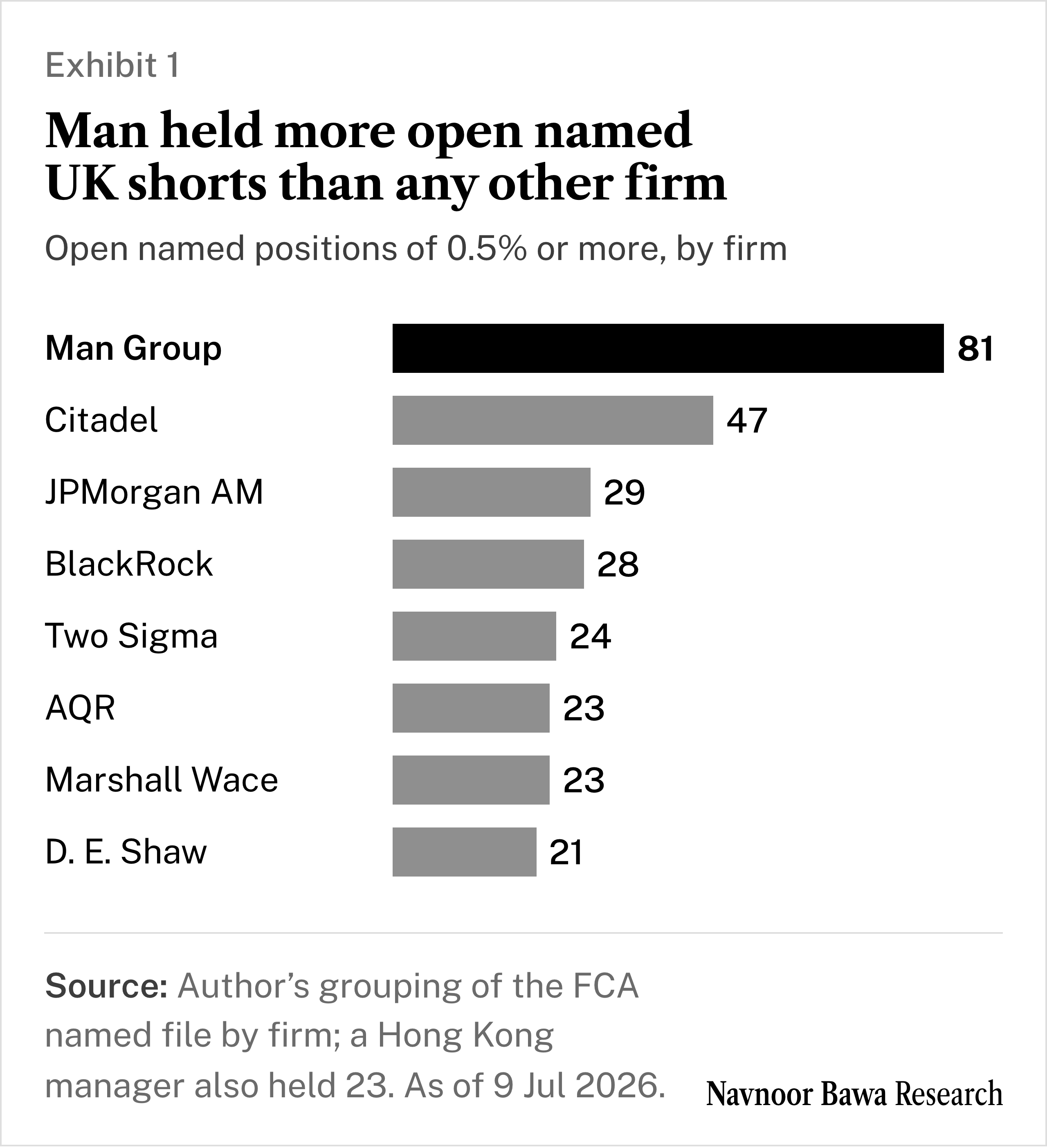
Source: FCA named file, sheet “Historic Disclosures 10.07.2026”, my grouping by firm; Citadel Securities, a market maker, excluded; Millennium’s own entities (18) and WorldQuant (6), separate firms, counted apart · as of 9 Jul 2026
Read the ranking, which leaves out a Hong Kong manager that also held 23, as a count of positions of 0.5% or more, never as money or as a measure of how bearish a firm is. The line favours concentrated stock pickers: a book spread thinly across many companies crosses 0.5% in fewer of them.
Hedgeweek, Alternatives Watch and Trustnet have ranked GLG at or near the top since 2021, and my count reproduces Trustnet’s 30 for GLG in August 2025. None that I found set a fund’s own reports against the register.
GLG named most of it this year
GLG’s count of open named positions went from 31 at the close of 2025 to 62 at the cutoff. Of the 62, 49 crossed the 0.5% line in 2026. Citadel Advisors, Citadel’s largest named entity, also doubled, from 22 to 44. Marshall Wace fell from 40 in March to 23. A crowd grew, and GLG led it.
Some of the count’s doubling may be growth: Alpha Select grew 26% in the half to £1.79bn, and a fund that grows pushes a short held at the same weight over the 0.5% line.
GLG manages the fund, with Charles Long and Nick Judge as portfolio managers, and the fund’s gross exposure was rebuilt before 2026. GLG wrote in the fund’s 2025 annual report: “Gross exposure increased during the second half of the year, especially in the third quarter, and ended at 193%.” What 2026 added was names on the register.
The fund’s monthly size table splits net exposure by the companies’ market value, in dollar bands, with index positions broken into their stocks. In April 2025 Alpha Select was net long 15.96% of its assets in the giants, companies worth more than $50bn. Below $10bn it was net short 9.10%. By June 2026 the two were 42.97% and 33.38%, with the fund close to flat overall. In pounds, its short side below $10bn grew 1.8 times between the two dates, to about £866m.
What the shorts are for
Call that shape the size tilt: long the giants, net short a third of the fund below $10bn. It is Alpha Select’s bet, not GLG’s: Man Absolute Value, GLG’s smaller UK long short fund (£320m), held the reverse on 30 June, net long 26.44% below $10bn. GLG’s two latest commentaries give a why for the shorts, though neither speaks of company size. The 2025 annual report says that “domestic stocks make up only a small part of our universe and offer exciting shorting opportunities, especially in domestic insurers and retailers.”
The report for the half year to 30 June widened the case to businesses that “need very little physical investment to grow”: “Those are precisely the businesses most exposed to artificial intelligence (AI), because much of what they do can potentially be replicated.”
On the other side, GLG wrote, companies that own physical assets, “utilities, industrial businesses and miners”, are “much harder to displace”. National Grid, Rolls-Royce, Anglo American, Glencore and Siemens were among the fund’s ten largest longs on 30 June.
Not every short is that bet. The 2025 report called one utility short “a partial hedge to the fund’s long position in National Grid”, which was still its largest long in June, at 3.45%. In June two of its ten largest shorts were again UK utilities, while its utilities sector was net long. So the size tilt is a chosen bet, and some shorts beneath it may be hedges.
London chose to hide the names
The FCA’s operational guide put it plainly: “From 13 July 2026, we will no longer disclose individual net short positions. We will instead begin to disclose anonymised ANSPs by company.”
An aggregated net short position (ANSP), what I call the total, sums every position “at or above the 0.2% threshold” in one company and publishes it without names. Funds still report to the FCA from 0.2%; what went is the public line at 0.5%, with a name. The first print, on 13 July, covered positions “held at midnight on 9 July 2026”.
The funds had asked for this. HM Treasury’s 2023 response records their case: “the current regime creates risks around copycat behaviour and short squeezes when individual positions are disclosed publicly”, and “individual position disclosures reveal proprietary trading strategies”. Jack Inglis, chief executive of AIMA, the hedge fund trade body, counted among AIMA’s wins that July “changing short selling rules to protect the confidentiality of investment managers’ positions”.
The register cannot test the first charge. It tests the second only in part: the names gave away positions, while GLG’s reasons, given industry by industry, sat in its own fund reports.
Listed companies argued the other way, the Treasury recorded: “the current individual disclosure regime helps to inform their corporate engagement with their investors”. That engagement now runs on one number per company, and on none where no short reaches 0.2%. The Treasury promised “greater transparency on the overall net short position in a company’s share than the current regime”, and on its own terms it delivered. Each total adds the band from 0.2% to 0.5% the register never printed: more of the crowd, none of the names.
Names still leak in one place: the Takeover Code’s Rule 8.3 makes anyone with a 1% interest in a company under offer disclose its shorts, but a pure short seller never discloses.
The fund lost 6.61% in July
In the three months to 30 September the FTSE 250, Britain’s mid cap index, rose 6.6% against 1% for the FTSE 100. Graeme Evans of interactive investor gave one reason: “Takeover action played a big part in the robust performance of the FTSE 250 index”. He gave another: investors “returned to heavily sold stocks” such as Hays and WPP.
Both reasons reach Man’s named list. Four of the FTSE 250’s ten best performers in the quarter, the top two among them, were on it at the cutoff: GLG’s Hays, Michael Page (PageGroup on the register) and Kainos, and Numeric’s Pinewood Technologies. Pinewood rose 67.7% in a quarter that brought a takeover. Yet Alpha Select held Hays and Michael Page long on 30 June: GLG’s named figure is its net across all its funds, so one fund can sit on the other side.
Alpha Select’s DL share class, the one its monthly reports track, lost 6.61% in July, its worst month of 2026, and 5.58% over the three months. Man’s own trading statement has its IL share class down 5.4% for the quarter, about £97m on the June assets before flows, against a 0.1% loss for the HFRX Equity Market Neutral index. Money came in, and the fund ended September at £1.79bn, where it began.
Around Alpha Select the firm had a strong quarter: Man’s assets rose 7% to $270.9bn on the same statement, so a £1.79bn fund’s bad July barely moves the firm’s numbers.
July’s movers cut both ways: two of the fund’s 30 June shorts, Vodafone and Sage, rose 18.3% and 19.3%, among the FTSE 100’s five best, and AstraZeneca, its second largest long, fell 10.4%. Its Hays and Michael Page longs rose 80.9% and 70.9%.
What company size explains
How much of the quarter is the size tilt? At June exposures, with the FTSE 250 standing in for the smaller companies, the FTSE 100 for the giants and about 3% assumed for the middle band, $10bn to $50bn, where the fund was net short 10.21%:
So the tilt explains roughly 2 of the 5.58 points for the quarter and leaves the rest to the stocks themselves. The estimate is rough: the size bands cover the fund’s whole book while the two indices are British, and its net short in UK companies was 10.35% in June.
It explains little of July: the FTSE 250 rose 4.2% that month and the FTSE 100 3.5%, a gap that costs about 0.3 points at the same exposures. Most of its estimated cost fell in August and September, when the fund made 0.50% and 0.60%, so July’s loss came from the companies it held.
GLG’s commentary covers the half to 30 June and never mentions July. It reached investors in a report the fund company’s directors approved on 26 August, after the loss. It tells them: “Investors should also expect that holding positions that differ from the consensus, in a market of this kind, will produce periods of sharp volatility in returns.”
The totals prove only the cuts
GLG was named short 1.75% of Kainos on 6 July, and at the cutoff every named position in the company added up to 2.43%. The first print put Kainos’s total at 4.46%, above the names, because it counts every short from 0.2%. The total first fell below GLG’s 1.75% on 21 August, at 1.68%, and rose back to 1.86% on 26 August. The total that replaced it on 22 October reads 0.21%, dated 22 September.
Reading a total against a fund’s last named position takes four steps:
The total sums every short of 0.2% or more in Kainos.
If GLG still holds 0.2% or more, its short sits inside that sum, so it cannot exceed the total.
If GLG holds less than 0.2%, it holds less than the total already.
Either way GLG holds 0.21% at most, so it has covered at least 1.54 points of its 1.75%.
When today’s total sits below a fund’s last named position, I call the fund capped: it holds the total at most. A fund is below the line, under 0.2%, when its company is still on the reportable list but carries no total. The same holds when the total is dated before the fund’s last disclosure, since the FCA’s Handbook dates a total by “the most recent position date included in a notification”.
Each fall below a named position is a dated proof; each rise is anonymous. The test cannot say whether GLG holds any Kainos at all. To redo it, read each last named position against the totals and the reportable list; a join on the totals file alone drops the companies with no total, which are among the strongest proofs.
GLG’s named figure nets all its funds, and where a total falls but stays above it, the totals cannot tell GLG from the crowd. That objection holds against the register, and fails, for one fund’s slice of the book, against Man’s own documents.
The totals fall as often in Citadel’s companies as in Man’s: the totals measure the crowd, the fund’s reports measure the fund.
In Alpha Select’s reports one number decides the question: its net short in companies below $10bn on 30 September, against 33.38% of the fund in June.
→ GLG’s Vistry short and the 17 other holders named beside it, costed from the FCA register and London closes and set against 44 UK crowds since 2012, a separate note on Patreon.
After a July that cost it 6.61%, how much of its bet against smaller companies did Alpha Select keep?
Below the paid line:
The schedule table: Man’s named companies marked where GLG’s own fund was short or long.
The size table: the fund’s exposure by company size before and after the quarter the names went dark.
The tests: every company where the totals prove GLG cut, and the control table on what they cannot say.
The verdict, the line that would prove it wrong, and four dated checks to watch.